Building Façade Inspection Guide for Property Maintenance Teams
By Samuel Jones on February 12, 2026
Building façades in commercial and residential properties represent the primary structural and aesthetic barrier against environmental damage, weathering, and safety hazards—with deteriorating exterior walls, falling masonry, water infiltration, and structural failures creating life-threatening conditions that generate liability claims averaging $100,000–$2,000,000 per incident and regulatory fines of $5,000–$50,000 per violation. Unlike interior building systems with controlled environments, façades endure constant exposure to wind loads up to 150 mph, thermal cycling from -20°F to 140°F, UV radiation degradation, freeze-thaw cycles causing 10% volume expansion in moisture-laden materials, acid rain with pH levels as low as 4.0, and seismic movements—all of which accelerate deterioration of mortar joints, cladding systems, sealants, anchoring systems, and structural connections. The complexity of modern building envelopes means that systematic inspection programs are the only reliable defense against catastrophic façade failures, water damage exceeding $500,000 per event, and pedestrian injury incidents from falling debris. Sign up free on OxMaint.
The financial impact of façade neglect is severe and accelerating: properties without structured inspection programs experience 300% higher emergency repair costs, with typical façade restoration projects ranging from $75–$250 per square foot compared to preventive maintenance at $8–$25 per square foot annually. A single avoided masonry failure event (average emergency stabilization cost: $150,000–$800,000) pays for 5–10 years of comprehensive façade inspection programs. Beyond direct cost avoidance, systematic façade maintenance preserves property values (well-maintained façades add 12–18% to asset valuation), reduces energy costs by 15–30% through envelope integrity, satisfies Local Law 11 (NYC), Chapter 13-D (Chicago), and similar façade inspection ordinances in major cities. Properties using CMMS platforms integrated with façade inspection cycles achieve 95%+ compliance with mandatory inspection deadlines and reduce water infiltration incidents by 85%. Book a demo to see how OxMaint manages façade compliance.
Building Envelope · Façade Safety · Compliance
Prevent Catastrophic Façade Failures with Systematic Inspection
Replace reactive emergency repairs with proactive condition assessment. Track deterioration patterns, document deficiencies with geo-tagged photos, and maintain complete regulatory compliance—all from one platform.
Average water damage cost per major façade infiltration event
Building Façade System Architecture
A commercial building façade is an integrated structural and environmental system with 100+ component types working together to resist weathering, support dead loads, and prevent water infiltration. Understanding this architecture is essential for targeted inspection—because a single water stain could originate from failed sealant joints, cracked masonry, displaced flashing, clogged weep holes, damaged membrane, or shelf angle corrosion.
Nine critical façade components each introduce unique deterioration patterns and failure modes. This risk matrix enables inspection teams to prioritize assessment effort based on failure impact severity and required inspection frequency.
Façade Component Risk Analysis
Critical
Masonry Veneer
Spalling, cracking, displacement, efflorescence
White deposits, vertical cracks, bulging, loose bricks
Water staining below, interior moisture, visible damage
5-year cycle
Medium
Weep Holes
Blockage from mortar, debris, insect nests, paint
No drainage observed, efflorescence, moisture staining
Annual inspection
Diagnostic Decision Framework
When a façade exhibits visible distress, water infiltration, or structural movement, the root cause could originate from material deterioration, design deficiencies, installation errors, or deferred maintenance. This framework provides a structured assessment path from visual symptoms to comprehensive testing.
Façade Distress Diagnostic Framework
⚠ Façade Distress, Deterioration, or Water Infiltration Observed
Façade inspection programs operate on three tiers of increasing depth and cost. Properties that execute all three tiers eliminate 85–90% of emergency façade repairs.
Annual Comprehensive Visual Assessment
Masonry Condition Survey: Inspect all visible brick/stone surfaces using binoculars from grade level. Document cracking patterns, spalling (depth >1"), displaced units, efflorescence, and bulging areas with reference markers.
Mortar Joint Assessment: Evaluate joint condition at each floor level. Probe joints with ice pick—sound mortar resists penetration. Document areas with >1/4" erosion, sandy texture, or missing sections.
Sealant Joint Inspection: Check all expansion joints, control joints, perimeter seals at windows/doors. Test adhesion by gentle probing. Document gaps, cracks, hardening, or pulling away from substrate.
Water Infiltration Evidence: Survey perimeter after rain events. Look for active leakage, water staining, efflorescence, rust staining, algae/mold growth, and saturated areas. Map on building elevations.
Weep Hole Verification: Locate and test all weep holes at base of masonry, above openings, and at shelf angles. Clear blockages with wire probe. Verify drainage during rain or flush test.
Structural Movement Indicators: Check for stair-step cracking (settlement), vertical cracks at corners (thermal), horizontal cracks at shelf angles (support failure). Measure crack widths with comparator card.
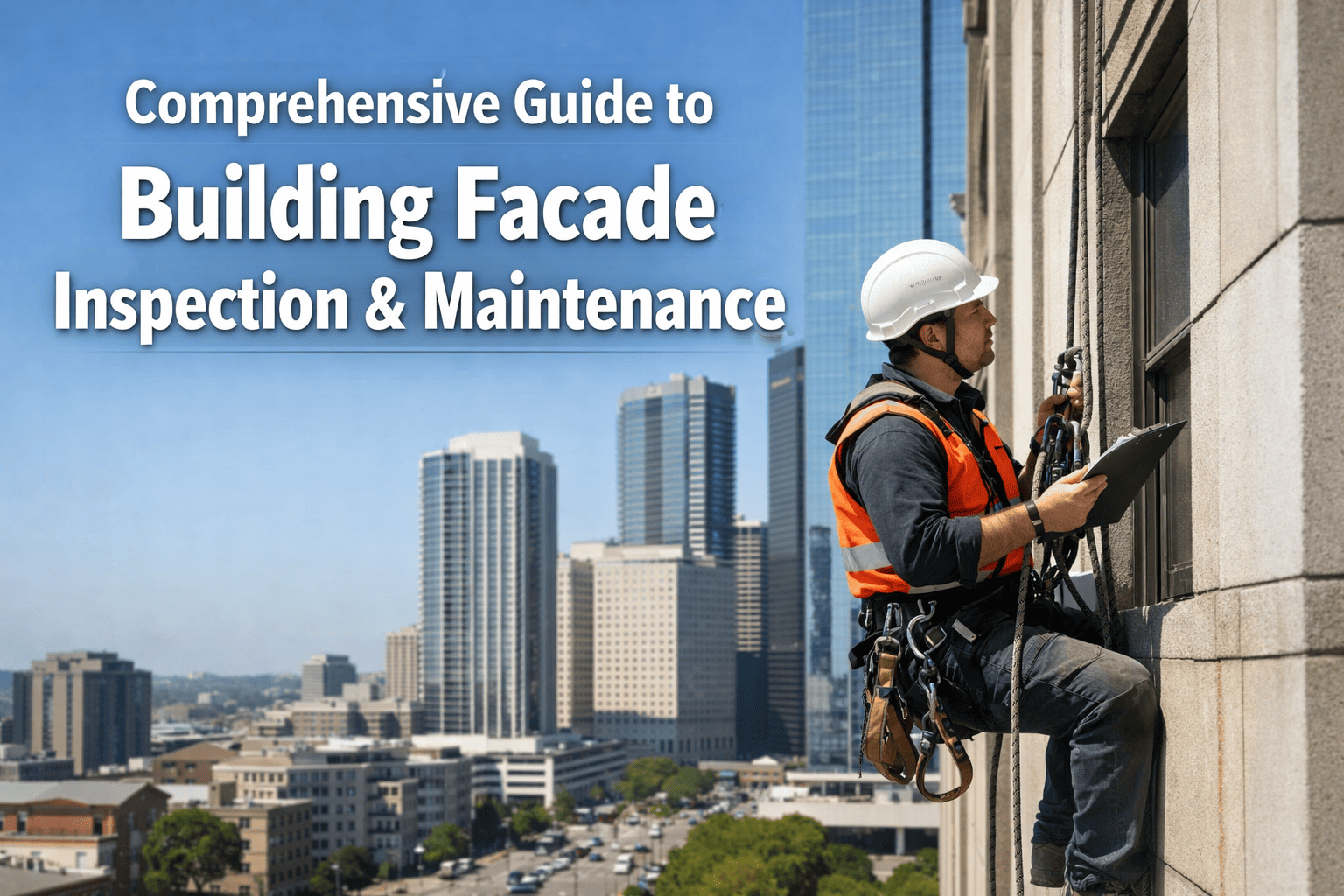
Buildings over 6 stories require hands-on inspection via swing staging, scaffolding, or rope access. Categorize deficiencies as Priority 1 (immediate hazard), Priority 2 (repair within 1 year), or Priority 3 (monitor).
Biannual Preventive Maintenance
Façade Cleaning Assessment: Clean envelope using appropriate methods (low-pressure water, chemical cleaners, steam). Cleaning reveals hidden defects and prevents long-term deterioration from trapped moisture.
Drainage System Check: Inspect and clear all weep holes, drainage channels, scupper outlets, and cavity wall drainage paths. Flush with water to verify flow.
Sealant Touch-Up: Apply new sealant to isolated failed joints. Clean surfaces, install backer rod (2:1 width-to-depth ratio), tool sealant for full substrate contact.
Minor Masonry Repairs: Address isolated spalls, loose bricks, and eroded mortar joints. Tuckpoint with compatible mortar matching original in strength, composition, and color.
Scheduled in spring (post-freeze/thaw) and fall (pre-winter). Work at heights requires fall protection and OSHA compliance.
Five-Year Comprehensive Hands-On Assessment
Close-Range Physical Inspection: Access all façade areas via swing staging, boom lift, or rope access. Arm's-length inspection of minimum 10% of façade surface plus all previously identified distress. Sounding hammer testing.
Probe Testing: Systematically probe mortar joints, sealant joints, and cladding. Mortar should resist penetration beyond 1/4". Test EIFS with moisture meter—readings >20% indicate infiltration.
Infrared Thermography Survey: Thermal imaging for hidden moisture, missing insulation, and delaminated cladding. Temperature differentials >5°F indicate anomalies.
Anchorage Assessment: Inspect visible brick ties and anchors. Check shelf angles for corrosion, deflection >L/600, and rust jacking (horizontal cracks 1–2" above angle).
Water Testing (ASTM E1105): Infiltration testing on representative assemblies at 3.4 L/min/m² for 15 minutes while monitoring interior. Document all leakage pathways.
Required by Local Law 11 (NYC) and similar ordinances. Costs $5,000–$50,000 depending on building size. Must be conducted by licensed PE/RA.
Component Service Life & Replacement Intervals
Understanding expected service life enables proactive budgeting and prevents emergency replacements that cost 3–5× more than planned restoration.
Façade Component Lifecycle & Cost Guide
Sealant Joints
10–20 yr (silicone) · 8–15 yr (polyurethane)
Inspect biannually, replace as needed
$8–$25 /linear ft
Mortar Joints
25–50 yr moderate · 15–30 yr harsh climate
Tuckpointing every 20–30 years
$15–$35 /sq ft
Brick Veneer
75–100+ yr with proper maintenance
Replace spalled units as needed
$45–$85 /sq ft
EIFS Coating
10–15 yr
Recoat every 10–15 years
$3–$8 /sq ft
Stone Cladding
50+ yr · anchors may fail sooner
Inspect anchors every 5 years
$75–$250 /sq ft
Flashing Systems
30–50 yr stainless · 15–25 yr galvanized
Replace during major renovations
$25–$75 /linear ft
Key Performance Indicators
Façade Program Performance TargetsKPI
100%
On-time regulatory inspection filing compliance
< 2%
Unplanned urgent façade repairs annually
Zero
Active leaks during normal weather conditions
Zero
Falling debris or pedestrian injury events
85%
Reduction in water infiltration incidents
12–18%
Asset valuation premium from maintained façades
Regulatory Compliance & Documentation
Major cities mandate periodic façade inspections for buildings above certain heights. Non-compliance results in fines of $1,000–$5,000 monthly plus potential building use restrictions.
Façade Inspection Ordinance Requirements
NYC
Local Law 11 (FISP)
Every 5 years for buildings >6 stories. Technical Report by licensed PE/RA filed with DOB. Most comprehensive façade ordinance in the U.S.
CHI
Chapter 13-D
Every 4 years for buildings >80 ft or 6 stories. Structural Engineer certification filed with Dept of Buildings.
BOS
Building Code Section 3403
Every 5 years for buildings >70 ft. Inspection report by licensed engineer filed with ISD.
SF
Article 11
Ongoing monitoring for buildings with specific conditions. DBI permit required for façade work, inspection by SE/RA.
Predictive Maintenance & Condition Trending
Advanced façade management programs use condition trending and predictive analytics to forecast deterioration rates and optimize repair timing.
Establish baseline condition ratings (1–5 scale) for representative façade zones. Re-rate at each cycle to quantify deterioration velocity. Accelerating rates (2+ point drop in 5 years) trigger proactive restoration.
Georeferenced Deficiency Mapping
Document all deficiencies with GPS coordinates and building grid references. Track progression via geo-tagged photos. Vertical stacking indicates flashing failure; random distribution suggests material issues.
Climate Correlation Analysis
Compare deficiency locations against building orientation, prevailing wind, and solar exposure. South and west façades deteriorate 30–40% faster. Adjust maintenance frequencies by exposure severity.
Implementation Strategy & ROI
Façade Inspection Program Financial Impact
Annual savings per commercial building with structured inspection
Emergency Repair Avoidance
$150,000
Water Damage Prevention
$95,000
Insurance & Liability Reduction
$55,000
Energy Savings (Envelope)
$35,000
12–25×
ROI from reduced liability, insurance savings, and asset value preservation
Expert Perspective
Why Façade Maintenance Is an Asset Value Problem, Not Just a Building Problem
The commercial real estate industry has traditionally treated façade maintenance as a cosmetic concern—something to address when tenants complain or regulators intervene. This perspective ignores the true cost equation. A single masonry failure event doesn't just cost $150,000–$800,000 in emergency stabilization—it triggers pedestrian safety closures that disrupt ground-floor retail revenue, generates liability exposure, causes insurance premium spikes of 20–40%, and depresses property valuation during remediation.
Properties that implement structured inspection programs through platforms like OxMaint flip this equation entirely. By investing $8–$25 per square foot annually in preventive maintenance versus $75–$250 per square foot in emergency restoration, they eliminate 85–90% of unplanned failures, maintain 12–18% higher asset valuations, satisfy Local Law 11 and similar ordinances without last-minute scrambles, and build defensible documentation that protects against premises liability claims.
Your Building Envelope Deserves Systematic Protection
Deploy OxMaint to automate façade inspection scheduling, compliance tracking, deficiency documentation, and condition trending across your property portfolio.
What are the legal requirements for building façade inspections?
Façade inspection requirements vary by jurisdiction. New York City's Local Law 11 (FISP) requires comprehensive inspections every 5 years for buildings over 6 stories, conducted by licensed professional engineers or registered architects. Chicago's Chapter 13-D mandates inspections every 4 years for buildings over 80 feet. Boston requires 5-year inspections for buildings over 70 feet. Non-compliance results in fines of $1,000–$5,000 monthly plus potential building use restrictions. Sign up on OxMaint to automate compliance tracking.
What are the most common causes of building façade failure?
The primary failure modes are: water infiltration through failed sealant joints, cracked masonry, or inadequate flashing (45% of major deficiencies), mortar joint deterioration from freeze-thaw cycling (25%), masonry veneer displacement from corroded shelf angles or failed wall ties (15%), EIFS delamination (8%), and stone cladding anchor corrosion (7%). Systematic inspection programs identifying these issues in early stages prevent 85–90% of catastrophic failures.
When should owners conduct hands-on inspections versus visual surveys?
Annual ground-level visual surveys using binoculars are appropriate for routine monitoring. Hands-on inspections requiring access equipment should be conducted every 5 years minimum for regulatory compliance, immediately following severe weather, when visual surveys identify concerning deficiencies, and before major renovations. Buildings with known problems or severe exposure warrant more frequent hands-on assessment.
How does preventive façade maintenance reduce costs?
Preventive tuckpointing at $15–$35/sq ft prevents complete rebuilds at $75–$150/sq ft (75% cost avoidance). Early sealant replacement prevents water damage averaging $500,000+ per event. Documented programs reduce insurance premiums by 15–30%. Maintained envelopes reduce energy costs 15–30% and support 12–18% higher valuations. Properties using CMMS achieve 40–60% reduction in total lifecycle costs.
How does OxMaint streamline façade inspection management?
OxMaint provides complete façade inspection lifecycle management: automated scheduling with compliance deadline tracking for Local Law 11 and similar ordinances, mobile photo documentation with GPS tagging mapped to building elevations, deficiency trending dashboards, priority-based work order generation, and vendor coordination for engineering consultants and façade contractors. Try OxMaint free to transform your façade management program.