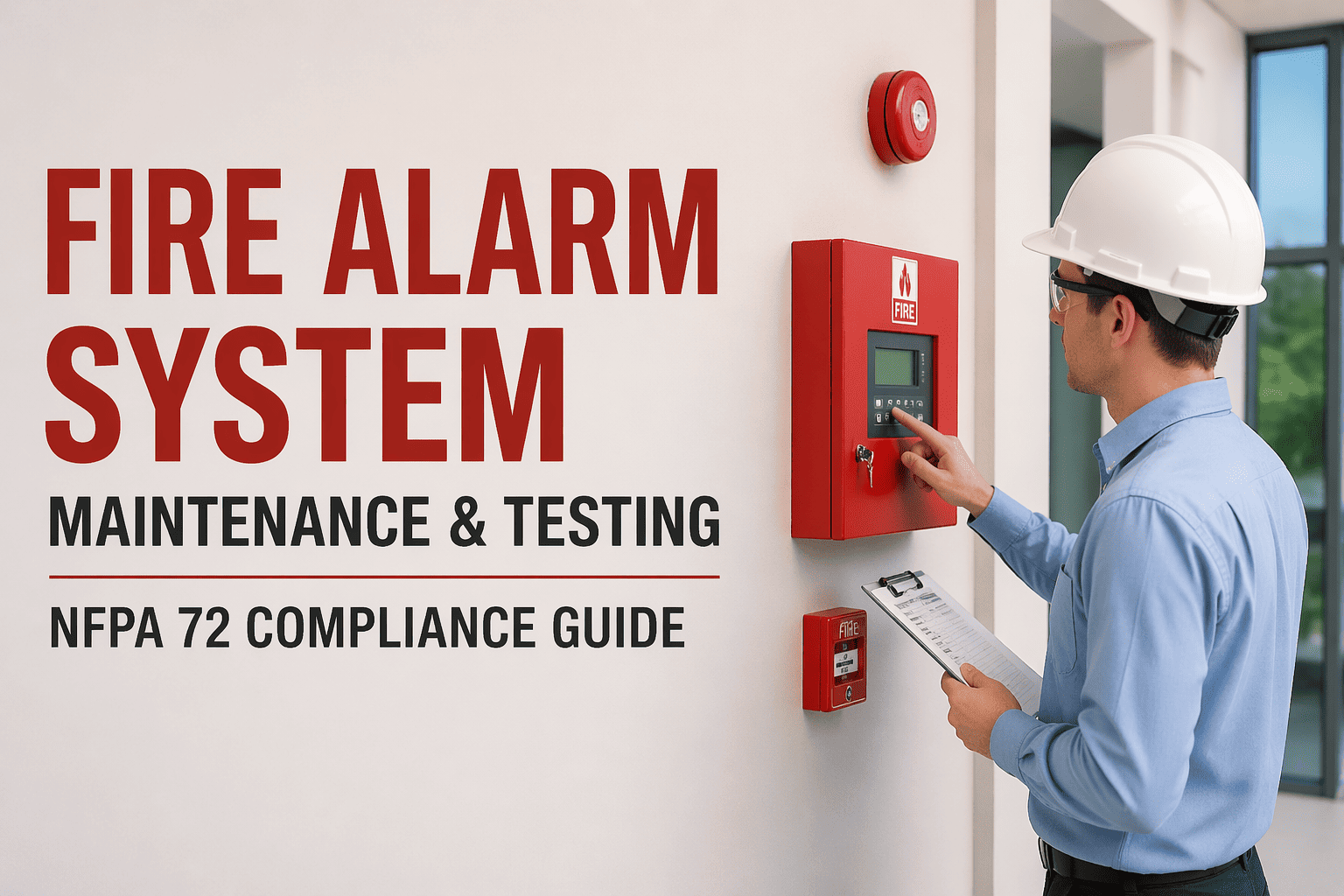
A fire alarm system that passes its last inspection and then fails silently over the next eighteen months is not an unusual story — it is the documented pattern behind the majority of fire alarm failures during actual emergencies. 59% of home fire deaths occur in properties with no working smoke alarms, and in commercial buildings, the failure mode is rarely the hardware itself. It is the gap between required testing intervals and what actually gets done. NFPA 72 is the National Fire Alarm and Signaling Code — the single standard governing how fire alarm systems are inspected, tested, and maintained across the United States. It is not optional guidance. NFPA 72 becomes law when a state or city adopts the International Fire Code, and Chapter 14 applies retroactively to all installed systems regardless of when they were installed. If your maintenance program is not built around this schedule — with documented proof of every task — your system is already out of compliance, whether it sounds an alarm on demand or not.
$16,550
OSHA penalty per serious fire detection maintenance violation
$165,514
OSHA penalty per willful or repeated violation
5–20%
Insurance premium reduction for monitored, compliant fire alarm systems
6
Possible NFPA 72 inspection frequencies — weekly through 5-year cycles
The NFPA 72 Testing Schedule: Every Interval Explained
NFPA 72 does not apply a single testing frequency to the entire fire alarm system. Fire alarm systems in commercial buildings require a tiered inspection schedule: weekly and monthly visual checks, quarterly testing of specific components, and a comprehensive annual professional inspection. Understanding which components fall under which interval — and who is qualified to perform each — is the foundation of a defensible compliance program.
Control panel — check for active trouble or supervisory signals
Verify no new fault indicators since last check
Confirm monitoring link status is active
Visual walk of accessible detector zones
Addressable systems with automated weekly self-inspection may reduce visual inspection to annual
Control panel and power supply visual inspection
Battery condition — check for corrosion or leakage
Pull stations — verify unobstructed and undamaged
Notification appliances — verify visible and unobstructed
Smoke detector functional test using approved aerosol
All results must be documented — undocumented inspections are treated as missed inspections during audits
Quarterly
Licensed Technician
Waterflow alarm devices — functional test
Pressure supervisory switches — operational verification
Valve supervisory and tamper switches — test
Sprinkler system supervisory signaling devices
Quarterly testing applies specifically to sprinkler-connected supervisory devices — not all fire alarm components
Semi-Annual
Licensed Technician
Visual inspection of all initiating devices — in place, unobstructed, undamaged
Remote annunciators — operating condition verified
Control unit trouble signals — readily visible check
Kitchen hood extinguishing system fire alarm interconnect switches
Notification appliances in high-occupancy environments
Exception for addressable systems with automated weekly self-inspection producing documented print-outs
Annual
NICET-Certified Technician
Full functional test of all system components
Smoke detector sensitivity test — within listed range
Battery load testing — capacity verification
Emergency voice/alarm communication system test
Central station monitoring verification
Complete documentation report submitted to building owner
Annual inspection report must be retained on-site and available to AHJ, fire marshal, and insurance carrier on demand
Component-Level Maintenance: What Each Part of the System Requires
Fire alarm systems are not monolithic — each component has its own degradation timeline, failure mode, and testing protocol under NFPA 72. A maintenance program that treats the system as a single asset will consistently miss component-specific requirements. These are the six components that account for the majority of compliance violations and emergency failures.
Monthly
Functional test using approved aerosol — verify alarm activation at the control panel
Semi-Annual
Visual inspection — in place, unobstructed, no physical damage, no paint overspray
Annual
Sensitivity test within 1 year of installation, then every other year thereafter. Detectors outside listed range must be cleaned, recalibrated, or replaced
CMMS trigger: Sensitivity test due date tracked per detector, not per system — each unit has its own schedule
Weekly
Check for active trouble signals, fault indicators, and monitoring link status
Monthly
Visual inspection of panel, fuses, LEDs, power supply — confirm no tampering or damage
Annual
Full functional test including primary and secondary power, CPU diagnostics, software version documentation, and communication path verification
CMMS trigger: Panel location must be in an occupied area or supplemented by automatic early warning detection per NFPA 72
Monthly
Visual — verify devices are visible, unobstructed, and undamaged across all zones
Semi-Annual
Functional test in high-demand and high-occupancy environments — verify audible and visual output meets ADA and NFPA 72 specifications
Annual
Complete system activation — verify all appliances activate simultaneously and notification reaches all building zones
CMMS trigger: Strobe candela output and horn decibel ratings must be documented against ADA and OSHA requirements
Monthly
Visual inspection — accessible, unobstructed, not locked or blocked, no physical damage
Annual
Functional test — activation of each pull station verified at the control panel, reset confirmed, no mechanical resistance
CMMS trigger: Pull stations must be at every required egress point — location audit should accompany annual functional test
Monthly
Visual inspection for corrosion, leakage, swelling, or terminal damage — replace immediately on any visual defect
Annual
Load capacity test — verify battery can sustain system in alarm condition for required standby duration (minimum 24 hours standby + 5 minutes alarm for most occupancies)
CMMS trigger: Battery replacement cycle tracked per unit — typical sealed lead-acid battery lifespan is 3–5 years regardless of test results
Semi-Annual
Visual inspection — verify accessible, sampling tubes unobstructed, no duct condensation or debris accumulation affecting sensing chamber
Annual
Functional test — simulate smoke introduction at sampling inlet, verify HVAC shutdown signal activates correctly at the air handling unit and at the control panel
CMMS trigger: HVAC shutdown verification must be confirmed — detector activation without AHU shutdown is a critical failure mode
Oxmaint CMMS for Fire Safety Compliance
Stop Managing NFPA 72 Schedules on Spreadsheets
Oxmaint auto-generates inspection work orders per component, per interval — with technician assignment, photo documentation, and audit-ready records that satisfy AHJ, insurance, and OSHA requirements.
Documentation: The Compliance Evidence NFPA 72 Actually Requires
NFPA 72 requires that all inspection, testing, and maintenance activities be documented and retained on site. This documentation must be available to the AHJ, insurance carrier, and fire marshals upon request. In the event of a fire, incomplete or missing inspection records can expose building owners to significant legal and financial liability, regardless of whether the system functioned correctly. Documentation is not a secondary concern — it is the primary evidence of compliance in every investigation, audit, and insurance claim review.
01
Device-Level Test Records
Every detector, pull station, notification appliance, and battery logged individually — not as a system batch. Results recorded as pass, fail, or adjusted with corrective action noted.
02
Technician Credentials
Name, license number, and certification level of technician performing each inspection recorded. NICET certification level required for annual functional inspections in most jurisdictions.
03
Deficiency & Corrective Action Log
Every deficiency found must be documented with date discovered, nature of deficiency, corrective action taken, and date resolved. Unresolved deficiencies must be tracked until closed.
04
Pre-Test Notification Records
NFPA 72 requires all affected parties be notified prior to any scheduled system test — building occupants, monitoring company, and fire code official. Notification records must be retained.
05
Sensitivity Test Results
Smoke detector sensitivity readings documented per device with listed sensitivity range referenced. Newer panels may log sensitivity continuously — confirm with contractor and document capability.
06
Reacceptance Test Records
After any system modification, 100% of affected components plus 10% of unaffected initiating devices must be retested. Scope and results of reacceptance testing documented separately from routine ITM records.
Common Compliance Violations and How to Prevent Them
Violation
How It Happens
Consequence
Prevention
Missing Inspection Records
Paper logbooks lost, inspection done but not logged, vendor reports not retained on-site
Treated as undone — full liability exposure even if inspection was completed
CMMS with automatic timestamped records per task and cloud storage accessible on demand
Lapsed Sensitivity Testing
Sensitivity test tracked at system level — individual detectors on different installation dates missed
Detectors outside listed range go undetected — fire alarm fails to activate at required threshold
Per-device sensitivity test schedule in CMMS — each detector tracked from individual installation date
Unresolved Deficiencies
Deficiency noted in inspection report — no work order generated, no follow-up, no closure date
Open deficiency at time of fire incident is treated as constructive knowledge of system failure
Auto-generated corrective work order for every deficiency — open until technician closes with documented repair
No Pre-Test Notification
Test scheduled and conducted without notifying occupants, monitoring company, or fire marshal
Unnecessary emergency response, occupant panic, regulatory citation, and potential injury liability
CMMS workflow includes notification checklist step — test cannot be marked complete without notification record
Obstructed Devices
Building renovation, new partitions, or signage installed over or near detectors and pull stations
Device fails activation test or is inaccessible — results in immediate AHJ citation and correction order
Monthly visual inspection checklist includes obstruction check — any renovation triggers reacceptance test workflow
Frequently Asked Questions
Who is responsible for NFPA 72 compliance — the building owner or the fire alarm contractor?
Both carry responsibility, but the building owner bears ultimate legal accountability. NFPA 72 Section 14.2.3.1 assigns compliance responsibility to the building owner regardless of contractor involvement. Hiring a licensed contractor satisfies the technical performance requirement, but the owner must verify that inspections are conducted on schedule, deficiencies are resolved, and records are retained on-site. OSHA 29 CFR 1910.164 citations go directly to the employer or building owner — not the contractor.
What is reacceptance testing and when is it required?
Reacceptance testing is required any time modifications are made to the fire alarm system — panel software changes, added or removed devices, wiring alterations, or control unit replacement. NFPA 72 requires 100% testing of all affected components, plus functional testing of 10% of unaffected initiating devices up to a maximum of 50. The fire code official must be notified prior to reacceptance testing, and all results documented separately from routine ITM records.
Can in-house facility staff perform fire alarm inspections or does NFPA 72 require a contractor?
Facility staff can perform weekly and monthly visual inspections — checking the control panel for trouble indicators, verifying pull stations and notification appliances are unobstructed, and confirming no physical damage. Functional testing of detectors, battery load tests, sensitivity testing, and the annual comprehensive inspection require a licensed technician with calibrated equipment. Most jurisdictions require NICET certification for annual inspections. The distinction matters for documentation — who performed each task must be recorded with credentials.
How does a CMMS help with NFPA 72 compliance specifically?
A CMMS addresses the most common compliance failure — documentation gaps — by automatically generating inspection work orders per component at the correct interval, capturing timestamped completion records with technician details, tracking open deficiencies until closed, and storing all records in a format accessible to inspectors on demand. Per-device scheduling handles sensitivity testing due dates for individual detectors, preventing the "system-level tracking" gap that causes most sensitivity test violations. The result is an audit-ready inspection history without manual log management.
Full NFPA 72 Compliance Automation
Every Interval. Every Component. Every Record — Automatically.
Oxmaint builds your NFPA 72 testing schedule into automated work orders — weekly through annual — with per-device tracking, deficiency management, and documentation that satisfies any AHJ inspection, insurance audit, or OSHA review.