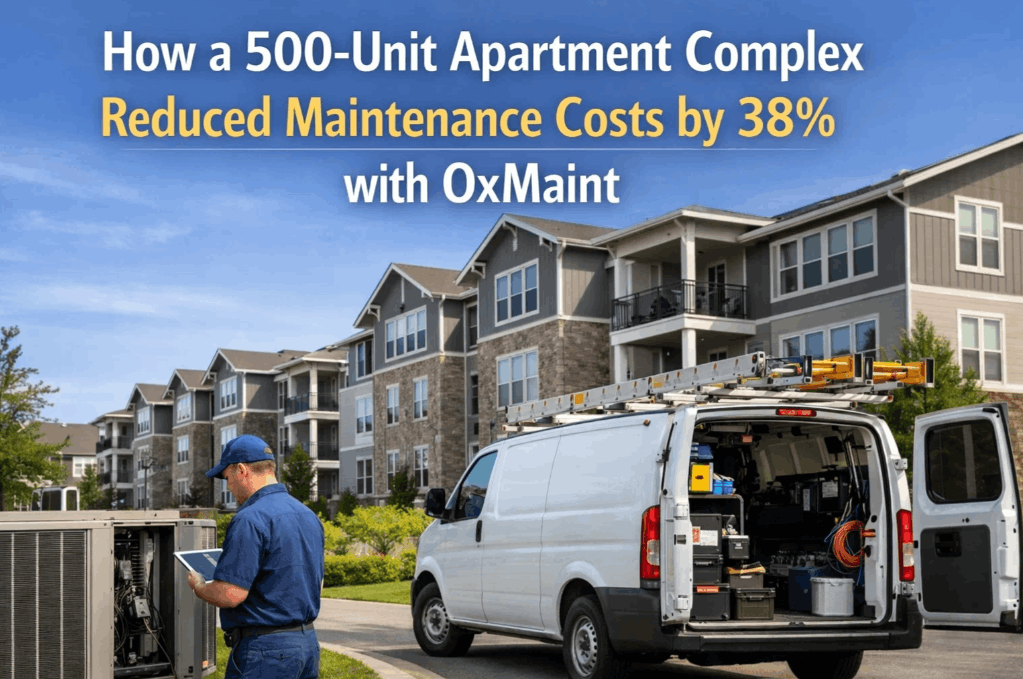
A 500-unit residential apartment complex in the midwest was watching its maintenance budget spiral out of control. Emergency calls consumed nights and weekends. Tenants were frustrated. Work orders were tracked on clipboards and spreadsheets that nobody fully trusted. In 14 months, the property management team transformed their entire maintenance operation using OxMaint — and the numbers tell a story worth reading. Book a free demo to see how OxMaint applies to your property.
Client Background
The property is a mixed-tenure residential apartment complex comprising 500 units spread across 8 buildings, with shared amenities including two swimming pools, a fitness center, underground parking, and landscaped common areas. Built in 2005 and operating at 91% average occupancy, it employs a 9-person in-house maintenance team alongside 3 contracted specialist vendors.
The Challenges
Before implementing a structured maintenance system, the property faced a compounding set of operational problems. Each issue fed the next, creating a cycle the team could not break without external intervention.
The Solution: OxMaint CMMS Deployment
The property management group evaluated three CMMS platforms. They selected OxMaint for its rapid deployment model, mobile-first design built for field technicians, and its ability to scale from a single property to a full portfolio without requiring additional headcount or consulting engagements. The decision was made on a Tuesday. The deployment began the following Monday.
All 1,100+ assets catalogued via mobile app with condition scores, install dates, manufacturer records, and location tags — the first structured asset inventory in the property's history.
31 PM schedules configured across HVAC, plumbing, electrical, appliances, pool systems, and building envelope. Each schedule auto-generates assigned work orders without manual intervention.
All reactive and planned work orders managed digitally on mobile devices. Pre-diagnosed task descriptions. Pre-ordered parts. Real-time status tracking visible to both technicians and property managers.
Every regulatory inspection — fire safety, elevator certification, boiler servicing, pool chemistry — mapped with automated reminders at 30 and 7 days prior to each deadline.
Residents submit maintenance requests through a branded portal. Requests auto-convert to work orders, routed to the right technician with zero manual dispatch overhead.
Condition-scored asset data feeds a 5-year capital replacement model. Management receives defensible, data-backed projections instead of age-based estimates for board approval.
Execution & Deployment Timeline
The entire deployment was completed in 14 days by the existing 9-person maintenance team alongside their normal daily operations. No consultants. No downtime. No new hires.
1,100+ assets catalogued across all 8 buildings. Each asset received a condition score, location tag, installation date, and manufacturer record — the first complete inventory the property had ever held.
31 preventive maintenance schedules built for all major systems. Auto-assignment rules configured by technician skill and zone. Parts pre-ordering workflows activated for high-frequency tasks.
All regulatory deadlines mapped with automated reminders. Tenant request portal configured, branded, and communicated to all 455 occupied units via building management notice.
Full team trained in under 3 hours on mobile app. First automated PM work orders dispatched on day 14. Within 45 days, the team reached 91% on-time work order completion with zero additional headcount.
Results After 14 Months
Same property. Same team. Same budget authority. One system changed everything.
Why It Worked
HVAC was the dominant cost driver. Scheduled filter replacements, coil cleanings, and refrigerant inspections intercepted 67% of HVAC failures before they escalated into after-hours emergencies. That single system change eliminated $78,000 in overnight labor premiums alone.
Preventive maintenance turned chaos into calendar. Moving from zero structured maintenance to 31 active PM schedules meant that every critical asset — boilers, pool pumps, elevator components, rooftop units — received attention on a defined cadence rather than at the point of failure. Failures that were once inevitable became preventable.
The tenant experience fundamentally changed. Residents stopped receiving surprise service disruptions and started receiving advance maintenance notifications. Complaints dropped 74%. Lease non-renewals attributable to maintenance fell from 11 to 1 in the 12 months following deployment. The $198,000 in previously lost rental income was effectively recovered. Book a session to see how PM scheduling directly supports lease retention at your property.
Capital planning became defensible. Condition scores from the initial asset registry fed directly into a 5-year replacement model that property ownership could present to their investment board with confidence. CapEx overruns dropped from 41% to under 5%. Approvals came 42% faster because the data behind every request was traceable, not estimated.
The team worked smarter, not harder. Technician productive time nearly doubled — from 29% to 56% — because work orders now arrived pre-diagnosed with parts already staged. Travel between buildings dropped 34%. The same 9-person team handled significantly more planned work while responding to significantly fewer emergencies.
Key Takeaways
At 68% reactive spend, this property was not managing maintenance. It was managing emergencies. The shift to structured prevention is not a refinement; it is a different operating model entirely.
Without a complete, condition-scored asset registry, PM scheduling, CapEx modeling, and compliance tracking are all built on guesswork. The asset inventory was completed in 4 days and enabled every downstream result.
The 11 non-renewals that occurred before deployment were not lost to competing amenities or pricing — they were lost to maintenance failures. Fixing the maintenance system recovered the retention problem without any changes to leasing strategy.
A 14-day deployment with no consultants and no new hires means the ROI clock starts almost immediately. Properties that delay CMMS adoption because they expect a months-long implementation are operating on an outdated assumption.
The 9-person maintenance team did not change. Their skills did not change. The system they worked within changed — and that produced a 38% cost reduction, a 61% emergency reduction, and a near-doubling of productive time.
Common Questions
How long did the initial asset inventory take?
Did tenants experience any disruption during the deployment?
Is OxMaint suitable for smaller multi-family properties?
Was any specialized training required for the maintenance team?
How quickly does the ROI materialize?
Conclusion
The 500-unit apartment complex in this case study did not have a maintenance team problem. It had a maintenance system problem. With no preventive schedules, no asset records, and no structured work order process, even a skilled team could only respond — never prevent.
OxMaint replaced that reactive structure with a proactive one. In 14 days, the property went from zero PM schedules to 31 active ones, from 1,100 untracked assets to a complete condition-scored registry, and from spreadsheet-based chaos to a digital system its team could run from a mobile phone on the roof or in the basement.
The $214,000 in year-one savings was not the result of the team working harder. It was the result of the team finally working inside a system that made prevention possible, planning predictable, and capital decisions defensible. That is the repeatable promise of structured maintenance — and the measurable result of this deployment.

.png)


