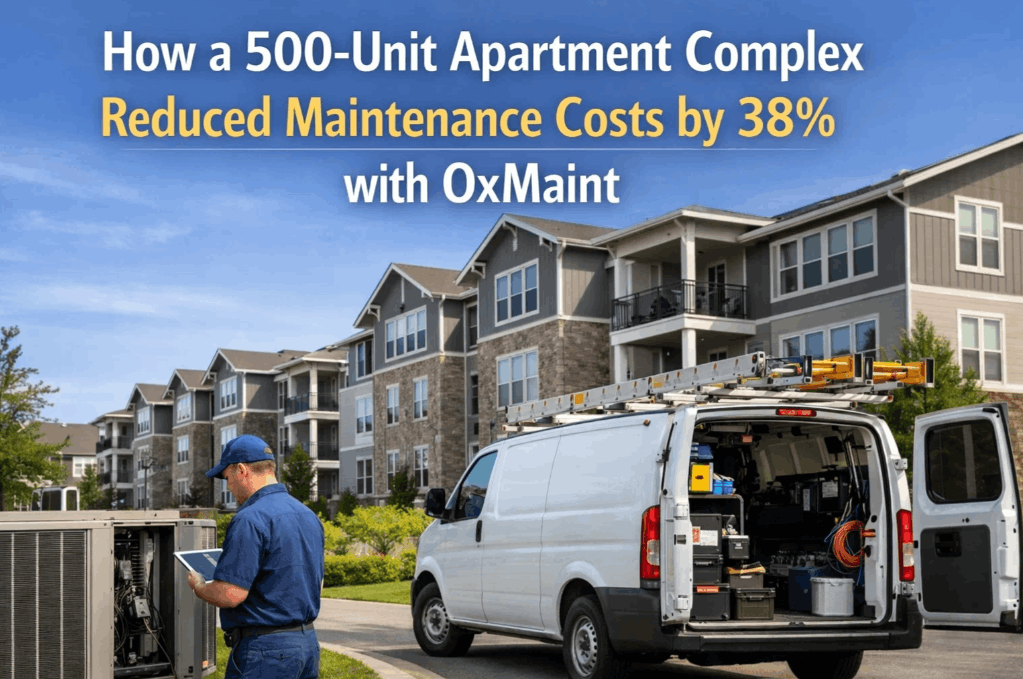
A 500-unit apartment complex in the mid-Atlantic United States was hemorrhaging maintenance budget with no clear insight into why. Aging infrastructure, reactive repair cycles, and a fully manual work order system had pushed annual maintenance costs to unsustainable levels. Technicians operated without visibility into asset history, supervisors approved work on gut instinct, and months-old data informed decisions that needed real-time answers. Twelve months after implementing OxMaint's predictive maintenance platform and digital work order system — sign up free to explore the platform — the property reduced total maintenance expenditure by 30%, slashed emergency repair incidents by 52%, and achieved full digital adoption across its 14-person operations team.
Ready to Cut Maintenance Costs by 30%?
See how OxMaint's predictive maintenance and digital work order platform transforms multifamily operations — 500 units, 30% cost reduction, fully deployed in under 30 days.
01 / The Property
500 Units. One Operations Team. A Maintenance Budget Under Pressure.
Property Type
Class B garden-style apartment complex. Mix of one-, two-, and three-bedroom units across 18 residential buildings. Common amenities include two outdoor pools, a clubhouse, fitness center, and on-site laundry facilities.
Scale
500 residential units across 18 buildings. Approximately 820 residents. Over 1,100 individual maintenance-tracked assets including HVAC units, water heaters, appliances, and electrical panels.
Maintenance Team
14-person in-house operations team. Two property supervisors, nine field technicians, three administrative coordinators. Trades covered: HVAC, plumbing, electrical, appliance repair, and grounds maintenance.
Request Volume
Averaging 510 maintenance requests monthly prior to deployment. Emergency after-hours calls averaging 38 per month. 100% of work orders processed through paper-based intake and manual spreadsheet logging.
Prior System
Paper work order binders, resident call-in intake via front office, and manual coordinator-maintained spreadsheets. No asset history tracking, no predictive scheduling, and zero real-time technician visibility.
Annual Maintenance Budget
Pre-deployment annual maintenance spend of approximately $618,000 — 23% above the regional benchmark for comparable properties. Emergency repair calls accounted for 31% of total annual expenditure.
02 / The Challenge
The True Cost of Reactive Maintenance
The property's maintenance model was reactive by default, not by design. Without asset tracking or historical maintenance records, technicians had no way to anticipate failures — they responded to them. This reactive posture cost significantly more per repair incident, pulled technicians from scheduled work, and created unpredictable budget variance that complicated annual financial planning. Emergency calls routinely arrived outside business hours, generating overtime costs that no paper system could flag or prevent — book a demo to see how OxMaint replaces reactive cycles with predictive scheduling.
31%
Budget consumed by emergency repairs
Emergency repair incidents — including after-hours HVAC failures, burst plumbing, and appliance breakdowns — accounted for nearly a third of annual maintenance spend, at an average cost 2.4x higher than planned repairs for the same equipment.
4.1 days
Average work order completion time
Manual routing, paper-based assignment, and absence of real-time technician status extended the average work order lifecycle to 4.1 days — nearly double the industry benchmark of 2.2 days for properties of comparable size and scope.
$0
Asset history available at point of repair
No digital asset records meant technicians arrived at each job without service history, prior repair notes, or warranty status. This caused duplicate diagnostics, incorrect parts ordering, and repeat-visit rates estimated at 22% of all closed work orders.
38
Emergency after-hours calls per month
Without condition monitoring or scheduled preventive maintenance for aging assets, the property averaged 38 emergency after-hours dispatches monthly — each carrying overtime labor premiums, expedited parts sourcing costs, and resident satisfaction penalties.
"We were spending more fixing failures than we would have spent preventing them. But we had no data, no history, and no system to tell us which assets were about to break down — until they did."
03 / The Solution
OxMaint: Predictive Maintenance and Digital Work Orders, Deployed as One System
After evaluating four CMMS platforms over a six-week selection process, the property management team selected OxMaint for its combination of predictive maintenance scheduling, mobile-native digital work orders, and an asset registry model built specifically for multifamily residential properties. The existing 14-person team — sign up free and see how simple the setup is — managed onboarding and configuration independently, without external consultants or dedicated IT staff.
The solution replaced every manual workflow touchpoint — from resident request submission through field execution to supervisor close-out — with a digital equivalent. Critically, the platform's predictive scheduling engine ingested asset age, usage data, and service history to generate maintenance forecasts that shifted the team from reacting to failures toward preventing them.
PREDICT
Predictive maintenance scheduling replaced calendar-based PM with condition-informed forecasts. OxMaint analyzed asset age, service intervals, and repair frequency to flag at-risk assets before failure — generating proactive work orders weeks ahead of anticipated breakdowns.
DIGITAL
Digital work order management eliminated paper entirely. Technicians received, updated, and closed work orders on mobile devices — with full asset history, prior repair notes, parts inventory, and photo documentation available at the point of work.
ASSETS
Structured asset registry created a permanent digital record for all 1,100+ maintenance-tracked assets — including installation date, warranty status, service history, and repair cost accumulation. Technicians scanned QR asset tags on arrival for instant history access.
INSIGHT
Real-time supervisor dashboards provided live visibility into open work orders, technician assignment, asset alert status, and monthly cost tracking — eliminating the manual reporting cycles that previously consumed 11+ hours of coordinator time each month.
04 / Implementation
Deployed in 28 Days. First Predictive Work Order Issued on Day 12.
Days 1–6
Asset Registry Build and Data Migration
All 1,100+ maintenance-tracked assets catalogued into OxMaint's asset registry — including unit HVAC systems, water heaters, common-area equipment, and electrical infrastructure. QR asset tags printed and physically installed across all tracked assets. Existing paper service records manually transcribed where available.
Days 7–12
Predictive Schedule Configuration and Mobile Deployment
OxMaint's predictive maintenance engine configured using asset age, manufacturer service intervals, and local climate data for HVAC and plumbing systems. Mobile app deployed across all 14 team devices. Offline functionality tested across all 18 buildings. First system-generated predictive work orders issued on day 12 — flagging 23 HVAC units as high-priority pre-season inspection targets.
Days 13–21
Parallel Operations and Role-Specific Training
Nine-day parallel period running paper and digital systems simultaneously. All team members completed role-specific training: field technicians in 1.5 hours, supervisors in 3 hours, coordinators in 2.5 hours. By day 21, 92% of field technicians rated themselves confident on the platform without supervisor prompting.
Days 22–28
Full Digital Cutover and Reporting Activation
Complete paper elimination across all 18 buildings. Resident request intake migrated to digital portal and front-office tablet. Automated status notifications activated for all work order milestones. Supervisor real-time dashboard live across all management devices. First digital monthly maintenance cost report generated in under 40 minutes — replacing a process that previously required 11 manual hours.
05 / Results
12 Months of Measured Maintenance Transformation
The shift from reactive to predictive maintenance produced compounding cost reductions that surpassed initial projections within the first six months of deployment. Emergency repair volume fell sharply as predictive work orders intercepted asset failures before they occurred. Administrative costs dropped as digital workflows replaced manual data entry. And for the first time, the operations team had the asset-level data — book a demo to see this in action for your property — to make evidence-based decisions about repair versus replacement across the full 500-unit portfolio.
| Metric |
Before OxMaint |
After OxMaint |
Change |
| Total annual maintenance spend |
~$618,000 |
~$433,000 |
−30% cost reduction |
| Emergency repair incidents (monthly) |
38 / month |
18 / month |
−52% emergency calls |
| Average work order completion time |
4.1 days |
1.9 days |
−54% cycle time |
| Repeat-visit rate (same asset, 30 days) |
22% |
6% |
−73% repeat visits |
| Resident maintenance satisfaction score |
5.8 / 10 |
8.4 / 10 |
+45% satisfaction |
| Monthly reporting time (admin hours) |
11 hrs manual |
Under 40 mins |
−94% reporting time |
| Work order record completeness |
61% |
100% |
100% complete records |
| Technician digital adoption (Day 30) |
N/A |
92% |
Fully adopted |
| Predictive work orders issued (monthly) |
0 |
74 / month |
From zero to 74/mo |
| Paper work orders processed |
510+ / month |
0 / month |
Fully paperless |
30%
Maintenance cost reduction
−52%
Emergency repair incidents
92%
Technician adoption Day 30
28 days
Full deployment timeline
"Within six months, we had recovered the full annual cost of the platform in emergency repair savings alone. The 30% budget reduction wasn't a forecast — it showed up in the numbers."
06 / Key Analysis
Why the Cost Savings Were This Large
01
Predictive maintenance intercepted failures before they became emergencies. The 52% reduction in emergency repair incidents was the single largest driver of cost reduction. OxMaint's predictive engine identified 23 HVAC units, 14 water heaters, and 11 plumbing assemblies as high-risk assets in the first 90 days — generating proactive work orders that resolved developing failures at planned-repair cost rather than emergency-call cost. Each prevented emergency call saved an average of $740 in overtime labor, expedited parts, and resident accommodation costs.
02
Asset history eliminated repeat visits and incorrect parts orders. The prior system's 22% repeat-visit rate was not a technician performance issue — it was a data access issue. Without service history at the point of repair, technicians diagnosed from scratch on every visit, ordered parts based on incomplete information, and frequently returned to complete repairs with correct components after an initial misdiagnosis. OxMaint's QR-tagged asset registry delivered complete service history on arrival, dropping the repeat-visit rate to 6% and reducing parts procurement errors by an estimated 68%.
03
Digital work orders compressed completion time by eliminating coordination lag. The 4.1-day average completion time was not a capacity problem — it was a routing problem. Paper work orders sat in in-boxes, required physical hand-offs, and could not be reassigned without supervisor intervention. OxMaint's digital assignment engine — get started free to see it live — routed work orders automatically by trade, location, and technician availability, compressing average completion time to 1.9 days without adding headcount.
04
Complete digital records created a defensible repair-versus-replace model. With full asset cost histories now available, the operations team identified nine assets whose cumulative repair spend exceeded 80% of replacement cost within the first year of tracking. Planned replacements for these assets, scheduled during the second year, are projected to save an additional $41,000 in maintenance expenditure — a benefit that paper-based records structurally prevented the team from ever identifying.
07 / Business Impact
Beyond Cost: What the Transformation Protected at Portfolio Level
Resident Retention
Maintenance satisfaction scores rose from 5.8 to 8.4 out of 10. The property recorded its highest annual lease renewal rate in four years — 87% — with exit survey data attributing improved maintenance responsiveness as a top-three retention factor for the first time in the property's operating history.
Budget Predictability
Shifting from reactive to predictive maintenance converted unpredictable emergency costs into forecastable planned-maintenance expenditure. Monthly maintenance cost variance dropped from ±34% to ±9%, enabling accurate annual budget planning and eliminating the mid-year budget overrun pattern that had characterized operations for three consecutive years.
Liability and Compliance
Achieving 100% work order record completeness — up from 61% — resolved a recurring finding in the property's annual insurance audit. Timestamped, photo-documented digital records now provide defensible evidence for tenant damage disputes, warranty claims, and regulatory inspections that previously required hours of manual file reconstruction.
Team Capacity Reallocation
Recovering 11+ administrative hours monthly per coordinator enabled both roles to absorb expanded responsibilities. One coordinator took on vendor contract management and procurement tracking; the other shifted to proactive resident lifecycle communication. Tasks previously deferred due to manual reporting workload are now standard monthly operations.
$618K
Annual spend before
$185K
Annual savings achieved
08 / Conclusion
Predictive Maintenance Is Not an Upgrade — It Is a Structural Shift
This property's 30% maintenance cost reduction was not the result of cutting services or reducing team size. It was the result of replacing an information deficit — no asset history, no condition visibility, no real-time work order status — with a data layer that made every maintenance decision more accurate and every maintenance resource more effective. OxMaint's platform made that transition achievable in 28 days — book a demo to map your property's timeline — with costs recoverable in the first two quarters through emergency repair savings alone.
The compounding value lies in what the data enables going forward: a complete, timestamped record of every maintenance event across every asset in the portfolio — available for trend analysis, capital planning, insurance documentation, and resident communication. The 30% cost reduction is the immediate return. The institutional asset intelligence now accumulating in structured digital form is the long-term competitive advantage that paper-based maintenance operations structurally prevented.
30% Cost Reduction. 52% Fewer Emergencies. Fully Deployed in 28 Days.
500 units. $185,000 in annual savings. Real-time predictive maintenance from day one. See what it looks like for your property.
09 / FAQ
Frequently Asked Questions
How does predictive maintenance reduce costs in apartment complexes?
Predictive maintenance reduces costs by identifying assets likely to fail before they break down — converting expensive emergency repairs into lower-cost scheduled maintenance events. Emergency repairs in multifamily properties typically cost 2–3 times more than identical planned repairs due to overtime labor, expedited parts sourcing, and resident accommodation requirements. By intercepting failures early, predictive maintenance removes the premium cost layer from a significant portion of total maintenance expenditure. This property's 52% reduction in emergency repair incidents accounts for the majority of its 30% overall cost reduction.
What is a CMMS, and how does it help apartment maintenance operations?
A CMMS (Computerized Maintenance Management System) is a digital platform that centralizes all maintenance operations — work order creation and routing, asset history tracking, preventive maintenance scheduling, technician assignment, and performance reporting — in a single system accessible from both desktop and mobile devices. For apartment complexes, a CMMS replaces manual paper-based workflows and disconnected spreadsheets with a real-time operational data layer that improves response times, reduces administrative overhead, and generates the maintenance records needed for insurance compliance, warranty claims, and capital planning decisions.
How long does it take to implement a digital maintenance system in a multifamily property?
Implementation timelines vary by property size and asset count, but mid-size multifamily properties typically complete full deployment in three to four weeks. This 500-unit, 14-person team was fully operational and paper-free within 28 days — including asset registry setup, QR tag installation, mobile device configuration, parallel operations, team training, and full cutover. OxMaint is designed for existing operations teams to implement independently, without external consultants or dedicated IT resources.
What maintenance cost savings can a 500-unit apartment complex realistically expect?
Properties transitioning from reactive, paper-based maintenance to a predictive digital system typically achieve 20–35% reductions in total maintenance expenditure within the first 12 months. The primary savings drivers are reduced emergency repair volume, lower repeat-visit rates, decreased parts procurement errors, and administrative overhead reduction. This property achieved 30%, recovering $185,000 annually against a pre-deployment spend of $618,000. Actual savings depend on the current emergency repair rate, asset age, and administrative inefficiency of the prior system.
How does digital work order management improve apartment maintenance response times?
Digital work order management improves response times by eliminating the coordination lag inherent in paper-based systems. Manual paper workflows require physical routing, phone-based status checks, and in-person supervisor approvals — each introducing delays that accumulate into multi-day completion cycles. Digital platforms route work orders automatically by trade and availability, give technicians complete job context on mobile devices, and give supervisors real-time status visibility that enables dynamic reassignment. This property reduced average work order completion time from 4.1 days to 1.9 days without adding headcount.
Can predictive maintenance systems integrate with existing apartment management software?
Most modern predictive maintenance platforms, including OxMaint, offer integration with leading property management systems to enable bidirectional data sharing — synchronizing resident information, unit assignments, and work order status between platforms. Integration depth varies by property management software and deployment configuration. OxMaint's team can assess compatibility with your existing property management stack during the initial consultation. For properties without existing digital infrastructure, OxMaint operates effectively as a standalone system.
What is the ROI timeline for a CMMS investment in a multifamily property?
For properties with high emergency repair rates and manual administrative workflows, CMMS ROI is typically achieved within the first two to three quarters of full deployment. Emergency repair cost reduction alone — the most immediate savings driver — generally offsets platform costs within the first six months for properties averaging 30+ emergency calls per month. This property recovered full annual platform cost in emergency repair savings within six months of deployment, with ongoing maintenance cost savings of approximately $185,000 annually thereafter.