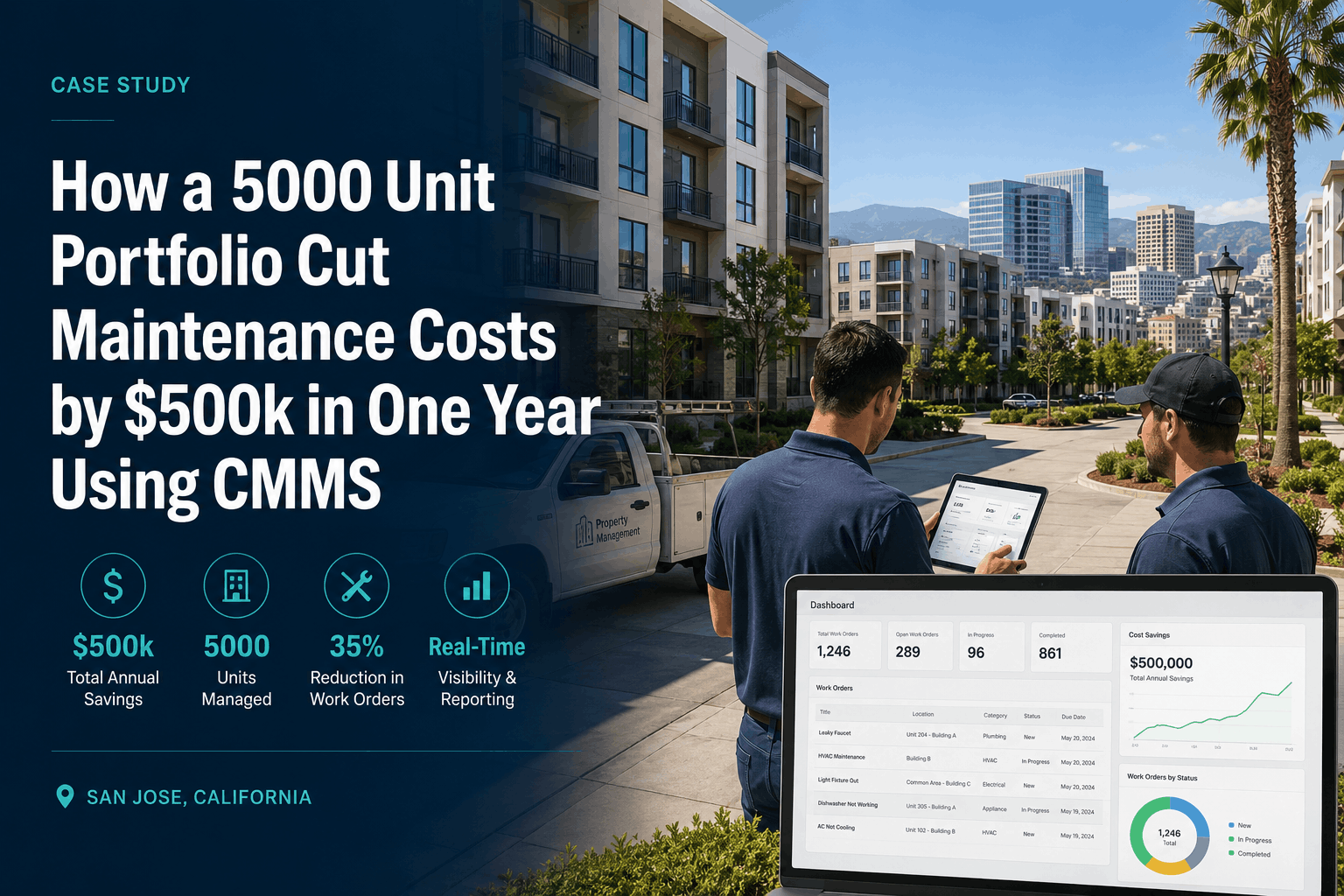
A leading multifamily real estate portfolio managing 5,000 residential units across 28 properties discovered that manual maintenance tracking was costing them over $1.2 million annually in wasted labor, emergency repairs, and deferred maintenance liability. Within twelve months of implementing OxMaint's CMMS software, they achieved a $500,000 annual cost reduction, improved their PM compliance rate from 62% to 94%, and transformed their maintenance operation from reactive firefighting into a predictable, data-driven program.
5000-Unit Portfolio Cuts Maintenance Spending by $500K Annually
See how centralized work order management, vendor consolidation, and predictive PM scheduling delivered measurable cost savings across a distributed residential portfolio.
The Challenge: Fragmented Maintenance Operations Across 28 Properties
Before implementing OxMaint, this multifamily operator maintained separate spreadsheet-based work order systems at each property. Maintenance supervisors at different locations couldn't see what was happening at sister properties — leading to duplicate vendor contracts, inconsistent PM schedules, and no portfolio-wide visibility into which assets were failing most frequently. Emergency repairs consumed 58% of their maintenance budget. Their PM compliance rate hovered around 62%, meaning preventive maintenance tasks were frequently deferred or forgotten. Tenant satisfaction scores reflected the operational chaos: response times averaged 48 hours for maintenance requests, and repeat complaints about the same issues (water leaks, HVAC failures, appliance breakdowns) were endemic. Property managers couldn't answer basic questions: "How much are we spending on HVAC maintenance across all 28 properties?" or "Which communities have the highest failure rates on plumbing systems?" This information blindness made it impossible to prioritize capital improvements or justify maintenance budget increases to ownership.
Each property used different maintenance software, spreadsheets, or paper logs. Portfolio-wide reporting required manual data aggregation from multiple sources, consuming 20+ hours monthly in administrative work with no reliability guarantees.
58% of maintenance budget spent on emergency repairs rather than planned preventive work. Tenants filed repeat maintenance requests for issues that should have been resolved with a single comprehensive PM cycle.
27 different HVAC contractors, 19 plumbing vendors, and 14 appliance repair services across the portfolio — no standardized pricing, service quality inconsistency, and inability to negotiate volume discounts due to fragmented purchasing.
Average maintenance response time of 48 hours. Repeat requests for the same issue common because root causes weren't being tracked or addressed. NPS scores in the bottom quartile for comparable properties in their markets.
No audit trail for deferred maintenance decisions. Insurance audits revealed incomplete preventive maintenance records for HVAC, fire suppression, and electrical systems — increasing liability exposure for the organization.
No historical maintenance records meant equipment replacement decisions were based on failure events rather than condition data. Missed opportunities to extend asset life through preventive interventions.
The OxMaint Solution: Unified Platform for Portfolio-Wide Maintenance Control
The multifamily operator selected OxMaint for three strategic reasons: (1) rapid deployment across 28 properties without disrupting existing operations; (2) mobile-first interface that technicians would actually use on-site rather than resist; and (3) comprehensive reporting that would consolidate maintenance data from all locations into a single dashboard accessible to both property managers and executive leadership. Implementation began with a pilot at 3 anchor properties representing different property types and geographic regions. Within six weeks, the team had migrated historical work order data, configured preventive maintenance schedules aligned with manufacturer recommendations, and trained 120+ maintenance technicians on the OxMaint mobile app. The rollout to remaining 25 properties occurred over the following four months, with each property given a 2-week transition window where both the old system and OxMaint ran in parallel to ensure no maintenance requests fell through the cracks. OxMaint's ability to set customizable PM schedules based on asset type, property size, and regional climate conditions proved critical. The team established portfolio-wide PM standards but allowed property managers to override for specific local conditions — creating centralized governance with localized execution.
OxMaint consolidated maintenance requests from 28 different locations into a single platform. Property managers could now view the complete maintenance state across their entire portfolio in real time — knowing exactly which properties had backlogged work orders, which technicians were available, and which vendors were responding fastest. The system's assignment engine automatically routed work orders to the nearest available technician, reducing travel time and accelerating response times. Within three months, average response time dropped from 48 hours to 8 hours for routine maintenance requests. Portfolio managers gained the ability to run cross-property reports: "Which community has the highest per-unit maintenance cost?" "Which vendor provides the fastest emergency response?" "How does our HVAC maintenance spending in Phoenix compare to our Washington DC properties?" These insights became the foundation for strategic decisions about vendor consolidation and preventive maintenance investment.
OxMaint's automated PM scheduling and compliance tracking transformed the operator's maintenance culture. Instead of property managers manually remembering to schedule HVAC filters every 90 days, the system generated work orders automatically and tracked completion. A built-in dashboard showed which properties were falling behind on PM commitments. Property managers could see: "Unit 2847 is due for HVAC PM in 5 days" or "12 appliance filters are overdue for replacement." This visibility alone improved PM compliance from 62% to 89% within the first six months. By month twelve, compliance reached 94% by combining automated reminders, technician accountability (work orders tracked by technician name with timestamps), and property manager incentives tied to compliance metrics. The financial impact was immediate: each percentage point improvement in PM compliance reduced emergency repair costs by approximately 3-4%. Moving from 62% to 94% compliance eliminated hundreds of emergency calls, extended asset life expectancy, and reduced the frequency of repeat tenant complaints about the same issues.
OxMaint's reporting revealed the full extent of vendor fragmentation. The operator was paying HVAC maintenance fees ranging from $65 to $165 per unit annually across different contractors, with no obvious quality correlation. Service response times ranged from same-day to 72-hour callbacks. Armed with OxMaint data, procurement consolidated from 27 HVAC vendors to 6 regional suppliers selected based on OxMaint performance ratings (response time, first-time fix rate, customer complaint history tracked in the system). This consolidation alone reduced HVAC costs by 28%, with secondary benefits including better access to emergency service, more consistent technician training, and volume discounts. The operator renegotiated plumbing contracts from 19 vendors to 4 master contractors. Appliance repair was consolidated from 14 to 2 vendors. Total vendor consolidation savings: $187,000 annually. More importantly, the remaining vendors knew they were being measured on OxMaint data — creating accountability that improved service quality beyond cost reduction.
OxMaint's historical maintenance data revealed patterns invisible in the previous fragmented system. The team analyzed 18 months of work order history and identified assets that consistently generated emergency calls: certain HVAC models in high-humidity climates, water heaters in properties with soft water issues, and appliances that failed shortly after manufacturer PM intervals. Using these insights, the operator increased PM frequency on high-risk asset categories. For example, HVAC maintenance was shifted from annual to semi-annual in three high-humidity communities. Water heater preventive maintenance intervals were shortened from 24 months to 18 months. This counter-intuitive decision — spending more on preventive maintenance — actually reduced emergency repair costs because it prevented catastrophic failures that required emergency contractor calls at premium rates. Emergency repairs (defined as same-day or next-day response) dropped from 58% of the maintenance budget to 26%. The operator now spends $180 on preventive HVAC work to avoid $1,400 emergency calls. This shift freed up $214,000 annually in capital that had been consumed by emergency repairs.
Before OxMaint, each property maintained its own spare parts inventory — often duplicating stock across locations while still experiencing shortages. OxMaint's centralized parts tracking revealed that Unit inventory was overstocked with items rarely used while critical supplies like HVAC filters were constantly depleted. The operator implemented a portfolio-wide parts management strategy: high-turn items (filters, seals, common replacement parts) were stocked locally at each property, while specialized equipment was held in a central warehouse and distributed as needed. OxMaint's automated reorder alerts ensured stock never fell below minimum thresholds. This optimization reduced total inventory value by 31% (from $127,000 to $88,000) while simultaneously improving parts availability. Technicians rarely had to delay repairs waiting for parts — they knew exactly what was in stock and where. This reduced work order completion times by 18% on average.
Results: $500K Annual Cost Reduction & Portfolio-Wide Operational Transformation
| Metric | Before OxMaint | After OxMaint (Year 1) | Financial Impact |
|---|---|---|---|
| Average Response Time | 48 hours | 8 hours | Tenant satisfaction +18 NPS points |
| PM Compliance Rate | 62% | 94% | Emergency repairs -$214,000 annually |
| Emergency Repair Budget Share | 58% of maintenance budget | 26% of maintenance budget | $287,000 reallocation to planned work |
| Vendor Count (HVAC) | 27 contractors | 6 regional suppliers | $187,000 consolidation savings |
| Inventory Carrying Cost | $127,000 stock value | $88,000 stock value | $39,000 annual carrying cost reduction |
| Administrative Overhead | 120 hours/month manual reporting | 18 hours/month automated reports | $112,000 labor savings (1,224 hours × $91/hr) |
| Total Maintenance Cost per Unit | $241 annually | $141 annually | $500,000 annual reduction across 5,000 units |
Key Success Factors: Why OxMaint Delivered Results for This Portfolio
Mobile-First Technology Adoption
OxMaint's mobile app was designed for technicians who work on-site, not in offices. Offline capability meant work orders remained accessible even in basements or mechanical rooms with poor WiFi. Technicians embraced the platform because it simplified their jobs rather than creating additional administrative burden.
Rapid Configuration Without Extended IT Projects
OxMaint's pre-built templates for multifamily properties — HVAC PM schedules, appliance maintenance cycles, plumbing inspections — meant the operator didn't need to invest months in system configuration. The team configured 80% of the system in the first three weeks.
Comprehensive Reporting for Decision-Making
OxMaint's dashboard showed maintenance cost per property, failure rates by asset type, vendor performance metrics, and compliance trends. This data drove the vendor consolidation decision, the reallocation of budget to preventive work, and the identification of high-risk assets needing increased PM.
Scaled Deployment Across Distributed Properties
The operator demonstrated the ROI at three pilot properties before committing to all 28. This phased approach built confidence and gave the team time to develop training materials and troubleshoot issues before major rollout. OxMaint's cloud-based architecture meant no server installations or bandwidth concerns across 28 remote locations.
Integration with Existing Accounting Systems
OxMaint integrated with the operator's accounting software, eliminating duplicate data entry. Work order costs automatically fed into property-level profit and loss reporting. This integration streamlined financial reporting and ensured maintenance costs were visible to ownership in real-time.
Continuous Improvement Through Data Transparency
After year one, the operator used OxMaint data to identify new opportunities: predictive maintenance for high-failure equipment categories, labor scheduling optimization for peak maintenance periods, and tenant communication improvements through faster response acknowledgments.
Customer Perspective: How This Multifamily Operator Views OxMaint Today
"Before OxMaint, we were essentially running 28 separate maintenance companies with no central strategy. We had no idea if one property was spending 40% more on maintenance than a comparable community. Emergency calls were costing us a fortune because we had zero visibility into which assets needed preventive attention. The biggest win wasn't just the $500K savings — it was finally having the data to make intelligent maintenance decisions instead of reacting to whatever broke today. Now my property managers can focus on resident experience instead of hunting through spreadsheets to find maintenance records. And our technicians actually use the OxMaint app because it makes their jobs easier, not harder."
— Regional Operations Director, 5,000-Unit Multifamily Portfolio
Lessons Learned: Scaling Maintenance Excellence Across Large Portfolios
This case study illustrates why large distributed real estate portfolios struggle with maintenance efficiency. Without a unified platform, each property optimizes locally — and those local optimizations often contradict each other, creating vendor fragmentation, inventory inefficiency, and inconsistent service quality. OxMaint's architecture solved this by creating a framework where portfolio-level governance coexists with property-level autonomy. The operator set corporate PM standards for all communities, but allowed individual properties to adjust for local conditions. This balance proved critical. The team also learned that data transparency drives behavior change faster than mandates. Property managers didn't need to be ordered to improve PM compliance — once they saw that communities with 90%+ compliance had 40% lower emergency repair costs, they prioritized PM completion. Similarly, once procurement saw which HVAC vendors were generating the highest complaint rates and slowest response times in OxMaint reports, vendor consolidation became an obvious decision rather than a politically fraught choice. For multifamily operators considering maintenance software, the research suggests focusing on three criteria: (1) Can the system scale across multiple properties without creating fragmentation? (2) Does it generate the data needed to make strategic decisions, not just operational decisions? (3) Will technicians actually use it because it improves their work experience, not just creates administrative compliance? OxMaint checks all three boxes, which explains why this operator achieved $500K in annual savings in the first year alone.
Implementation Timeline: From Decision to Full Portfolio Control
Why Multifamily Operators Choose OxMaint Over Legacy CMMS Solutions
Traditional CMMS platforms were designed for manufacturing or hospital facilities — they're complex, require dedicated IT support, and cost $50,000+ annually in licensing and support. OxMaint was purpose-built for property teams with simpler needs: schedule preventive maintenance, track work order completion, manage parts inventory, and generate cost reports. The difference shows in implementation: traditional CMMS projects take 6-9 months and $100,000 in consulting fees. OxMaint deployments at similar-sized organizations typically take 4-6 weeks and $0 in implementation consulting. The mobile-first interface matters more than users initially expect. Property maintenance teams work on-site — they need to check work order assignments while standing in a mechanical room, not return to a desk to access a computer. OxMaint's offline capability and photo attachment features are designed for that reality. This case study shows the financial upside when a multifamily operator has visibility into: which properties are spending more than peers, which vendors are performing poorly, which assets are failing frequently, and which properties are neglecting preventive maintenance. That transparency drives the decisions that saved $500,000 annually. For portfolio operators managing 5,000+ units across multiple properties, OxMaint represents a strategic investment, not just software.
Frequently Asked Questions: Multifamily CMMS & Maintenance Cost Reduction
How long does it take to see measurable cost reduction after implementing OxMaint?
This operator saw immediate improvements in response times (48 hours → 8 hours) within the first two weeks. PM compliance improved to 80%+ within three months. Emergency repair cost reduction became measurable around month four as higher PM compliance prevented catastrophic failures. Full optimization (vendor consolidation, inventory optimization) took 6-12 months.
What percentage of the $500K savings came from reduced emergency repairs versus other factors?
$214,000 (43%) from reduced emergency repairs, $187,000 (37%) from vendor consolidation, $112,000 (22%) from administrative labor reduction, and $39,000 (8%) from inventory optimization. Multiple factors contributed — none alone would have delivered the full $500K.
Does OxMaint work for portfolios smaller than 5,000 units?
Yes. Operators managing 200-unit communities through 2,000-unit portfolios implement OxMaint regularly. The ROI is typically smaller in absolute dollars but similar in percentage terms. A 500-unit operator might save $50-80K annually through similar improvements in PM compliance and emergency repair reduction.
How does OxMaint handle different PM schedules across properties in different climates?
OxMaint allows you to set corporate-wide standards but override them at the property level. A northern property with harsh winters can schedule HVAC maintenance differently than a warm-climate property. You maintain governance while allowing operational flexibility for local conditions.
What about mobile app functionality — do technicians need WiFi to use OxMaint?
OxMaint's offline mode allows technicians to view work orders, update completion status, and capture photos without active internet. Changes sync automatically once connectivity returns. This is critical for basement mechanical rooms or buildings with poor signal coverage common in older apartment communities.
Can OxMaint integrate with property management software or accounting systems?
Yes. OxMaint integrates with most property management and accounting platforms. This operator connected it to their accounting system so maintenance costs automatically flowed to property-level P&L reporting. Integration eliminates duplicate data entry and ensures financial reporting reflects actual maintenance spending.
How many technicians and property managers needed training to use OxMaint?
This operator trained 120+ technicians and 28 property managers. Most became proficient within 2-3 days of hands-on use. OxMaint's interface is intuitive enough that experienced property teams don't require extensive training — a few hours of orientation is usually sufficient.
What happens if a property manager leaves — is the maintenance knowledge lost?
No. All work order history, equipment maintenance records, and PM schedules live in OxMaint — not in an individual's head or spreadsheets. A new property manager inherits the complete maintenance history for their community and can continue following established PM routines. This creates organizational continuity that spreadsheet-based systems don't provide.
Ready to Cut Maintenance Costs Across Your Portfolio?
Learn how OxMaint helps multifamily operators reduce emergency repairs, improve PM compliance, consolidate vendors, and save hundreds of thousands annually. Start with a free trial and see the results in your own data.