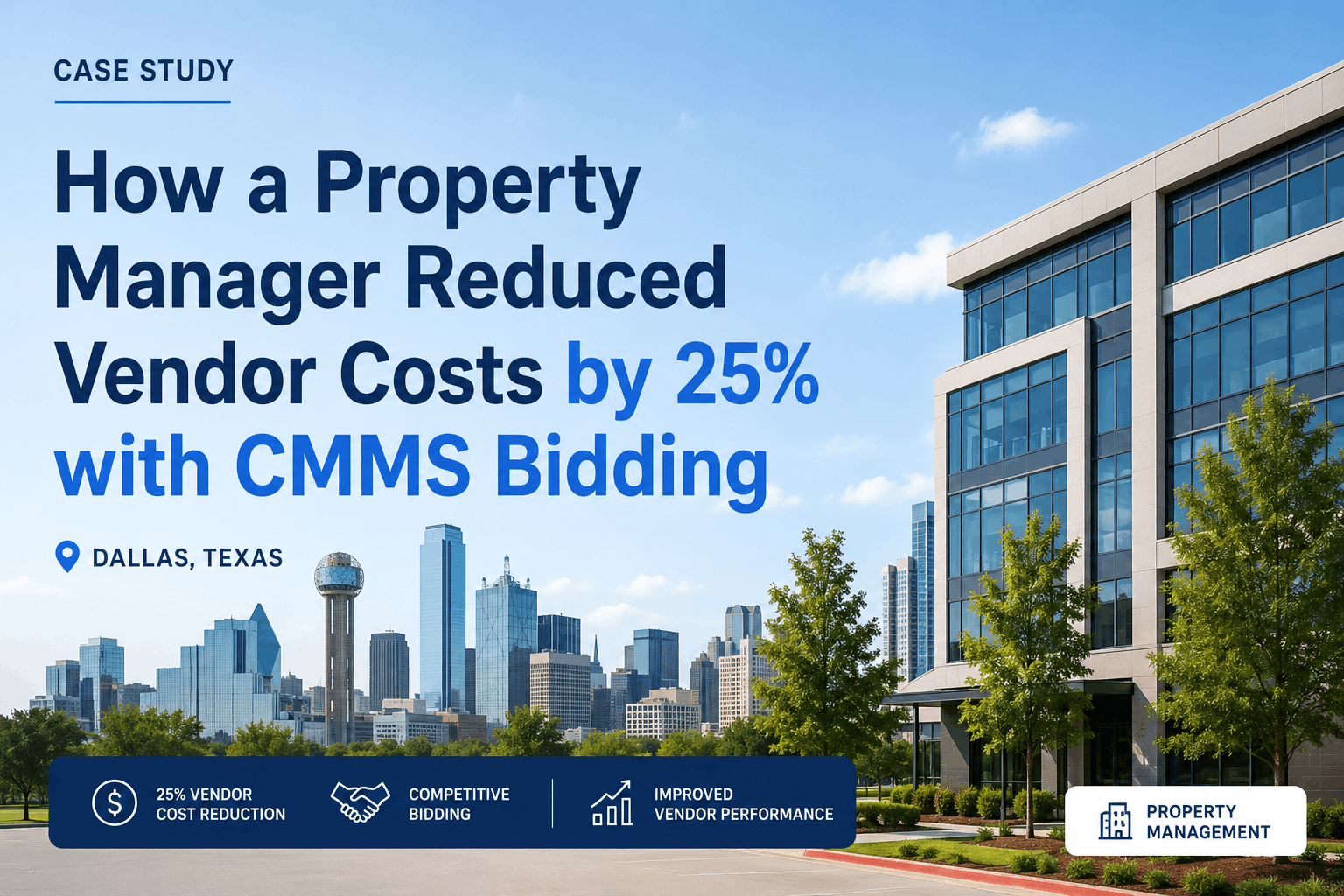
How a Property Manager Reduced Vendor Costs by 25% with CMMS Bidding
By Alex Jordan on June 22, 2026
A property management company overseeing 80 commercial and mixed-use buildings across three metropolitan markets faced a vendor cost problem that seemed intractable. Over three years, their HVAC vendor costs had grown 34% with no corresponding improvement in tenant satisfaction or system uptime. Contracts were being renewed automatically. Invoices were being paid without question. And no one could answer a basic question: which vendors were actually performing, and which were draining the budget with repeated callbacks and billing errors? By implementing a structured vendor management and competitive bidding program powered by CMMS data, the company cut total HVAC vendor spend by 25% in 18 months—saving over $1 million annually without reducing service quality. Start a free trial with Oxmaint to implement competitive vendor bidding, or book a demo to see how Oxmaint's vendor management module enables data-driven procurement.
Case Study: How a Property Manager Reduced Vendor Costs by 25% with CMMS Bidding
Vendor cost reduction through competitive bidding, vendor consolidation, and SLA tracking — a property management success story using maintenance software to transform procurement and vendor performance.
25%Reduction in total HVAC vendor spend in 18 months
$1M+Annual savings achieved across 80-building portfolio
31%Fewer emergency vendor dispatches after vendor consolidation
14 → 9Vendors retained after performance review
The Challenge — $4.1 Million in Vendor Spend with Zero Visibility
Before implementing a structured vendor management and competitive bidding program, the property management company operated with 14 HVAC vendors across 80 buildings, spending $4.1 million annually. Three problems were invisible because data was scattered across email threads, paper invoices, and fragmented spreadsheets [citation:12].
The 80/20 Problem
Hidden
38% of emergency HVAC dispatches came from just 11 buildings — all with assets past economic useful life that had never been flagged for capital replacement review [citation:1].
The Performance Gap
Measurable
6 of 14 vendors had first-call resolution rates below 60% — meaning nearly half their jobs required a second visit, billed separately, for the same issue [citation:1].
The Billing Leak
Financial
$340,000 in duplicate or incorrectly billed vendor charges identified in the first 6 months of systematic invoice-to-work-order matching [citation:1].
The Solution — CMMS-Driven Vendor Management and Competitive Bidding
The company deployed a CMMS-based vendor management platform that transformed vendor relationships from relationship-based to performance-based [citation:1][citation:12]. Every vendor dispatch created a work order with defined scope, response time SLA, and completion criteria — making performance measurement automatic rather than manual. The system enabled three core capabilities:
Capability 1: Structured Work Order Scope
Eliminate Scope Creep
Every vendor dispatch issued through the CMMS includes asset ID, defined scope, expected resolution criteria, and maximum authorized spend — eliminating scope creep and verbal approval issues [citation:1].
Invoices are matched against completed work orders before payment approval, catching billing errors before payment [citation:11].
Capability 2: Automated SLA Tracking
Measure What Matters
The CMMS timestamps every stage — work order issued, vendor acknowledged, technician on-site, work completed — calculating SLA compliance automatically [citation:1].
Vendors with response times below contract requirements are flagged automatically for review [citation:11].
Capability 3: First-Call Resolution Scoring
Track Quality
When a work order requires a return visit for the same issue within 30 days, the CMMS automatically flags it as a recall — tracking each vendor's first-call resolution rate [citation:1].
This metric alone drove a 39% reduction in return visits after vendors knew their performance was being tracked and benchmarked [citation:1].
Capability 4: Competitive Bidding
Drive Competition
Performance data at 90 days before contract renewal gives property managers documented grounds for competitive rebidding [citation:11].
Vendors perform to contract obligations when they know their SLA compliance is tracked and compared against peers [citation:1].
The Results — $1 Million in Annual Savings
The Results — $1 Million in Annual Savings
Within 18 months, the property management company achieved verified cost reductions across every vendor performance metric [citation:1].
Total Spend Reduction
25%
$4.1M → $3.1M annually
Verified at 18-month audit. Over $1 million in annual savings retained every year going forward [citation:1].
Vendors improved performance when their metrics were tracked and benchmarked against peers [citation:1].
Vendor Consolidation
14 → 9 Vendors
Better coverage, lower cost
Lowest-performing vendors were not renewed based on documented performance data [citation:1].
How CMMS Bidding Works — The Procurement Transformation
The competitive bidding capability was the key driver of cost reduction. The CMMS enabled three procurement improvements that were previously impossible with informal vendor management [citation:11][citation:12].
CMMS Competitive Bidding — Three Core Capabilities
How data-driven procurement produces measurable savings
1
Invoice-to-Work-Order Matching
Vendor invoices are matched against completed work orders before payment approval. Line items outside the authorized scope require manager review — catching billing errors before payment. In the first year alone, this recovered $340,000 in billing errors [citation:1].
2
Performance-Based Vendor Selection
At contract renewal, the CMMS generates a performance report for each vendor — SLA compliance rate, repeat failure rate, invoice error rate, and response time trend. Property managers walk into negotiations with documented performance data, not subjective impressions [citation:11].
3
Competitive Bid Management
When performance falls below thresholds, the CMMS triggers competitive bidding. Pre-qualified vendors receive scoped work orders with documented requirements, enabling apples-to-apples comparison of bids. Bidding drives price competition while SLA tracking maintains quality [citation:11].
"
Property managers underestimate how much money leaks through unmeasured vendor relationships. A contractor with a 55% first-call resolution rate is not a bad vendor — they are a 45% surcharge on your maintenance budget, because every repeat visit is a second labor charge for work that should have been completed once. You can't negotiate this away. You fix it with data — specifically, by making every vendor know their performance is being tracked and benchmarked against their peers. Behavior changes immediately when the scoreboard is visible [citation:1].
VP of Operations — National Commercial Property Management Firm — 14M sq ft under management
Vendor Cost Reduction Benchmarks — What to Expect
The 25% reduction achieved in this case study is consistent with industry benchmarks. BOMA International's 2023 Office Market Study found that properties using CMMS-based vendor management platforms reported 22–28% lower maintenance costs per square foot compared to those managing vendors through email and spreadsheets [citation:1]. The savings are concentrated in three areas:
CMMS competitive bidding reduces vendor costs through three mechanisms: (1) Invoice-to-work-order matching catches billing errors before payment, (2) Performance data at contract renewal gives property managers leverage for renegotiation or competitive rebidding, and (3) Pre-qualified vendors bid against each other for scoped work, driving price competition while documented SLAs maintain quality. In this case study, these mechanisms produced a 25% reduction in vendor spend [citation:1][citation:11]. Start a free trial to see your potential savings.
What vendor metrics should I track to reduce costs?
The five essential vendor metrics for cost reduction are: (1) First-call resolution rate — lower rates mean more repeat visits and higher costs, (2) On-time arrival rate — missed appointments create schedule disruption and tenant dissatisfaction, (3) Invoice accuracy rate — billing errors are common without work-order matching, (4) Emergency response time — delayed responses increase damage costs, and (5) Repeat failure rate — the same failure recurring on the same asset signals quality issues. The case study vendor improved first-call resolution from 58% to 81% when these metrics were tracked [citation:1][citation:12]. Book a demo to see automated vendor scorecards.
How many vendors should a property manager have?
The right number of vendors balances competition with coverage. This case study consolidated from 14 to 9 HVAC vendors after performance review — reducing cost while actually improving coverage because the retained vendors were higher-performing. A general guideline is 2–3 qualified vendors per trade category in each market — enough for competitive bidding without creating administrative overhead. Performance data should drive consolidation decisions, not arbitrary targets [citation:1]. Use Oxmaint's vendor analytics to identify consolidation opportunities.
What is the ROI of CMMS vendor management?
The ROI of CMMS vendor management is substantial. In this case study, the company saved $1 million annually on $4.1 million in spend — a 25% reduction. Industry benchmarks suggest 22–28% reduction in maintenance costs per square foot for properties using CMMS-based vendor management compared to informal methods. The software investment typically pays for itself in the first 3–6 months through invoice error recovery alone [citation:1][citation:11]. Start free to calculate your potential savings.
Reduce Vendor Costs by 25% — Start Your CMMS Bidding Program Today.
Oxmaint's vendor management module tracks every contract, SLA, and invoice — giving you the data to run competitive bids, consolidate vendors, and drive measurable cost reduction. Free to start.