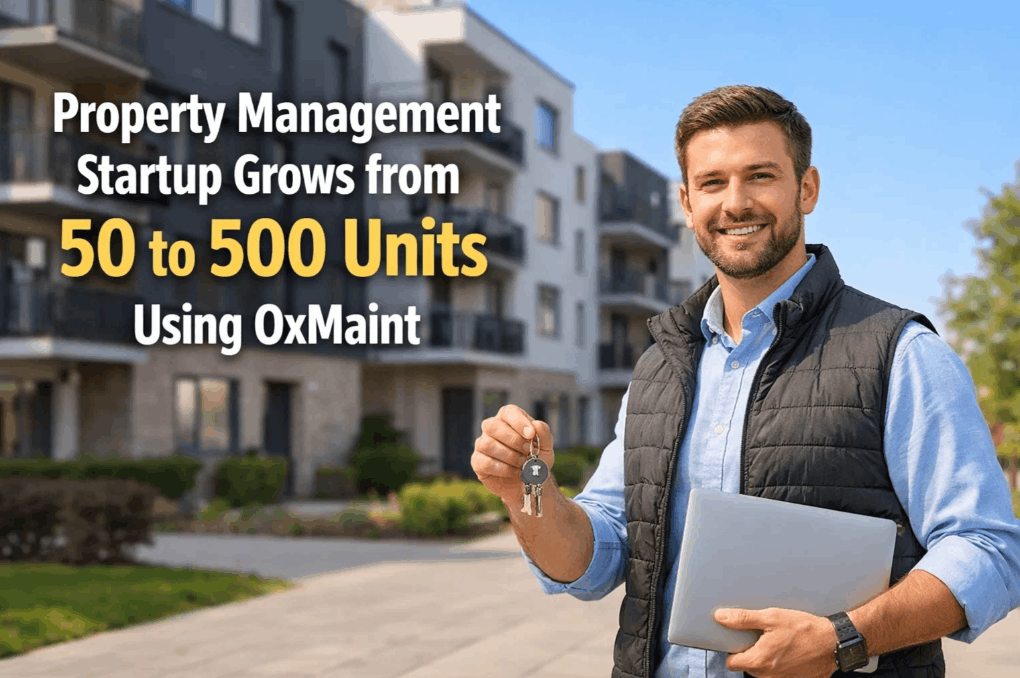
In 2022, a first-time property management startup launched with a single 50-unit residential building, two part-time technicians, and a shared spreadsheet to track everything from leaky faucets to HVAC outages. Eighteen months later, that same team was managing 500 units across 11 buildings — without hiring a single additional back-office employee. The engine behind that growth wasn't headcount. It was OxMaint. Book a free demo to see how OxMaint can scale with your portfolio.
50 Units to 500 — Without a Single Back-Office Hire
See how OxMaint became the operational backbone for a startup that scaled its entire portfolio in 18 months on one platform, one team, and zero disruption.
10xPortfolio Growth
18moTime to Scale
0Back-Office Hires
4.6/5Tenant Satisfaction
Client Background
The company was founded by two former real estate brokers who identified a gap in the mid-market rental space — professionally managed, well-maintained housing at accessible price points. They secured their first building in Q1 2022 and immediately committed to building operations infrastructure before they needed it, not after.
Company TypeEarly-stage residential property management startup
Portfolio at Launch50 units, 1 building, 2 part-time maintenance staff
Portfolio at Month 18500 units, 11 buildings, 7 full-time maintenance staff
Property TypesMixed-use residential — studios, 1BR, 2BR across urban and suburban submarkets
OxMaint DeploymentAll platform features: asset registry, PM scheduling, work orders, tenant portal, CapEx planning
Operational GoalScale from 50 to 500+ units without proportional headcount growth
The Challenge
Scaling a property management portfolio is not simply a leasing problem — it is fundamentally an operations problem. Every new building added assets, compliance obligations, tenant requests, and maintenance complexity. Without a structured system in place, growth would mean proportional chaos: more emergencies, more spreadsheet rows, more things falling through the cracks.
No system
to onboard new buildings at speed. Each new acquisition required manually re-creating asset lists, assigning staff, and building maintenance routines from scratch — a process that took 3–5 weeks per building with no standardization.
100%
reactive maintenance at launch. With no PM schedules and no asset history, every maintenance event was a surprise. Early tenant reviews flagged slow response times and unresolved repeat issues as top complaints.
$0
capital planning infrastructure. When investors asked for forward-looking CapEx projections at month 6, the founders had none. Budget requests were based on age estimates and intuition — not asset condition data.
3.1/5
initial tenant satisfaction score. Tenants reported inconsistent maintenance communication, missed follow-ups, and slow resolution times. In a competitive rental market, reputation was at risk before it had fully formed.
Fragile
handoff process when onboarding new staff. As the team grew from 2 to 7 technicians, institutional knowledge lived in individual heads, not in a system. A technician departure meant losing asset history, vendor contacts, and service patterns entirely.
The founders had a clear vision for what the business could become. What they needed was the operational infrastructure to get there without breaking under the weight of growth.
The Solution: OxMaint as the Growth Operating System
Rather than waiting until operations became unmanageable, the founding team made a deliberate decision: deploy OxMaint before scaling began. The goal was not to fix a broken system — it was to build the right system first and grow into it. OxMaint was selected for its ability to support a 50-unit startup and a 500-unit portfolio on the same platform, with no migration, no re-training, and no operational disruption at each growth threshold.
01Scalable Asset Registry
- All assets tagged via mobile app in under 48 hrs
- Condition scores, install dates & location data recorded
- Permanent searchable record — scales with every building
02Standardized PM Templates
- 22 PM templates built once, reused on every acquisition
- Covers HVAC, plumbing, electrical & common areas
- Auto-generates work orders from day one of ownership
03Mobile-First Work Orders
- Single mobile interface across all 11 buildings
- Pre-diagnosed tasks with asset history & parts notes
- Eliminated travel & sourcing overhead portfolio-wide
- Branded portal deployed across all properties
- Requests auto-route to the right technician
- Residents track status — zero manual dispatch needed
- Fire safety, elevator & pool inspections centrally managed
- Automated reminders at 30 and 7 days before deadlines
- Zero missed regulatory obligations across 18 months
06Investor-Ready CapEx Reporting
- 5-year replacement model fed by live condition data
- Building-by-building & portfolio-wide projections
- Capital approvals 38% faster with data-backed requests
Implementation Approach
The deployment model was designed to match the startup's pace of growth — not slow it down. Each new building acquisition triggered a repeatable onboarding sequence that the team could execute independently, without OxMaint support involvement. The process that took 3–5 weeks at launch was reduced to under 48 hours by month 6.
Month 1
Foundation Deployment — 50 Units, 1 Building
Full OxMaint deployment on the initial property. Asset registry completed in 2 days. 22 PM templates configured. Tenant portal launched. Team of 2 trained in under 3 hours. Platform validated before scaling began.
Months 2–6
Accelerated Expansion — 50 to 200 Units
Four additional buildings added. Each onboarded using the PM template library built in month 1. Average time to full operational status per building: 3 days. New technicians trained in under 4 hours each using the same mobile interface.
Months 7–12
Portfolio Maturation — 200 to 380 Units
Asset condition data from early buildings began maturing. CapEx projections became data-driven and defensible. PM compliance rates reached 89% portfolio-wide. Emergency work orders declined 44% as scheduled prevention intercepted failures.
Months 13–18
Full Scale — 380 to 500 Units
Final four buildings acquired and onboarded without operational disruption. Portfolio-wide maintenance now managed by 7 technicians across 11 buildings using a single platform. Zero back-office hires made throughout the 18-month scaling period.
Results After 18 Months
From a single spreadsheet and 50 units to a fully structured 500-unit portfolio — the results reflect what happens when operational infrastructure is built before it is needed.
Portfolio Size
Month 1
50 units, 1 building
Month 18
500 units, 11 buildings
10x portfolio growth with the same core operational platform. No system migration. No re-training events.
Emergency Work Orders
Month 18
52% reduction in emergency rate
22 PM schedules running portfolio-wide. Planned maintenance now accounts for 61% of all work orders. After-hours labor premiums reduced by $64,000 annually.
Building Onboarding Time
Month 1
3–5 weeks per building
Repeatable onboarding sequence using PM template library. Each acquisition operationally live within 2 days. No consulting support required.
Tenant Satisfaction Score
Maintenance-related complaints fell 68%. Lease renewal rates rose from 61% to 84% across the portfolio as maintenance consistency became a competitive advantage.
Technician Productive Time
Pre-diagnosed work orders with parts pre-staged eliminated travel and sourcing waste. 7 technicians managed a 500-unit portfolio at output levels that previously required 12+.
CapEx Planning Capability
Month 1
No data. Estimate-based.
Month 18
5-year model, condition-scored
Investor presentations now include portfolio-wide CapEx projections backed by real asset condition data. Capital approval timelines shortened by 38%.
Scale Your Portfolio Without Scaling Your Back-Office
OxMaint deploys in days and grows with you from 50 units to 5,000 — on the same platform, with the same team. See what structured maintenance looks like at your current portfolio size.
Key Benefits & Business Impact
The 18-month growth story produced compounding benefits across every dimension of the business — operational, financial, and reputational.
01
Operational leverage multiplied with every acquisition.
Each new building added assets and complexity — but not proportional effort. The PM template library and standardized onboarding meant the 10th building took less effort to absorb than the 2nd.
02
Institutional knowledge became platform knowledge.
As the team grew from 2 to 7 technicians, every asset history and vendor note lived in OxMaint — not in individual memory. New hires were productive within days.
03
Maintenance quality became a leasing differentiator.
A 4.6/5 maintenance satisfaction score drove inbound interest and retention. Lease renewal rates rose from 61% to 84%, directly reducing vacancy costs as the portfolio grew.
04
Investor confidence grew alongside asset data maturity.
By month 12, the team was presenting condition-scored 5-year CapEx projections to investors. Faster capital approvals unlocked faster acquisition timelines.
05
Compliance risk was eliminated before it became exposure.
Across 11 buildings, fire safety, elevator, and pool records were managed centrally with automated reminders. Zero regulatory deadlines missed in 18 months.
06
Same team, significantly more output.
Technician productive time rose from 31% to 58%. Pre-diagnosed work orders with staged parts eliminated travel and sourcing waste across the entire portfolio.
By month 18, the operational infrastructure the founders built before they needed it had become the competitive advantage that made 10x growth possible without 10x overhead.
Conclusion
Most property management startups scale reactively — adding systems only after existing ones break under growth pressure. This case study demonstrates the alternative: build the operational foundation first, and let growth compound on top of it rather than against it.
In 18 months, this startup grew from 50 to 500 units without a single back-office hire, without operational disruption at any acquisition milestone, and without ever outgrowing the platform they launched on day one. OxMaint served as the maintenance operations backbone for every stage of that journey — from the first asset catalogue to the first investor CapEx presentation to the 500th unit under management.
The lesson is not that this startup was exceptional. The lesson is that the system made the growth executable. Any property management company — startup or established — can achieve the same operational leverage when the right infrastructure is in place from the beginning. See how OxMaint applies to your portfolio today.
Ready to Build the Foundation for 10x Growth?
50 units or 500 — OxMaint deploys in days and scales without limits. Start with the same platform this startup used to grow their entire portfolio without ever outgrowing their operations system.
Frequently Asked Questions
Is OxMaint suitable for startups with fewer than 100 units?
Yes. OxMaint is purpose-built to scale with your portfolio — not just serve large, established operators. This case study began at just 50 units, and the platform handled that deployment just as effectively as it did the 500-unit milestone. Many customers start at 20–30 units specifically to build a structured operational foundation before accelerating acquisitions. Deploying early means every new building inherits a ready system — asset registry, PM templates, compliance calendar — on day one of ownership, not weeks later.
How does onboarding a new building work in practice?
Each new building is onboarded using OxMaint's mobile app for asset cataloguing and the existing PM template library for schedule configuration. The first onboarding in this case study took under 10 days. By month 6, the team had refined the process to under 48 hours per building. Assets are tagged with condition scores, location data, and manufacturer records. PM schedules are activated from templates and begin auto-generating work orders immediately. The tenant portal is configured and communicated to residents before the first week is complete.
How long does the initial setup take for a first-time user?
The full initial deployment — asset registry, PM schedules, tenant portal, and compliance calendar — was completed in under 10 days for this startup's first building. The maintenance team completed mobile app training in under 3 hours and was dispatching PM work orders on day 14. Each subsequent building took progressively less time as the team standardized their onboarding sequence. By the time the portfolio reached 11 buildings, new acquisitions were fully operational on the platform within 48 hours — with no external support required.
Can OxMaint support multiple building types in one portfolio?
Yes. This portfolio grew to include urban mid-rise, suburban garden-style, and mixed-use residential buildings — all managed on a single OxMaint instance. Asset categories, PM schedule templates, compliance calendars, and tenant portal configurations are fully customizable per property type. Each building maintains its own asset registry and work order history while sharing a unified dashboard for portfolio-wide reporting. There is no need to create separate accounts or migrate data as the portfolio diversifies across building types or geographies.
What does the CapEx planning feature produce for investors?
The CapEx planning feature uses condition scores from the asset registry to generate a 5-year capital replacement model — building by building and portfolio-wide. Instead of relying on installation dates and rough age estimates, every projection is backed by actual condition data collected during routine PM activity. This startup was able to present investor-grade CapEx schedules within weeks of each new acquisition. Capital approval timelines shortened by 38% once projections became data-driven and traceable rather than estimate-based.
How quickly does ROI materialize after deployment?
Emergency dispatch reduction typically begins within the first 60–90 days as PM schedules start intercepting failures before they escalate to after-hours calls. Labor premium savings are usually the first measurable financial impact. Over months 3–6, PM compliance rates rise and reactive work order volume falls consistently. The full financial picture — reduced emergency spend, improved CapEx accuracy, and higher lease retention — compounds over 6–12 months as asset condition data matures and the team builds operational rhythm around the platform.