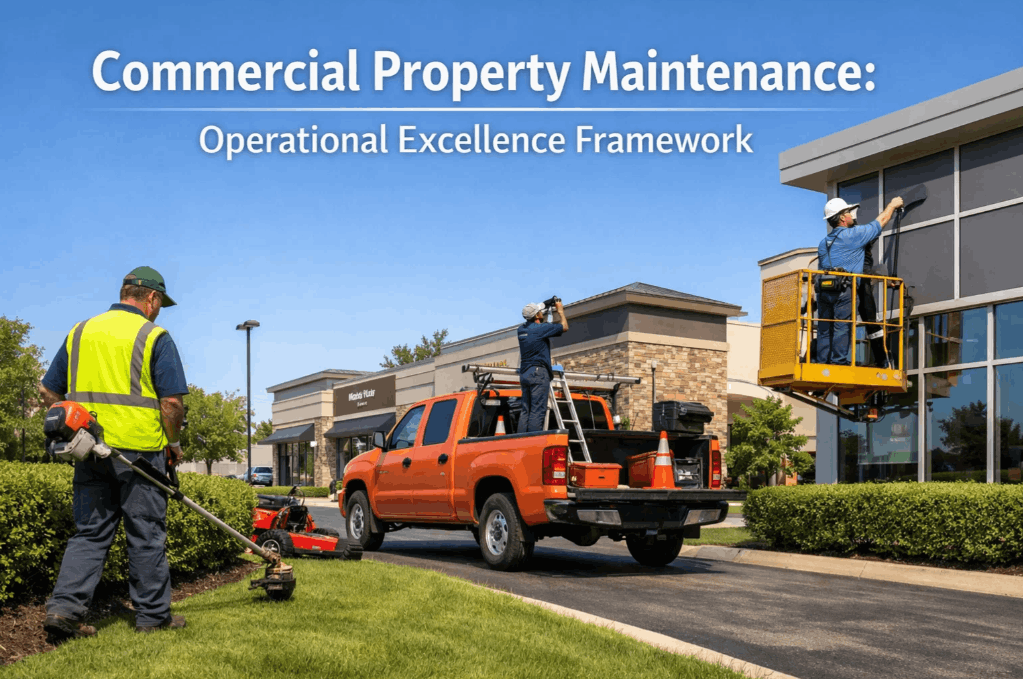
Commercial property maintenance is no longer just about fixing what's broken — it's about building an operational excellence framework that drives measurable performance, reduces costs, and protects asset value at every level. Property owners and facility managers who treat maintenance as a reactive function are consistently outpaced by those who treat it as a strategic discipline. This guide breaks down exactly how to build, implement, and sustain an operational excellence framework for commercial property maintenance — with proven strategies, tools, and best practices for 2026 and beyond.
Stop Managing Maintenance Reactively — Build a System That Works
OxMaint helps commercial property teams standardize SOPs, track performance metrics, and drive continuous improvement — all in one connected platform.
What Is Operational Excellence in Commercial Property Maintenance?
Operational excellence in facility management refers to a systematic approach where every maintenance process — from work order creation to completion — is standardized, measured, and continuously improved. It shifts your operation from firefighting to strategic control.
At its core, it's about answering three questions: Are your processes consistent? Are your people accountable? Is your data telling you where to improve? When all three align, you have an excellence framework — not just a maintenance schedule.
For commercial properties, this translates directly to lower operating costs, higher tenant satisfaction scores, fewer emergency breakdowns, and longer asset lifecycles. It's the difference between a property that hemorrhages maintenance budget and one that outperforms its benchmarks year after year.
The 5 Pillars of a Commercial Property Maintenance Excellence Framework
No framework succeeds on a single pillar. World-class commercial property maintenance operations are built on five interconnected foundations — each reinforcing the others.
Standardized Operating Procedures (SOPs)
Every recurring task — HVAC inspection, roof drain clearing, elevator servicing — must have a written, step-by-step SOP. Consistency depends on written standards, not institutional memory that walks out the door when a technician resigns.
Preventive Maintenance Planning
A proactive PM schedule aligned with manufacturer recommendations and property-specific conditions reduces unplanned downtime significantly. This pillar transforms your team from responders to operators.
Performance Measurement & KPIs
What gets measured gets managed. Tracking metrics like Mean Time to Repair (MTTR), PM completion rate, and cost per work order gives leadership the data to make confident investment decisions.
Continuous Improvement (CI) Culture
Operational excellence is a journey, not a destination. Regular process reviews, root cause analysis on failures, and structured feedback loops from technicians create compounding improvements over time.
Technology & Digital Infrastructure
Manual systems cannot scale. A modern commercial property maintenance platform automates scheduling, captures real-time data, and gives managers instant visibility across their entire portfolio.
Workforce Development & Accountability
The best framework fails without trained, accountable people. Structured onboarding, role-specific certification, and clear performance expectations are as essential as any tool or SOP.
Building Standard Operating Procedures for Commercial Property Maintenance
Maintenance SOPs are the foundation of operational consistency. Without them, quality depends entirely on who is on shift — a risk no professionally managed commercial property can afford.
What Every Maintenance SOP Must Include
SOP Governance: Keeping Procedures Current
SOPs age. Equipment changes, building systems are upgraded, and regulatory requirements evolve. Build a quarterly SOP review cycle into your operations calendar — assign SOP ownership to a senior technician or facilities manager, not a committee that never acts.
Track SOP acknowledgment per technician. In any compliance or liability situation, knowing that every team member reviewed and signed off on current procedures is a critical protection for your organization.
Key Performance Indicators: Measuring Maintenance Excellence
You cannot improve what you do not measure. Commercial property maintenance KPIs translate operational activity into business intelligence — helping leadership understand performance, justify budgets, and identify where investment delivers the highest return.
| KPI | What It Measures | Target Benchmark | Why It Matters |
|---|---|---|---|
| PM Completion Rate | Preventive maintenance tasks completed on schedule | > 90% | Indicates whether your proactive program is actually running |
| Mean Time to Repair (MTTR) | Average time from fault detection to resolution | < 4 hours (critical systems) | Directly impacts tenant satisfaction and business continuity |
| Work Order Backlog | Open work orders older than 7 days | < 5% of total open WOs | Signals resource capacity and prioritization effectiveness |
| Reactive vs. Planned Ratio | Percentage of work that is unplanned emergency response | < 20% reactive | Healthy operations run >80% planned — above 30% reactive is a red flag |
| Cost per Work Order | Total maintenance spend divided by work orders completed | Benchmarked to property type | Tracks operational efficiency and vendor pricing over time |
| Tenant Satisfaction Score | Tenant-reported satisfaction with maintenance response | > 85% satisfied | Linked directly to lease renewal decisions and occupancy rates |
Preventive Maintenance Planning: The Core of Operational Excellence
A structured preventive maintenance program is the single highest-ROI investment a commercial property team can make. For every dollar spent on scheduled PM, industry data consistently shows $3–$5 saved in emergency repairs, tenant disruption costs, and premature asset replacement.
Building a PM Schedule That Actually Gets Executed
Most PM programs fail not because of poor planning but because the schedule lives in a spreadsheet that no one follows consistently. A maintenance SOP system tied to automated scheduling — where work orders generate themselves and route to the right technician — is the infrastructure that turns plans into outcomes.
Asset-Based PM Prioritization
Tier 1: Mission-Critical Systems
HVAC, elevators, fire suppression, electrical distribution, and plumbing main lines. These assets demand the most frequent PM intervals and the strictest documentation requirements. Any failure here creates immediate tenant and liability risk.
Tier 2: Business Continuity Systems
Lighting systems, parking structures, security and access control, generators, and building automation controls. Failure affects operations but not life safety. PM intervals should align with manufacturer guidelines and seasonal demands.
Tier 3: Aesthetic and Compliance Systems
Landscaping, exterior cleaning, signage, common area finishes, and ADA compliance assets. These systems directly affect tenant perception and property value but carry lower immediate risk. PM here supports lease renewal and asset repositioning goals.
Tier 4: Seasonal and Cyclical Tasks
Roof inspections pre-storm season, cooling tower startup and winterization, parking lot sealing, and holiday lighting infrastructure. These tasks are predictable but often missed without a formal seasonal maintenance calendar built into your property maintenance system.
Maintenance Technology: The Tools That Enable Operational Excellence
Modern commercial property maintenance operations require a digital backbone. The gap between high-performing facilities and struggling ones is increasingly a technology gap — not a people or budget gap.
What to Look for in a Commercial Property Maintenance Platform
IoT and Predictive Maintenance Integration
The next frontier in commercial property maintenance is condition-based monitoring — where sensors on HVAC units, motors, and water systems continuously feed data to your maintenance platform. Alerts trigger work orders before failure, not after.
Early adopters of IoT-integrated facility maintenance software report 15–25% reductions in unplanned downtime within the first 12 months of implementation. For large commercial portfolios, this translates to six-figure annual savings.
ROI of Operational Excellence: The Business Case for Property Leaders
Operational excellence is not a cost center — it is a return generator. Property leaders who build this business case correctly secure budget, talent, and technology investments that compound over time.
Reduced Emergency Repair Costs
Emergency callouts cost 3–5x more than scheduled maintenance for identical tasks. Shifting from reactive to planned operations is the most direct path to budget recovery in commercial property management.
Extended Asset Lifecycles
HVAC systems maintained to spec last 15–20 years. Neglected systems fail at 8–10 years. The capital avoidance value of a disciplined PM program on a 500,000 SF commercial property can exceed $2M over a decade.
Higher Tenant Retention
Maintenance responsiveness is consistently ranked among the top three factors in commercial tenant lease renewal decisions. Properties with structured maintenance systems retain tenants at measurably higher rates than those without.
Regulatory and Insurance Risk Reduction
Documented maintenance records are your primary defense in code violation disputes, insurance claims, and litigation. Properties with audit-ready records settle disputes faster and at lower cost than those without.
Energy Cost Optimization
Well-maintained HVAC and building systems run at design efficiency. Deferred maintenance adds 15–30% to energy consumption through degraded equipment performance. PM programs pay for themselves in utility savings alone in many commercial properties.
Improved Property Valuation
Cap rate compression is directly influenced by NOI — and maintenance costs are a core NOI driver. Properties demonstrating controlled, declining maintenance cost trends command premium valuations in commercial real estate transactions.
Common Challenges in Commercial Property Maintenance — and How to Solve Them
Inconsistent Task Execution Across Shifts and Sites
When procedures live in people's heads rather than documented SOPs, quality varies with personnel. Solution: Standardize every recurring task in a digital SOP library, make procedures accessible on mobile, and track completion with mandatory checklist confirmation — not just "closed" status.
No Visibility Into Contractor Performance
Properties spending significant budget on third-party contractors often have no performance data to evaluate them. Solution: Require work order completion documentation from every vendor, track response time and quality ratings per contractor, and benchmark against market alternatives annually.
Deferred Maintenance Accumulation
Small deferred items compound into large capital replacements. Solution: Implement a criticality classification system for all open work orders and enforce a maximum deferral window by tier — never allow Tier 1 items to slip past 48 hours without executive escalation.
Knowledge Loss from Staff Turnover
When experienced technicians leave, they take institutional knowledge with them. Solution: Build asset histories, repair notes, and lessons learned into your work order system so that knowledge is captured in the platform, not in an individual's memory.
Reactive Culture Resistant to Change
Teams accustomed to reacting to emergencies often resist proactive programs as unnecessary bureaucracy. Solution: Show technicians the data — how much time they spend on avoidable emergencies, and how a PM program reduces that burden. Operational buy-in accelerates when people see personal benefit, not just management priorities.
Maintenance Maturity Model: Where Does Your Property Operation Stand?
Most commercial property maintenance operations fall into one of five maturity levels. Knowing where you are today is the first step toward planning a realistic path to operational excellence.
Reactive
- No PM schedule
- No SOPs or tracking
- High costs & complaints
- Always firefighting
Preventive Basics
- Basic PM for critical assets
- Spreadsheet work orders
- Inconsistent records
- Still mostly reactive
Planned & Documented
- Written SOPs in place
- Digital work orders
- Monthly KPI reporting
- Improving steadily
Optimized Operations
- Real-time analytics
- <20% reactive work
- 85%+ tenant satisfaction
- Structured CI cycles
Predictive Excellence
- IoT condition monitoring
- Predict failures early
- Portfolio benchmarking
- Documented ROI
Best Practices for Sustaining Operational Excellence Long-Term
Building the framework is the hard part. Sustaining it requires deliberate habits and governance structures that keep performance from drifting back toward reactive chaos over time.
Implementing Your Operational Excellence Framework: A 90-Day Roadmap
Knowing what to build is one thing — knowing where to start is another. This 90-day implementation roadmap gives commercial property teams a practical, sequenced path from current state to a functioning excellence framework.
Commercial property maintenance operational excellence is not a one-time project — it is an ongoing commitment to standardization, measurement, and continuous improvement that compounds in value year over year. The properties that invest in this infrastructure today are the ones that outperform on cost efficiency, tenant retention, and asset value a decade from now. OxMaint gives commercial property teams the platform to build and sustain this excellence — from work order management and SOP libraries to real-time analytics dashboards that keep leadership informed and operations accountable.
Ready to Build an Audit-Ready, High-Performance Maintenance Operation?
OxMaint's commercial property maintenance platform gives your team the SOPs, scheduling automation, and analytics you need to move from reactive to excellent — starting today.
Frequently Asked Questions About Commercial Property Maintenance Frameworks
What is operational excellence in commercial property maintenance?
Operational excellence in commercial property maintenance means having standardized, documented processes for every recurring task, real-time performance measurement against defined KPIs, and a continuous improvement culture that reduces costs and improves outcomes year over year. It is the systematic alternative to reactive, ad-hoc maintenance operations.
How do I build a preventive maintenance schedule for a commercial property?
Start with an asset inventory, classify assets by criticality tier, and assign PM frequencies based on manufacturer recommendations and historical failure data. Load the schedule into a digital maintenance management platform that auto-generates work orders and tracks completion rates. Review and adjust quarterly based on actual performance data.
What KPIs should commercial property maintenance teams track?
The most important KPIs are PM completion rate (target above 90%), Mean Time to Repair for critical systems (target under 4 hours), reactive-to-planned work ratio (target below 20% reactive), work order backlog age, cost per work order, and tenant satisfaction scores. These five metrics give leadership a complete picture of operational health.
How long does it take to implement a maintenance excellence framework?
A functioning framework — including software deployment, SOP development for critical systems, and PM schedule activation — can be operational within 90 days for most commercial properties. Advancing through the maturity levels to predictive excellence typically takes 12–24 months of sustained effort and continuous improvement cycles.
What is the ROI of a structured commercial property maintenance program?
Properties with structured maintenance programs typically report 25–30% reductions in emergency repair costs, 15–25% lower energy costs from well-maintained systems, and measurably higher tenant retention rates. For a mid-size commercial property, the combined financial benefit commonly exceeds the cost of implementation within the first 12–18 months.


-template-library.png)

