Property managers who rely on gut instinct and spreadsheets are leaving serious money on the table. Data-driven decision making in property maintenance means using real analytics — not guesswork — to control costs, reduce downtime, and extend asset life. The shift is happening fast across the US, UK, Canada, Germany, and UAE. If your maintenance team is still reacting instead of predicting, it's time to change that. Explore OxMaint and see how smarter data transforms daily operations.
Turn Maintenance Data Into Smarter Decisions
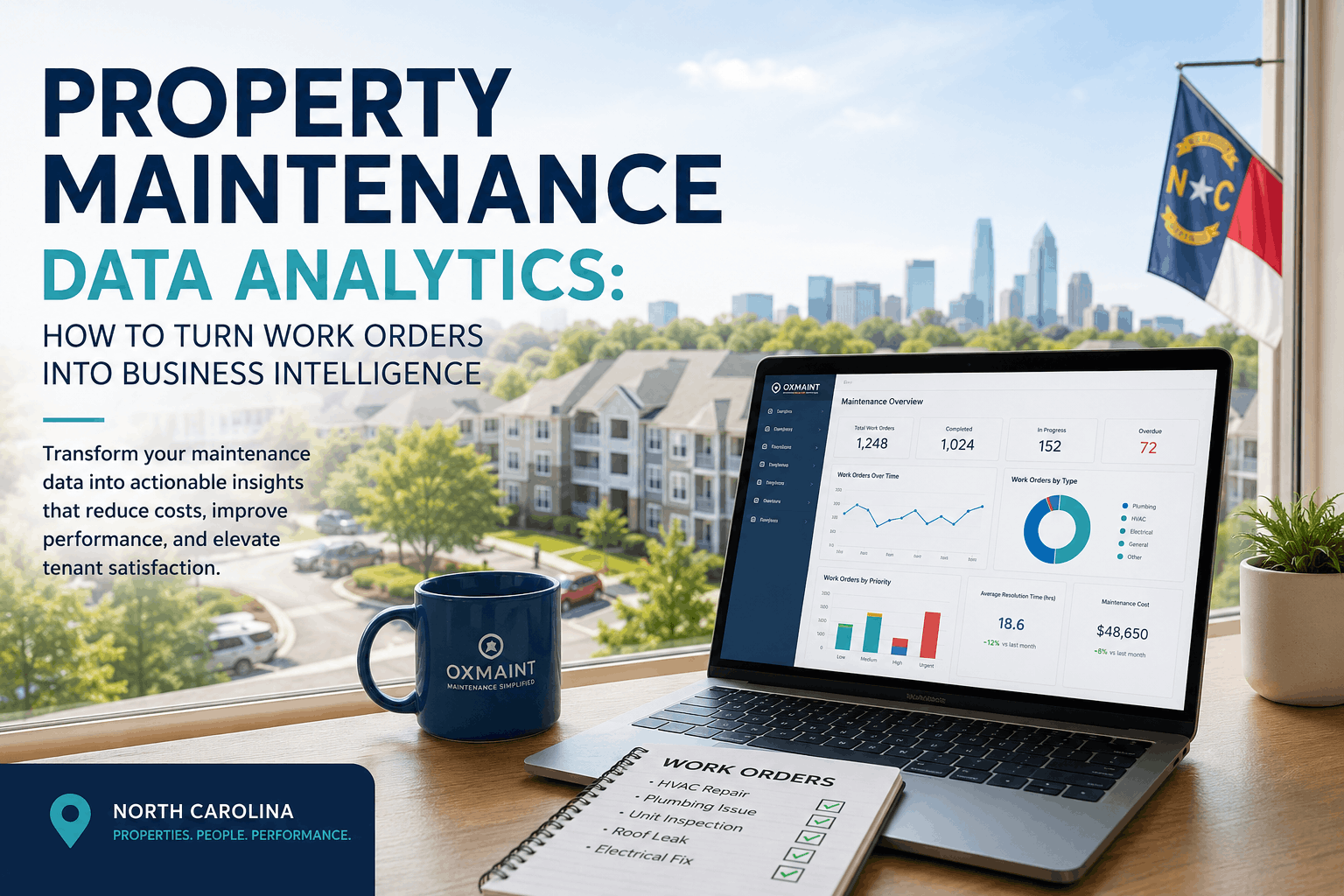
OxMaint's Analytics & Reporting Dashboard gives property teams real-time KPIs, trend insights, and AI-powered forecasting — all in one place.
What Is Data-Driven Property Maintenance?
Data-driven maintenance is the practice of using structured, real-time, and historical operational data to guide every maintenance decision — from scheduling a technician to replacing an aging asset. Rather than relying on calendar-based service cycles or gut instinct, data-driven decision making replaces assumption with evidence at every level of property management.
The traditional maintenance model suffers from a fundamental visibility problem. Work orders are completed, costs are logged, assets degrade — but without a unified analytics system, this information stays siloed. Property managers in the UK, Canada, and Germany face the same challenge: teams that are busy but not necessarily effective, because no one can see the full picture. Maintenance intelligence solves that by aggregating all activity data into a single source of truth.
When your maintenance software captures every work order, every labor hour, every parts cost, and every equipment reading, patterns emerge. You can see which assets fail most often, which technicians resolve tickets fastest, where your budget is being absorbed, and what your next 12 months of expenditure will look like. Try OxMaint free and start capturing analytics-ready data from day one.
Core Components of a Maintenance Analytics System
A fully functional maintenance analytics platform is built from several interconnected data layers. Understanding what each layer contributes helps property teams evaluate software options and identify gaps in their current systems.
Real-Time Dashboard Analytics
A live dashboard aggregates open work orders, technician utilization, asset health scores, and compliance status into a single view. Decision-makers in multi-site portfolios across the UAE and North America can monitor operations without waiting for weekly reports or manual data pulls.
KPI Tracking & Performance Benchmarking
Meaningful KPI tracking means measuring mean time to repair (MTTR), planned maintenance compliance (PMC), cost per work order, and first-time fix rate. Benchmarking these metrics against historical baselines and industry standards reveals where performance is improving and where intervention is needed.
Maintenance Trend Analysis
Trend data exposes patterns that snapshots miss. A dashboard showing 40 open work orders today is less useful than one showing a 35% increase in reactive tickets over the past quarter. Maintenance trends drive strategic decisions — adjusting PM schedules, retraining technicians, or accelerating asset replacement cycles.
Cost Breakdown & Budget Forecasting
Maintenance budgets are routinely under-justified because spending data is fragmented across systems. A centralized maintenance reporting platform disaggregates costs by asset class, location, failure type, and contractor — enabling finance teams in Germany and the UK to model future expenditure with precision.
Asset Lifecycle Intelligence
Every repair event, parts replacement, and performance reading extends or shortens an asset's useful life projection. Lifecycle analytics calculate the tipping point where continued maintenance exceeds replacement value — the most defensible CapEx justification a facilities director can present to a board.
Workforce Productivity Reporting
Labor is typically the largest line item in a maintenance budget. Analytics that surface technician utilization rates, average response times, and task completion ratios give operations managers the data to optimize schedules, identify training needs, and make staffing decisions based on evidence.
Key Maintenance KPIs Every Property Manager Should Track
Not all data is equally valuable. The most impactful maintenance intelligence programs focus on a defined set of KPIs that are directly linked to operational performance and business outcomes. Below is a reference framework used by leading property management teams across the US, Canada, and UAE.
| KPI | What It Measures | Why It Matters | Target Benchmark |
|---|---|---|---|
| Mean Time to Repair (MTTR) | Average hours from fault report to resolution | Reflects technician efficiency and parts availability | < 4 hours for critical assets |
| Planned Maintenance Compliance (PMC) | % of scheduled PMs completed on time | Indicates proactive maintenance discipline | > 90% |
| Reactive vs Planned Ratio | Proportion of reactive to scheduled work orders | High reactive ratio signals systemic failure | < 20% reactive |
| Cost Per Work Order | Total maintenance spend / number of work orders | Measures operational efficiency over time | Varies by asset class |
| Asset Downtime Rate | % of time assets are unavailable due to failure | Directly correlates to revenue and compliance risk | < 2% for mission-critical assets |
| First-Time Fix Rate (FTFR) | % of work orders resolved without return visits | Reflects technician skill and parts inventory accuracy | > 80% |
| Maintenance Backlog | Volume of overdue or unscheduled work orders | Measures accumulated risk and resource gaps | < 10% of monthly volume |
How AI Vision Enhances Property Maintenance
Artificial intelligence has moved well beyond predictive algorithms. AI Vision — computer vision technology that analyzes images and video in real time — is opening a new frontier in property maintenance analytics. For facility managers in the UK, Germany, Canada, and the UAE, AI Vision transforms cameras and inspection tools from passive recording devices into active intelligence systems.
Photos uploaded during inspections are scanned by AI instantly — flagging cracks, corrosion, or water damage in seconds. No specialist review needed, faster reporting, consistent results.
Periodic photos analyzed by AI track surface deterioration over time — rooftops, HVAC units, structural elements — giving condition data without expensive sensor hardware.
AI auto-tags and validates inspection photos against compliance checklists. Audit-ready records are generated automatically — cutting documentation time by up to 70%.
Cameras at key monitoring points feed video to an AI system that detects anomalies or maintenance issues — no on-site presence required across distributed portfolios.
Before-and-after photos are compared by AI to confirm work meets standard. Substandard jobs are flagged before invoices are approved — an automated quality gate on every task.
AI builds a visual baseline for each asset over time. When current images deviate from that baseline, the system predicts when intervention will be needed — ideal for roofing and building envelopes.
Implementing a Data-Driven Maintenance Strategy: Step by Step
Transitioning from reactive maintenance to a fully data-driven decision making model is a structured process. The following implementation pathway has proven effective for property teams of all sizes, from community housing associations in the UK to commercial real estate operators in the UAE. Schedule a demo to map this pathway to your specific portfolio.
Audit Your Current Data Landscape
Before deploying any analytics system, map what data you currently capture and where it lives. Work order history, asset registers, maintenance logs, and contractor invoices may exist across spreadsheets, email threads, legacy CMMS platforms, and paper records. Identifying these sources — and their quality — shapes the data migration and cleansing plan that precedes analytics deployment.
Define the KPIs That Drive Your Decisions
Agree on the five to ten metrics that will serve as the primary performance indicators for your organization. Align these with business objectives — cost reduction, compliance achievement, tenant satisfaction, or asset longevity. KPIs selected by operations, finance, and executive teams together are far more likely to receive ongoing attention and investment than metrics chosen unilaterally.
Select and Deploy the Right Analytics Platform
Choose a maintenance software platform that combines work order management with native analytics and reporting. Avoid tools that require manual data exports to third-party BI systems — every manual step introduces lag and error. OxMaint's analytics dashboard ingests work order data, asset readings, and labor records in real time, eliminating the reporting gap between operational activity and management visibility.
Establish Data Quality Standards and Workflows
Analytics is only as accurate as the data that feeds it. Create clear protocols for how technicians log work orders, how assets are categorized, and how costs are attributed. Mobile-first work order tools that prompt technicians for required fields at the point of task completion are the single most effective way to improve data quality at source.
Build a Reporting Cadence and Review Culture
Data-driven maintenance only delivers value when data is actually reviewed and acted upon. Establish weekly operational reviews for team leads covering open work orders and backlog trends. Run monthly executive reports on cost per work order, PMC rates, and asset downtime. Quarterly strategic reviews should use maintenance trends to inform the following year's budget and capital planning cycle.
Top Maintenance Analytics Software and Platforms
The market for maintenance analytics software has matured significantly, with platforms now offering everything from basic reporting to AI-powered predictive insights. The comparison below covers the principal evaluation dimensions for property management organizations selecting an analytics-enabled CMMS or maintenance intelligence platform.
| Platform Feature | Basic Reporting Tools | Standard Analytics Platforms | OxMaint Analytics Dashboard |
|---|---|---|---|
| Real-Time Dashboard | Static reports only | Near real-time (hourly refresh) | Live, configurable dashboards |
| KPI Customization | Fixed metric templates | Limited custom KPIs | Fully configurable KPI library |
| Predictive Insights | None | Basic trend lines | AI-powered failure and cost prediction |
| Asset Lifecycle Tracking | Manual spreadsheet | Asset register only | Integrated cost-to-replace modeling |
| Multi-Site Reporting | Single location | Portfolio rollup available | Native multi-site with drill-down |
| Mobile Data Capture | Desktop-only entry | Mobile app with limited fields | Full mobile work order + analytics |
| Compliance Documentation | Manual filing | Basic audit log | Automated audit-ready reporting |
| Integration Capability | Standalone only | API available (developer effort required) | Native IoT, ERP, and BMS integrations |
The ROI of Maintenance Analytics: Quantifying the Business Case
For property owners and operations directors in Canada, Germany, the UK, and the UAE, every software investment requires a defensible financial case. The return on maintenance analytics operates through four primary value streams that compound over time as data volume and model accuracy improve.
Beyond the direct cost savings, maintenance intelligence platforms deliver significant indirect value. Property owners in competitive rental markets cite improved tenant retention linked to faster maintenance response times. Finance teams appreciate the ability to model maintenance expenditure scenarios with confidence during annual budget cycles. Explore OxMaint's analytics features to see exactly how these savings are realized.
Common Challenges — and How Data-Driven Teams Overcome Them
Transitioning to a data-driven maintenance model is not without friction. Understanding the most common obstacles — and the practical solutions that high-performing teams use — prevents the implementation failures that give analytics programs an undeserved bad reputation.
Problem: Technicians skip fields, assets get miscategorized, work orders lack detail.
Fix: Use mobile tools with mandatory field validation — no ticket closes without an asset tag and failure code.
Problem: Costs in ERP, work orders in CMMS, records in spreadsheets — no single view.
Fix: A unified maintenance platform with native ERP and BMS integrations pulls everything into one dashboard.
Problem: Experienced teams distrust algorithmic recommendations. Adoption stalls.
Fix: Involve frontline leads in KPI selection from day one. Teams that see their own data used fairly adopt quickly.
Problem: Too many metrics — dashboards get ignored because no one knows what needs attention.
Fix: Start with five core KPIs. Use alert-driven dashboards so critical deviations surface automatically.
Best Practices for Maintenance Reporting and Data Visualization
The quality of your data visualization determines how effectively your maintenance data drives decisions at every level of the organization. A well-designed reporting framework presents the right data, to the right audience, at the right frequency.
Design Dashboards for Specific Roles
Technicians need today's jobs. Managers need MTTR trends. CFOs need cost forecasts. Give each person only the data that drives their decisions.
Prioritize Trend Data Over Snapshots
A single data point shows where you are. A 12-month trend shows where you're heading. Always pair current KPI values with a trend line.
Use Alerts to Make Data Actionable
Set automated alerts for KPI threshold breaches — a spike in reactive work, a missed PM, an overdue asset inspection — so problems surface without manual checking.
Close the Loop Between Data and Action
After every monthly review, record the top decisions made from data. This builds team confidence in analytics over time and justifies future investment.
Benchmark Against Industry Peers
Internal trends need external context. Compare your KPIs against sector averages in Canada, Germany, or the UK to know if your performance is truly strong.
Schedule Regular Metric Reviews
KPIs that work today may not fit in 18 months. Revisit your framework annually as your portfolio grows and regulations evolve in the UK or UAE.
The Future of Maintenance Analytics: AI-Powered Business Intelligence
The next generation of maintenance intelligence platforms will go beyond describing what has happened to actively recommending what should happen next. AI-powered decision support — where the system surfaces not just data but prioritized recommendations — is already available in leading platforms and will become standard within the next three to five years.
Natural language querying will allow maintenance managers to ask their analytics platform questions in plain language — "Which assets have the highest cost per repair in the past six months?" — and receive instant, accurate answers without building custom reports. Automation will further reduce the cognitive load on maintenance teams by converting analytics insights directly into action — generating a prioritized work order, sourcing required parts, and scheduling the best-available technician automatically.
OxMaint Analytics: From Raw Data to Real Decisions
OxMaint's Analytics & Reporting Dashboard connects your maintenance operations data, surfaces the KPIs that drive your business, and delivers AI-powered insights that make every maintenance decision faster, smarter, and more defensible. Trusted by property management teams across the US, UK, Canada, Germany, and UAE.
Frequently Asked Questions
It means using real operational data — work order history, asset performance, labor records, and costs — to guide maintenance decisions instead of fixed schedules or gut instinct. A centralized analytics platform surfaces trends and risk areas automatically, so managers act on evidence rather than assumption. Organizations that adopt this approach typically see significant reductions in reactive maintenance costs within the first 12 months.
The most impactful starting KPIs are Mean Time to Repair (MTTR), Planned Maintenance Compliance (PMC), reactive-to-planned work order ratio, cost per work order, and asset downtime rate. These five metrics collectively reflect the health of your maintenance operation and create a clear baseline for improvement tracking. As your analytics system matures, expand to include workforce utilization rates and lifecycle cost-per-asset calculations.
AI-powered maintenance analytics goes beyond static reporting by identifying patterns and anomalies in large datasets that human reviewers would miss. Machine learning models can predict when an asset is likely to require unplanned intervention, flag work order cost outliers, and recommend PM schedule adjustments based on actual asset condition rather than manufacturer defaults. AI Vision capabilities further extend this by analyzing inspection photos to identify physical deterioration automatically.
Yes. Cloud-based maintenance software platforms have removed the infrastructure barriers that once made analytics inaccessible to smaller operators. Even a portfolio of 10 to 20 properties generates enough data to reveal meaningful patterns within three to six months of consistent data capture. The key is starting with a focused set of KPIs and building the data discipline to capture complete work order records from day one. Book a demo to explore how OxMaint scales to your portfolio size, or start a free trial and begin capturing analytics-ready data immediately.