-for-elevator-controller-faults-(2).png)
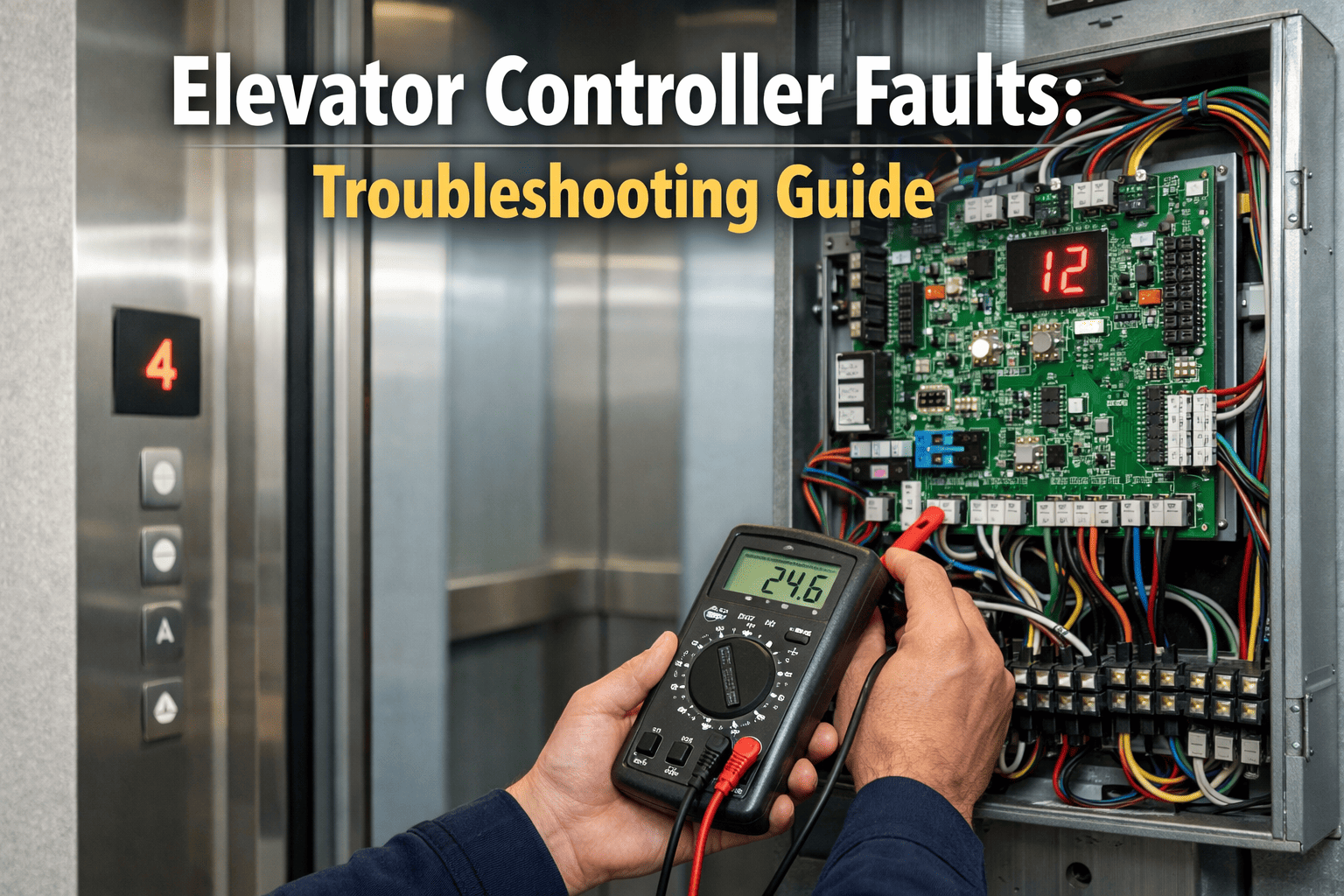
Elevator controller faults represent the most technically complex and diagnostically challenging category of elevator failures. The controller is the central nervous system of every elevator—managing car movement, floor leveling, door timing, safety circuit monitoring, and passenger call processing through integrated relay logic, microprocessor boards, variable frequency drives (VFDs), and communication interfaces. When controller components degrade, the resulting faults range from intermittent nuisance shutdowns and erratic floor leveling to complete system lockouts that strand passengers and take elevators out of service for hours or days.
Unlike mechanical failures that produce visible wear indicators, controller faults often present as intermittent, seemingly random events that frustrate technicians and resist conventional troubleshooting. A failing relay may pass its contact resistance test 95% of the time—yet that 5% failure rate generates multiple shutdowns per week. A VFD with degrading capacitors may operate normally under light load but fault under peak demand. A corroded board-level connector may function at room temperature but open-circuit when ambient temperature rises above 85°F. These intermittent failure patterns make controller faults uniquely suited to Root Cause Analysis methodology, which replaces reactive troubleshooting with systematic elimination logic signup on OxmaintAI.
Facilities implementing structured RCA programs for elevator controller faults reduce unplanned shutdowns by 65–85%, cut diagnostic time by 50%, and extend controller system lifecycles by 3–5 years. This guide delivers the complete RCA framework: every controller fault category, diagnostic pathway, root cause mapping, and corrective action protocol that elevator maintenance teams need Book a demo.
Controller Fault Landscape: The Diagnostic Challenge
Elevator controllers range from legacy relay-logic panels still operating in thousands of buildings to modern microprocessor-based systems with integrated VFDs and networked diagnostics. Regardless of technology generation, all controllers share common failure patterns driven by environmental stress, electrical degradation, and component aging. The challenge is that controller faults rarely present with a single, clear symptom—instead producing cascading error codes that obscure the true root cause beneath layers of secondary effects.
Controller Fault Taxonomy: The Classification Framework
Accurate RCA begins with standardized fault classification. The following taxonomy maps every controller fault into five primary categories, each with distinct diagnostic pathways and root cause profiles. Classifying a fault correctly at intake determines which diagnostic decision tree the technician follows—eliminating wasted time on irrelevant tests and accelerating root cause identification.
| Fault Category | Fault Indicators | Diagnostic Entry Point | Typical Root Causes |
|---|---|---|---|
| Relay/Contactor | Intermittent response, welded contacts, chatter | Contact resistance testing | Contact pitting, coil degradation, spring fatigue |
| VFD/Drive | Speed fluctuation, overcurrent faults, bus voltage errors | Drive parameter readout | Capacitor aging, IGBT degradation, fan failure |
| Processor/Board | Random error codes, communication loss, lockout | Diagnostic code analysis | Solder joint failure, capacitor leak, firmware corruption |
| Safety Circuit | Unexpected shutdowns, safety chain open faults | Safety circuit continuity walk | Governor switch drift, buffer contact, door interlock chain |
| Communication | Floor display errors, call button failures, group dispatch issues | Network signal analysis | Cable degradation, connector corrosion, protocol mismatch |
Controller Health Rating Scale: The RCA Severity Language
A standardized severity rating system ensures every technician evaluates controller health using the same criteria—eliminating subjective assessments and enabling portfolio-wide comparison. This 5-level scale maps directly to maintenance urgency and budget allocation decisions.
RCA Diagnostic Types: A Complete Protocol Set
Each controller fault category requires a specific diagnostic protocol that guides the technician from symptom observation through systematic testing to confirmed root cause. The following protocol types cover every diagnostic scenario encountered in elevator controller maintenance.
Defect Matrix: What RCA Inspections Find
Structured RCA inspections consistently uncover defects that conventional troubleshooting misses—particularly intermittent faults, cascading failure chains, and environmental factors that only manifest under specific conditions. The following matrix documents the most common defect findings across thousands of controller RCA inspections.
| Component | Defect Found | Root Cause | Why Standard Troubleshooting Misses It |
|---|---|---|---|
| Main Contactor | Intermittent dropout under load | Coil insulation breakdown at temperature | Passes bench test at room temperature |
| VFD Capacitor Bank | Bus voltage ripple exceeding 5% | Electrolytic capacitor ESR increase | VFD runs normally under light load |
| Processor Board | Random resets every 3–7 days | Cold solder joint on crystal oscillator | Board passes all static diagnostic tests |
| Encoder Interface | Floor leveling drift ±1/4 inch | Cable shield grounding degradation | Signal appears clean on spot check |
| Safety Chain | Unexplained safety trips at floor 7 | Door interlock contact oxidation + vibration | Contact tests good when door manually closed |
| Relay Timer | Door dwell time inconsistent | Relay contact bounce increasing with age | Timer circuit measures correctly under static test |
The Cost of Neglect: ROI of Proactive Controller RCA
Every unresolved controller root cause generates a compounding cost cascade: repeat service calls, extended downtime, tenant complaints, code violations, and premature controller replacement. The following framework quantifies the cost difference between reactive symptom repair and permanent root cause elimination—making the business case for RCA investment undeniable.
Document Every Fault, Defend Every Decision
Complete controller fault documentation protects your maintenance program against code violations, liability claims, and contractor disputes. Build an unassailable maintenance record.
CMMS-Powered Controller RCA Operations
A digital CMMS platform transforms controller RCA from ad-hoc troubleshooting into a systematic, scalable program. OxMaint provides the infrastructure to capture every fault, guide every diagnosis, document every repair, and track every outcome across your entire elevator fleet.
Controller Technology: The Complexity Question
Not all elevator controllers present the same RCA challenge. Legacy relay-logic controllers have simpler failure modes but lack diagnostic data. Modern microprocessor controllers generate extensive fault logs but require deeper technical expertise to interpret. Understanding where your controller fleet sits on this spectrum determines the RCA approach, training investment, and tooling required.

.png)

-for-elevator-door-fault-failures.png)


