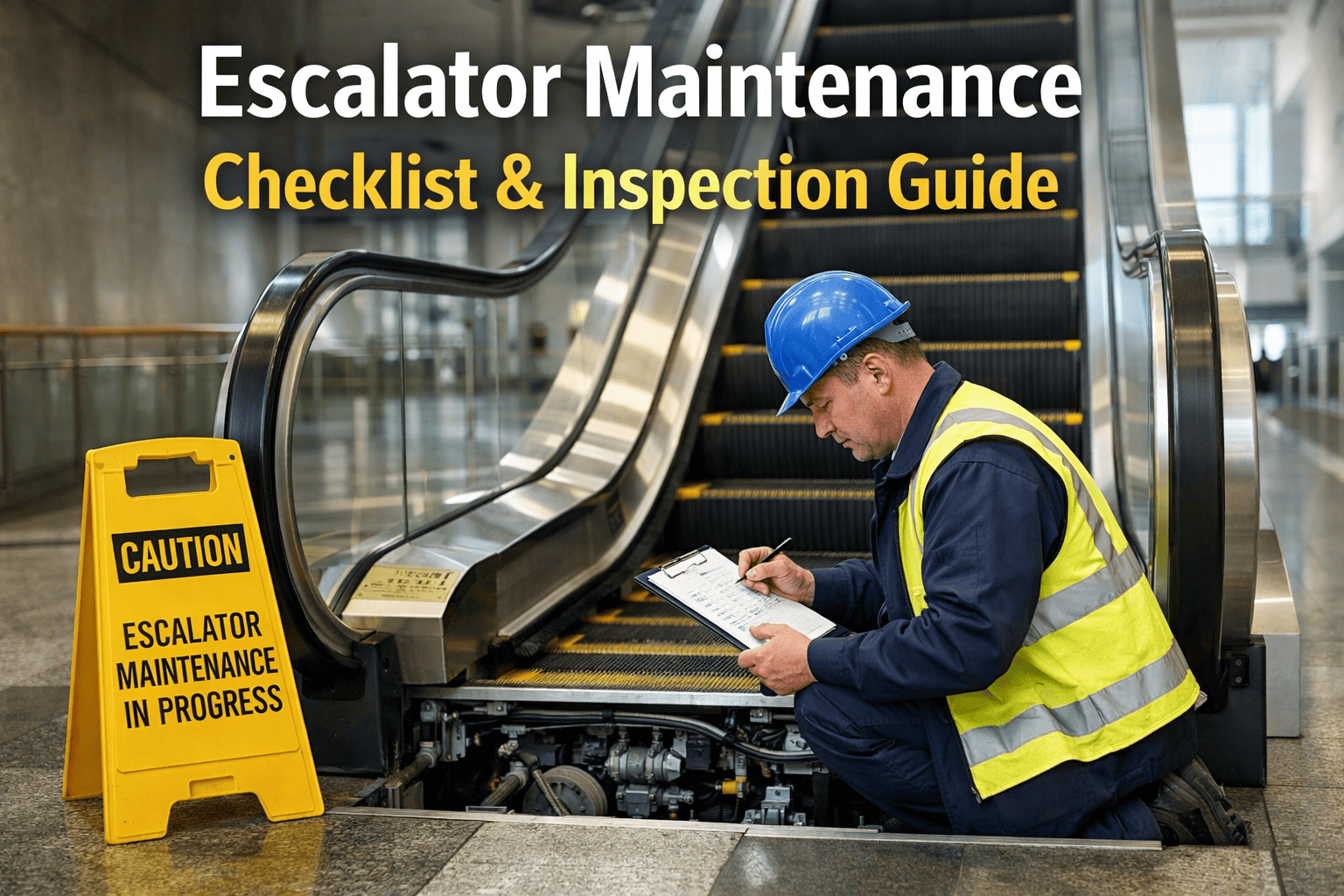
Escalator failures injure passengers and shut down revenue-critical transit points — and 70% of those failures show detectable precursor conditions at the prior inspection. This checklist gives facility engineers and escalator maintenance teams a structured component-by-component assessment protocol covering 42 inspection items across six zones. Each item is a single observable or measurable condition with a priority rating based on failure consequence. Complete it at every scheduled PM visit and as a walkdown observation between visits. For digital completion with automatic work order routing, deploy via OxMaint's zone-based inspection module. Book a demo to see how OxMaint converts this checklist into live digital work orders.
70%
of escalator failures show detectable warning signs at the prior inspection — missed because no structured checklist was in use
42
inspection items across six zones — step chain, handrail, comb plates, safety devices, drive system, and controller
6
inspection zones structured by component group with Critical, Monitor, and Routine priority tiers
78%
reduction in unplanned shutdowns at facilities using structured CMMS-managed escalator PM programs
Checklist Scope and Usage
This checklist covers six zones: step chain and sprockets, handrail and drive system, comb plates and step treads, safety devices, drive machine and brakes, and controller and electrical. Critical items have a short window to passenger injury or code violation. Monitor items require a work order and defined re-inspection. Routine items are documented and trended. All FLAG findings require photo documentation before the work order is raised.
The step chain is the primary drive mechanism. Chain elongation beyond 2% requires immediate replacement per ASME A17.1. Sprocket tooth wear accelerates chain elongation — both must be measured together.
Chain Condition — Monthly Measurement
Sprocket Condition
Zone 2 — Handrail and Drive System
Handrail speed must match step speed within 2% per ASME A17.1. Speed mismatch causes passenger imbalance — the second most common escalator injury mechanism after comb plate entrapment.
Handrail Speed and Condition — Weekly Check
Digitise This Checklist in OxMaint
Zone-based inspection on mobile, timestamped photo capture, and automatic work order routing for every FLAG finding.
Comb plate entrapment is the leading cause of escalator passenger injuries. Missing teeth, worn step cleats, and excessive comb-to-step clearance create entrapment hazards that must be checked daily.
Every safety device must be tested on schedule. A failed safety device that goes undetected creates maximum liability exposure — regardless of the condition of every other component.
Safety Device Testing — Monthly
Zone 5 — Drive Machine and Brakes
Brake failure causes either runaway (acceleration beyond safe speed) or sudden uncontrolled stop — both produce serious passenger injuries. Stopping distance must be measured, not estimated.
Brake System — Monthly Test
Drive Motor and Gearbox
Zone 6 — Controller and Electrical
Controller faults cause intermittent shutdowns that frustrate building operators and reduce escalator availability. Relay degradation and contactor wear are progressive — test proactively.
Controller Inspection — Quarterly
Every Checklist. Every Frequency. Auto-Generated and Tracked.
OxMaint's escalator PM templates are pre-built for immediate deployment — assign, execute, and document inspections from day one.
CSA B44 — Provincial enforcement with additional public transit escalator requirements. OxMaint generates province-specific checklists.
UK
EN 115-1 / LOLER — Six-monthly LOLER examination, EN 115-1 safety requirements. OxMaint schedules LOLER exams and tracks certifications.
Germany
EN 115-1 / BetrSichV — Biennial ZUeS inspection. OxMaint coordinates TUeV/DEKRA scheduling with dual-language records.
Australia
AS 1735.4 — Annual inspection with escalator-specific requirements. OxMaint generates state WorkSafe documentation.
Saudi Arabia
SBC / SASO — EN 115 adopted with SASO certification. OxMaint supports Arabic documentation and SASO tracking.
OxMaint vs. Competitors
Scroll
Capability
OxMaint
MaintainX
UpKeep
Fiix
Limble
IBM Maximo
Hippo
Escalator PM templates
Yes
No
No
No
No
Custom
No
Chain measurement tracking
Yes
No
No
No
No
Custom
No
Safety device test logging
Yes
Limited
Limited
No
No
Yes
No
Multi-code compliance
Yes
No
No
Limited
No
Yes
No
Photo evidence per item
Yes
Yes
Yes
No
Yes
Yes
Limited
Setup
Minutes
Hours
Hours
Days
Hours
Months
Days
Pricing
Free tier
Mid-range
Mid-range
Enterprise
Mid-range
Enterprise
Mid-range
Results
78%
Fewer Shutdowns
Reduction in unplanned escalator shutdowns at OxMaint-managed facilities
100%
Audit Pass Rate
Compliance audit pass rate with automated inspection scheduling and evidence
45%
Fewer Incidents
Reduction in escalator-related passenger incidents with structured PM
$0
Violation Fines
Safety violation fines for facilities using OxMaint escalator checklists
Data Security
AES-256 encryption, TLS 1.3
Role-based access, building-level permissions
Tamper-evident audit trail, 99.9% uptime
SOC 2-aligned, annual penetration testing
Deploy This Checklist as Live Digital Inspections in OxMaint
Every zone and every item available as a structured digital work order — assigned to your escalator fleet, completed on mobile with photo capture and automatic work order routing for every abnormal finding.
Zone-Based InspectionPhoto DocumentationAuto Work Order RoutingCompliance Audit Trail
Frequently Asked Questions
How often should escalators be inspected?
Daily visual checks for comb plates and step treads. Weekly handrail speed verification. Monthly safety device testing and chain measurement. Annual full inspection per ASME A17.1 or EN 115. OxMaint auto-schedules all frequencies per unit. Book a demo.
What is the most common escalator safety hazard?
Comb plate entrapment — where shoes, clothing, or objects are caught between step cleats and comb teeth. Preventable with daily visual checks and monthly gap measurement, both auto-tracked in OxMaint.
When should a step chain be replaced?
ASME A17.1 requires replacement when elongation exceeds 2% of original pitch. OxMaint tracks monthly measurements per unit and alerts when any chain approaches threshold. Start free.
Can OxMaint manage escalators and elevators together?
Yes. OxMaint manages your entire vertical transportation fleet — escalators, elevators, and moving walkways — from a single dashboard with asset-specific PM templates and portfolio-wide reporting.