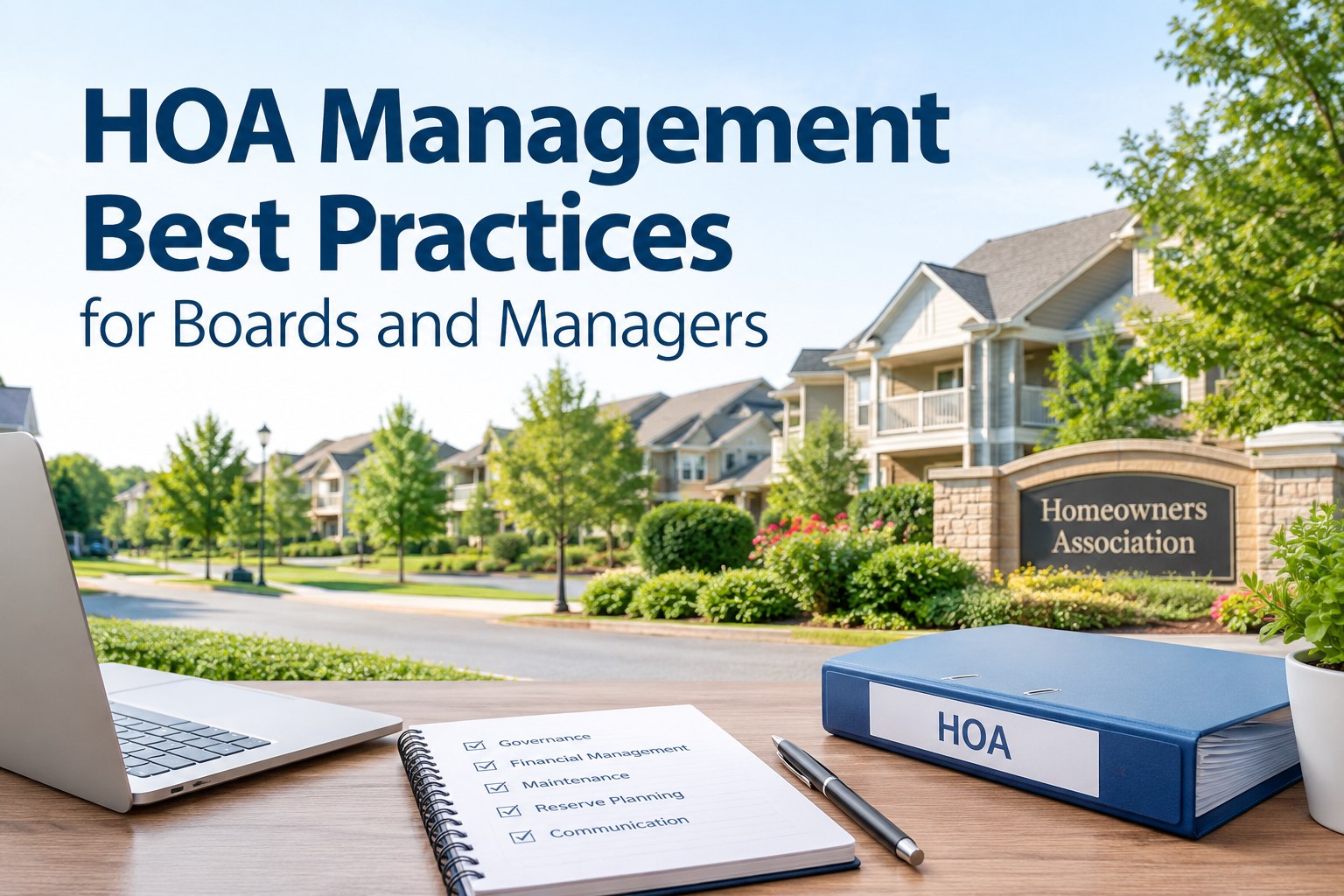
The difference between an HOA community that runs smoothly and one that generates constant conflict is almost never the amenities or the budget size — it's consistency. Boards that apply the fundamentals evenly, communicate clearly, and document what they do build homeowner trust; boards that improvise create the complaints, special assessments, and legal exposure that make HOA management a thankless job. HOA management sits at a genuinely different intersection than rental property management: fiduciary governance, community relationships, and physical-asset stewardship all at once, run largely by volunteers. This guide covers HOA management best practices for boards and managers — governance, finances, reserves, common-area maintenance, and communication — and where the right operational system quietly removes most of the friction. Start free or book a demo.
HOA Management Best Practices: Consistency Is the Whole Game
Well-run associations don't have better luck — they apply the same fundamentals to every homeowner, every vendor, and every dollar, and they keep a record that proves it. This is the playbook, and the operational discipline that turns good intentions into a community that runs itself.
The Failure Pattern Every Struggling HOA Shares
It almost always starts the same way: the board defers reserve funding to keep assessments low, lets maintenance slip to avoid short-term cost, and enforces rules unevenly to avoid confrontation. Each choice buys a quiet year — and builds toward a loud one: an emergency special assessment, a deferred-maintenance failure that tanks property values, or a selective-enforcement lawsuit. As one reserve report put it, visibility precedes discipline — you cannot fund, maintain, or defend what you cannot see clearly. The best-practice areas below are all, at root, ways of making the community visible. Sign up free — no credit card and give the board a clear operational picture of common-area assets and work from day one.
The Ten Pillars of Well-Run HOA Management
Top-performing boards in 2026 apply all ten of these consistently — not the three that are easy. Here's the full set, grouped by what they protect. Schedule a 30-minute demo to see where an operations platform strengthens the maintenance and vendor pillars.
Reserves: The Number That Decides Everything
Reserve planning is the single highest-leverage thing an HOA board does, because underfunding is invisible right up until it isn't. A professional reserve study every three to five years evaluates asset condition, forecasts the timing and cost of major repairs, and recommends funding levels — turning "we'll deal with the roof later" into a fundable plan. Manage the fund on a clear hierarchy, and keep it walled off from operating cash. Create your free account and keep the asset condition data that makes each reserve study sharper.
Two non-negotiables: keep separate accounts for operating and reserve funds, and never borrow from reserves to cover an operating shortfall — it clarifies audits and protects the community's financial security.
The $4,000 Special Assessment Nobody Saw Coming — Except the Roof.
The clubhouse roof failed in plain sight — deferred every budget cycle to hold assessments flat, until it leaked into the ballroom with no reserve line to cover it. OxMaint tracks common-area condition, schedules preventive work, and keeps the repair history that feeds a credible reserve study — so the roof is a planned line item, not a crisis.
Common-Area Maintenance: Where Complaints Are Born or Prevented
Nothing drives homeowner frustration faster than a pool that's closed all summer, a gate that's been broken for weeks, or a request that vanished into a board member's inbox. Common-area maintenance is where residents actually experience the HOA — and where an operational system does the most visible good. This is the pillar OxMaint is built for. Schedule a live walkthrough to see it on your community's assets.
Communication & Enforcement: Consistency Made Visible
Two pillars fail for the same reason — inconsistency that homeowners can see. Enforcement applied to some owners and not others invites legal challenge; communication that happens once a year at the annual meeting leaves residents feeling in the dark. Both are fixed by the same habit: document evenly, share openly. Sign up free and let the maintenance and request record be one clear, shareable source of truth.
Apply all ten pillars consistently, fund reserves on a current study, keep common areas visibly maintained, and document everything — and HOA management stops being a source of chronic complaints and becomes a community that runs smoothly. Sign up free or schedule a demo to strengthen the operational side of your association.
I took over a five-building association where the running joke was that the pool opened whenever someone finally complained loud enough. Maintenance requests lived in three board members' emails and half never got done. We put common-area assets and resident requests into OxMaint, and the change was immediate: every request becomes a tracked work order, preventive service on the amenities is scheduled instead of forgotten, and I walk into every board meeting with a maintenance report instead of excuses. Our last reserve study was the first one grounded in real service history — and homeowner complaints dropped to a trickle.
Frequently Asked Questions
Strengthen the Operational Backbone of Your Association.
Track common-area assets, turn resident requests into work orders, schedule preventive maintenance, and build the history that feeds credible reserve studies. Start free — no credit card. Or book a demo.