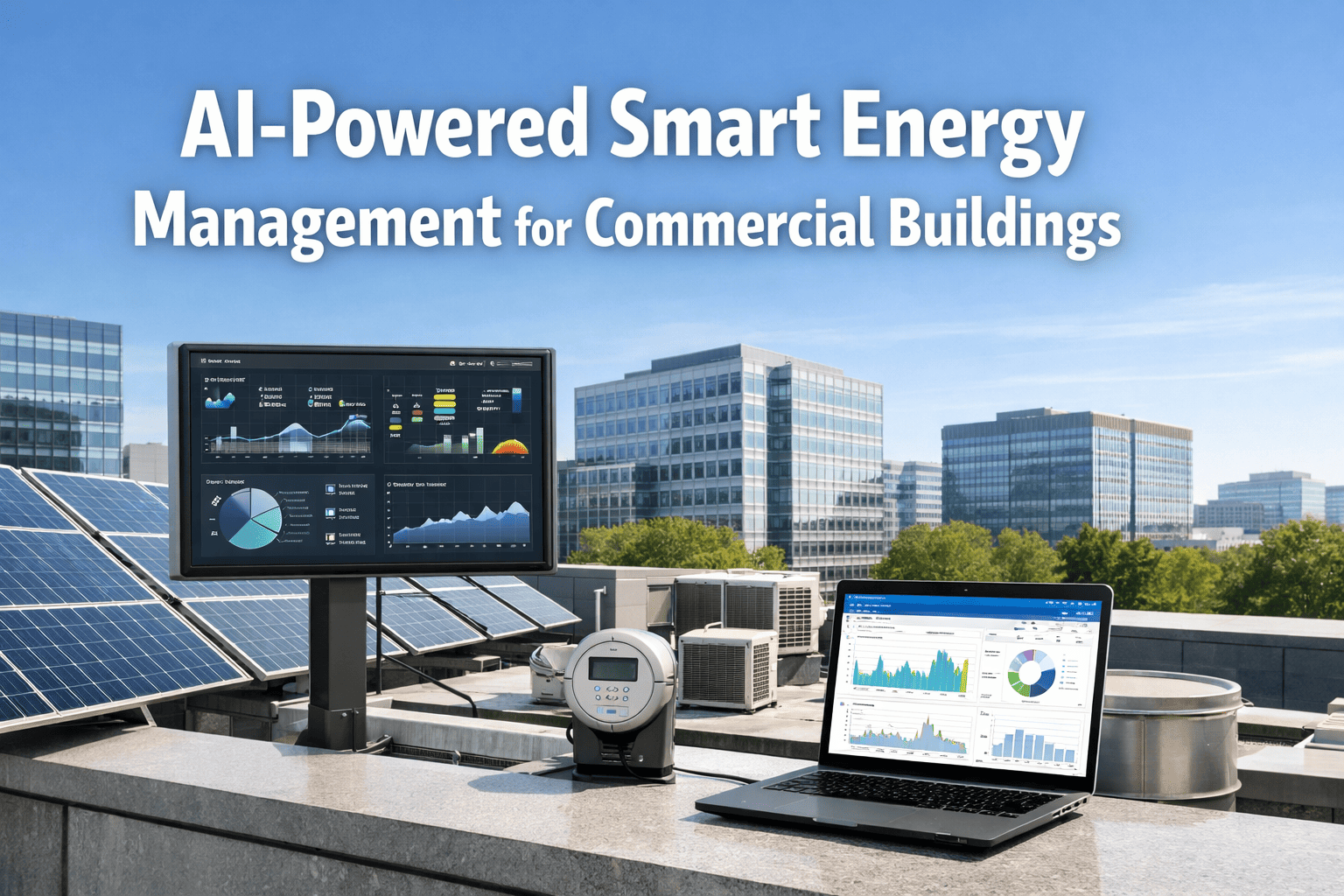
HVAC energy optimization is now the single largest lever commercial building operators have for cutting operating costs — and AI-driven setpoint control is why. Traditional HVAC management locks buildings into fixed temperature schedules that waste energy during low-occupancy hours, ignore real-time weather shifts, and miss demand response windows entirely. AI setpoint optimization changes that equation by continuously adjusting heating, cooling, and ventilation targets based on occupancy data, outdoor conditions, utility rate signals, and predictive load models — delivering building energy savings of 20–35% without sacrificing occupant comfort.
What Is HVAC Energy Optimization with AI Setpoint Control?
HVAC energy optimization is the practice of continuously tuning temperature setpoints, airflow rates, and equipment schedules to minimize energy consumption while maintaining occupant comfort. Conventional building automation systems rely on static time schedules — the same setpoints apply whether the building is 100% occupied or completely empty. AI setpoint optimization replaces static rules with dynamic, data-driven decisions.
AI-driven smart HVAC control systems ingest data from multiple streams — occupancy sensors, weather forecasts, utility pricing signals, and historical load profiles — and compute optimal setpoints in real time. The result is a building that heats and cools exactly as much as needed, exactly when needed, and no more. Explore OxMaint's HVAC energy management platform to see how condition-based control works in practice.
Why Static HVAC Scheduling Is Costing Buildings More Than They Realize
Most commercial properties still operate HVAC on time-of-day schedules set when the building was commissioned — often years or decades ago. These fixed schedules share a common flaw: they assume occupancy and weather are predictable and uniform. In reality, neither is true.
A Monday with a conference event on three floors has dramatically different cooling loads than a Monday when half the staff works remotely. A mild autumn day requires far less heating than the schedule assumes. Without HVAC smart controls that respond to actual conditions, buildings pay for conditioning that delivers no value to occupants. Sign up free to see how OxMaint replaces static schedules with real-time AI setpoint control.
Fixed-Schedule HVAC — Hidden Costs
- Pre-cooling and pre-heating empty spaces before occupancy begins
- Full setpoints maintained during partial-occupancy days and holidays
- No response to real-time weather or internal load changes
- Missed demand response incentives from utility providers
- Overcooling perimeter zones while core zones remain warm
AI Setpoint Optimization — What Changes
- Setpoints adjust dynamically to real-time occupancy sensor data
- Weather-predictive pre-conditioning eliminates overcooling waste
- Demand response events trigger automatic setpoint relaxation
- Zone-level control matches conditioning to actual occupancy patterns
- Energy use intensity monitored continuously and benchmarked
Core Components of an AI-Driven HVAC Energy Management System
A complete HVAC energy optimization platform integrates four technology layers that work together to convert raw building data into energy-saving setpoint decisions. Understanding each layer helps facility managers evaluate which capabilities a smart HVAC control solution must deliver. Book a demo to walk through how OxMaint delivers all four layers in a single connected platform.
Occupancy-Based HVAC Control
Occupancy sensors — PIR detectors, CO₂ monitors, access control data, and Wi-Fi device counts — feed real-time presence signals to the control system. AI models translate occupancy density into precise ventilation and temperature setpoint requirements for each zone, eliminating the energy waste of conditioning unoccupied spaces to full comfort levels.
Predictive Load Modeling and Smart Scheduling
Machine learning models analyze historical energy data, weather forecasts, calendar events, and equipment thermal response rates to predict future heating and cooling loads. Smart HVAC scheduling pre-conditions spaces to reach target temperatures at exactly the right moment — not an hour early — minimizing pre-conditioning energy without sacrificing comfort at occupancy start.
HVAC Demand Response Integration
Demand response programs pay commercial buildings to reduce HVAC load during grid stress events. AI setpoint control enables automated participation by pre-cooling buildings before demand response windows, relaxing setpoints during events within pre-defined comfort boundaries, and resuming normal operation afterward — capturing utility incentives without manual intervention.
Continuous Energy Performance Analytics
AI analytics compare actual energy consumption against predictive models and weather-normalized benchmarks to surface setpoint deviations, equipment efficiency degradation, and optimization opportunities. Continuous monitoring closes the feedback loop — allowing HVAC energy management strategies to improve automatically as AI models accumulate building-specific performance data.
HVAC Setpoint Optimization Strategies That Deliver the Biggest Energy Savings
Not all HVAC energy optimization tactics carry equal weight. The strategies below produce the largest measurable reductions in building energy consumption and are the highest-priority implementations for any smart HVAC control deployment. Get started free and configure these strategies inside OxMaint from day one.
| Optimization Strategy | How It Works | Typical Energy Saving | Best Application |
|---|---|---|---|
| Optimal Start/Stop Scheduling | AI calculates exact pre-conditioning start time based on outdoor temp, thermal mass, and occupancy time | 8–15% | Office buildings, schools, retail |
| Occupancy-Linked Setback | Setpoints relax automatically when zones fall below occupancy threshold | 10–20% | Mixed-use, open-plan offices |
| Weather-Compensated Setpoints | Supply temperature resets dynamically with outdoor air temperature to reduce compressor load | 5–12% | Chillers, boilers, AHUs |
| Demand Response Setpoint Flex | Pre-cooling/heating stores thermal energy before demand events; setpoints float during event window | Up to 30% during events | Large commercial, hospitals |
| VAV Static Pressure Reset | Supply duct static pressure resets to minimum required level based on zone demands | 15–25% fan energy | VAV systems in office towers |
| Chilled Water Supply Reset | Chilled water temperature raises when building load is low, reducing chiller compressor work | 6–10% | Central plant chiller systems |
How Occupancy-Based HVAC Control Works in Commercial Buildings
Occupancy-based HVAC control is the highest-impact single feature in any smart building energy strategy. Research consistently shows that commercial buildings are unoccupied or significantly under-occupied for 30–50% of scheduled operating hours — and most HVAC systems condition those empty spaces at full setpoints throughout.
Modern occupancy-based HVAC systems use a layered sensing approach. CO₂ sensors provide demand-controlled ventilation signals. Passive infrared (PIR) sensors detect presence at zone level. Access control systems and Wi-Fi analytics provide building-wide occupancy forecasts that allow predictive setpoint scheduling rather than purely reactive responses. Try OxMaint free to see occupancy-driven setpoint control working across your building zones.
Baseline Occupancy Profiling
Collect 4–8 weeks of occupancy sensor and access control data to build zone-level occupancy probability profiles by time of day and day of week. This profile becomes the foundation for predictive setpoint scheduling.
Zone Segmentation and Setpoint Zoning
Map each VAV zone or AHU serving area to its occupancy sensors and assign comfort setpoints and unoccupied setback setpoints. Critical zones (data centers, server rooms, healthcare) receive protected setpoints outside AI adjustment bounds.
AI Setpoint Decision Engine Deployment
Connect the AI control platform to your BAS or BMS via BACnet, Modbus, or API integration. Configure comfort bounds, setback limits, and occupancy trigger thresholds. The AI engine begins issuing setpoint commands in place of static schedules.
Comfort Verification and Feedback Loop
Monitor tenant comfort feedback, zone temperature adherence, and energy consumption in parallel for the first 30–60 days. AI models refine setpoint decisions based on measured comfort outcomes and thermal response data specific to your building.
Demand Response Enrollment and Optimization
Enroll in available utility demand response programs and configure AI setpoint flex parameters for event participation. Pre-cooling and setpoint relaxation strategies are automated, allowing passive demand response revenue without manual BAS adjustments.
HVAC Demand Response: Turning Grid Signals into Building Revenue
HVAC demand response programs are one of the most underutilized HVAC cost reduction opportunities available to commercial building operators. Utilities across North America, Europe, and Asia offer direct payment or rate incentives to buildings that can curtail HVAC load on demand — and AI setpoint optimization makes automated participation possible without tenant disruption. Schedule a demo to see how OxMaint automates demand response enrollment and setpoint flex for your building.
The mechanism is straightforward. When a demand response event is called, the AI control system has typically pre-cooled the building thermal mass during the hours before the event window. During the event, setpoints float upward by 1–3°F within pre-approved comfort limits, and chiller or AHU load drops accordingly. When the event ends, the building returns to normal setpoints — often without occupants noticing any change in comfort.
Key KPIs to Measure HVAC Energy Optimization Performance
Deploying AI setpoint control without tracking the right KPIs leaves energy savings unmeasured and ROI unjustified to building owners. The metrics below give facility managers and energy managers a complete view of HVAC energy management program performance.
Selecting an HVAC Energy Optimization Platform: 6 Non-Negotiable Capabilities
The commercial market for smart HVAC control and building energy management software has expanded significantly, and not all platforms deliver equivalent results. When evaluating solutions for AI setpoint optimization, these six capabilities separate high-impact platforms from those that generate dashboards without producing measurable savings.
Frequently Asked Questions: AI HVAC Energy Optimization
What is HVAC setpoint optimization and how does it save energy?
HVAC setpoint optimization continuously adjusts heating and cooling temperature targets based on real-time occupancy, weather conditions, and utility pricing — rather than following a fixed time schedule. By conditioning spaces only when and how much they need it, setpoint optimization eliminates the energy waste of heating and cooling unoccupied or lightly occupied zones at full comfort setpoints. Buildings typically achieve 20–35% HVAC energy savings within the first year of AI setpoint deployment.
How does occupancy-based HVAC control work without disrupting tenants?
Occupancy-based HVAC control sets comfort bounds within which AI setpoint adjustments operate — typically a 2–4°F band around target temperatures. Setpoints never drift outside pre-configured comfort limits regardless of occupancy signals. Pre-cooling and pre-heating strategies ensure zones reach comfort setpoints before occupancy begins, so occupants experience normal conditions at all times while the system has already captured energy savings during the empty pre-occupancy window.
What is HVAC demand response and how much can commercial buildings earn?
HVAC demand response programs pay commercial buildings to temporarily reduce HVAC energy load during periods of grid stress. Payment structures vary by program type: capacity markets pay annual commitments; real-time demand response pays per event curtailment; peak demand charge reduction saves money by flattening the building's demand profile. Large commercial buildings with AI setpoint control can capture $50,000–$250,000 annually in combined demand response incentives and demand charge savings depending on building size and utility program availability.
Can AI setpoint optimization work with existing building automation systems?
Yes. AI setpoint optimization platforms connect to existing BAS infrastructure via standard protocols including BACnet IP, BACnet MSTP, and Modbus TCP — without requiring BAS replacement. The AI platform issues setpoint commands to existing controllers through the BAS integration layer. Buildings with legacy BAS systems typically require a gateway device to bridge communication protocols, but full BAS replacement is not necessary to benefit from AI-driven setpoint control.
How long does it take to see ROI from smart HVAC control?
Most commercial facilities deploying AI setpoint optimization achieve measurable energy savings within the first billing cycle after full integration — typically 30–60 days after deployment. Full payback on platform investment plus sensor and integration costs is commonly achieved within 12–18 months. Buildings enrolling in demand response programs alongside setpoint optimization often accelerate payback to under 12 months through utility incentive revenue.
What building types benefit most from AI HVAC energy optimization?
Office buildings, healthcare facilities, retail centers, hotels, and educational campuses show the largest savings from AI setpoint optimization because their occupancy patterns are predictable and variable — ideal conditions for occupancy-driven setpoint scheduling. Buildings with high HVAC energy costs, existing BAS infrastructure, and utility demand response program eligibility capture the fastest and largest returns from smart HVAC control deployment.