In 2026, the commercial real estate industry is being reshaped by a single mandate: prove performance with data, or lose capital. AppFolio's February 2026 industry report found that 81% of property managers report a positive outlook — yet the gap between task completion and actual performance remains wide. Deloitte's survey of 850+ CRE executives revealed that 61% still rely on legacy core systems incapable of producing the real-time analytics that investors, lenders, and tenants now demand. The firms closing that gap are not the ones working harder. They are the ones measuring smarter — tracking the maintenance KPIs that directly influence NOI, tenant retention, and asset valuation.
Meanwhile, the numbers keep telling the same story: 92% of CRE teams have piloted AI, but only 5% achieved their program goals. The problem is not adoption — it is measurement. Most portfolios track work orders completed. Top-performing portfolios track MTTR, asset uptime, PM compliance, SLA adherence, cost per asset, and emergency ratios — the KPIs that separate profitable maintenance operations from expensive reactive firefighting. This is the guide to the KPIs that actually move the needle.
Why Most Portfolios Track the Wrong Metrics
The 2026 Buildium Property Management Industry Report confirmed that dealing with longer vacancies and rising operational costs are the top challenges facing property managers. Yet the majority of commercial teams still measure maintenance success by a single metric: work orders closed. That number tells you nothing about response quality, cost efficiency, tenant impact, or asset health. Here is the measurement gap separating average operations from high-performing portfolios.
Vanity Metrics
✗Work Orders Completed
Volume without quality context
✗Total Maintenance Spend
Aggregate cost without per-asset clarity
✗Vendor Count
Number of contractors, not their performance
✗Inspection Count
Tasks checked off without outcome tracking
VS
Performance KPIs
✓MTTR (Mean Time to Repair)
Speed of resolution by asset and priority
✓Cost Per Asset Per Month
Granular spend tied to individual equipment
✓Vendor SLA Compliance Rate
Contractor performance scored against contract
✓PM Completion Within Window
Preventive work done on schedule, verified
Organizations with optimized MTTR achieve: 35–45% lower total maintenance costs and 28% higher asset availability
The Eight KPIs That Drive Real Portfolio Performance
Research from EY shows that real estate KPIs are shifting away from cost-only oversight toward measuring effectiveness and value contribution. These eight maintenance KPIs are the ones that directly correlate with NOI improvement, tenant retention, investor confidence, and long-term asset value. Each one includes the formula, the benchmark, and why it matters for commercial portfolios in 2026.
01
Mean Time to Repair (MTTR)
Total Repair Time / Number of Repairs
Target: Under 4 hours for critical assets
Organizations with MTTR under 4 hours achieve 28% higher asset availability. Every minute of unplanned downtime compounds into tenant complaints, emergency premiums, and NOI erosion. Track MTTR by asset type, property, and technician.
02
PM Compliance Rate
PMs Completed on Time / Total PMs Scheduled x 100
Target: 90% or higher
The 10% rule: PMs should be completed within 10% of the scheduled interval. Monthly PMs within 3 days of due date. Organizations relying on reactive maintenance experience 3.3x more downtime and 16x more defects than proactive operations.
03
Emergency Work Order Ratio
Emergency WOs / Total WOs x 100
Target: Below 20%
Legacy-managed buildings run 60%+ emergency work orders. AI-first platforms reduce this to 15–25% within 90 days. Emergency repairs cost 3–5x more than planned maintenance — making this ratio a direct lever on maintenance spend.
04
Maintenance Cost Per Sq Ft
Total Maintenance Spend / Total Rentable Sq Ft
Target: $2.00–$3.50 (Class A Office)
Properties on reactive programs spend $2.50–$4.00/sq ft vs. $1.50–$2.50 for digitally managed operations. For a 100,000 sq ft property, that is $100K–$150K in annual savings — visible only when this KPI is tracked per property.
05
Asset Uptime Percentage
(Total Hours - Downtime Hours) / Total Hours x 100
Target: 95%+ for critical building systems
HVAC, elevators, fire safety, and electrical systems must maintain uptime above 95%. Every percentage point below target correlates with tenant satisfaction drops and lease renewal risk. Predictive platforms achieve 97–99% uptime on critical assets.
06
Vendor SLA Compliance
SLA-Met Work Orders / Total Vendor WOs x 100
Target: 85%+ across vendor base
Without scored vendor performance, portfolios overpay for underperformance. SLA tracking identifies which contractors consistently miss response windows, enabling consolidation that cuts vendor spend 18–24% across a portfolio.
07
Tenant Satisfaction Score
Satisfied Responses / Total Survey Responses x 100
Target: 85%+ (top quartile: 90%+)
85% of tenants now expect more than just space — they expect operational excellence. One case study showed predictive maintenance improved tenant satisfaction from 72% to 94%, reduced complaints by 40%, and improved retention by 25%.
08
Work Order Backlog (Weeks)
Open WOs / Avg Weekly WO Completion Rate
Target: 2–4 weeks
Zero backlog means overstaffed. 10+ weeks means drowning. A healthy 2–4 week backlog indicates proper resource allocation. Track by property to identify sites that need additional technician hours or vendor support before tenant impact occurs.
The KPI Benchmarks That Separate Leaders From Laggards
Colliers' 2026 outlook warned that the AI productivity gap is widening between firms that operationalize data and those stuck in pilot mode. Here are the documented benchmark gaps across commercial property portfolios — the difference between teams that measure and teams that guess.
4.6 Days
Average response time for legacy-managed portfolios — vs. under 18 hours with AI-first auto-dispatch systems
60%+
Work orders that are reactive emergencies in portfolios without predictive KPI tracking — vs. under 20% in data-driven operations
78%
Equipment downtime reduction achieved by commercial firms that switched to predictive maintenance with live KPI dashboards
35%
Maintenance cost reduction documented by a 12-building Class A portfolio after deploying AI-driven KPI monitoring
Stop Guessing. Start Measuring What Matters.
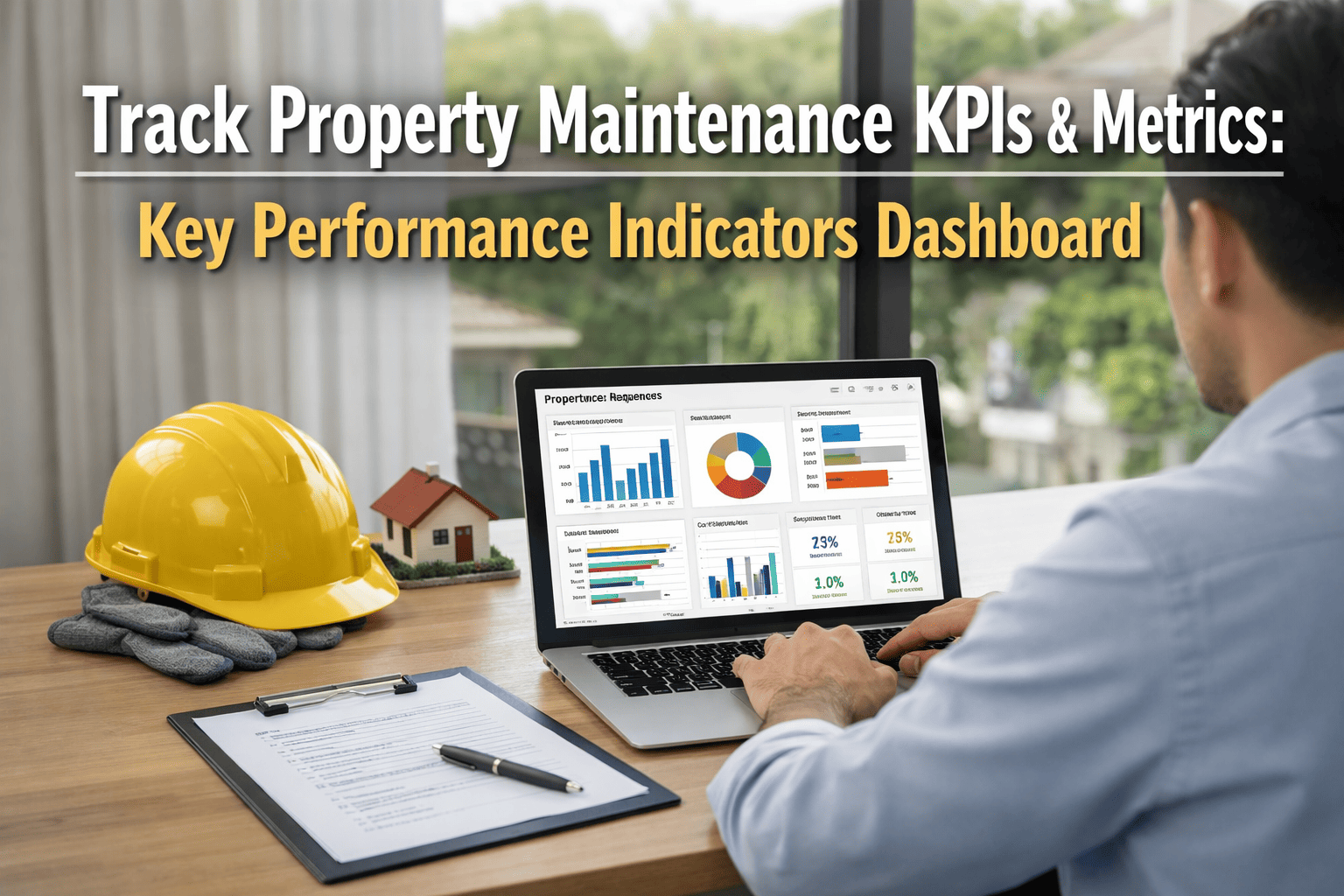
Oxmaint delivers live portfolio dashboards with MTTR, PM compliance, emergency ratios, vendor SLA scores, cost-per-asset, and tenant satisfaction tracking — automatically calculated from every work order, inspection, and repair across all your properties.
How a KPI-Driven Platform Transforms Maintenance Operations
Tracking KPIs in spreadsheets is not KPI management — it is data archaeology. By the time the report is compiled, the numbers are already weeks old. A KPI-driven CMMS captures, calculates, and displays maintenance performance in real time, enabling decisions that prevent problems instead of documenting them after the damage is done.
The Financial Impact of KPI-Driven Maintenance
Morgan Stanley projects AI could generate $34 billion in efficiency gains for real estate by 2030. The first place that value materializes is inside maintenance operations — where KPI visibility turns reactive cost centers into optimized, investor-grade operations.
MTTR Optimization
Reducing average repair time from 4.6 days to under 18 hours eliminates extended tenant disruptions and emergency premiums
Emergency Ratio Reduction
Shifting from 60%+ to under 20% emergency work orders saves 3–5x per incident — avg $120K per prevented emergency event
PM Compliance Above 90%
Consistent preventive maintenance extends asset useful life 18–30% and reduces unplanned capital expenditures by up to 50%
Vendor SLA Accountability
Performance scoring and contract consolidation cut vendor spend 18–24% — visible only when SLA data is tracked per contractor
Tenant Retention Value
Satisfaction scores above 85% correlate with 25% higher retention rates — each retained lease worth $42K+ avg annual rent
Reporting Efficiency
Auto-generated KPI dashboards save 15+ hours per week vs. manual spreadsheet compilation for investor and board reporting
First-Year Total Value from KPI Visibility
$480K–$960K
Frequently Asked Questions
What is the single most important maintenance KPI for commercial portfolios?
MTTR (Mean Time to Repair) is the highest-impact KPI because it directly correlates with tenant satisfaction, emergency spend, and asset availability. Organizations with MTTR under 4 hours achieve 28% higher asset availability and 35–45% lower total maintenance costs. However, MTTR should always be tracked alongside PM compliance and emergency work order ratio for a complete picture — no single metric tells the whole story.
How many KPIs should we track at once?
Industry best practice recommends starting with five core KPIs to avoid data overwhelm: MTTR, PM compliance rate, emergency work order ratio, cost per sq ft, and tenant satisfaction. Once those five are consistently measured and acted on, add vendor SLA compliance, asset uptime, and work order backlog. The key is tracking fewer metrics with discipline rather than many metrics without action.
Can we benchmark our KPIs against similar portfolios?
Yes. Oxmaint provides cross-portfolio benchmarking that compares MTTR, cost-per-asset, PM compliance, vendor performance, and emergency ratios across all your properties — and against industry benchmarks for your asset class. This identifies underperforming sites that need intervention and high-performing sites whose practices should be replicated across the portfolio.
How does the platform calculate KPIs automatically?
Every work order is timestamped at creation, assignment, dispatch, arrival, completion, and closure. The platform auto-calculates MTTR from these timestamps, PM compliance from scheduled vs. completed dates, vendor SLA adherence from response time vs. contract terms, and cost per asset from linked invoices and labor hours. No manual data entry, no spreadsheet formulas — the KPI engine runs on every transaction in real time.
What PM compliance rate should we target?
90% or higher is the industry benchmark for PM schedule compliance. The 10% rule means monthly PMs should be completed within 3 days of the due date. Organizations that consistently maintain 90%+ PM compliance report 3.3x less downtime, 16x fewer defects, and significantly lower emergency repair frequency. Portfolios below 75% compliance are almost certainly spending more on reactive emergencies than the cost of a proper PM program.
Does this integrate with our existing property management software?
Yes. Oxmaint integrates with Yardi, MRI Software, AppFolio, RealPage, Buildium, and Entrata. Maintenance cost data, asset records, and tenant information flow between systems automatically. Integration setup takes 2–4 hours per platform. Your PM software handles leasing and financials while Oxmaint handles maintenance KPI tracking, work order management, and portfolio performance analytics.
Your Portfolio's Performance Is Only as Good as What You Measure
Oxmaint gives commercial property teams the KPI dashboard that investors, lenders, and boards expect — MTTR, PM compliance, emergency ratios, vendor SLA scores, cost-per-asset, and tenant satisfaction tracked in real time across every property in your portfolio.
MTTR tracked by asset, property, and technician
PM compliance monitoring with automated alerts
Vendor SLA scorecards ranked by performance
Investor-ready reports generated automatically