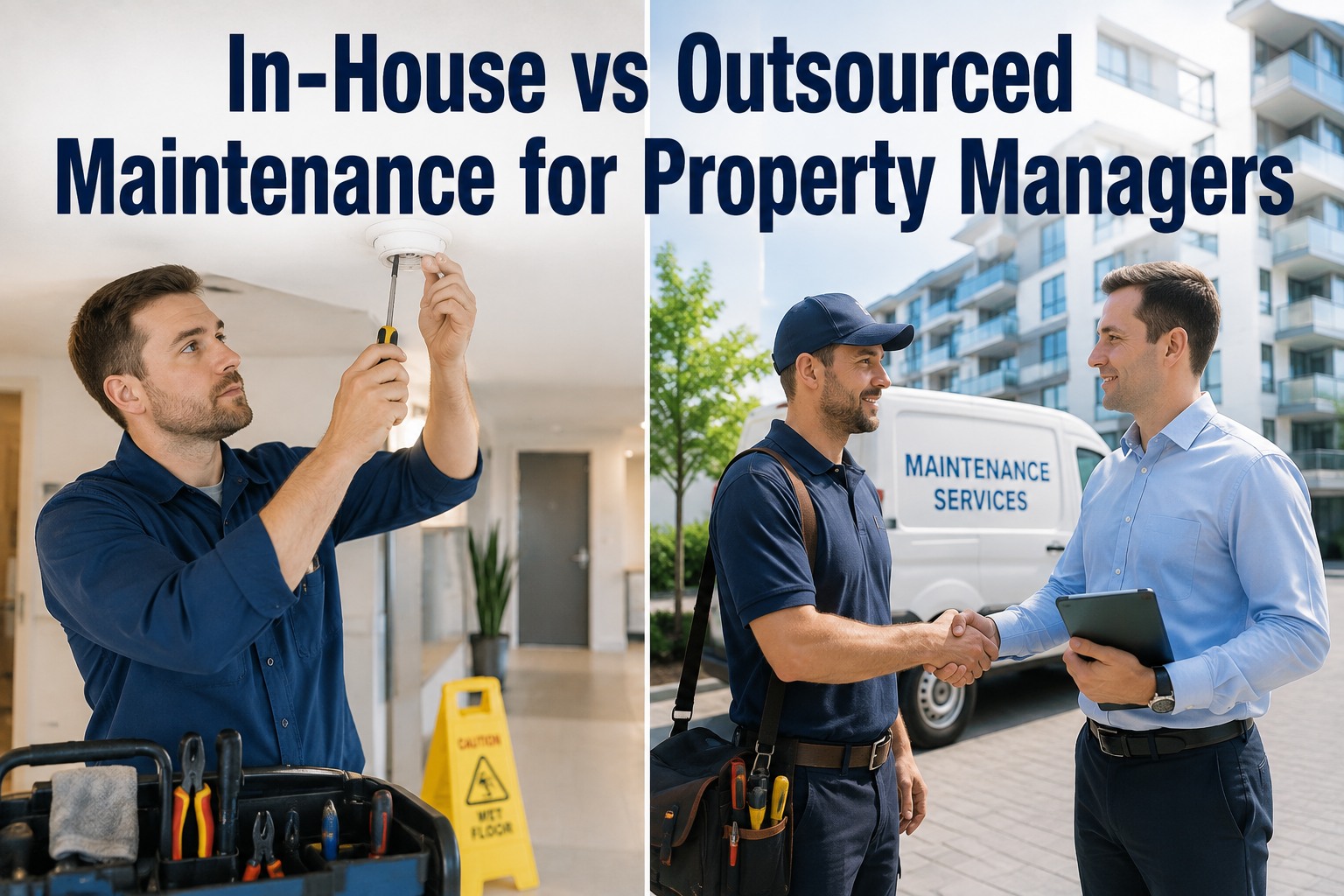
The decision to outsource property maintenance or keep work in-house is never truly binary — and it's rarely decided once and held permanently. Budget cycles bring pressure to cut costs. Key technicians retire or leave. Regulatory inspections reveal compliance gaps. Portfolio scale shifts. The question property managers face annually is not "Should we outsource?" but "Which functions should be managed in-house versus outsourced, and under what model?" The 2026 answer is almost always a hybrid: in-house teams for recurring, predictable work and emergency response; outsourced specialists for HVAC, electrical, roofing, or other trades requiring expertise; and a centralized CMMS coordinating work regardless of who executes it. This approach delivers cost predictability, maintains vendor accountability, and captures economies of scale while preserving direct control over operational quality and emergency response.
Outsourcing vs In-House Maintenance: The Hybrid Model That Wins on Cost and Control
Stop choosing between cost and control. Learn the hybrid maintenance model that gives you fixed labor costs, access to specialized expertise, full SLA accountability, and emergency response all from one coordinated platform.
The Three Maintenance Models: Cost Structure, Control, and Operational Trade-offs
The fully in-house model employs maintenance staff directly with salary, benefits, vehicles, tools, and training paid by the organization. For a portfolio of 15-20 properties, this typically requires 2-3 full-time technicians plus overhead, costing $180,000-280,000 annually. Advantages are direct control over response times, consistency with company standards, and deep familiarity with properties. Disadvantages are fixed costs regardless of maintenance volume, difficulty accessing specialized expertise (HVAC, electrical, plumbing), and perpetual recruitment pressure. When a technician leaves, operations suffer until replacement. Emergency situations require paying overtime. The fully outsourced model contracts all maintenance to third-party vendors, paying only for services rendered plus a management markup (typically 5-15%). For the same 15-20 property portfolio, outsourced labor costs $250,000-350,000 annually due to the markup and inefficiencies from vendor fragmentation. Advantages are no fixed labor cost and access to specialized expertise. Disadvantages are loss of direct control, inconsistent service quality across vendors, communication delays, and zero accountability once work is handed off. The hybrid model maintains 1-2 in-house technicians for routine work, emergency response, and vendor coordination, then outsources specialized trades (HVAC, roofing, electrical, plumbing) via contracts with SLAs.
The Hidden Costs of Outsourced Maintenance — Fragmentation, Communication Delays, and Quality Control Loss
The biggest failure mode in outsourced maintenance is fragmentation. A 50-property portfolio with 8-10 different contractors (HVAC, plumbing, electrical, general, roofing, etc.) creates coordination chaos. A water heater failure requires a call to the plumbing contractor; a thermostat malfunction requires a separate HVAC call; an electrical outlet needs an electrician. With no centralized coordination, jobs are scheduled independently, creating overlapping site visits, inefficient routing, and communication breakdowns. A tenant reports a problem to property management at 10am; the PM calls a contractor at 11am; the contractor is booked until 3pm; the tenant waits five hours. With an in-house technician, response is 30 minutes. The extra cost of fragmented response is real: emergency plumbing costs 150-200% more than scheduled work; lost tenant productivity from delayed repairs becomes operational cost. Outsourcing without centralized coordination also creates "finger pointing" between contractors. Was the electrical issue caused by faulty wiring or by HVAC technician error during last service? Accountability dissolves.
The Hybrid Model in Practice — Real Portfolio Examples and Payoff Scenarios
A 28-property residential portfolio maintained two full-time technicians at $280,000 annual cost (salary, vehicles, tools, benefits). Maintenance quality was inconsistent; specialized work was done by the same generalist technicians, often poorly. The portfolio shifted to one full-time technician ($130,000) plus contracted HVAC ($22,000), plumbing ($18,000), electrical ($15,000), roofing ($12,000), and general labor ($35,000), totaling $232,000 — a $48,000 annual savings (17%). Emergency response time dropped from 4-6 hours to 2-3 hours because one dedicated tech could prioritize and coordinate. Quality metrics improved: HVAC work is now done by certified HVAC specialists instead of a generalist. All work is documented in a central CMMS, creating accountability across all vendors. Tenant satisfaction scores increased by 8 points. A 50-property commercial portfolio was fully outsourced to two property management companies which then subcontracted to multiple vendors. Labor costs were $350,000, but fragmentation meant emergency repairs averaged $4,200 (excessive); vendor coordination issues delayed 15% of work orders; quality was inconsistent. The portfolio hired one full-time facility manager ($95,000) to coordinate all vendor work and manage a central CMMS. Vendors were consolidated to primary contractors with SLA requirements.
Our 16-property portfolio was trying to be everything — one in-house technician doing plumbing, electrical, roofing, HVAC preventive work, and emergency response. Quality was suffering; the technician was constantly interrupted by emergencies; specialized jobs were half-done by someone unqualified. We transitioned to one technician plus outsourced HVAC and electrical specialists coordinated through Oxmaint. Work orders all go to one system, vendors see the full property history, and accountability is crystal clear. Cost actually went down by $21,000 annually because we stopped doing poor HVAC work that had to be redone. Quality went way up. Tenant complaints dropped by 60%. For the first time in five years, we have strategic capacity to do preventive planning instead of reacting to emergencies.
SLA Enforcement and Vendor Accountability — The Critical Component for Outsourced Success
Outsourced maintenance fails when vendors are managed individually without oversight. A CMMS becomes the accountability enforcement tool: every work order shows assignment, estimated vs. actual completion time, and quality acceptance. SLAs (Service Level Agreements) specify response times (emergency within 2 hours, routine within 24 hours), completion timelines (most jobs within 5 business days), and quality standards (work certified by supervisor, tenant sign-off required). When a vendor misses an SLA, the CMMS automatically flags it and triggers escalation. Billing is tied to SLA compliance — missing timelines results in 5-10% service fee reduction. This structures vendor accountability without requiring daily oversight from property management. A proper CMMS also creates transparency for tenants: they can see work order status, estimated completion, and technician arrival windows. This reduces "Where is my repair?" communication. Vendors prefer systems with clear work orders and documentation — it eliminates disputes and improves billing.
Frequently Asked Questions
Find Your Optimal Maintenance Model — Hybrid or Otherwise.
Calculate the true cost of your current model and see what hybrid optimization could save. Get your custom ROI comparison based on portfolio size and current spending.