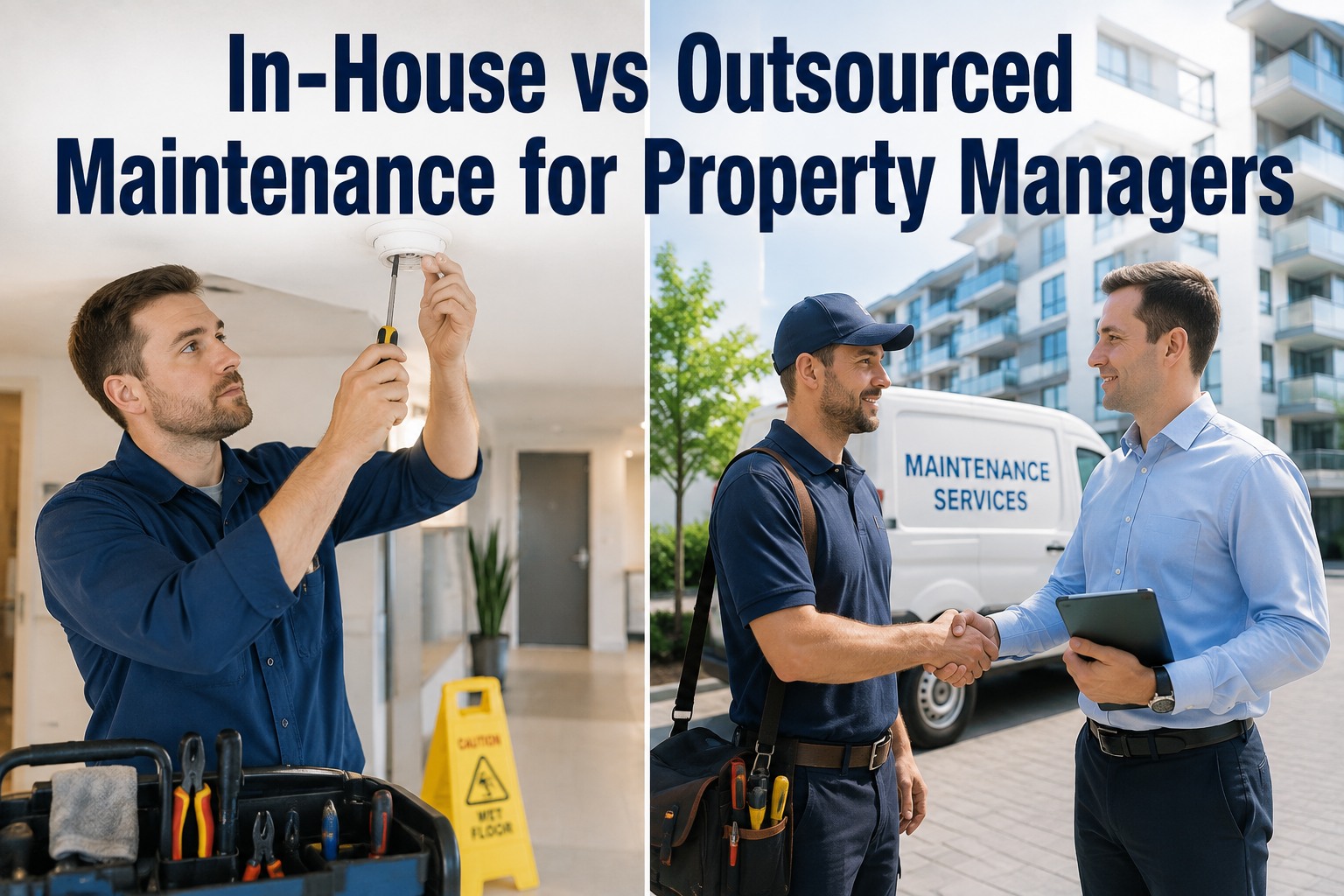
Choosing between in-house vs outsourced maintenance is one of the most consequential staffing decisions a property manager makes — in-house teams deliver control and faster response, while outsourced vendors deliver flexibility and specialized skills without fixed payroll. Most portfolios above a few hundred units end up running a hybrid: an in-house maintenance team for turns, make-readies and routine work orders, and outsourced property maintenance for HVAC, elevators, roofing and other licensed trades. The right property maintenance model depends on your unit count, work-order volume, response-time promises and true fully-loaded labor cost per unit per month. Below we break down the real numbers, break-even points and quality-control trade-offs — and show how a CMMS makes either model measurable. You can Start Free Trial to track both in-house technicians and outside vendors in one system from day one.
Property Maintenance Staffing Decision Guide
In-House vs Outsourced Maintenance: Which Model Fits Your Portfolio?
The honest comparison property managers actually need — fully-loaded costs, break-even unit counts, response-time math, and the hybrid model most successful operators run.
Control + Speed
- 15–30 min emergency response
- Fixed cost: $55–$75K/yr per tech
- Break-even near 150–250 units
Flex + Specialization
- Pay per job: $75–$150/hr trade rates
- Zero payroll, benefits or downtime
- Best under ~120 units or for licensed trades
The Real Numbers
What Does an In-House Maintenance Team Actually Cost Per Unit?
A maintenance technician's salary is only 60–70% of the true cost. The fully-loaded number is what decides whether in-house property maintenance pencils out.
True annual cost per tech = Base salary × 1.25–1.40 (taxes, benefits, insurance) + vehicle & fuel ($8–$12K) + tools & parts stock ($3–$6K) + training, PTO & coverage gaps
Worked example: a 300-unit garden-style portfolio hiring two technicians at $58K salaries doesn't spend $116K — it spends roughly $170K–$185K fully loaded, or about $47–$51 per unit per month. If that portfolio's actual work-order volume only keeps 1.4 technicians busy, outsourcing the overflow at $95/hr is cheaper than a second full-time hire. This is the math most property maintenance staffing decisions skip — and it's exactly the math a CMMS work-order history gives you.
Side-by-Side
In-House vs Outsourced Property Maintenance: Full Comparison
Nine decision criteria, scored honestly. Neither model wins across the board — which is why the hybrid model dominates.
| Criteria | In-House Maintenance Team | Outsourced Property Maintenance |
|---|---|---|
| Cost structure | Fixed: $68K–$92K fully loaded per tech, paid whether busy or idle | Variable: $75–$150/hr trade rates + trip fees; scales with volume |
| Emergency response | 15–30 minutes on-site; resident-facing and immediate | 2–24 hours depending on contract SLAs and vendor queue |
| Quality control | Direct supervision, consistent standards, photo-verified work orders | Varies by vendor; requires scorecards, inspections and re-work clauses |
| Specialized trades | Limited — generalists can't legally touch elevators, boilers, major HVAC | Deep — licensed specialists on demand for any trade |
| Scalability | Slow: hiring a tech takes 4–8 weeks; layoffs are painful | Instant: add vendors for turn season, storm response, renovations |
| Break-even point | Typically pencils out at 150–250+ units of steady work volume | Cheaper below ~120 units or for low-frequency, high-skill work |
| Resident experience | Familiar faces, consistent communication, higher satisfaction scores | Inconsistent; strangers on site, scheduling friction |
| Liability & risk | Workers' comp, safety training, OSHA exposure on your payroll | Shifted to vendor — but verify COIs, licenses and insurance annually |
| Data & accountability | Full visibility if tracked in a CMMS; invisible on paper | Often a black box — invoices without work-order detail |
Decision Framework
Portfolio Size Break-Evens: When to Build, When to Buy
Work-order volume — not unit count alone — is the real trigger. But unit count is a reliable proxy: one unit generates roughly 1.5–2.5 work orders per year, plus turns and preventive tasks.
Outsource Almost Everything
Volume can't keep one tech productive. Keep a vetted vendor bench — plumber, electrician, HVAC, handyman — and a strong dispatch process. Your cost stays variable and matches revenue.
First Hire + Hybrid
Hire one strong generalist for make-readies, routine work orders and inspections. Outsource licensed trades and overflow. This is where most property managers feel the staffing squeeze hardest.
Core Team, Specialized Vendors
A 3–8 person in-house crew handles 70–80% of volume. Vendors cover elevators, fire systems, roofing and surge capacity. Scheduling software becomes non-negotiable.
Regionalized In-House + Contracts
Dedicated techs per sub-market, a floating specialist team, and negotiated rate cards with preferred vendors. Preventive maintenance programs drive cost per unit down 15–25%.
What Top Operators Do
The Hybrid Maintenance Staffing Model Most Portfolios Actually Run
In practice, the in-house vs outsourced debate resolves to a split: roughly 70–80% of work-order volume in-house, 20–30% outsourced. Here's the five-step playbook for building it.
Audit 12 months of work orders
Categorize every ticket by trade, urgency and labor hours. Most managers discover 60%+ of volume is routine — appliance repairs, plumbing stoppages, lockouts, drywall — perfect for a generalist.
Draw the license line
Anything requiring a license, permit or certification — elevators, boilers, fire suppression, major electrical — goes to vendors permanently. This is risk management, not just cost.
Size the in-house crew to the baseline, not the peak
Staff for average weekly volume. Cover turn season and storm surges with vendors. Staffing to peak means paying for 20–30% idle time the rest of the year.
Build a scored vendor bench
Two vendors minimum per trade. Track response time, first-time-fix rate, re-work rate and cost per job. Cut the bottom performer annually — scorecards make this objective.
Run both models through one system
Every work order — in-house or vendor — gets dispatched, tracked, photo-verified and cost-coded in the same CMMS. Without this, the hybrid model is just organized chaos.
How OxMaint Helps
One Platform for Your In-House Crew and Every Outside Vendor
Whichever property maintenance model you choose, OxMaint turns it from guesswork into measured performance — so you can prove cost per unit, response time and first-time-fix rate for every dollar spent.
Unified Work Orders
Dispatch in-house techs and external vendors from the same queue. Mobile checklists, photo proof and resident notifications cut callback rates 20–30% and eliminate paper tickets entirely.
Vendor Scorecards
Track every outsourced job's response time, cost and re-work rate automatically. Renew or cut vendors on data, not anecdotes — most teams renegotiate 10–15% off rate cards with this visibility.
Preventive Maintenance Scheduling
Auto-schedule HVAC filter changes, inspections and seasonal tasks across every unit. Shifting from reactive to planned work cuts emergency call-outs — the most expensive maintenance labor — by up to 40%.
Cost-Per-Unit Analytics
See true maintenance cost per unit per month, split by in-house labor vs vendor spend. This is the exact data you need to time your next hire — or justify cutting one — with confidence.
See OxMaint on Your Portfolio — Book a 30-Min Demo
We'll map your current work-order volume and show you the exact in-house vs outsourced split your numbers support — plus how to track both in one dashboard.
People Also Ask
In-House vs Outsourced Maintenance: FAQs
Is it cheaper to outsource property maintenance or hire in-house?
Below roughly 120 units, outsourcing is almost always cheaper because work volume can't keep a full-time technician productive. Above 150–250 units of steady volume, an in-house tech at $68K–$92K fully loaded usually beats paying $75–$150/hr trade rates for routine work. The answer depends on your actual work-order hours, which is why tracking volume in a CMMS matters before you decide.
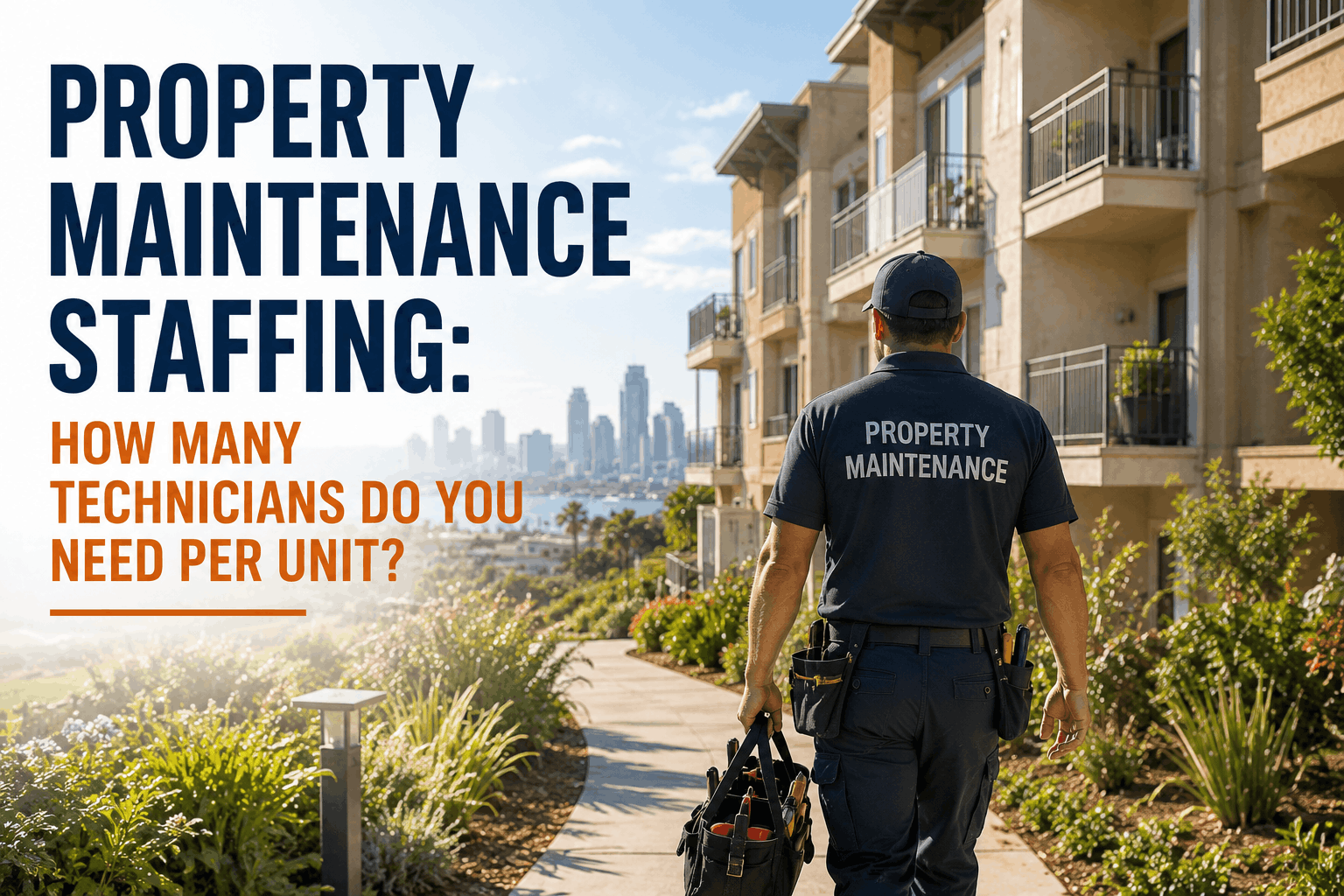
How many maintenance technicians do I need per unit?
The industry rule of thumb is one technician per 100–150 units for routine work, adjusted for property age, turn rate and amenities. Older assets or high-turn student housing may need one per 75–100 units, while newer Class A properties can stretch to one per 175. OxMaint's analytics show your real labor hours per unit so you can size the team on data — Book a Demo to see it on your portfolio.
What maintenance tasks should always be outsourced?
Anything requiring a license, permit or certification: elevator service, boiler and chiller work, fire suppression systems, major electrical panels, roofing and structural repairs. The liability of unlicensed in-house work far exceeds any labor savings, and vendor contracts for these trades include insurance your policy likely won't.
What is a hybrid maintenance model in property management?
A hybrid model keeps an in-house maintenance team for high-frequency routine work — make-readies, appliance repairs, plumbing stoppages, inspections — while outsourcing licensed trades and seasonal surge capacity. Most portfolios over 200 units run roughly 70–80% of work-order volume in-house and 20–30% through vendors, tracked in one system for cost comparison.
How do I control quality with outsourced maintenance vendors?
Require photo-documented completion on every job, set response-time SLAs in writing, and score vendors monthly on first-time-fix rate, re-work rate and cost per job. A CMMS automates all three — you can Start Free Trial and have vendor scorecards running within your first week.
Stop Guessing Your Maintenance Staffing Model
OxMaint tracks every in-house hour and every vendor invoice in one place — so your next staffing decision is a math problem, not a gut call.
Free 14-day trial · No credit card · Set up in under an hour