Property maintenance software delivers measurable financial returns — but only if you calculate ROI correctly before committing. Most portfolios see payback in under six months through reduced emergency repairs, extended asset lifespan, improved technician productivity, and compliance automation. The average property manager sees $360,000 in annual savings from a $45,000 CMMS investment, creating an ROI of 7.78x within the first year. Yet teams often skip the analysis, leaving millions in value on the table and failing to justify continued investment when budget cuts arrive.
Calculate Your Property Maintenance Software ROI Before Implementation
Stop guessing at maintenance ROI. Learn the five-category framework that drives 3x returns within 18 months, plus the exact formula to project savings for your portfolio size, team composition, and current spend.
The Five Categories of CMMS ROI — Which One Are You Missing?
Most property managers calculate only direct savings — fewer emergency repairs, reduced overtime. But CMMS ROI is the sum of five distinct value categories. Emergency repairs cost 4.8 times more than planned maintenance. A single shift from 60% reactive work to 40% preventive scheduling delivers 25-40% reduction in total spend. Technician productivity gains through mobile work orders and automated scheduling recover 35% of time lost to paperwork, vehicle idle time, and return visits — that is 1.3 additional work orders per technician per day. Asset life extension through predictive scheduling prevents premature replacement of HVAC systems, roofs, and mechanical equipment — extending lifespan by 15-25% on major assets. Compliance automation eliminates manual certificate tracking (fire alarm, LOLER, EICR, gas safety, electrical), reducing fine exposure and audit failures. When all five categories are measured, CMMS ROI consistently exceeds 3x within 18 months.
ROI Calculation Framework — The Exact Formula Used by Property Portfolio Directors
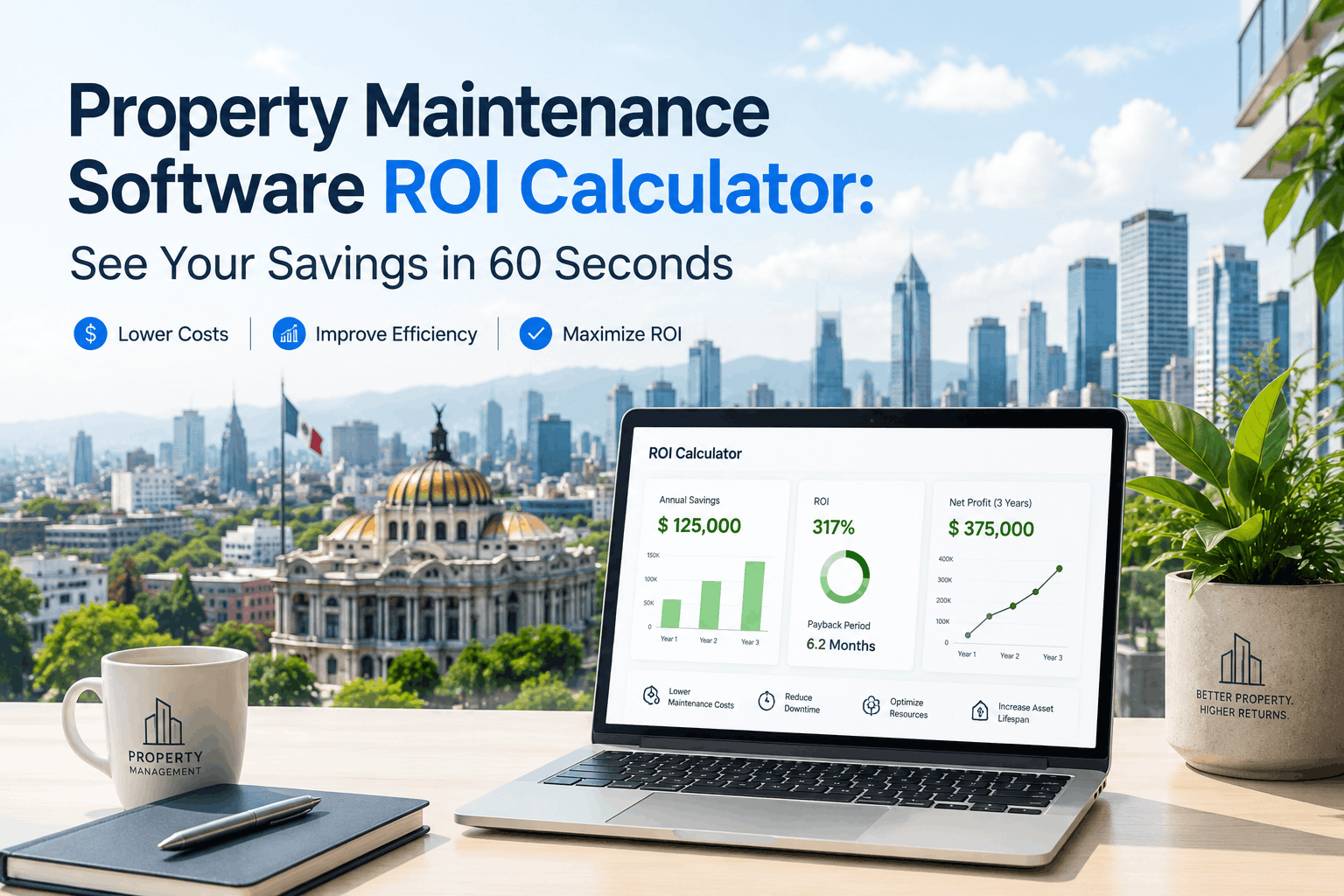
Calculating CMMS ROI requires comparing total cost of ownership against measurable value delivered. The formula is straightforward: (Annual Savings − Annual Software Cost) ÷ Annual Software Cost = ROI Ratio. For example, a 50-property portfolio with 8 technicians spending $85,000 annually on CMMS sees these savings: Emergency repair reduction saves $48,000 annually. Technician productivity gains free up 240 hours per year ($18,000 value at $75/hour billing rate). Compliance automation prevents one accident investigation ($12,000 estimated). Asset life extension defers one HVAC replacement by three years ($8,000 present value). Total annual savings: $86,000. Minus annual software cost of $24,000 = $62,000 net benefit. ROI: $62,000 ÷ $24,000 = 2.58x, or 258% return in year one. Most implementations hit breakeven between month 3 and month 6, then generate pure savings thereafter. The payback period calculation uses monthly savings divided by implementation cost. For a facility investing $12,000 upfront and realizing $2,000 per month in savings, payback occurs at month 6.
Real Portfolio Case Studies — ROI Scenarios Across Property Types and Sizes
ROI projections must account for portfolio-specific factors: number of properties, technician team size, current maintenance spend, and asset age. A 25-property residential portfolio with four technicians and $380,000 annual maintenance spend sees $152,000 in year-one savings (40% of current spend reduced through preventive scheduling). At a $28,000 annual software cost, ROI is 5.42x. A 60-property commercial portfolio with 12 technicians spending $890,000 annually sees $296,000 in savings (emergency repair reduction plus technician recovery). At $52,000 software cost, ROI is 5.69x. A single large property with $200,000 annual maintenance spend and two technicians sees $62,000 in savings at $12,000 software cost, delivering 5.17x ROI. The key insight: ROI scales with current spend and team size. Smaller portfolios may see 2-3x returns, while multi-hundred-unit operators consistently achieve 5-7x because economies of scale amplify productivity gains and emergency cost reductions. A property maintenance schedule template integrated into your CMMS accelerates the ROI capture by automating preventive work.
Total Cost of Ownership — Software, Implementation, Support, and Training
CMMS TCO includes more than subscription cost. Software licensing ranges from $200-500 per technician annually, scaling with team size. Implementation typically requires 40-80 hours (one to two weeks for most portfolios) at internal staff time cost of $8,000-15,000. Training takes 8-12 hours across the team ($3,000-6,000 in productivity cost). Mobile device hardware (tablets or ruggedized phones) adds $2,000-5,000 for a team of 8. Integration with existing systems (accounting software, tenant portals, IoT sensors) costs $5,000-12,000 if needed. Annual support and updates run $4,000-8,000 for most platforms. For a typical 50-property portfolio, first-year TCO averages $45,000-55,000, dropping to $28,000-36,000 in subsequent years (no implementation cost). Even with full TCO included, ROI remains above 2.5x in year one and exceeds 8x by year three as savings compound without additional investment. The most successful implementations see month 3-4 payback, then operate at pure profit, generating $60,000-120,000 in annual net value depending on portfolio size.
Our 42-property portfolio was bleeding money on emergency HVAC repairs — $54,000 one year alone from reactive maintenance. After six months on Oxmaint, we'd shifted 65% of work to preventive scheduling. Emergency repair costs dropped to $18,000 annually. Our technicians recovered 12 hours per week from paperwork elimination. The ROI calculation was so clear we couldn't justify not investing. Payback was actually achieved in month 2.5, not month 6 like we projected.
Benchmark Data — What Other Property Managers Are Achieving
Industry data from 3,000+ property management teams across residential and commercial portfolios shows consistent ROI patterns. Emergency repair reduction averages 36-42% across portfolios (from shifting 40-50% of work from reactive to preventive). Technician time recovery averages 32-38% (primarily from mobile work orders, route optimization, and reduced callbacks). Asset lifespan extension saves an average of $8,000-15,000 annually on major component replacements (roofs, HVAC, plumbing). Compliance automation prevents an average of 2-3 audit failures annually, each carrying $500-3,000 in documentation cost. Tenant satisfaction improvements correlate with 4-8% reduction in turnover, valued at $2,000-6,000 per prevented vacancy depending on property type and location. Across all categories, most implementations see year-one savings of 35-45% of current maintenance spend, with 70% of that benefit captured in the first four months as preventive scheduling takes hold. The remaining 55-65% of current spend reflects truly necessary maintenance that no software eliminates — instead, CMMS makes it more efficient.
Frequently Asked Questions
Your Portfolio ROI Is Waiting. Calculate It Today.
Stop guessing at maintenance ROI. Get your custom five-category calculation based on your actual portfolio size, team, and current spend.