Service Level Agreements are contracts on paper, but they are only enforceable when backed by systematic tracking and documented breach evidence. Most property managers operate under vendor contracts that specify emergency response times of 2–4 hours, routine response within 24–48 hours, and PM completion within specified windows — yet lack any centralized system tracking actual response times against these commitments. A vendor who regularly takes 36 hours to respond to an "urgent — 24-hour" work order is technically in breach every single time, but without automated tracking, that breach goes unnoticed until a tenant escalates, a lease comes up for renewal, or a performance review finally surfaces the data. This creates a hidden cost structure: tenants experience slow service and vote with their feet, property managers lack negotiation leverage, and vendors face no accountability for sub-standard performance. OxMaint automates SLA tracking with real-time vendor scorecards, breach notifications, and documented evidence for contract enforcement — converting vague contract language into measurable, enforceable standards.
Hold Vendors Accountable With Real-Time SLA Tracking and Breach Documentation
Automate response time tracking, generate vendor scorecards, and document every SLA breach with timestamped evidence — so contract negotiations and service credit clauses are based on data, not memory.
The Economics of Poor SLA Enforcement
Properties without SLA tracking have median response times of 11.4 hours and resolution windows stretching past 6 days. The gap between this and a disciplined SLA environment (2-hour acknowledgment, 24-hour resolution) is measured in millions of dollars per portfolio. Every hour of delayed response increases tenant frustration, damages retention rates, and creates cascade failures: a broken HVAC request takes 2 days to acknowledge, another day to dispatch, the tenant experiences a week without climate control, and the lease renewal rate drops. Multiply this across a 50-unit portfolio and you're looking at $200,000–$400,000 annually in lost NOI from tenant turnover driven by poor response times. Without systematic SLA enforcement, vendors have zero competitive pressure to improve performance, costs creep annually despite declining service quality, and property managers lack the documentation needed to renegotiate or replace underperforming vendors. OxMaint's SLA tracking dashboard creates the accountability infrastructure that closes this performance-cost gap.
The Four-Tier SLA Framework: Industry Benchmarks and Response Windows
Effective SLA enforcement requires a tiered structure that accounts for different request priorities. The framework below represents industry consensus across commercial, multifamily, and healthcare property portfolios — tight enough to protect operations and tenant satisfaction, realistic enough that contractors will actually sign to it. Emergency requests (life-safety issues, HVAC failures during extreme weather, security breaches) get immediate acknowledgment and 2-hour dispatch windows. Urgent requests (non-critical system failures, habitability issues, tenant-impacting problems) get 24-hour response and 48-hour completion. Routine requests (cosmetic repairs, minor maintenance, non-urgent upgrades) allow 5-business-day response windows. Preventive maintenance (PM inspections, filter changes, servicing) has scheduled intervals with 2-week advance notice. This framework eliminates the ambiguity that allows vendors to miss targets without consequence. OxMaint configures SLAs by priority tier and tracks actual response times against contract targets in real-time.
Real-Time Vendor Scorecards and SLA Compliance Reporting
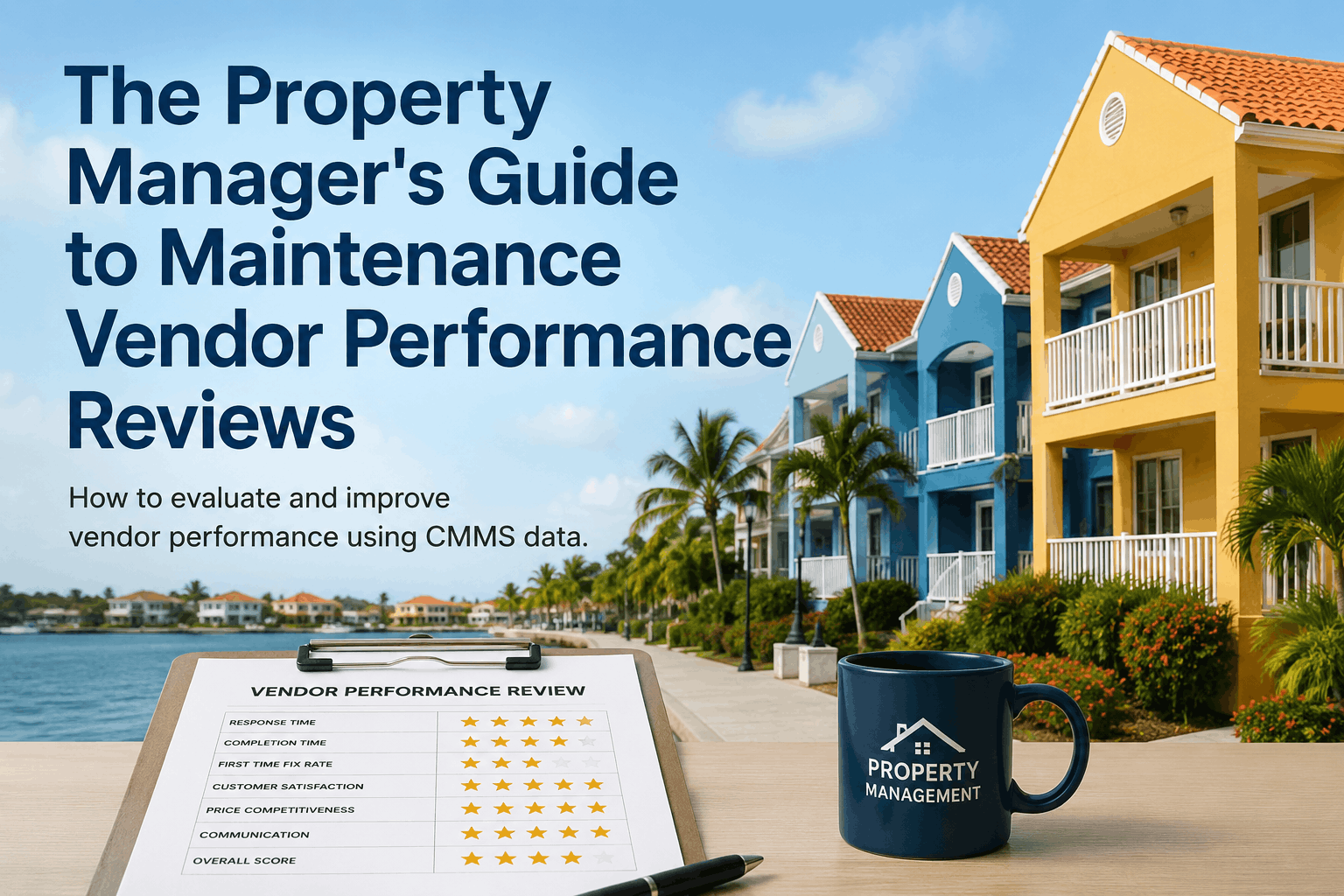
A vendor performance report generated at contract renewal time — showing response times and completion rates for the entire year — comes too late to guide day-to-day decisions or address emerging performance issues. Real-time vendor scorecards, updated on every work order, create continuous visibility into performance trends. When a plumber's SLA compliance drops from 95% to 78%, it shows up immediately on the scorecard with specific data: which work orders breached, by how many hours, and the pattern (late responses on evening calls, for example). This real-time visibility allows property managers to intervene early — escalate with the vendor, add backup contractors, or initiate replacement — before poor performance becomes entrenched and starts affecting tenant satisfaction. At contract renewal, the data supports negotiation: "Your Q3 response time averaged 34 hours on urgent requests when the contract specifies 24 hours. Here's the cost of that underperformance in lost tenant renewals." OxMaint calculates vendor scorecards automatically from every timestamped work order event.
Monthly vendor report showing: percentage of requests meeting response time targets, average response time by priority tier, completion rate within estimated windows, and quality scores from tenant feedback and rework frequency.
Automatic detection of SLA breaches with timestamped evidence: when response time or completion deadline is missed, the system flags it, calculates service credit amount per contract terms, and queues it for property manager review and vendor communication.
At contract renewal, generate one-page summaries per vendor showing: on-time percentage, average response time, cost per request, total service credits earned, and trend data over the contract period — all audit-ready and timestamped.
Property managers can share SLA performance data with tenants: "Average emergency response time is 1.8 hours" or "99% of urgent requests resolved within 48 hours" — converting internal performance metrics into tenant-facing accountability transparency.
We had a plumbing contractor who was taking 48 hours to respond to urgent requests when the contract said 24 hours. But without data, we couldn't prove it — and the contractor denied it. OxMaint's SLA tracking showed response times on every single work order. We had documentation going back 18 months. We renegotiated the contract and recovered $82,000 in service credits. Now that vendor knows we're watching, and response times improved 40%. That's the power of data.
Stop Paying for SLA Breaches Without Proof. Track Vendor Performance in Real-Time.
OxMaint timestamps every work order event, calculates SLA compliance automatically, and generates vendor scorecards that turn contract language into enforceable accountability.
Common SLA Setting and Enforcement Pitfalls
Setting Unrealistic SLAs That Vendors Won't Sign
Overly aggressive SLA targets (1-hour emergency response across a large service area, for example) create contracts that look good on paper but aren't actually enforced because both parties know they're unachievable. Industry benchmarks (2–4 hours emergency, 24–48 hours urgent) provide realistic starting points.
SLA Terms So Vague They're Unenforceable
"Prompt response" or "reasonable timeframe" are unenforceable because they're subjective. Effective SLAs specify measurable, time-based targets: "24-hour response time" is measurable; "fast response" is not.
Service Credit Clauses Never Actually Invoked
Most contracts include penalty clauses with specific service credit percentages, but without proof of breach, they're aspirational rather than enforceable. Automated SLA tracking provides the timestamped evidence needed to invoke credits.
Not Distinguishing Between Response Time and Resolution Time
Some vendors respond quickly but take weeks to complete work. Effective SLAs track both: response time (acknowledgment), dispatch time (technician arrival), and completion time (work finished). Each tier gets its own target.
Frequently Asked Questions
What is a reasonable emergency response SLA for property maintenance?
Industry standard is 2–4 hours for life-safety emergencies (HVAC failure, loss of power, security breach). Geographic service area and vendor staffing determine whether 2-hour or 4-hour targets are realistic.
How do we handle SLAs for parts that need to be ordered?
SLAs typically track response time (technician arrival to assess and diagnose) separately from completion time. For parts-dependent repairs, the SLA includes a specific window for parts procurement (e.g., "5 business days for standard parts").
Should we have different SLAs for in-house staff versus external vendors?
Yes. In-house staff typically have tighter SLAs (same-day response, next-day completion for routine work). Vendor SLAs account for commute time and external scheduling constraints (2–4 hour response vs. same-day).
What's a typical service credit percentage for SLA breaches?
2–5% of the monthly invoice per breach is standard. For example: 2% credit for 1–2 hour response delay, 4% for 2–4 hour delay, 6% for breaches exceeding 4 hours or multiple breaches in a month.
How should SLAs be communicated to tenants?
Post them publicly on the property portal or resident handbook: "Emergency requests receive response within 2 hours" or "Routine requests acknowledged within 24 hours." This sets expectations and allows tenants to track actual performance.
Can we negotiate different SLAs with different vendors?
Yes. Specialty vendors (HVAC, pool, electrical) may have different response capabilities than general maintenance contractors. Higher-tier vendors may commit to tighter SLAs at higher rates.
What if a vendor continuously misses SLA targets?
After 2–3 months of consistent breaches, schedule a performance meeting, issue written notice, and initiate search for replacement vendor. Most contracts include termination rights for repeated SLA failures.
Your Vendor Contracts Are Unenforceable Without Real-Time SLA Tracking and Breach Documentation.
OxMaint automates SLA monitoring, calculates vendor scorecards, and provides timestamped evidence for service credit recovery and contract enforcement — turning vague commitments into measurable accountability.