Property maintenance operations depend on a dense web of external relationships — plumbers, electricians, HVAC technicians, landscapers, cleaning crews, and dozens of other specialized contractors who collectively keep buildings functional, safe, and compliant. When those relationships are managed informally — through spreadsheets, email chains, and institutional memory — the result is inconsistent service, cost overruns, compliance exposure, and the constant operational friction of chasing down contractors who don't show up, invoices that don't match estimates, and work that doesn't meet standards. Structured vendor management transforms those informal relationships into a governed, measurable, optimizable system that delivers predictable outcomes at controlled costs.
Centralize Your Entire Vendor Network in One Platform
Stop managing contractor relationships in spreadsheets. OxMaint automates vendor onboarding, tracks performance metrics, and generates compliance-ready documentation automatically.
What Is Vendor Management in Property Maintenance?
Vendor management in property maintenance is the end-to-end process of identifying, onboarding, evaluating, contracting, scheduling, and monitoring the external contractors and service providers who perform maintenance work on behalf of a property owner or facilities team. It encompasses everything from the initial credentialing of a new HVAC contractor to the annual review of whether that contractor continues to meet performance and cost benchmarks.
Effective vendor management is not simply a procurement function. It sits at the intersection of operations, compliance, finance, and risk management. A contractor who performs substandard electrical work creates liability exposure. A vendor who invoices inconsistently erodes budget predictability. A cleaning company whose staff lacks background screening creates safety risks for tenants. Each of these outcomes is a vendor management failure — and each is preventable with the right systems in place. Teams looking to build that foundation can explore OxMaint as a starting point for centralizing their entire vendor network.
The Business Case for Structured Vendor Management
Organizations that invest in formal vendor management programs consistently outperform those that manage contractors reactively. The performance gap manifests across multiple dimensions: cost efficiency, service consistency, risk exposure, and regulatory compliance. The following data points reflect outcomes documented across property management organizations that have implemented structured vendor governance frameworks.
Core Components of an Effective Vendor Management Program
A functional vendor management program is built from five interconnected components. Each component is necessary. Missing any one of them creates gaps that compound over time — a vendor pool without performance tracking drifts toward mediocrity; a credentialing process without ongoing monitoring becomes a compliance snapshot that immediately begins to age. Platforms like OxMaint are designed to support all five of these components within a single unified system. The sections below break down each component and what it requires in practice.
Before any contractor performs work on a managed property, they must clear a structured onboarding process that verifies their qualifications, insurance coverage, licensing status, and compliance with applicable regulations. This process should be standardized across all vendor categories — not tailored ad hoc for each new contractor. Onboarding documentation should include proof of general liability insurance with the property management company named as an additional insured, workers' compensation certificates, applicable trade licenses, W-9 or equivalent tax documentation, and any required background screening results for staff who access tenant spaces.
Every vendor relationship should be governed by a formal contract that defines the scope of services, pricing structure, response time commitments, quality standards, and the conditions under which the agreement can be modified or terminated. Service Level Agreements embedded within those contracts should specify measurable performance thresholds — response time for emergency calls, completion rates for scheduled work orders, acceptable rework rates — that give both parties a shared definition of satisfactory performance.
A vendor management program without an efficient dispatch and scheduling mechanism creates its own bottlenecks. Property managers should maintain a tiered vendor roster that maps specific work categories to pre-qualified contractors, allowing work orders to be assigned rapidly without restarting a vendor selection process for every job. Scheduling systems should account for vendor availability, geographic proximity to the property, workload distribution, and contractual priority obligations for recurring maintenance clients.
Vendor performance should be measured continuously against the metrics defined in the SLA, not just reviewed annually or when problems arise. Key performance indicators for maintenance vendors typically include on-time arrival rate, work order completion rate, callback and rework rate, invoice accuracy, tenant satisfaction scores for completed work, and responsiveness to emergency calls. These metrics should be tracked at the individual vendor level and reviewed on a defined cycle — monthly for high-volume vendors, quarterly for lower-frequency specialists.
Vendor compliance requirements do not expire at onboarding. Insurance certificates have annual renewal dates. Licenses require periodic renewal. Regulatory training certifications for handling refrigerants, asbestos, lead paint, or electrical systems must be kept current. A vendor management program that does not monitor ongoing compliance creates liability exposure the moment a credential lapses — and organizations typically discover those lapses only after an incident has already occurred.
Vendor Performance Metrics: What to Track and Why
The value of vendor performance tracking is entirely dependent on the quality and specificity of the metrics being measured. Generic assessments — "the vendor is doing okay" — are not actionable. The table below identifies the core performance metrics that property maintenance operations should track for every contracted vendor, along with the threshold that typically distinguishes acceptable from underperforming service delivery. To see how these metrics are tracked automatically in a live environment, book a demo with the OxMaint team.
| Performance Metric | Measurement Method | Review Frequency | Minimum Acceptable Threshold |
|---|---|---|---|
| On-Time Arrival Rate | Work order timestamp vs. scheduled arrival window | Monthly | ≥ 90% of scheduled appointments |
| Work Order Completion Rate | Completed orders ÷ assigned orders per period | Monthly | ≥ 95% within agreed timeframe |
| Callback / Rework Rate | Rework requests ÷ total completed jobs | Monthly | ≤ 5% of completed work orders |
| Emergency Response Time | Time from dispatch to on-site arrival | Per incident; reviewed monthly | Within SLA window (typically 2–4 hrs) |
| Invoice Accuracy Rate | Invoices matching PO/estimate ÷ total invoices | Monthly | ≥ 98% without manual correction |
| Tenant Satisfaction Score | Post-service survey or property manager rating | Quarterly aggregate | ≥ 4.0 / 5.0 average rating |
| Credential Compliance Status | License and insurance expiration monitoring | Continuous; flagged at 30/60 days prior to expiry | 100% current at all times |
Building Your Vendor Tier Structure
Not all vendors carry the same strategic weight in a property maintenance operation. A plumber who handles emergency calls across a 500-unit residential portfolio demands a different level of relationship management than the vendor supplying janitorial consumables. A tiered vendor structure formalizes these distinctions and allocates management attention accordingly — ensuring that critical vendor relationships receive the oversight they require without consuming the entire team's capacity.
High-volume, multi-service vendors with deep integration into daily operations. Includes primary HVAC contractors, electrical vendors, and emergency response providers. Require quarterly business reviews, dedicated account management, and formal SLA governance.
Regularly used specialists with established track records. Includes plumbers, painters, flooring contractors, and landscapers. Require semi-annual performance reviews and active credential monitoring. First-call status for relevant work categories.
Credentialed and vetted contractors available for overflow or specialty work. Used when Tier 1 and Tier 2 vendors are unavailable or out of scope. Require annual credential review and performance documentation for each engagement.
Common Vendor Management Failures — and How to Prevent Them
The most costly vendor management failures are rarely dramatic. They are the quiet accumulation of small process gaps: credentials that lapsed unnoticed, invoices that were approved without verification, performance problems that were tolerated because replacing a familiar vendor felt inconvenient. The gaps below represent the most common and impactful failure modes in property maintenance vendor management, along with the process controls that close them.
Emergency situations create pressure to dispatch whoever is available fastest. Organizations without a pre-qualified emergency vendor pool frequently end up using unvetted contractors — exposing themselves to liability, inconsistent work quality, and inflated pricing. The solution is to pre-qualify a dedicated emergency tier of vendors across all critical trade categories before an emergency occurs, with contracts that include explicit emergency response commitments and rate schedules.
Insurance certificates and trade licenses expire on defined dates. Organizations that track these manually — or don't track them at all — routinely allow vendors to work with lapsed credentials. A digital vendor management system with automated expiration alerts eliminates this gap by flagging renewals 30, 60, and 90 days in advance, giving both the vendor and the property management team time to update documentation before it lapses.
Verbal instructions to vendors — "just fix what you find" — create open-ended cost exposure and make invoice disputes nearly impossible to resolve. Every work authorization should include a written scope, either through a formal purchase order or a documented work order with an approved estimate. This applies to small repairs as well as large projects; scope creep starts at the point where verbal authorization replaces written scope.
An SLA that carries no consequences for non-performance is a document, not a management tool. Vendor contracts should explicitly define what happens when performance thresholds are not met — whether that is a service credit, a formal corrective action process, or accelerated grounds for contract termination. Without defined consequences, underperforming vendors have no incentive to prioritize improvement.
Over-reliance on a single vendor for a critical service category creates operational fragility. When that vendor is unavailable — due to workload, staffing issues, or business failure — the property management operation has no fallback. Maintaining at least two pre-qualified vendors per critical trade category, and distributing work volume between them to keep both engaged, is the standard mitigation for vendor concentration risk.
Vendor Management Software: What to Look For
Managing a vendor network at scale requires purpose-built software tools. Spreadsheets and email threads are adequate for organizations with five or fewer vendors; they become serious operational liabilities once a property portfolio grows beyond that threshold. The right vendor management platform provides a centralized record system for all vendor data, automated workflows for onboarding and credential renewal, and performance dashboards that give management real-time visibility into contractor quality across the entire portfolio. Property teams ready to make the switch can sign up free with OxMaint and start building a structured vendor database immediately.
A single record system containing all vendor profiles, credentials, insurance certificates, contact information, service categories, and historical work order data — searchable and accessible to the entire team.
Automatic tracking of insurance and license expiration dates with configurable alert thresholds. Vendors should be flagged well before credentials lapse, not after the expiration date has already passed.
Direct connection between the vendor management system and the work order workflow so that dispatch, scheduling, completion tracking, and invoice matching all flow through a single platform without manual hand-offs.
Automated calculation of vendor KPIs based on work order data — arrival rate, completion rate, rework rate — presented in dashboards that enable data-driven vendor evaluation and contract renewal decisions.
Centralized storage for vendor contracts with SLA terms accessible at the point of dispatch, enabling property managers to hold vendors accountable to documented commitments rather than memory or informal expectations.
Three-way matching of purchase orders, work orders, and vendor invoices to catch billing discrepancies before payment. Cost tracking by vendor, property, and trade category to support budget management and vendor benchmarking.
Ready to Build a High-Performance Vendor Network?
OxMaint gives property management teams a single platform to manage every vendor relationship, credential, work order, and compliance requirement across their entire portfolio. Join thousands of property managers already using OxMaint to eliminate vendor management gaps before they become costly problems.
Vendor Onboarding Process: Step-by-Step Framework
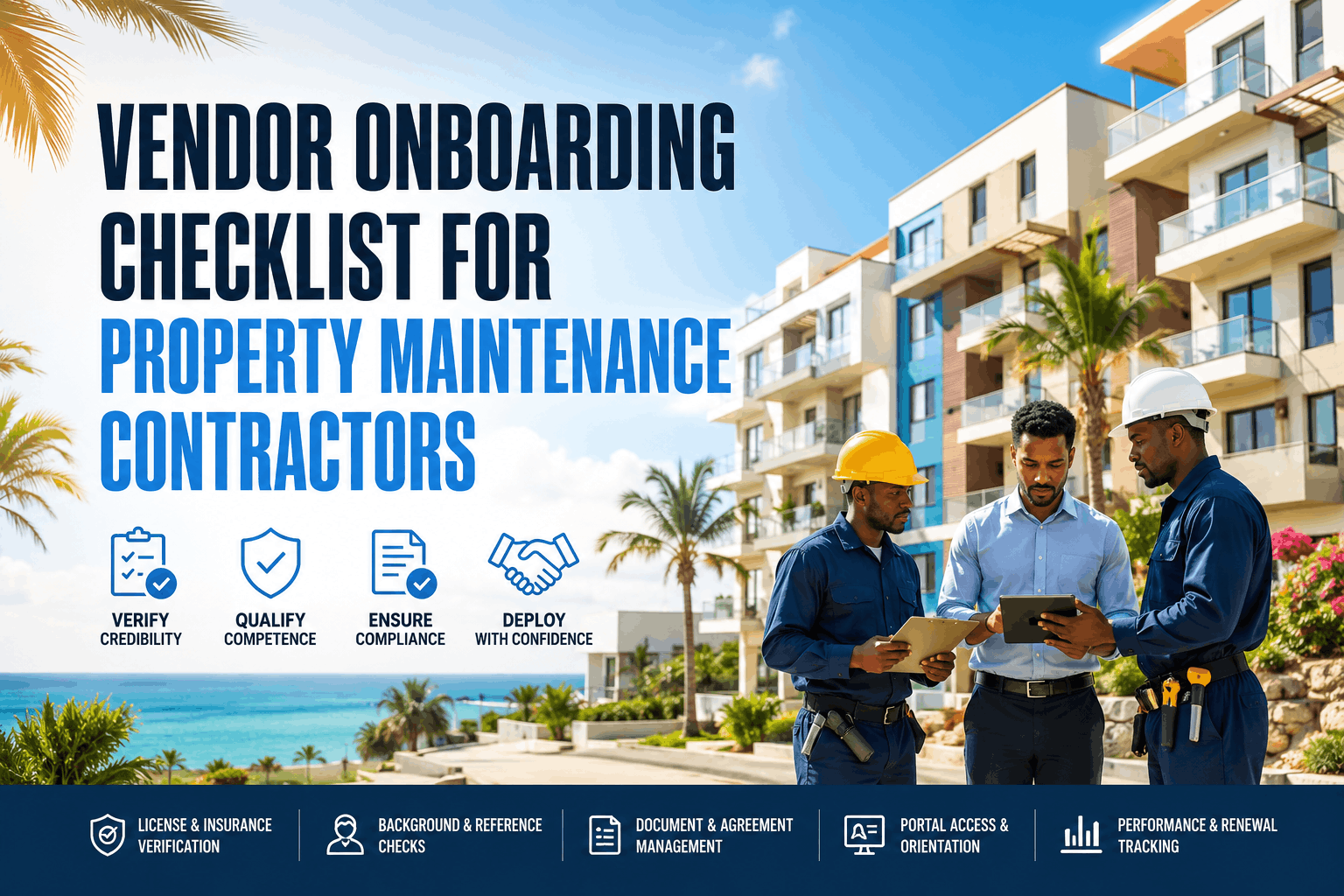
A consistent onboarding process ensures that every vendor who enters the approved vendor pool has cleared the same quality and compliance bar. The framework below represents the minimum viable onboarding sequence for property maintenance vendors. Organizations with higher-risk portfolios or more complex regulatory environments should extend this framework with additional verification steps appropriate to their context. Teams managing large vendor networks can use a platform like OxMaint to digitize and automate each of these steps, eliminating manual follow-up and creating a permanent audit record for every vendor onboarded.
The vendor completes a standardized application providing business information, service categories, geographic coverage, years in operation, and references from comparable clients. Initial qualification screening eliminates vendors who do not meet baseline criteria before investment in deeper review.
Collect and verify general liability insurance certificate, workers' compensation certificate, all applicable trade licenses, business registration documentation, W-9, and any required certifications for specialized work (refrigerant handling, lead abatement, electrical licensing, etc.). Each document should be verified against the issuing authority where possible.
Contact provided client references to verify work quality, reliability, and professional conduct. For vendors whose staff will access tenant units, conduct background screening consistent with applicable local regulations and the property's security standards.
Execute the master service agreement covering payment terms, scope limitations, liability allocation, indemnification, insurance maintenance requirements, and SLA performance commitments. Both parties should sign before any work is assigned.
Enter the vendor into the property management or CMMS platform, configure their service categories, assign their tier designation, establish dispatch contacts, and communicate the work order submission and invoicing procedures. A structured onboarding briefing ensures the vendor understands operational expectations before their first assignment.
Optimizing Vendor Costs Without Sacrificing Quality
Cost optimization in vendor management does not mean selecting the lowest bidder. It means achieving the best value outcome — the right level of service quality at a sustainable price — across the entire vendor portfolio. The most effective cost optimization strategies in property maintenance vendor management work by improving process efficiency, reducing waste from rework and emergency call-outs, and creating competitive tension within the vendor pool without undermining the vendor relationships that deliver reliable service.
Volume consolidation is one of the most immediate cost levers available to property management organizations. Contractors who receive consistent, predictable work volumes from a portfolio-level relationship are typically willing to negotiate preferred pricing that reflects the reduced marketing and business development costs that relationship provides them. Organizations managing multiple properties should aggregate their maintenance spend across the portfolio when negotiating master vendor agreements, rather than allowing each property to negotiate independently.
Preventive maintenance programs, while primarily a risk management tool, also function as a cost optimization mechanism. Properties with structured PM programs for HVAC, plumbing, roofing, and electrical systems consistently incur lower emergency repair costs than properties managed reactively — because the component failures that generate expensive emergency calls are identified and addressed at the routine maintenance stage, when repair costs are a fraction of emergency rates. Vendor management programs that integrate preventive maintenance scheduling into the vendor assignment workflow capture this cost advantage systematically rather than property by property. Organizations looking to model this approach can book a demo to see how integrated PM and vendor scheduling works in practice.
Frequently Asked Questions
What is vendor management in property maintenance?
Vendor management in property maintenance is the structured process of selecting, onboarding, contracting, scheduling, monitoring, and evaluating the external contractors and service providers who perform maintenance work on managed properties. It encompasses credential verification, SLA governance, performance tracking, cost management, and compliance monitoring across the entire vendor network.
What documents should every maintenance vendor provide?
At minimum, maintenance vendors should provide a current general liability insurance certificate with the property management company named as an additional insured, workers' compensation insurance, all applicable trade or contractor licenses, business registration documentation, and tax identification documentation. Vendors whose staff access tenant spaces may also be required to provide background screening results and facility-specific compliance training records.
How often should vendor performance be reviewed?
High-volume vendors with significant operational impact should be reviewed monthly against quantitative KPIs such as on-time rate, completion rate, and rework rate. Formal comprehensive reviews — including SLA compliance assessment, pricing benchmarking, and relationship evaluation — should occur semi-annually for strategic vendors and annually for lower-tier contractors. Ad hoc reviews should be triggered any time performance falls below defined threshold levels.
What is a vendor SLA and why does it matter?
A vendor Service Level Agreement defines the specific, measurable performance commitments a contractor is obligated to meet — including response time windows, completion timeframes, quality standards, and consequences for non-performance. SLAs matter because they replace vague expectations with documented, enforceable standards that give property managers a clear basis for performance evaluation, escalation, and contract decisions.
Can vendor management software replace manual contractor tracking?
Yes — and for organizations managing more than a handful of vendors across multiple properties, digital replacement of manual tracking is strongly recommended. Purpose-built vendor management platforms automate credential expiration monitoring, work order dispatch, performance metric calculation, and invoice matching. This eliminates the administrative overhead of manual tracking, reduces compliance risk from unmonitored credential lapses, and gives management real-time visibility across the entire vendor portfolio.