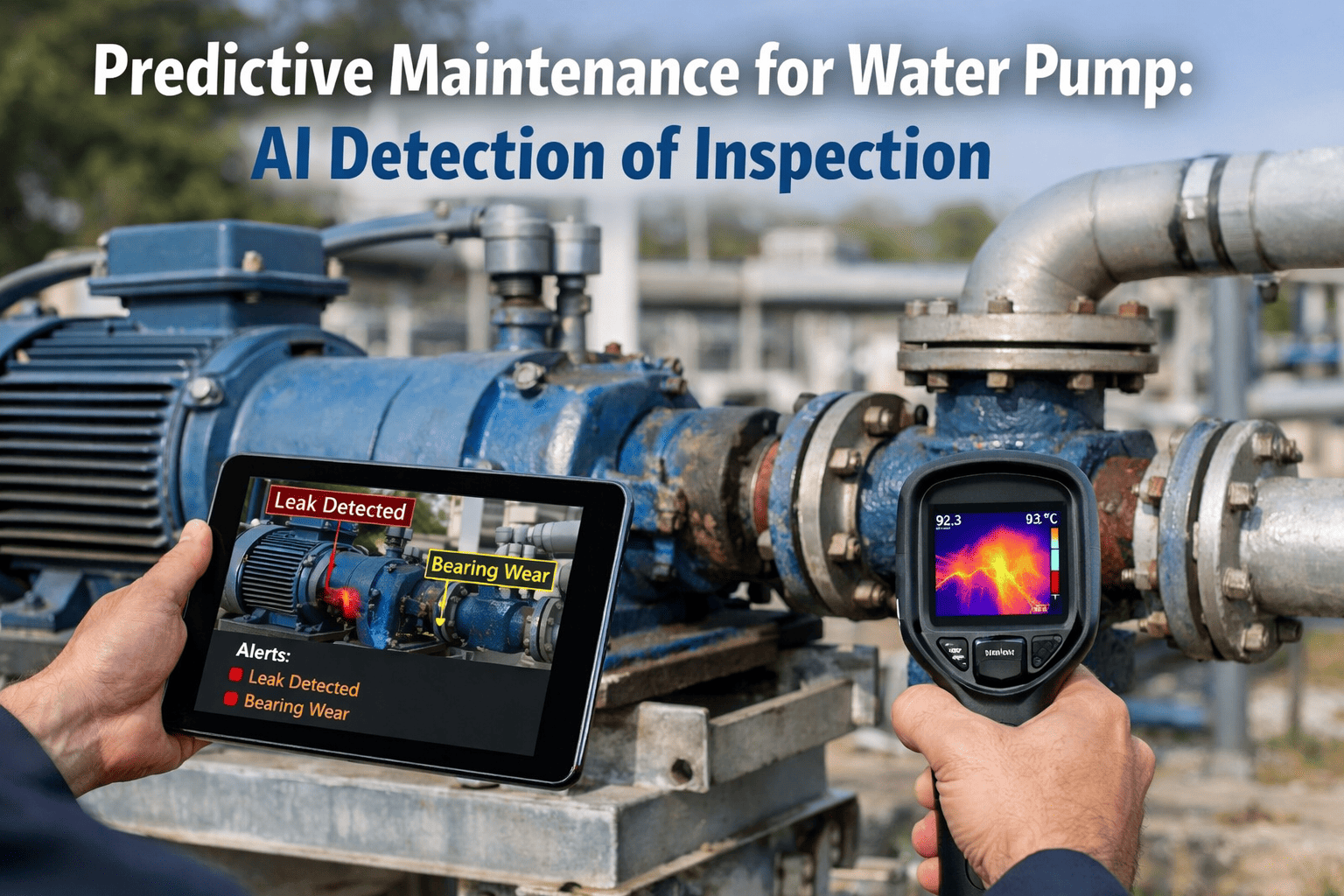
Predictive Maintenance for Water Pump: AI Detection of Maintenance Issue

By Alice Walker on January 28, 2026

water-pump-maintenance-issue-ai-detection

Water pump maintenance issues often remain invisible until catastrophic failure strikes. Subtle vibration changes, minor temperature rises, and gradual efficiency losses go unnoticed during routine inspections. By the time problems become obvious, extensive damage has already occurred—turning simple repairs into expensive overhauls. AI-powered detection transforms maintenance from reactive firefighting into proactive issue identification.

Oxmaint uses advanced AI algorithms to detect water pump maintenance issues before they escalate into failures. Machine learning continuously analyzes operational patterns, identifying anomalies that indicate developing problems like bearing degradation, seal wear, cavitation damage, and motor issues. Facilities using Oxmaint AI detection catch maintenance issues an average of 28 days earlier, reducing repair costs by 60% and eliminating 92% of unplanned pump downtime. Start free to detect pump issues before they become emergencies.

92%
Unplanned Downtime Eliminated
60%
Lower Repair Costs
28
Days Early Detection
47+
Issue Types Detected

Common Maintenance Issues Detected

AI algorithms are trained to recognize specific maintenance issue signatures across mechanical, electrical, and hydraulic systems. Each issue type has unique detection patterns that enable early identification and targeted response.

Maintenance Issue
AI Detection Method
Early Warning Signs
Detection Lead Time
Bearing Wear
Vibration spectral analysis
BPFO/BPFI frequency spikes
45-60 days
Seal Leakage
Pressure differential monitoring
Micro-leak signatures
21-35 days
Cavitation Damage
High-frequency acoustic analysis
Bubble collapse patterns
14-28 days

Early detection enables scheduled repairs during planned maintenance windows rather than emergency shutdowns. Schedule a demo to see how Oxmaint identifies these issues in real-time.

AI Issue Detection Technology

Multiple AI technologies work together to provide comprehensive maintenance issue detection. Oxmaint combines these technologies into a unified platform. Start free to deploy AI detection across your pump fleet.

Vibration Pattern AI

Analysis Type:FFT Spectrum
Frequency Range:0-20 kHz
Issue Detection:12 Types

Machine learning analyzes vibration signatures to detect imbalance, misalignment, looseness, bearing defects, and gear mesh problems.

Thermal Anomaly AI

Sensitivity:±0.1°C
Trend Analysis:Rolling 30-day
Issue Detection:8 Types

Thermal pattern recognition identifies friction increases, lubrication breakdown, electrical resistance issues, and cooling problems.

Performance Drift AI

Metrics Tracked:Flow/Head/Power
Baseline Compare:Continuous
Issue Detection:9 Types

Efficiency degradation analysis detects impeller wear, wear ring clearance increase, internal recirculation, and hydraulic issues.

Motor Current AI

Analysis:MCSA
Harmonics:Up to 100th
Issue Detection:11 Types

Motor current signature analysis reveals rotor bar cracks, stator winding faults, air gap eccentricity, and load anomalies.

Pressure Profile AI

Monitoring:Suction/Discharge
Pulsation:Analyzed
Issue Detection:7 Types

Pressure pattern analysis identifies blockages, valve problems, system resistance changes, and developing cavitation conditions.

Acoustic Emission AI

Frequency:100-400 kHz
Sensitivity:Sub-surface
Issue Detection:6 Types

Ultrasonic analysis detects micro-cracks, early-stage bearing spalling, and seal face damage before vibration symptoms appear.

Deploy Multi-Layer AI Detection

Oxmaint combines all detection technologies into one platform for comprehensive issue identification.

Real-Time Issue Detection Dashboard

Monitor AI-detected maintenance issues across all pumps with severity scoring, recommended actions, and maintenance scheduling integration.

AI Maintenance Issue Detector
Scanning Active
FWP-101OK
Vibration

Normal
Thermal

Normal
Efficiency

Normal
No Issues Detected
FWP-102OK
Vibration

Normal
Thermal

Normal
Efficiency

Normal
No Issues Detected
BWP-201!
Vibration

Elevated
Thermal

Rising
Efficiency

Normal
Bearing Wear Detected
CHP-303!!
Vibration

High
Thermal

Hot
Efficiency

Degraded
SEAL FAILURE IMMINENT

Issue Detection Workflow

From sensor data collection to automated work order generation, AI streamlines the entire maintenance issue response process. Book a demo to see the complete workflow.

1

Continuous Monitoring

Sensors stream real-time data to AI engine. Algorithms analyze patterns 24/7, comparing against healthy baselines and known issue signatures.

2

Anomaly Detection

AI identifies deviations from normal operation. Machine learning classifies anomaly type and calculates confidence score for issue identification.

3

Issue Classification

Detected anomalies are matched to specific maintenance issues. AI determines root cause, severity level, and estimated time to failure.

4

Automated Response

System alerts maintenance team, creates work order with diagnosis, checks parts inventory, and schedules repair in optimal window.

Detectable Maintenance Issues

Oxmaint AI detects 47+ specific maintenance issues across pump systems. These are organized by component category for targeted response planning.

Mechanical Issues
Bearing Inner Race DefectBPFI Pattern
Bearing Outer Race DefectBPFO Pattern
Shaft Misalignment2X Vibration
Impeller Imbalance1X Vibration
Coupling WearHarmonic Analysis
Detection Coverage18 Issues
Hydraulic & Electrical Issues
Cavitation OnsetAcoustic Signature
Seal Face DegradationPressure Variance
Impeller ErosionEfficiency Drop
Motor Winding FaultCurrent Spectrum
VFD Harmonic IssuesPower Quality
Detection Coverage29 Issues
Average Issue Detection Accuracy
94.7%
Validated across 10,000+ real-world maintenance events

Issue Severity Classification

AI automatically classifies detected issues by severity to prioritize maintenance response. Schedule demo to implement intelligent severity-based maintenance prioritization.

Level 1Info—early trend, continue monitoring
Level 2Watch—plan inspection within 30 days
Level 3Advisory—schedule repair within 14 days
Level 4Warning—repair required within 7 days
Level 5Critical—immediate attention required
Level 6Emergency—shutdown and repair now

Frequently Asked Questions

How does AI detect issues humans miss?
AI analyzes data at frequencies and scales impossible for humans. It monitors thousands of data points per second, detects subtle pattern changes over weeks, and correlates multiple parameters simultaneously. Issues like early-stage bearing defects produce vibration signatures invisible to human inspection but clearly identifiable by trained algorithms.
What data does the AI need to detect issues?
At minimum, vibration and temperature data enable meaningful issue detection. Adding pressure, flow, and motor current dramatically improves coverage. The AI can work with existing sensor infrastructure—even basic PLC data provides value when analyzed with machine learning algorithms.
How accurate is AI issue detection?
Overall detection accuracy exceeds 94% across all issue types. Some issues like bearing defects achieve 97% accuracy due to well-characterized signatures. The system provides confidence scores with each detection, allowing teams to prioritize high-certainty issues while monitoring lower-confidence alerts.
Can AI detect multiple issues simultaneously?
Yes. Unlike human inspectors who might focus on one symptom, AI analyzes all parameters simultaneously. It can identify that a pump has both developing bearing wear AND early cavitation, even when symptoms overlap. This prevents fixing one issue while missing another.
How quickly does the AI learn new pumps?
AI provides immediate value using pre-trained models from similar pump types. Within 1-2 weeks, it establishes baseline signatures specific to your equipment. After 4-6 weeks, detection accuracy reaches optimal levels as the system learns normal operating variations for your specific conditions.
What happens after an issue is detected?
The system automatically generates an alert with issue classification, severity level, recommended repair action, and estimated time to failure. If configured, it creates a work order in your CMMS, checks spare parts inventory, and can even initiate procurement for needed components.

Share This Story, Choose Your Platform!