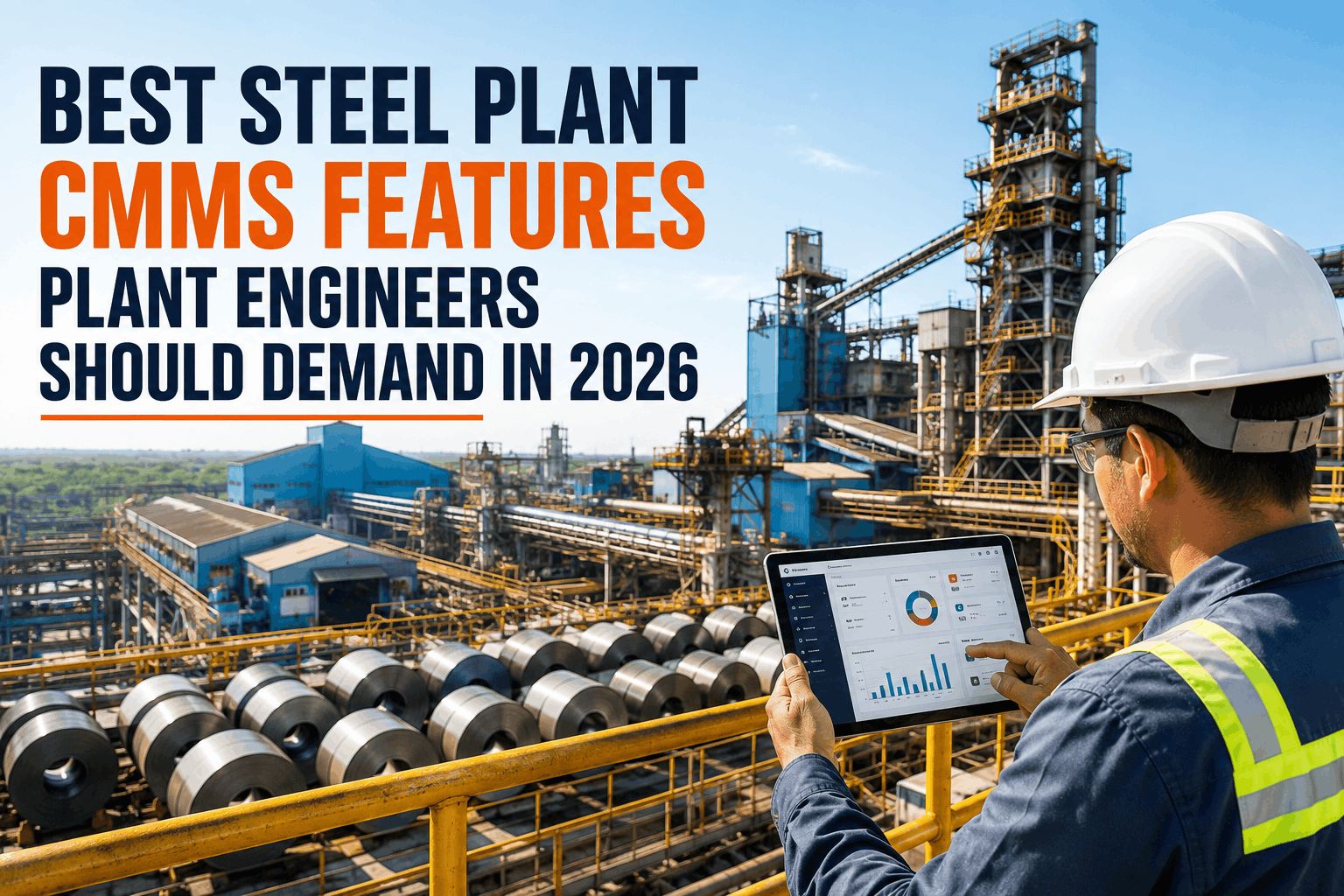
Best Steel Plant CMMS Features Plant Engineers Should Demand in 2026
By Alex Jordan on May 21, 2026
The steel industry's maintenance technology gap in 2026 is not about awareness — every reliability engineer and plant maintenance director in the U.S. understands that reactive maintenance costs 4.8× more per incident than planned work. The gap is in execution: specifically, the gap between the generic CMMS features that vendors advertise and the steel-specific features that actually determine whether a platform can manage a blast furnace campaign, track electrode consumption per heat, handle EAF cooling circuit integrity monitoring, or generate an OSHA 29 CFR 1910.179-compliant crane inspection export on demand. Plant engineers evaluating CMMS platforms for steel operations in 2026 need a feature checklist built for steel — not a repackaged facilities management criteria list. This guide defines the best steel plant CMMS features that plant engineers should demand in 2026, organized by the six technical domains that determine platform adequacy for BF-BOF and EAF production environments: production-variable asset management, predictive maintenance integration, compliance documentation, mobile floor crew execution, ERP connectivity, and AI-driven maintenance intelligence. Oxmaint natively delivers all features in this guide — without add-on modules, custom development contracts, or the $500K+ implementation projects that enterprise alternatives require. Pair this feature evaluation with a review of the 2026 implementation case studies to see which features drove the most measurable outcomes.
Average OEE at U.S. steel plants — world-class is 78–85%, representing $15–45M unrealized value
8
Non-negotiable feature categories that separate steel-grade CMMS from facilities management platforms
$500K+
Implementation cost to get equivalent steel features from Maximo — Oxmaint delivers them free to start
3–5 days
Oxmaint go-live at a steel plant with all demanded features active — no IT project required
The 8 Feature Domains Steel Plant Engineers Must Evaluate
Steel plant CMMS evaluation fails when plant engineers use the same generic feature checklist applied to a facilities management or light manufacturing platform. The 8 feature domains below are the ones that actually determine whether a CMMS will work on a blast furnace platform, inside an EAF bay, or alongside a continuous caster — domains where the feature requirement is fundamentally different from what works in a commercial building or a warehouse. Oxmaint was built to pass evaluation in all 8 domains natively — the features below are not add-on modules or professional services deliverables. They are configuration options available on day one of deployment.
OXMAINT vs GENERIC CMMS — STEEL FEATURE CAPABILITY SCORECARD
Feature Domain
Generic CMMS
Oxmaint
Steel Impact
Production-Variable PM Triggers
Calendar only
Heat-count, tonnage, hours
Eliminates premature and overdue PM — aligns intervals with actual wear physics
Refractory Campaign Tracking
Not available
Per-vessel campaign logic
Prevents missed relines — BOF/EAF/ladle safety and cost control
Mobile Offline Architecture
View-only or limited
100% offline, full DB sync
Floor crew adoption in dead zones — BF, EAF bay, rolling mill pit
This is the single most important differentiating feature for steel plant CMMS selection — and the feature most generic platforms fail. Calendar-based PM scheduling is structurally wrong for steel plant equipment. A blast furnace tuyere doesn't wear by calendar week. It wears by heat count, by hot blast temperature, and by burden distribution patterns. A BOF vessel lining doesn't age by month. It ages by heat processed, by grade mix, and by slag splashing practice effectiveness. A rolling mill stand doesn't degrade by Tuesday. It degrades by tonnes rolled, by rolling force, and by temperature cycle history. Oxmaint allows PM triggers to be configured against any measurable production variable — heat counts, tonnage processed, operating hours, sequence count, or any SCADA-readable parameter. This aligns maintenance intervals with actual equipment wear rather than calendar dates that ignore production variability and generate both premature replacements (wasted capital) and overdue maintenance (failure risk).
Feature Domain 2: BF/BOF/EAF Zone Dashboards
A steel plant maintenance dashboard that shows a list of open work orders sorted by date is not a steel plant maintenance dashboard. Plant engineers need zone-specific views that reflect the production cascade structure of their facility: blast furnace → steelmaking → ladle metallurgy → continuous caster → rolling mill. Each zone carries different criticality logic, different compliance requirements, different asset trigger types, and different technician team assignments. Oxmaint's configurable dashboard hierarchy mirrors the production zone structure of each specific plant — giving maintenance planners a real-time view of work order status, PM compliance, and asset health by zone, while giving floor crew mobile views filtered to their assigned area. Corporate reliability teams see the portfolio-level view; zone supervisors see their zone; technicians see their current shift queue.
Feature Domain 3: AI Predictive Maintenance — What "AI" Actually Means in Steel
In 2026, virtually every CMMS vendor claims AI-powered predictive maintenance. The claim requires scrutiny: a threshold alert that fires when vibration exceeds a fixed value is not AI — it is a conditional rule that industrial control systems have executed for decades. What distinguishes genuine AI predictive maintenance in a steel plant context is multi-parameter model correlation — the ability to identify failure precursors that are invisible to single-parameter threshold monitoring. A rolling mill gearbox health model that fires only when vibration is elevated AND oil particle count is rising AND motor current is above normal is 4–6× more precise than vibration alone. Steel plants running multi-sensor AI models report false-positive rates below 8% versus 35–40% for single-sensor threshold systems. Oxmaint's AI engine correlates vibration, temperature, pressure, current draw, and acoustic data across assets — detecting the subtle multi-parameter signatures that precede failure while filtering the single-parameter noise that generates alert fatigue and technician disengagement.
AI PREDICTIVE MAINTENANCE — THRESHOLD vs OXMAINT ML MODEL
Simple Threshold Alerting
Detection MethodSingle parameter exceeds fixed value
Detection MethodCorrelates vibration + temperature + current + oil simultaneously
False Positive RateBelow 8% — technicians trust and act on every alert
Advance Warning2–8 weeks — sufficient time for planned maintenance scheduling
Failure CoverageSubtle multi-parameter failure signatures invisible to single sensors
ResultHigh precision alerts → high action rate → prevented failures
Feature Domain 4: ERP Integration — Bi-Directional vs One-Way
Nearly every CMMS vendor claims ERP integration. The distinction that matters in a U.S. steel plant context is the difference between a one-way data export (CMMS sends work order data to SAP as a daily batch file) and a true bi-directional real-time sync (work order costs update SAP PM maintenance orders in real time; SAP work center availability updates Oxmaint technician scheduling in real time; asset master data changes in SAP propagate to Oxmaint asset registry automatically). The operational consequence of one-way batch integration is a maintenance-to-finance data lag that can exceed 24–72 hours — creating budget variance reporting that is always behind the current maintenance spend position. Oxmaint's bi-directional SAP PM and Oracle EAM API integration maintains real-time alignment between maintenance execution and financial reporting, eliminating the manual reconciliation sessions that consume finance and maintenance admin teams at month-end close.
"We evaluated five CMMS platforms against our steel plant RFP. Oxmaint was the only one that natively handled heat-count PM triggers for our BOF vessels, had genuine offline mobile for our EAF bay crews, and offered bi-directional SAP PM integration without a six-figure consulting engagement. We were live in four days. No other platform came close to that combination."
Reliability Engineering Manager
Midwest Integrated Steel Operations — 1.8M MTPA, SAP S/4HANA Environment
Frequently Asked Questions
Q1 What CMMS features should plant engineers demand for BF-BOF steel operations in 2026?
The non-negotiable features are heat-count and tonnage PM triggers, per-vessel refractory campaign tracking, individual ladle fleet management, 100% offline mobile with rugged device support, OSHA crane inspection export, and bi-directional SAP PM integration — all of which Oxmaint delivers natively on day one of deployment.
Q2 What is the difference between calendar PM scheduling and production-variable PM scheduling for steel plants?
Calendar scheduling generates both premature and overdue maintenance because steel equipment wears by production throughput, not calendar time — Oxmaint's production-variable triggers align PM intervals with actual heat counts, tonnage processed, and rolling hours, matching maintenance timing to real wear physics and extending asset life 15–25% on average.
Q3 Does Oxmaint integrate with SAP PM or Oracle EAM at U.S. steel plants?
Yes — Oxmaint provides bi-directional real-time API integration with SAP PM and Oracle EAM, syncing work order costs, asset condition records, and maintenance transactions without the manual reconciliation or 24-hour batch file delays that one-way export integrations generate at month-end close.
Q4 What SSO and enterprise authentication options does Oxmaint support for steel plant IT environments?
Oxmaint supports SAML 2.0, Azure Active Directory, and Okta for enterprise single sign-on — meeting the IT security requirements of U.S. steel plant corporate IT environments without custom authentication development or additional licensing costs beyond the standard platform subscription.
Q5 How does Oxmaint's AI predictive maintenance differ from simple threshold alerting for steel plant assets?
Oxmaint's ML models correlate vibration, temperature, current, pressure, and oil analysis data simultaneously — reducing false positive rates below 8% versus the 35–40% false positive rates of single-parameter threshold systems, and detecting failure signatures 2–8 weeks before breakdown rather than hours before collapse.
Q6 What compliance documentation features must a steel plant CMMS generate for OSHA and MSHA?
A steel-grade CMMS must auto-generate OSHA 29 CFR 1910.179 crane inspection records, LOTO procedure sign-offs, confined space and hot-work permit trails, pressure vessel inspection logs, and NFPA fire system records — all exportable as audit-ready PDFs within 2 minutes for any asset, date range, or inspection type.
Q7 How important is electrode consumption tracking as a CMMS feature for EAF mini-mills?
Electrode tracking is the highest-value EAF-specific CMMS feature — at $30,000–$80,000 per electrode set, per-heat consumption data builds the operating practice dataset that enables 8–15% consumption optimization, with documented savings of $380,000 per year at a single Indiana EAF mini-mill in 2026.
Q8 What should plant engineers specifically test during a steel plant CMMS demo or RFP evaluation?
Demand a live demonstration of offline work order completion without network connectivity, a heat-count PM trigger configuration for a BOF or ladle asset, an OSHA crane inspection export from a sample asset, and the sensor-to-work-order automation flow from a simulated IoT threshold breach to an assigned field work order.
Evaluate Oxmaint Against Your Steel Plant RFP — Free
Every feature in this guide is available in Oxmaint from day one — no add-on modules, no consulting contracts, no implementation fee. Live at your U.S. steel plant in 3–5 days.

.png)