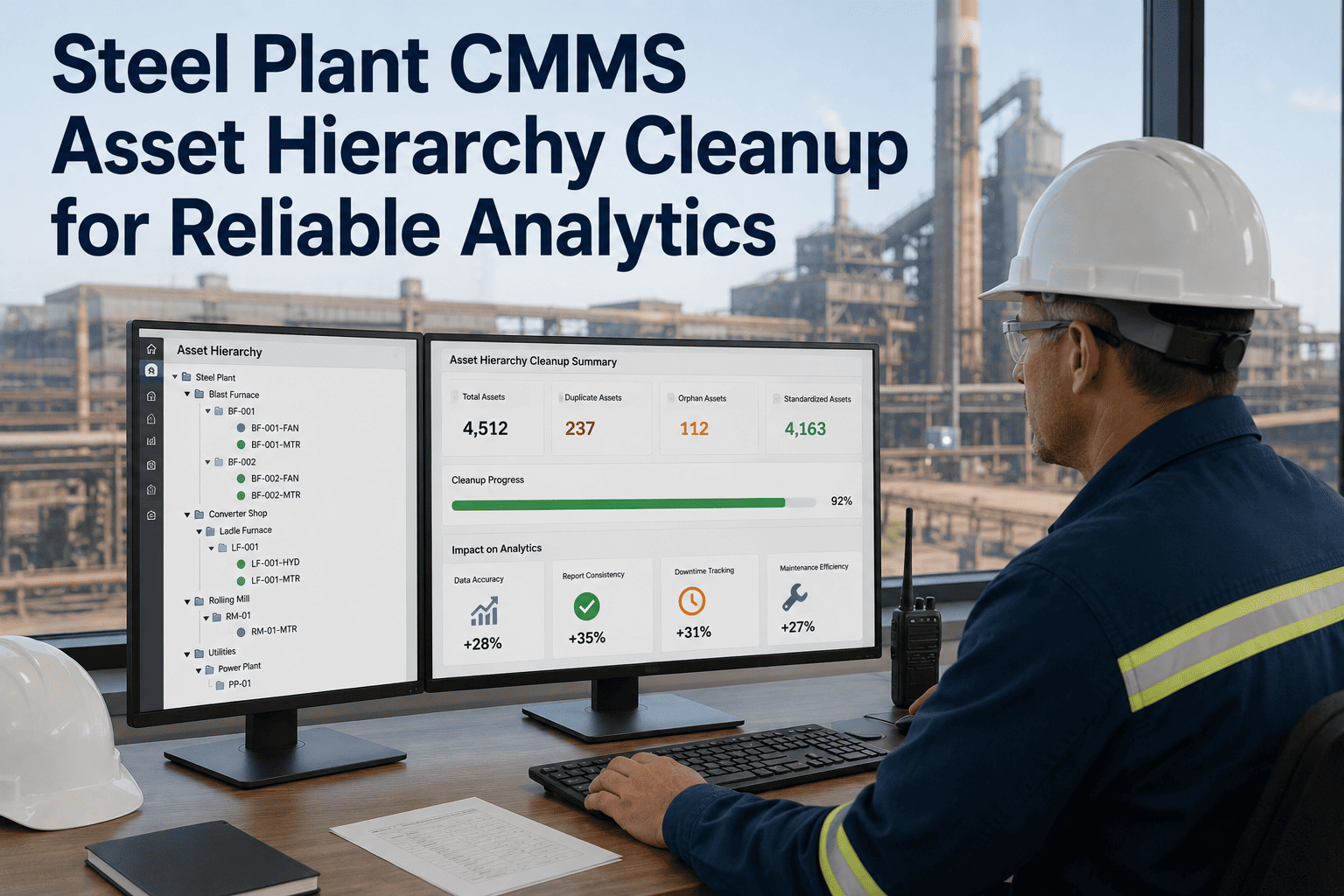
Every steel plant CMMS implementation begins or ends with a single decision that no software vendor can make for you: what is your asset hierarchy structure? An EAF melt shop with 400 assets organized as a flat list of equipment names is not an asset register — it is an unsearchable inventory. A blast furnace complex with assets entered by 12 different maintenance foremen over 30 years, each using a different naming convention, is not a taxonomy — it is organized confusion that will produce incoherent KPIs, unmatched spare parts records, and PM schedules that cannot be exported for ISO 55001 audit compliance. The steel plant asset hierarchy template that you build before your CMMS implementation — or import into Oxmaint from this free 5-tier framework — determines whether your CMMS produces actionable maintenance intelligence or simply digitizes the same disorganized data that paper ran before. This free steel plant asset hierarchy covers all six major production and utility areas of an integrated or EAF-based U.S. steel plant: blast furnace complex, steelmaking (BOF and EAF), continuous casting, rolling mills, finishing and processing lines, and utilities — structured across five tiers from plant site to component level, following ISO 14224 asset classification principles adapted for steel manufacturing environments. Sign Up Free to import this 5-tier hierarchy directly into Oxmaint as your CMMS asset register foundation — pre-built asset templates, failure code library, and PM checklists are ready to assign to each hierarchy node from day one.
This steel plant asset hierarchy template covers BF, BOF, EAF, caster, rolling mill, and utilities across 5 tiers. Use it as your CMMS asset register foundation — or import it directly into Oxmaint where pre-built PM templates and failure codes are ready to assign at every hierarchy node.
Why Steel Plant Asset Taxonomy Failures Are the #1 CMMS Implementation Killer
A steel plant CMMS asset hierarchy is not a cosmetic organizational choice. It is the data architecture that determines whether your CMMS can produce cross-asset failure trend analysis, meaningful MTTR benchmarks, accurate spare parts demand forecasting, and ISO 55001-compliant asset management records. These are the six ways a flat or inconsistent steel plant asset taxonomy silently destroys the business case for every CMMS investment in U.S. steel manufacturing.
Problem #1
Flat Asset Lists Kill KPI Comparability
A CMMS where the blast furnace tuyere cooler TY-04 and the cooling tower fan CT-17 both appear at the same organizational level cannot produce process-area MTTR analysis, production-impact criticality scoring, or PM compliance rates that mean anything to a maintenance manager who thinks in terms of process areas rather than alphabetical equipment lists. A 5-tier hierarchy enables every KPI to be sliced from plant level down to individual component — and back up to production area for corporate reporting.
When the Indiana plant calls them "Hot Blast Valves," the Ohio plant calls them "HBVs," and the Pennsylvania plant calls them "Blast Furnace Inlet Valves," no cross-site failure trend analysis is possible. A standardized steel plant asset breakdown structure with enforced naming conventions — applied at the system and equipment tiers — is what allows a steel group's CMMS to identify that the same valve seal failure is occurring at three plants before the fourth failure triggers an emergency replacement campaign at $180,000 per event.
Problem #3
Spare Parts Can't Link to Asset Records
A spare parts catalog that lists "Bearing, 6308-2RS" without linking the bearing to the specific equipment and component position that uses it cannot drive demand forecasting, reorder point calculation, or cross-site transfer recommendations. Oxmaint's 5-tier steel plant asset structure ensures every spare part in the storeroom is linked to the specific equipment and component it serves — enabling automatic reorder alerts when critical spares reach minimum stock levels and cross-site transfer recommendations before emergency procurement is triggered.
Problem #4
ISO 55001 Audit Trails Require Asset Hierarchy
ISO 55001 asset management system certification requires that every maintenance action be traceable to a defined asset with an unambiguous location in the asset hierarchy — from the portfolio or plant level down to the component on which work was performed. A CMMS with a flat asset list cannot produce this evidence. U.S. steel producers pursuing ISO 55001, ISO 14001, or insurance carrier certification for advanced maintenance programs must have a 5-tier structured hierarchy in place before the certification audit begins.
Problem #5
PM Schedules Can't Follow Production Variables
Oxmaint's production-aware PM triggers — which adjust inspection intervals based on actual throughput data from SCADA — require the target asset to be structured with a parent equipment and production area assignment. A hot strip mill coiler drive bearing with a throughput-based PM trigger needs to know its parent system (Coiler Area), its production area (Hot Strip Mill), and its process criticality — none of which can be calculated from an equipment name alone without a defined 5-tier hierarchy.
Problem #6
No Criticality Scoring Without Hierarchy Context
Maintenance criticality ranking requires knowing an asset's production impact — which is a function of its position in the production cascade. A tuyere cooler failure on a blast furnace producing 3,000 tons/day has a fundamentally different production impact than a tuyere cooler failure on a mothballed furnace in reserve standby. Without a plant hierarchy that places assets in their production context, criticality scores are guesses rather than calculations — and work order prioritization breaks down at the first multi-failure event.
The diagram below shows the 5-tier hierarchy structure applied to a U.S. steel plant, with a detailed branch showing the Blast Furnace Area from Plant level through to Component level. The same structure is applied consistently to every process area: Steelmaking (BOF/EAF), Continuous Casting, Rolling Mills, and Utilities. This is the steel plant asset structure that Oxmaint uses as its pre-built import template.
Steel Plant 5-Tier Asset Hierarchy — Structure with BF Area Detailed Branch
The 5 Tiers Defined — Steel Plant Asset Hierarchy Standard
Each tier in the Oxmaint steel plant asset hierarchy template carries a defined set of required fields, naming conventions, and data points that ensure every downstream CMMS function — from PM scheduling to ISO 55001 audit exports — works correctly without manual intervention. Schedule a hierarchy configuration session to see how your existing asset register maps to this 5-tier standard.
Tier 1
Plant / Site
The top-level container for all assets at a geographic location. For multi-site groups, each plant site is a separate Tier 1 node within the corporate Oxmaint hierarchy. Required fields: Site name, address, plant type (integrated / EAF / service center), annual capacity, primary contact, and applicable regulatory jurisdiction (OSHA PSM, EPA Tier II). All KPIs, PM compliance rates, and cost metrics roll up to Tier 1 for corporate reporting.
The major production or utility area within the plant — the level at which maintenance supervisors, shift managers, and area maintenance engineers organize their operations. Production areas define the PM compliance reporting boundary and the MTTR calculation scope for each operational zone. Tier 2 nodes are the primary organizational layer for Oxmaint's work order dispatch and maintenance scheduling workflows.
Standard Areas: BF Complex · BOF / EAF Shop · Continuous Caster · Hot Strip Mill · Cold Mill · Finishing Lines · Utilities · Material Handling · Infrastructure
Tier 3
System
A functional grouping of equipment within a production area that performs a defined sub-process. Systems are the level at which failure mode libraries, PM template assignments, and spare parts allocation are organized. All PM schedules in Oxmaint are assigned at the system or equipment level — with parent system context used for criticality scoring and production impact calculations. System names must follow the standardized naming convention to enable cross-site failure pattern analysis.
BF Examples: Hot Blast System · Casthouse · Tuyere Cooling · Charging System · Stove Battery · Gas Cleaning · Dust Collection
Tier 4
Equipment
The individual piece of equipment or machine — the level at which work orders are created, PM schedules are executed, and maintenance history is recorded. Every Tier 4 equipment record in Oxmaint carries: equipment ID, OEM manufacturer, model number, serial number, installation date, commissioning date, criticality rating, associated spare parts, applicable failure codes, and maintenance history. Sensor data and robotic inspection findings are linked to Tier 4 equipment records for AI predictive analysis.
The individual sub-component or assembly within an equipment item — the level at which condition-based maintenance, remaining useful life predictions, and component-level failure mode analysis are recorded. Not all Tier 4 equipment requires Tier 5 component records — only assets with condition monitoring programs, sensor data, or high-frequency failure components (bearings, seals, electrodes, refractory segments) warrant component-level decomposition. Component records enable Oxmaint's AI model to build degradation curves per specific component position.
ISO 14224-aligned hierarchy depth covering Plant → Area → System → Equipment → Component for all steel plant process areas
200+
Pre-built PM checklists in Oxmaint ready to assign to hierarchy nodes from day one — BF, EAF, caster, rolling mill, utilities
2 Hours
Typical time to import a complete steel plant asset register from legacy spreadsheet into Oxmaint using pre-formatted CSV template
17.8%
MRO inventory cost reduction when spare parts are linked to asset hierarchy — enabling cross-site transfer before emergency procurement
Complete 5-Tier Asset Hierarchy Template — By Process Area
The following section contains the actual asset hierarchy content for each major steel plant process area. Copy these templates into your CMMS import spreadsheet, adapt asset IDs to your plant's naming convention, and import directly into Oxmaint via CSV upload. Oxmaint's implementation team will review your import file and confirm taxonomy compliance before any PM templates are assigned.
Flat/Inconsistent Asset List vs Oxmaint 5-Tier Structured Hierarchy
Flat / Inconsistent Asset List
"Valve-BF-1," "BF Valve 1," "Blast Valve HBV01" — three entries for the same asset, no parent assignment
No process area grouping — blast furnace and utility assets share the same list level
Spare parts catalog not linked to equipment — bearing part number has no asset association
PM scheduled on equipment name alone — no system context, no criticality weighting
MTTR calculated across all equipment — blast furnace and compressed air at same level
ISO 55001 audit requires manual traceability reconstruction — no hierarchy = no evidence path
AI sensor data has no equipment record to link to — predictive maintenance cannot function
Oxmaint 5-Tier Steel Plant Hierarchy
HBV-01 linked to Hot Blast System → BF Complex → Pittsburgh Works — unambiguous and searchable — Sign Up Free
Tier 2 production areas enable per-area KPIs: BF MTTR separate from Utilities MTTR
Every spare part linked to Tier 4 equipment and Tier 5 component — demand forecasting enabled
PM assigned at system level with equipment criticality weighting — priority calculated automatically
MTTR by production area, by system, by equipment category — each filterable for corporate reporting
ISO 55001 audit trail complete: every WO traces Plant → Area → System → Equipment → Component
AI sensor data linked to Tier 4/5 records — remaining useful life predictions by component position
Your Asset Hierarchy Is the Foundation. Get It Right From Day One.
Oxmaint's pre-built 5-tier steel plant asset templates cover BF, EAF, BOF, caster, rolling mill, and utilities — importable via CSV in under 2 hours. Book a hierarchy configuration session to see your specific plant's asset register mapped to the 5-tier standard with PM templates assigned at every node.
What a Steel Plant Reliability Engineer Says About Oxmaint Asset Taxonomy
"
We spent four months trying to build our own Excel-based asset hierarchy for a 620-asset EAF melt shop and caster complex in southern Ohio before we discovered that Oxmaint already had the 5-tier template pre-built for our process areas. We imported our asset register in a single CSV upload, mapped our existing IDs to the hierarchy, and had PM templates assigned across all critical assets within 48 hours. The hierarchy structure is exactly what our ISO 55001 certification auditor required — the traceability from component up to site level through the hierarchy is what made our first surveillance audit a pass rather than a finding.
What is a steel plant 5-tier asset hierarchy and why does the number of tiers matter?
A 5-tier steel plant asset hierarchy structures assets from Plant Site (Tier 1) through Production Area (Tier 2), System (Tier 3), Equipment (Tier 4), and Component (Tier 5) — creating a connected data model where every maintenance action, spare part, and sensor reading is traceable to its exact physical location in the production process. Fewer than 5 tiers typically loses the System and Component levels needed for ISO 55001 compliance, failure mode analysis, and AI predictive maintenance — while more than 5 tiers creates administrative overhead that steel plant maintenance teams will not sustain.
What ISO standard governs steel plant asset hierarchy structure?
ISO 14224 provides the international standard for asset classification and data collection in industrial environments and is the reference framework for steel plant asset taxonomies. ISO 55001 (Asset Management Systems) requires that every maintenance action be traceable to a defined asset within a documented asset hierarchy — making the 5-tier structure a practical prerequisite for ISO 55001 certification in U.S. steel plant environments. Oxmaint's pre-built hierarchy templates align with both standards.
How do I import an existing asset register into Oxmaint's 5-tier hierarchy?
Oxmaint's CSV import template has five column groups corresponding to each tier level — you populate the columns from your existing spreadsheet or legacy CMMS export, map each existing asset record to its correct tier position, and upload the file. The import wizard validates tier completeness and naming convention compliance before finalizing the import. Oxmaint's implementation team provides a mapping guide and a 60-minute data review session to help complete the import — most steel plant asset registers of 200–800 assets are imported in 2–4 hours.
Does the 5-tier hierarchy template cover both integrated steel plants and EAF mini-mills?
Yes. Oxmaint provides two base hierarchy variants: an integrated steel template covering BF → BOF → Caster → HSM → Cold Mill → Finishing with all applicable system and equipment sub-levels, and an EAF mini-mill template covering EAF → LMF → Caster → Rolling with electrode management, scrap handling, and fume extraction systems pre-populated. Both templates include the Utilities area (Tier 2) covering gas plants, compressed air, cooling water, and power distribution, and both are importable via CSV with equipment IDs mapped to your plant's existing numbering scheme.
How does the asset hierarchy connect to PM scheduling in Oxmaint?
PM schedules in Oxmaint are assigned at Tier 3 (System) or Tier 4 (Equipment) level, with scheduling frequency determined by the equipment's criticality rating (derived from its Tier 2 production area assignment and Tier 4 criticality score). Production-aware PM triggers use the Tier 2 production area's SCADA throughput data to dynamically adjust inspection intervals based on actual operating load — so a rolling mill bearing's PM is triggered by tonnage rolled rather than calendar date, and both the trigger and the PM record carry the complete 5-tier hierarchy context for ISO 55001 traceability.
What fields are required at each hierarchy tier in Oxmaint's steel plant template?
Tier 1 (Plant) requires: site name, type, location, regulatory jurisdiction, and primary contact. Tier 2 (Area) requires: area name, area type, production criticality class, and area maintenance engineer. Tier 3 (System) requires: system name, functional description, and applicable failure code library. Tier 4 (Equipment) requires: equipment ID, OEM, model, serial number, installation date, criticality rating, and spare parts BOM. Tier 5 (Component) requires: component position ID, component type, and condition monitoring method. All required fields are enforced at import time — Oxmaint will not accept a CMMS import file with missing required fields at critical tiers.
How many assets should a U.S. integrated steel plant typically have in its CMMS hierarchy?
A complete integrated steel plant CMMS hierarchy typically contains 800–3,500 Tier 4 equipment records across all process areas — with critical plants tracking 500–1,500 additional Tier 5 component records for condition-monitored assets. U.S. EAF mini-mills typically range from 150–600 Tier 4 records depending on downstream product complexity. Steel service centers range from 40–250 records per processing location. Oxmaint supports unlimited hierarchy depth and asset count at all paid tiers, and the free tier allows up to 50 assets for evaluation purposes before a full import commitment.
Can Oxmaint's asset hierarchy support multi-site steel groups with different process areas at each plant?
Yes. Oxmaint's multi-site hierarchy model places each plant as a separate Tier 1 node within the corporate group — each plant inherits the group's Tier 2 standardized production area taxonomy and Tier 3 system naming conventions, but can add plant-specific equipment at Tier 4 that exists only at that location. Corporate reporting rolls up from all Tier 1 plants into the group dashboard — with each plant's unique asset configuration visible at the site level and group-comparable KPIs produced using the standardized Tier 2 and Tier 3 structure that makes cross-site analysis meaningful.
Stop Building Your Asset Hierarchy in Spreadsheets. Import It Into Oxmaint in Hours.
Oxmaint's pre-built 5-tier steel plant hierarchy templates — covering BF, EAF, BOF, caster, rolling mills, and utilities — give your CMMS implementation the data foundation it needs from day one. Sign Up Free and access the CSV import template today. Or book a hierarchy mapping session to see your existing asset register configured into the 5-tier standard with an Oxmaint steel plant specialist.