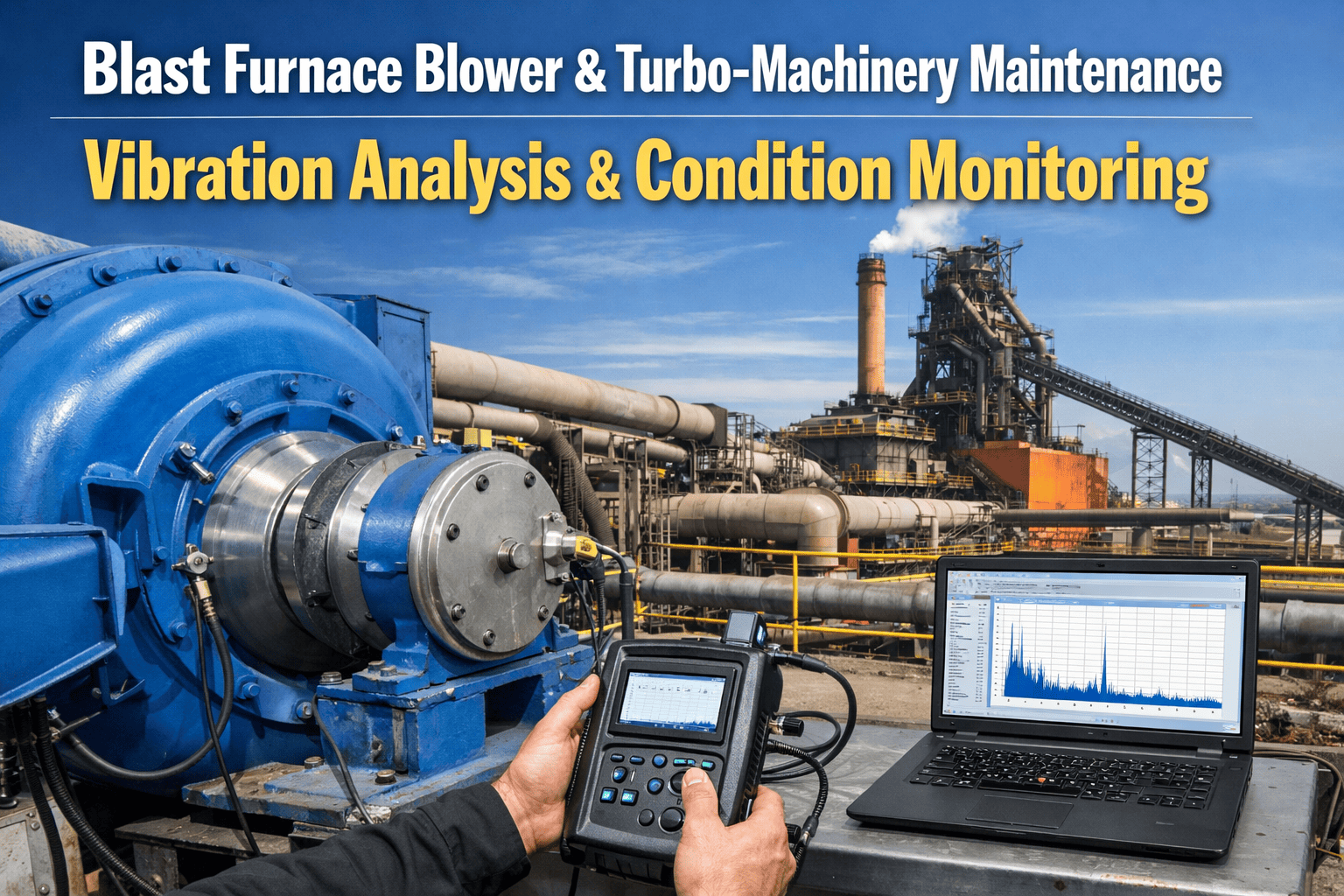
Your blast furnace blower is the single most critical rotating machine in the entire steel plant. Not the most expensive. Not the most complex. The most critical — because when it stops, everything stops. The blast furnace loses wind pressure. Within minutes, the burden starts to hang. Within an hour, the furnace is banking. Within four hours, you're looking at a 24–72 hour recovery that costs $2–$8 million in lost production, wasted energy, and refractory damage from thermal cycling. And the blower doesn't fail gracefully. It doesn't slow down and give you a week's notice. A bearing seizure, a blade failure, a coupling fracture — these happen at 3,600 RPM under thousands of horsepower, and they go from "detectable vibration anomaly" to "catastrophic shutdown" in days or hours, not weeks. The turbo-machinery supporting an integrated steel plant — blast furnace blowers, oxygen plant compressors, BOS gas recovery turbines, power generation turbines, and process gas compressors — represents $50–$200 million in installed equipment value. But the replacement cost is trivial compared to the production cost of losing any one of them unexpectedly. Predictive maintenance for turbo-machinery isn't a reliability initiative. It's a production survival strategy. The technology to detect every common failure mode 3–12 months before catastrophic failure exists today and has been proven in thousands of installations. The only question is whether you're using it — or whether you're betting millions of dollars of daily production on the hope that today isn't the day something lets go at 3,600 RPM.
$2M–$8M
cost of a single unplanned
blast furnace blower failure
3,600
RPM
Operating speed where "detectable anomaly" becomes "catastrophic failure" in days, not weeks
24–72
hours
Blast furnace recovery time after an unplanned blower trip — every hour costs $100K–$300K
3–12
months
Advance warning that predictive monitoring provides for every major turbo-machinery failure mode
The Turbo-Machinery That Keeps a Steel Plant Alive
These aren't just "rotating equipment." They're the heart, lungs, and circulatory system of the entire operation. Lose any one of them without warning and production doesn't slow down — it stops. Facilities that sign up to centralize their turbo-machinery maintenance and monitoring data build the predictive foundation that turns catastrophic surprises into planned maintenance events.
Blast Furnace Blower
CRITICALITY: MAXIMUM
Axial or centrifugal compressor delivering 4,000–7,000 m³/min of air at 3–5 bar to the blast furnace tuyeres. Typical drive: 15,000–40,000 HP synchronous motor or steam turbine. No redundancy at most plants — one blower per furnace, zero backup. Failure = furnace bank = $2M–$8M per event.
Unplanned failure impact: Immediate blast furnace bank. 24–72 hour recovery. Cascading impact to BOF, caster, and rolling mill within 4–8 hours. Total cost: $2M–$8M including production loss, energy waste, refractory thermal shock, and recovery labor.
Oxygen Plant Main Air Compressor
CRITICALITY: MAXIMUM
Multi-stage centrifugal compressor feeding the air separation unit that produces oxygen for the BOF. Typical rating: 8,000–20,000 HP. Oxygen supply interruption forces BOF to natural draft operation (dramatically reduced throughput) or complete stop within the oxygen storage buffer duration — typically 2–8 hours.
Unplanned failure impact: BOF throughput reduced 50–70% or stopped entirely. Caster and mill cascade within buffer duration. Total cost: $1M–$4M per event depending on oxygen storage capacity and alternative supply availability.
BOS Gas / BF Gas Recovery Turbines
CRITICALITY: HIGH
Top-pressure recovery turbines (TRT) on the blast furnace and gas expansion turbines recovering energy from steelmaking off-gas. Generate 15–40 MW of electrical power. Failure doesn't stop production directly but eliminates self-generated power, forcing full grid dependency and $20K–$80K/day in additional energy costs.
Unplanned failure impact: $20K–$80K/day in energy cost increase. Gas bypass through pressure letdown valves wastes recoverable energy. Environmental compliance risk from flaring. Extended outage if rotor damage requires off-site repair: 4–12 weeks.
Power Plant Steam Turbine-Generators
CRITICALITY: HIGH
On-site power generation from blast furnace gas, coke oven gas, and BOF gas. Typical capacity: 50–200 MW across multiple units. Provides 40–80% of plant electrical demand. Individual turbine failure reduces self-generation capacity, increases grid purchase, and can trigger load-shedding of non-critical processes during peak demand periods.
Unplanned failure impact: $15K–$60K/day in energy cost increase per unit. Risk of plant-wide load shedding during grid constraints. Rotor repair timeline: 6–16 weeks if sent to OEM facility.
Every one of these machines is telling you exactly when it's going to fail.
The only question is whether you're listening.
The Six Failure Modes Predictive Maintenance Catches
Turbo-machinery fails in well-understood, well-documented patterns. Each failure mode produces a specific, detectable signature months before catastrophic damage occurs. The monitoring technology is not experimental — it's been proven across tens of thousands of turbo-machinery installations worldwide over four decades.
01
Bearing Degradation
Journal bearings and thrust bearings supporting the rotor at speeds of 3,000–10,000 RPM. Failure modes include babbitt fatigue, oil film breakdown, contamination-induced wear, and thrust overload from process upsets.
Detection method: Proximity probe vibration monitoring (shaft relative displacement), bearing metal temperature trending, and oil debris analysis. Bearing defects are detectable 6–12 months before failure through sub-synchronous vibration patterns and temperature rise trends.
Warning time: 6–12 months at early detection, 1–4 weeks at advanced degradation, hours at imminent failure
02
Rotor Imbalance & Shaft Bow
Uneven mass distribution from blade erosion, deposit buildup, coupling misalignment, or thermal bow during startup/shutdown transients. Produces 1× vibration at running speed that increases progressively.
Detection method: Synchronous (1×) vibration amplitude and phase trending from permanent proximity probes. Phase angle changes distinguish imbalance from other 1× sources (bow, coupling). Bode and polar plots during startup/shutdown reveal thermal sensitivity.
Warning time: 3–12 months for progressive imbalance, immediate detection for sudden events (blade loss, deposit shedding)
03
Blade & Impeller Damage
Erosion from dust-laden blast furnace gas, corrosion from moisture and chemical attack, fatigue cracking from resonant vibration, and foreign object damage. Blade failures at operating speed release fragments with enormous kinetic energy — secondary damage can destroy the entire machine.
Detection method: Blade passing frequency (BPF) analysis, sideband patterns around BPF indicating individual blade damage, performance degradation monitoring (pressure ratio vs. flow vs. power), and borescope inspection during planned outages.
Warning time: 3–6 months for erosion/corrosion, 2–8 weeks for fatigue cracking via BPF pattern changes
04
Seal System Degradation
Labyrinth seals, carbon ring seals, and dry gas seals that prevent process gas leakage along the shaft. Wear increases internal leakage, reducing machine efficiency and contaminating bearing oil. Catastrophic seal failure can cause bearing damage from oil contamination or process gas release.
Detection method: Seal leakage flow measurement, bearing oil contamination analysis (gas-in-oil), inter-stage pressure differential trending, and machine performance monitoring showing efficiency degradation not attributable to blade condition.
Warning time: 2–6 months through efficiency trending, immediate detection through seal leakage monitors
05
Coupling & Alignment Failure
Gear couplings, disc couplings, and diaphragm couplings connecting drivers to driven machines. Misalignment from foundation settlement, thermal growth, or piping strain produces 2× vibration, coupling wear, and bearing overload. Coupling failure disconnects the driver from the compressor instantly.
Detection method: 2× vibration trending, axial vibration amplitude monitoring, coupling element inspection during outages, and laser alignment verification. Thermal growth alignment checks under operating conditions versus cold alignment data.
Warning time: 3–12 months for progressive misalignment, 1–4 weeks for coupling element fatigue
06
Lubrication System Failure
Oil pumps, coolers, filters, reservoirs, and control valves that maintain the lubricant film between rotating and stationary components. Total oil supply loss causes bearing failure within 30–90 seconds at full speed. Partial degradation (contamination, overheating, low flow) causes accelerated bearing wear over weeks to months.
Detection method: Oil pressure, temperature, and flow trending at each bearing. Oil analysis (particle count, water content, viscosity, wear metals). Pump vibration monitoring. Filter differential pressure trending. Cooler effectiveness monitoring.
Warning time: Months for contamination and degradation, seconds for catastrophic supply loss (requires automatic trip systems, not predictive maintenance)
Predictive Data Without Maintenance Action Is Just an Expensive Way to Watch Equipment Fail.
OxMaint connects turbo-machinery monitoring to maintenance execution — when vibration trends cross thresholds or oil analysis flags contamination, the system generates a work order with the right priority, the right parts, and the right procedure. Detection becomes prevention. Automatically.
The Monitoring Architecture for Steel Plant Turbo-Machinery
Turbo-machinery monitoring in steel plants requires a layered approach — continuous online protection systems that prevent catastrophic damage in real time, combined with predictive analytics that identify developing problems months before they reach the protection threshold.
Protection Layer — Millisecond Response
Machine Protection System (API 670)
Continuous monitoring with automatic trip capability. Proximity probes on every bearing measure shaft vibration, position, and speed. Thrust position probes detect axial displacement. Temperature sensors on every bearing shoe and seal. When any parameter exceeds the trip setpoint, the machine shuts down automatically — faster than any human can react — preventing secondary damage from a failure in progress.
Shaft vibration — trip at 125µm or 2× alert level
Thrust position — trip at ±0.5mm from normal
Bearing temperature — trip at 120°C or rate-of-rise alarm
Speed — overspeed trip at 110% rated RPM
Predictive Layer — Days to Months Warning
Condition Monitoring & Analytics Platform
The same sensor data used for protection is also analyzed for subtle trends invisible to threshold-based systems. Vibration spectrum analysis detects bearing defects, blade damage, misalignment, and seal degradation at amplitudes far below trip levels. Performance analytics track efficiency degradation. Oil analysis identifies wear patterns. The predictive layer turns "the machine is still running" into "the machine will need intervention in 3 months."
Spectrum analysis — subsynchronous, synchronous, and harmonic patterns
Performance trending — pressure ratio, flow, power, efficiency vs. baseline
Oil analysis — wear metals, particle count, water content, viscosity
Transient analysis — startup/shutdown Bode and polar plot trending
Action Layer — Predictive to Preventive
CMMS Integration & Work Order Generation
This is where most steel plants fail. They have the sensors. They have the data. They have the analytics. But the connection between "we detected a developing problem" and "we scheduled and executed the repair" runs through emails, meetings, and manual work order creation — adding weeks of delay to a process that should take minutes. CMMS integration closes this gap automatically.
Alert → work order — automatic generation with severity-based priority
Parts staging — BOM-linked spare parts reserved at work order creation
Outage planning — predictive work orders fed into next planned outage scope
Trend history — full condition history linked to asset record in CMMS
You already have the sensors. You probably have the analytics.
What you're missing is the connection between detection and action.
The Money: Predictive Maintenance ROI for Steel Plant Turbo-Machinery
$11.5M
estimated annual value — integrated steel mill
$6.2M
Avoided Catastrophic Failures
Prevention of 1–3 major turbo-machinery failures per year × $2M–$8M cascade cost per event
$2.8M
Extended Component Life
Running bearings, seals, and blades to actual condition-based end-of-life extends intervals 30–60% vs calendar replacement
$1.5M
Optimized Outage Timing
Condition data enables scheduling turbo-machinery overhauls during planned outage windows rather than emergency stops
$600K
Secondary Damage Prevention
Early bearing intervention prevents rotor damage, seal destruction, and casing erosion — avoiding $500K–$2M repair bills
$400K
Energy Efficiency Recovery
Performance monitoring detects efficiency degradation from blade erosion, seal leakage, and fouling — triggering cleaning/repair before energy waste accumulates
What I'd Tell Every Steel Plant Reliability Manager
"
I've been monitoring turbo-machinery in steel plants for 22 years. I've watched three blast furnace blowers go down unplanned. Each one cost more than every penny we've ever spent on predictive monitoring across the entire career of our program. Combined.
The hardest lesson
Having the data isn't enough. Our first blower failure happened with a fully functional monitoring system installed. The vibration analyst saw the bearing defect developing. He wrote a report. The report went into an email. The email went to a distribution list. The planner read it a week later. The maintenance manager scheduled a review meeting for the following week. The bearing failed on Thursday — two days before the meeting that was going to discuss whether to act on the data that was three weeks old. We had every piece of information needed to prevent a $3.4 million failure, and we still failed because the information traveled through humans instead of systems.
What we changed
We connected the monitoring platform directly to the CMMS. Alert crosses threshold — work order appears in the planner's queue within minutes, pre-loaded with the asset record, the failure history, the recommended procedure, and the parts list. No emails. No meetings to decide if we should act. No three-week delay between detection and response. The second thing we changed: we stopped treating turbo-machinery PdM as a reliability department activity and started treating it as a production protection activity. The reliability engineer reports to the production director, not the maintenance manager. Because when a blower analyst says "we need to take this machine down for bearing replacement next week," it's not a maintenance request — it's a production decision worth $3–$8 million.
Connect monitoring directly to CMMS — if alerts travel through email, the delay will eventually kill you
Turbo-machinery PdM is a production protection function — not a maintenance department activity
Every unplanned turbo-machinery failure was detectable — the question is always "why didn't we act?"
One prevented blower failure pays for a decade of monitoring — the ROI math is absurd
Blast furnace blowers and turbo-machinery are the highest-consequence rotating equipment in any steel plant. Every common failure mode is detectable months in advance with proven technology. The gap between detection and prevention is a CMMS that turns alerts into action without human delay. If you're ready to close that gap, book a free demo to see how turbo-machinery monitoring integrates with maintenance execution on OxMaint.
Detect It. Plan It. Fix It. Before It Takes the Furnace Down.
OxMaint connects your turbo-machinery monitoring systems to maintenance execution — automatic work orders from condition alerts, parts staging from equipment BOMs, outage planning integration, and complete machinery health history in one platform.
What monitoring sensors are required for a blast furnace blower?
A comprehensive blast furnace blower monitoring installation follows API 670 (Machinery Protection Systems) as the minimum standard, with additional sensors for predictive capability. Per API 670, each radial bearing requires two proximity probes mounted at 90° (X-Y configuration) measuring shaft relative vibration, plus a bearing metal temperature sensor (RTD or thermocouple) on the loaded zone of each bearing shoe. Each thrust bearing requires axial position probes measuring rotor thrust displacement, plus temperature sensors on each thrust shoe. A keyphasor (speed/phase reference) probe provides the once-per-revolution timing signal essential for synchronous vibration analysis. Beyond the API 670 minimum, predictive monitoring adds casing-mounted accelerometers for high-frequency bearing defect detection (enveloped acceleration), dynamic pressure transducers for surge detection on centrifugal units, and integration with process instrumentation (suction/discharge pressure, temperature, flow) for performance monitoring. The total sensor count for a fully instrumented blast furnace blower train (motor + coupling + compressor) is typically 24–36 sensors. Installation cost ranges from $150K–$300K including sensors, cabling, monitoring system hardware, and commissioning — a trivial investment relative to the $2M–$8M cost of a single unplanned failure.
How does vibration analysis detect bearing problems months before failure?
Turbo-machinery bearings fail through a predictable degradation sequence that produces distinct vibration signatures at each stage. In the earliest stage (6–12 months before failure), subsurface fatigue in the bearing babbitt or rolling element produces ultrasonic-frequency stress waves detectable by high-frequency accelerometers and enveloped spectrum analysis. Vibration amplitude at this stage is far below any alarm threshold — it's only visible through spectral analysis comparing current patterns to the established baseline. In the intermediate stage (2–6 months before failure), surface damage progresses to visible defects that generate vibration at characteristic bearing defect frequencies — ball pass frequency outer race (BPFO), ball pass frequency inner race (BPFI), ball spin frequency (BSF), and cage frequency (FTF) for rolling element bearings, or broadband subsynchronous vibration for journal bearings with babbitt damage. These frequencies are mathematically related to bearing geometry and shaft speed, making identification unambiguous. In the advanced stage (weeks before failure), defects widen and deepen, producing harmonics and sidebands of the defect frequencies. Broadband vibration increases. Bearing temperature begins to rise. At this stage, the damage is severe enough to be visible on spectrum plots without sophisticated analysis. The key is that each stage provides months of advance warning before the next stage — giving maintenance teams ample time to plan and execute repairs during scheduled outages rather than emergency stops.
Can predictive maintenance prevent surge events on centrifugal compressors?
Surge — the violent flow reversal that occurs when a centrifugal compressor operates below its minimum stable flow — is both a cause and consequence of machinery problems, and predictive monitoring addresses both aspects. Anti-surge control systems provide real-time protection by opening recycle valves when the compressor approaches the surge line, preventing individual surge events. Predictive monitoring complements anti-surge control by identifying conditions that push the compressor toward surge more frequently. These conditions include blade erosion (reduces head generation, shifting the surge line), fouling (reduces flow capacity), seal degradation (increases internal recirculation, reducing effective throughput), and performance degradation of upstream or downstream equipment that changes the operating point. By trending compressor performance maps over time — actual head, flow, and power versus the manufacturer's original performance curves — predictive monitoring identifies efficiency degradation and surge margin erosion months before they become critical. A compressor that operated at 15% surge margin when new may have degraded to 5% surge margin over two years of service, making it vulnerable to surge during process transients that it previously handled safely. Predictive performance monitoring flags this narrowing margin and triggers cleaning, blade repair, or overhaul before an operational upset triggers the first surge event — which in blast furnace blowers can cause blade damage, bearing overload, and thermal instability in the furnace.
What spare parts strategy does turbo-machinery require?
Turbo-machinery spare parts strategy follows a criticality-based tiered approach because component costs range from hundreds to millions of dollars, and lead times range from days to years. Tier 1 — insurance spares (plant-stocked): complete spare rotors for blast furnace blowers and oxygen plant compressors. These items cost $500K–$2M each and have 12–24 month manufacturing lead times. Stocking them is expensive, but the alternative — waiting a year for a rotor while the blast furnace sits cold — is unthinkable. The CMMS tracks rotor condition (operating hours, number of thermal cycles, repair history) to predict when the installed rotor will need replacement and whether the spare requires refurbishment before it's needed. Tier 2 — critical spares (plant-stocked): bearing assemblies, seal assemblies, coupling elements, and control system components. Lead times of 4–16 weeks, costs of $5K–$100K each. Stocked based on MTBF data and failure history from the CMMS — if a bearing type fails every 3–5 years on average, a spare is stocked. The CMMS tracks usage, reorder points, and vendor lead times to ensure availability. Tier 3 — maintenance spares (plant-stocked): gaskets, O-rings, instrumentation, filters, and consumables used during routine maintenance. Low cost, short lead time, managed through standard min/max inventory in the CMMS. Tier 4 — vendor-managed or consortium-shared: non-critical spares with long shelf life that can be shared across multiple plants in the same company or purchased through rapid-delivery agreements with OEM service centers.
How does the CMMS integrate with existing turbo-machinery monitoring systems?
Integration between turbo-machinery monitoring platforms and the CMMS follows established pathways depending on the monitoring system vendor. Major monitoring platforms (Bently Nevada/Baker Hughes, Emerson/CSI, SKF, Brüel & Kjær) all support API-based or database-level integration with modern CMMS platforms. The integration typically operates at the alert/alarm level: when the monitoring system detects a condition that exceeds a configured threshold (vibration amplitude increase, temperature trend, performance deviation), it generates an alert. The integration layer — either a direct API connection, middleware, or OPC interface — transmits this alert to the CMMS, which automatically creates a work order. The work order is pre-populated with the asset identification, alert details (parameter, current value, threshold, trend data), recommended action from the monitoring system's diagnostic rules, linked spare parts from the equipment BOM, and priority level based on alert severity. The critical design principle is that the integration should require zero human intervention between alert detection and work order creation. Every step that requires a human to read, decide, and act adds delay — and in turbo-machinery, delay is measured in millions of dollars. The CMMS planner reviews and schedules the auto-generated work order, but they don't create it. This changes their role from "deciding whether to act" to "deciding when to act" — a far simpler and faster decision that keeps the detection-to-action timeline within days rather than weeks.