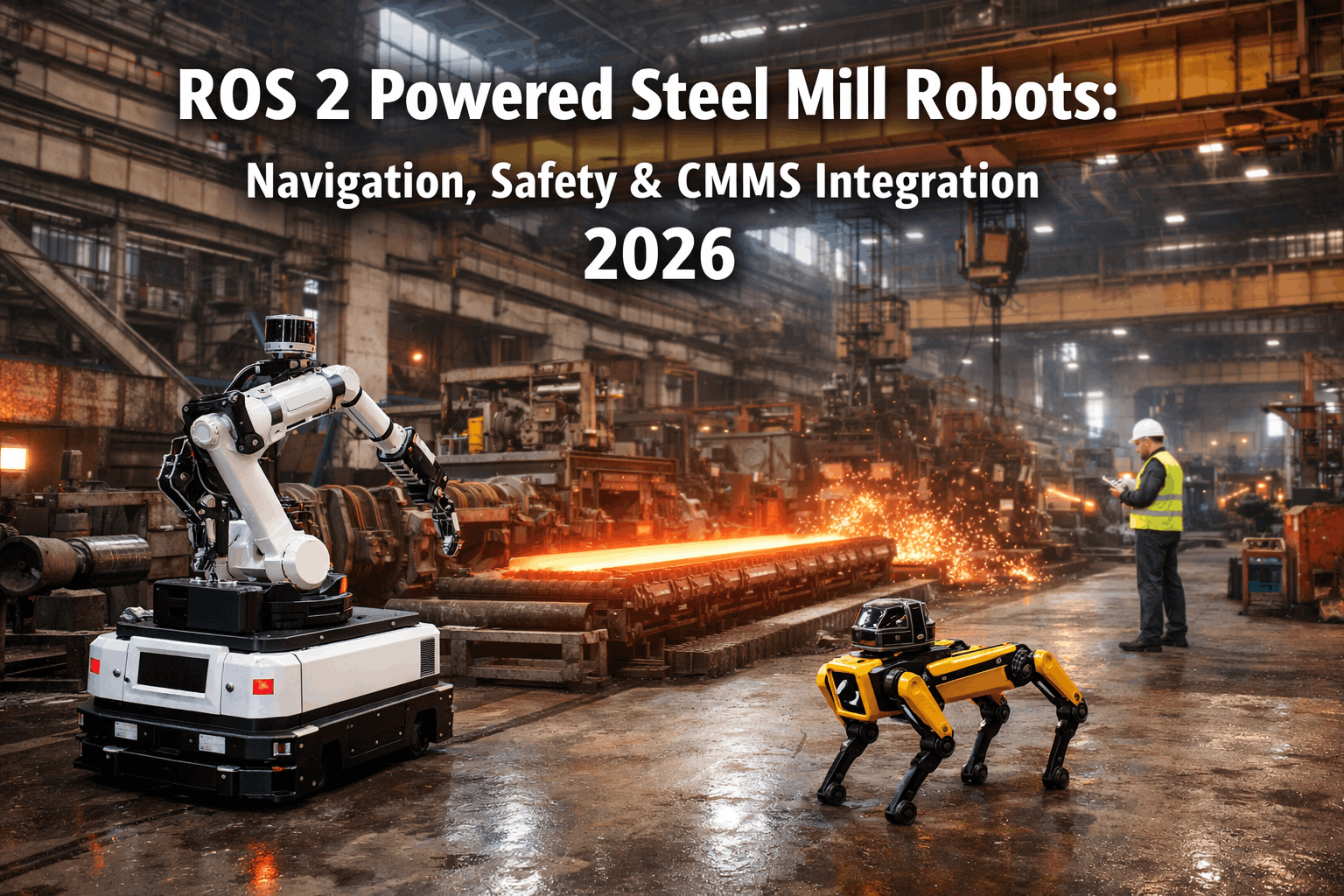
Continuous casting operations demand precision robotic systems to maintain consistent mold level control and perform real-time strand inspection. As casting speeds increase and quality tolerances tighten in 2026, robotic maintenance strategies must evolve beyond scheduled interventions to predictive, condition-based approaches that minimize unplanned downtime and prevent costly breakout events. Book a demo to see how AI-driven maintenance keeps your continuous casting robots operating at peak performance.
The Role of Robotics in Continuous Casting
Modern continuous casting lines rely on an array of robotic and automated systems—from mold level sensors and electromagnetic stirrers to strand surface inspection cameras and automated torch cutting machines. These systems work in extreme thermal environments where temperatures exceed 1,500°C, making manual inspection dangerous and inconsistent. Robotic maintenance ensures these critical assets deliver the accuracy and reliability that high-speed casting demands.
$6.8M
Average annual cost of unplanned casting stoppages due to robotic system failures
14%
Of all breakout events are linked to mold level control sensor degradation
3.5hrs
Average downtime per robotic inspection system failure during active casting
42%
Of casting quality defects are detectable earlier with properly maintained inspection robots
Don't let robotic failures halt your casting line. Oxmaint delivers predictive maintenance intelligence for every robotic system in your continuous caster.
Sign Up
Critical Robotic Systems in Continuous Casting
Continuous casting relies on multiple robotic and automated subsystems, each with distinct maintenance requirements and failure modes. Understanding these systems and their interdependencies is essential for building an effective maintenance program that keeps the caster running safely and efficiently.
01
Mold Level Control Systems
Eddy current sensors, radioactive source detectors, and electromagnetic mold level controllers maintain steel meniscus stability within ±3mm. Sensor drift, cable degradation from radiant heat, and actuator wear require continuous calibration and proactive replacement cycles.
02
Strand Surface Inspection Robots
High-temperature vision systems and laser profilometers scan strand surfaces for cracks, oscillation marks, and depressions at casting speed. Lens fouling from steam and scale, thermal drift in camera housings, and vibration-induced misalignment are primary failure modes.
03
Automated Mold Oscillation Mechanisms
Hydraulic or electromechanical oscillation systems prevent shell sticking and control surface quality. Bearing wear, hydraulic seal degradation, and servo motor fatigue affect oscillation frequency and stroke precision.
Sign up for Oxmaint to monitor oscillation health in real-time.
04
Robotic Torch Cutting Systems
Automated oxy-fuel or mechanical cutting robots perform strand separation at precise lengths. Nozzle wear, positioning accuracy degradation, and thermal warping of guide rails directly impact cut quality and downstream processing.
05
Secondary Cooling Spray Robots
Automated spray nozzle arrays and robotic positioning systems control strand solidification profiles. Nozzle clogging, flow rate sensor drift, and actuator corrosion from water and scale buildup compromise cooling uniformity and strand quality.
Mold Level Control: Maintenance Best Practices for 2026
Mold level stability is the single most critical parameter in continuous casting—directly influencing breakout risk, surface quality, and inclusion entrapment. Maintaining the robotic and sensor systems that govern mold level requires a disciplined, data-driven approach that accounts for the harsh casting environment.
Sensor Calibration & Drift Monitoring
AI tracks sensor output deviation trends over time, flagging calibration drift before it exceeds tolerance. Automated recalibration scheduling reduces manual intervention by up to 60%.
Stopper Rod & SEN Actuator Health
Predictive analytics on stopper rod and submerged entry nozzle actuators detect response lag, hysteresis changes, and mechanical wear patterns that precede flow control failures.
Electromagnetic Stirrer Maintenance
Coil resistance monitoring, coolant flow verification, and magnetic field uniformity checks ensure electromagnetic stirrers maintain optimal meniscus control and inclusion flotation performance.
Control Loop Tuning & Optimization
Machine learning continuously optimizes PID parameters for mold level control based on casting speed, steel grade, and mold condition—adapting faster than manual tuning cycles.
Prevent breakouts before they happen. See how Oxmaint monitors mold level system health in real-time across your entire casting operation.
Book a Demo
Strand Inspection Robot Maintenance Metrics
Maintaining inspection robot accuracy is essential for catching surface defects before they propagate through downstream rolling and finishing operations. These metrics help maintenance teams prioritize robotic inspection system upkeep and ensure consistent defect detection rates.
Traditional vs. AI-Powered Robot Maintenance
The transition from calendar-based to condition-based robotic maintenance in continuous casting environments delivers measurable improvements in caster availability, product quality, and maintenance cost efficiency.
Calendar-Based Maintenance
- Fixed-interval sensor recalibration regardless of drift
- Scheduled camera cleaning on time-based cycles
- Reactive replacement after inspection system failure
- Manual vibration checks on oscillation systems
- Paper-based maintenance logs with delayed analysis
6-9%
unplanned caster downtime from robotic failures
AI-Powered Predictive Maintenance
- Condition-triggered calibration based on real-time drift data
- Automated lens fouling detection with cleaning alerts
- Predictive component replacement before failure onset
- Continuous vibration and performance monitoring via IoT
- Digital maintenance twins with automated trend analysis
Under 2%
unplanned caster downtime from robotic failures
ROI of Predictive Robot Maintenance in Casting
Investing in AI-powered maintenance for continuous casting robotic systems delivers returns through reduced breakout incidents, improved strand quality, extended component lifespans, and higher overall caster availability.
74%
Reduction in breakout events linked to mold level failures
31%
Decrease in casting surface defect rates
45%
Lower robotic maintenance costs through predictive scheduling
6mo
Typical payback period for casting robot maintenance systems
Moving to predictive maintenance on our mold level sensors and strand inspection robots was transformative. We went from chasing breakout scares every week to running 45-sequence campaigns with confidence. The data visibility alone changed how our casting operators and maintenance teams collaborate.
— Casting Operations Manager, Integrated Steel Works
Implementation Strategy for Casting Robot Maintenance
Deploying a predictive maintenance program for continuous casting robotic systems requires systematic integration with existing automation layers, careful baseline establishment, and phased rollout to minimize disruption to active casting operations.
Week 1-2
Asset Audit & Baseline
Inventory all robotic systems and sensor arrays
Establish performance baselines per equipment
Map failure history and maintenance records
Week 3-4
IoT & Data Integration
Deploy condition monitoring sensors on critical robots
Connect mold level and inspection data streams
Integrate with Level 2 automation and historian
Week 5-7
Model Training & Validation
Train failure prediction models on historical data
Calibrate alert thresholds per robotic system type
Validate predictions against known failure patterns
Week 8+
Live Deployment & Optimization
Activate predictive alerts during live casting
Train maintenance crews on data-driven workflows
Continuous model refinement with new casting data
Ready to future-proof your casting robot maintenance? Our team will design a predictive maintenance strategy tailored to your caster configuration.
Book a Demo
Integration with Casting Plant Systems
Effective robotic maintenance in continuous casting requires seamless data exchange with plant-wide systems to correlate equipment health with casting performance and product quality outcomes.
Maximize Caster Uptime with Intelligent Robot Maintenance
Your continuous casting line's reliability depends on the health of every robotic system—from mold level sensors to strand inspection cameras. Oxmaint delivers predictive maintenance intelligence, real-time condition monitoring, and automated alerting—ensuring your casting robots perform flawlessly through every sequence and grade transition.
Frequently Asked Questions
How does predictive maintenance prevent breakout events caused by mold level sensor failures?
Predictive systems continuously monitor sensor output stability, response time, and calibration drift. When degradation patterns match known pre-failure signatures, alerts are generated well before the sensor loses accuracy—giving maintenance teams time to recalibrate or replace the sensor during a planned casting break rather than during an emergency.
Book a demo to see breakout prevention in action.
What maintenance challenges are unique to strand inspection robots in casting environments?
Strand inspection robots operate in extreme conditions—high radiant heat, steam, water spray, and airborne scale particles. Primary challenges include rapid lens fouling requiring frequent cleaning, thermal expansion causing camera misalignment, cable insulation degradation from heat exposure, and vibration from the casting machine affecting image quality. AI-driven maintenance tracks all these degradation vectors simultaneously.
Can robotic maintenance systems integrate with older continuous casters?
Yes. Predictive maintenance platforms can interface with legacy Level 2 systems, older PLC architectures, and analog sensor outputs through gateway devices and protocol converters. The key is establishing reliable data feeds from critical robotic systems—even basic vibration and temperature sensors added to existing robots provide significant predictive capability.
Sign up to explore integration options for your caster.
How often should mold level control systems be recalibrated in 2026 best practices?
The 2026 approach moves away from fixed recalibration intervals. Instead, AI monitors sensor drift in real-time and triggers calibration only when deviation approaches threshold limits—typically reducing calibration frequency by 40-50% while improving mold level stability. The optimal interval varies by sensor type, casting environment, and steel grade mix.
What ROI can casting operations expect from robotic maintenance optimization?
Typical deployments achieve a 50-75% reduction in breakout events, 25-35% improvement in casting surface quality, and 40-50% reduction in unplanned robotic maintenance costs. Payback periods range from 4-8 months depending on caster size and current maintenance maturity. The combined impact on yield, uptime, and quality makes this one of the highest-ROI investments in casting operations.