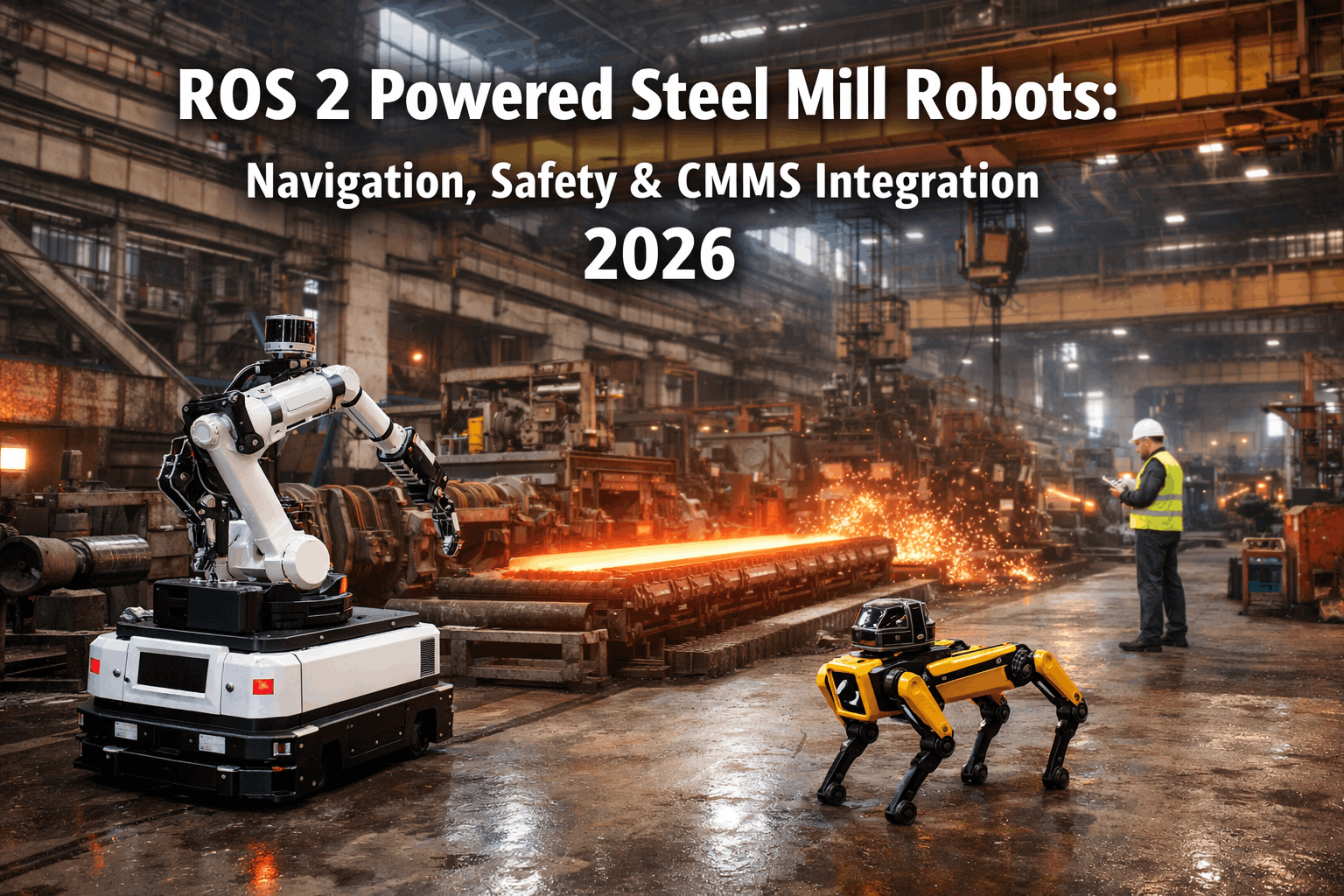
Steel Coil Handling & Warehouse Robots: AMR Fleet Maintenance with CMMS 2026
By John Mark on February 20, 2026
When a 25-ton steel coil slipped from an Autonomous Mobile Robot's cradle at a Midwest distribution centre at 3:12 AM in January 2025, the impact buckled 40 feet of racking, shut down an entire warehouse aisle for 9 days, and triggered $1.8 million in structural repairs, product damage, and lost throughput. The root cause wasn't the coil or the rack—it was a worn hydraulic lift cylinder on the AMR that had been leaking for six weeks. A vibration sensor on the lift mechanism would have flagged the degradation at week two, generating a CMMS work order for a $900 cylinder reseal during the next scheduled maintenance window. Instead, the fleet ran reactive: robots operated until they broke, and the break happened to involve 25 tons of rolling steel. Coil-handling AMRs are not warehouse picking bots. They carry loads that kill people and destroy infrastructure when maintenance fails. Talk to our team about deploying predictive AMR fleet maintenance across your steel handling operations.
This guide provides warehouse operations managers, steel logistics directors, and maintenance engineers with a comprehensive framework for maintaining AMR fleets that handle steel coils in warehouse and distribution environments. Oxmaint AI integrates IoT sensors, fleet telemetry, predictive analytics, and CMMS automation to keep heavy-payload robots running safely and efficiently. We cover AMR health monitoring, coil-handling-specific failure modes, predictive maintenance triggers, CMMS work order automation, and OSHA/ANSI compliance—transforming fleet telemetry into prioritised maintenance action. Teams ready to modernise steel coil AMR maintenance can start their free Oxmaint trial today.
Steel Coil AMR Reality
Why Predictive Maintenance Is Critical for Coil-Handling Warehouse Robots
70%
of unplanned AMR downtime in steel warehouses traces to hydraulic, drive motor, or load-cradle failures detectable 4–8 weeks before breakdown
85%
reduction in coil-drop incidents when AMR fleets shift from reactive to predictive CMMS-driven maintenance programmes
$2.4M
average annual savings per facility when coil-handling AMR maintenance moves from breakdown-based to sensor-driven predictive scheduling
Steel coil-handling AMRs operate under extreme mechanical stress: payloads of 5–30 tons, repetitive lift-and-carry cycles, metal dust contamination, floor vibration, and 24/7 operational tempos. These conditions accelerate wear on hydraulic systems, drive trains, load cradles, navigation sensors, and battery packs far faster than standard warehouse picking robots. Predictive maintenance powered by IoT telemetry, AI anomaly detection, and CMMS work order automation is not optional—it is the difference between controlled uptime and catastrophic coil drops. This guide provides the architecture.
The AMR Fleet Maintenance Lifecycle
Maintaining a coil-handling AMR fleet follows a structured lifecycle—from sensor deployment and telemetry ingestion through AI-driven failure prediction, CMMS work order generation, and compliance documentation. Each phase requires specific hardware decisions, data pipeline design, and safety mapping. The advantage: every degradation signal is classified, prioritised, and routed to maintenance crews before a breakdown occurs.
Coil-Handling AMR Predictive Maintenance Framework
From real-time telemetry to automated CMMS work orders
01
Instrument & Connect
Deploy vibration, pressure, temperature, and current sensors on hydraulic lifts, drive motors, load cradles, and battery packs across the AMR fleet
02
Monitor & Ingest
Stream real-time fleet telemetry via MQTT/OPC-UA into centralised data lake. Aggregate vibration spectra, hydraulic pressure curves, and thermal profiles per robot
03
Predict & Classify
AI models predict remaining useful life for critical subsystems and classify failure modes by type (hydraulic, drivetrain, cradle, sensor, battery) with severity scores
04
Act via CMMS
Push predicted failures to Oxmaint CMMS for auto work order generation with robot ID, subsystem, failure probability, recommended parts, and optimal service window
The predictive approach eliminates the catastrophic risk inherent in reactive maintenance for heavy-payload robots. When AI-classified degradation signals trigger CMMS work orders through standard APIs, maintenance teams receive actionable intelligence with full context—robot ID, subsystem location, failure timeline, required parts, and recommended intervention—scheduled into production gaps that minimise throughput impact. Book a Demo.
Reactive vs. Predictive: The Failure Physics of Coil-Handling AMRs
The choice between reactive and predictive maintenance for coil-handling AMRs is not a cost preference—it is a safety decision that determines whether you prevent coil drops or respond to them. Under reactive maintenance, robots run until failure. With 5–30 ton payloads, failure means hydraulic blowouts mid-lift, drive motor seizures during transport, and cradle mechanism releases that send steel coils rolling across warehouse floors. Predictive maintenance intercepts every one of these failures 4–8 weeks before they occur.
Maintenance Comparison: Reactive vs. Predictive AMR Fleet Management
1
Reactive / Run-to-Failure
Robots operate until breakdown—no early warning of degradation
Hydraulic leaks undetected until pressure loss causes mid-lift failure
Drive motor wear invisible until seizure during loaded transport
Coil cradle fatigue cracks propagate to catastrophic release
Unplanned downtime averages 18–36 hours per incident
Collateral damage to racking, flooring, and adjacent inventory
OSHA recordable incidents and potential citations
High Risk — Catastrophic Failures
2
Predictive / Sensor-Driven CMMS
IoT sensors detect degradation signatures 4–8 weeks before failure
Hydraulic pressure trending identifies seal wear at earliest stage
Vibration analysis catches bearing degradation in drive assemblies
Strain gauges on cradle mounts detect fatigue before crack initiation
Planned maintenance windows average 2–4 hours during shift gaps
Zero collateral damage—all repairs completed before failure event
Full OSHA/ANSI compliance with documented predictive evidence
Low Risk — Controlled Maintenance
Predictive maintenance does not replace scheduled preventive maintenance—it enhances it. Calendar-based PM catches time-dependent wear (lubrication, filter changes), while predictive analytics catch condition-dependent degradation (bearing spalling, seal erosion, electrical insulation breakdown) that calendar intervals miss. Together, they provide the complete maintenance intelligence that heavy-payload AMR operations demand.
Predictive AMR Fleet Maintenance Impact Metrics
Measured improvements from sensor-driven coil-handling AMR maintenance programmes
85%
Coil-Drop Incident Reduction
Predictive vs. Reactive Maintenance
92%
Fleet Uptime Achieved
Across 24/7 Operations
6wk
Avg Early Warning Window
Before Critical Failure
8–12x
ROI Return
Within First Year of Deployment
Fleet Monitoring Technology: The Coil-Handling AMR Maintenance Toolkit
Maintaining coil-handling AMRs requires purpose-built monitoring across four domains: hydraulic system health for lift and tilt mechanisms, drivetrain condition for loaded transport, load cradle structural integrity, and navigation/battery systems for operational reliability. Each monitoring domain feeds the same AI prediction pipeline and CMMS integration layer. Book a Demo.
AMR Fleet Monitoring Platforms for Steel Coil Operations
Hydraulic Health Monitoring
Pressure transducers, flow meters, and particle counters on lift cylinders, tilt actuators, and hydraulic power units. Detects seal degradation, fluid contamination, and valve wear 4–8 weeks before failure.
Drivetrain Vibration Analysis
Tri-axial accelerometers on drive motors, gearboxes, wheel bearings, and steering actuators. Spectral analysis identifies bearing spalling, gear tooth wear, and motor winding faults under loaded conditions.
Cradle & Structural Integrity
Strain gauges, load cells, and ultrasonic thickness sensors on coil cradle arms, pivot pins, and chassis mounting points. Continuous fatigue monitoring prevents catastrophic structural release during coil transport.
AI Prediction Engine
Machine learning models trained on 500,000+ coil-handling cycles predict remaining useful life for hydraulics (38%), drivetrain (29%), cradle systems (21%), and battery/nav (12%) with 90%+ accuracy.
The Economics: Predictive Maintenance vs. Reactive Breakdown
The financial case for predictive AMR fleet maintenance in steel coil operations is driven by a single reality: when a 25-ton coil drops, the cost cascade is massive and the cost of prevention is trivial by comparison. A hydraulic seal replacement detected predictively costs $800–$2,000 in parts and planned labour. The same seal failing during a loaded lift costs $200,000–$1.8 million in structural damage, product loss, downtime, and regulatory exposure. The comparison below illustrates real-world economics for a 40-robot coil-handling fleet over 24 months.
Cost Comparison: Reactive vs. Predictive AMR Maintenance
Based on a 40-robot steel coil AMR fleet over 24 months
Planned parts & labour (predictive repairs)$195,000
24-Month Investment: $573,000
Beyond direct cost avoidance, predictive AMR maintenance delivers operational confidence: fleet availability reaches 92%+ versus 74% under reactive regimes, throughput variance drops by 60%, and OSHA audit readiness becomes continuous rather than event-driven. Facilities with documented predictive programmes demonstrate the due diligence that strengthens their position in safety reviews and insurance negotiations.
Turn AMR Fleet Telemetry Into Automated Maintenance Action
Oxmaint's open API ingests real-time sensor data from coil-handling AMRs—automatically generating prioritised work orders with robot ID, subsystem diagnosis, failure probability, required parts, and optimal service windows for every robot in your fleet.
Deploying predictive maintenance for coil-handling AMR fleets is a maturity journey. Start with sensor instrumentation on your highest-utilisation robots, progress to AI-driven failure prediction with CMMS integration, and scale to fleet-wide digital twins and autonomous maintenance scheduling across all warehouse operations.
Coil-Handling AMR Fleet Maintenance Maturity Model
Level 1
Foundation — Instrument & Baseline (Months 1-4)
IoT Sensor DeploymentTelemetry Pipeline SetupBaseline Health ProfilingFleet Registry in CMMS
Level 2
Predictive — AI Failure Prediction & CMMS (Months 5-10)
AI Remaining Life ModelsAuto CMMS Work OrdersFailure Mode TrendingOSHA/ANSI Documentation
Level 3
Autonomous — Digital Twins & Fleet Optimisation (Months 11+)
Digital Twin per RobotAutonomous SchedulingSpare Parts PredictionFleet-Wide Dashboards
Start by instrumenting your highest-utilisation coil-handling robots with vibration, pressure, and strain sensors. Build baseline health profiles over 2–3 months of operational data before activating AI failure prediction. As your models accumulate confirmed failure data, expand to fleet-wide digital twins and connect all predictive intelligence directly to Oxmaint CMMS for automated work order generation and regulatory compliance documentation.
AMR Subsystems Covered by Predictive Maintenance
Predictive maintenance applies across every critical subsystem of coil-handling AMRs—hydraulic lifts, drivetrain assemblies, load cradle mechanisms, navigation systems, battery packs, and safety interlocks. Because sensor-driven anomaly detection reveals degradation regardless of subsystem type, any component where failure poses a safety or throughput risk benefits from continuous predictive monitoring.
Predictive Maintenance Coverage Across AMR Subsystems
Comprehensive fleet health monitoring for every robot component
Hydraulic Lift Systems
Drive Motors & Gearboxes
Coil Cradle Mechanisms
Wheel Bearings & Steering
Battery & Charging Systems
LiDAR & Navigation Sensors
Safety Interlocks & E-Stops
Chassis & Frame Structure
Remaining Useful Life Prediction
AI models analyse sensor trends to predict when each subsystem will reach failure threshold—enabling maintenance scheduling 4–8 weeks ahead with 90%+ accuracy on timing and failure mode classification.
OSHA & ANSI B56.5 Compliance
Documented predictive maintenance programmes satisfy OSHA warehouse robotics safety requirements and ANSI/ITSDF B56.5 guidelines with sensor-backed evidence and automated audit trails.
Multi-OEM Fleet Integration
Sensor packages and AI models work across AMR manufacturers—KUKA, Jungheinrich, Dematic, and custom coil handlers all feed the same CMMS pipeline, ensuring consistent maintenance quality fleet-wide.
Deploy predictive maintenance across your entire coil-handling AMR fleetGet Started →
By standardising on predictive maintenance across AMR subsystems, steel warehouse operators gain fleet-wide visibility into robot health that calendar-based PM alone cannot provide. This enables risk-based prioritisation of maintenance budgets, regulatory compliance documentation, and the confidence that no degradation signal goes undetected between service intervals. Book a Demo.
Protect Every Robot. Prevent Every Coil Drop. Maximise Every Shift.
Join forward-thinking steel logistics operations using predictive IoT monitoring with Oxmaint CMMS to turn fleet telemetry into automated maintenance action. Detect degradation at the earliest signal, generate prioritised work orders before failure, and demonstrate regulatory due diligence across your entire AMR fleet.
Why do coil-handling AMRs need different maintenance than standard warehouse robots?
Standard warehouse picking robots carry payloads of 10–100 lbs and operate with electric actuators. Coil-handling AMRs transport 5–30 ton steel coils using hydraulic lift systems, heavy-duty drivetrains, and specialised cradle mechanisms that experience 50–100x the mechanical stress per cycle. This stress accelerates wear on hydraulic seals, drive bearings, cradle pivot pins, and chassis mounting points at rates that standard maintenance intervals cannot predict. More critically, failure under load means a multi-ton steel coil in uncontrolled motion—a fundamentally different risk profile than a dropped parcel. Predictive maintenance with vibration, pressure, and strain sensors detects degradation specific to heavy-payload operations that calendar-based PM misses entirely.
What are the most common failure modes for coil-handling AMRs?
Coil-handling AMR failures cluster into four primary categories. Hydraulic system failures (38% of incidents): seal degradation, fluid contamination, valve stiction, and cylinder rod scoring from metal dust ingress cause lift and tilt malfunctions. Drivetrain failures (29%): bearing spalling in drive motors, gear tooth pitting in reduction gearboxes, and wheel bearing collapse under sustained heavy loading. Cradle and structural failures (21%): fatigue cracking at cradle arm pivot points, weld joint degradation on chassis mounting brackets, and cradle latch mechanism wear. Battery and navigation failures (12%): accelerated battery degradation from high-current discharge cycles and LiDAR sensor fouling from steel dust. Sign up free to see how failure predictions become CMMS work orders.
What sensors are required for predictive maintenance on coil-handling AMRs?
A comprehensive coil-handling AMR sensor package includes: tri-axial vibration accelerometers on drive motors, gearboxes, and wheel bearings (sampling at 10–25 kHz for spectral analysis); hydraulic pressure transducers on lift and tilt cylinders (0.1% accuracy); hydraulic fluid particle counters (ISO 4406 cleanliness monitoring); strain gauges on cradle arms and chassis mounting points (micro-strain resolution); temperature sensors on motor windings, hydraulic fluid, and battery packs; and current sensors on drive motor phases for electrical health monitoring. Data streams via MQTT or OPC-UA to a centralised telemetry platform at 1–10 Hz for trend analysis and 10–25 kHz burst capture for vibration diagnostics.
How does predictive AMR data integrate with a CMMS like Oxmaint?
The AI prediction engine processes fleet telemetry and generates structured maintenance records containing: robot ID and asset tag, affected subsystem (hydraulic, drivetrain, cradle, battery/nav), predicted failure mode, remaining useful life estimate, confidence score, recommended intervention, required parts list, and optimal service window based on production schedule. These records are transmitted via REST API to Oxmaint CMMS, which auto-generates prioritised work orders grouped by robot, urgency, and required skill set. The CMMS tracks repair execution with before/after sensor comparisons, maintains OSHA/ANSI compliance audit trails, and feeds confirmed outcomes back to AI models for continuous accuracy improvement. Book a demo to see the telemetry-to-CMMS pipeline in action.
What is the typical cost and timeline for implementing predictive maintenance on a coil-handling AMR fleet?
A pilot programme on 8–12 robots typically takes 14–18 weeks: 3 weeks for sensor procurement and installation, 6 weeks for baseline data collection under normal operating conditions, 3 weeks for AI model training on fleet-specific degradation signatures, and 2–4 weeks for CMMS integration and workflow validation. Sensor hardware costs range from $3,000–$6,000 per robot depending on subsystem coverage. Annual operating costs for a 40-robot fleet are $180,000–$350,000 including sensor maintenance, AI processing, and CMMS subscription. Most facilities achieve ROI from the first prevented coil-drop incident—a single avoided breakdown saves $200,000–$1.8 million, making the entire programme cost trivial by comparison.