When a hot strip mill produces 400 coils per day and a single roll surface defect imprints itself onto every meter of steel that passes through, the cost of a missed grinding cycle or an undetected weld crack is not measured in repair bills alone — it is measured in thousands of tons of downgraded product, customer rejection penalties, and lost mill availability. In 2026, the rolling mills that dominate quality rankings and production throughput are not the ones with the newest stands; they are the ones where robots perform the grinding, welding, and inspection work that human hands cannot execute with the speed, consistency, or safety that modern steelmaking demands.
Rolling mills sit at the heart of every steel plant's value chain. Whether producing flat products on hot strip mills and cold rolling complexes or long products on bar and section mills, the rolls themselves are the most critical consumable asset in the process. Roll surface condition directly determines product surface quality, dimensional accuracy, and mill throughput. Automated robotic systems for roll grinding, roll and component welding, and in-line quality inspection are transforming how the world's best mills maintain this critical asset. Mills ready to automate their roll shop and in-line maintenance can start their free trial today.
2026 Rolling Mill Robotics
Why Manual Roll Maintenance Is Costing You Millions
$3.4M
Average annual cost of roll-related quality defects per hot strip mill
18%
of total mill downtime is caused by roll changes, regrinding delays, and roll shop bottlenecks
4x
faster defect detection with robotic vision systems versus manual visual inspection
Source: AISE Rolling Technology Conference & ArcelorMittal Operational Benchmarking 2025
The modern rolling mill is a precision machine operating at extraordinary speeds — hot strip mills run at up to 20 meters per second, while cold mills achieve mirror-finish tolerances measured in microns. At these speeds and tolerances, roll surface quality is everything. A 50-micron grinding error, a subsurface weld crack, or a thermal fatigue pattern missed during inspection can cascade into strip breaks, cobbles, thickness deviations, and surface defects that shut down the mill or flood the rejection yard. Robotic automation of grinding, welding, and inspection eliminates the variability that makes manual methods unreliable at these precision levels, and when integrated with a CMMS like Oxmaint, creates a closed-loop system where every roll's lifecycle is tracked, optimized, and predicted.
Three Pillars of Rolling Mill Robot Maintenance
Robotic maintenance in rolling mills is not a single technology. It is an ecosystem built on three interconnected pillars: automated grinding for roll surface preparation, robotic welding for roll and component repair, and machine-vision quality inspection for real-time defect detection. Each pillar addresses a different failure mode, and together they form a comprehensive defense against the quality and availability losses that plague conventional mills.
Pillar 1
Automated Roll Grinding
CNC and robotic grinding systems restore roll profiles to micron-level accuracy, eliminating operator-dependent variability and reducing grind cycle times by up to 40%.
Crown & taper profiling
Surface roughness control (Ra/Rz)
Thermal camber compensation
Automated roll measurement
Pillar 2
Robotic Welding & Hardfacing
Robotic submerged arc welding (SAW) and laser cladding rebuild worn rolls and mill components with consistent bead geometry, reducing scrap rates and extending roll campaigns.
Roll body rebuild welding
Journal & neck repair
Hardfacing overlay application
Weld preheat & interpass control
Pillar 3
Robotic Quality Inspection
Machine vision, eddy current, ultrasonic, and laser profilometry systems detect surface and subsurface defects in real-time, both on rolls and on the strip in-line.
Roll surface crack detection
Strip surface defect classification
Ultrasonic subsurface scanning
Dimensional profile verification
When these three pillars operate as an integrated system feeding data into a CMMS, the rolling mill achieves something previously impossible: a complete digital lifecycle for every roll. From the moment a roll is ground and its profile is recorded, through every campaign in the stand where in-line inspection monitors its surface degradation, to the point where robotic welding rebuilds it for its next life — every data point is captured, trended, and used to optimize the next decision.
Automated Grinding: Precision That Humans Cannot Match
Roll grinding is the foundation of strip quality. The crown profile, surface roughness, and geometric accuracy of the roll directly determine strip flatness, thickness uniformity, and surface finish. Manual grinding operations, even by experienced operators, introduce variability that compounds across an entire roll campaign. Automated CNC grinding with robotic measurement and loading eliminates this variability entirely.
Before: Manual Grinding
✗
Crown profile accuracy ±15-25 microns operator-dependent
✗
Surface roughness Ra variation up to ±0.3μm between shifts
✗
Grind cycle time 45-90 minutes depending on operator skill
✗
Roll measurement done offline with separate gauging equipment
✗
Thermal damage risk from inconsistent coolant application
✗
No digital record linking grind profile to strip quality data
After: Robotic CNC Grinding
✓
Crown profile accuracy ±2-5 microns with closed-loop control
✓
Surface roughness Ra held within ±0.05μm across all shifts
✓
Grind cycle time reduced to 25-40 minutes with auto compensation
✓
Integrated in-machine laser measurement after every pass
✓
Adaptive coolant flow prevents thermal grinding damage
✓
Full grind record stored in CMMS linked to roll ID and campaign
The impact on strip quality is immediate and measurable. Mills that transition from manual to automated grinding typically see a 60-80% reduction in roll-related surface defects within the first six months. When every grind profile is digitally recorded in the CMMS and linked to downstream strip quality data, the mill gains the ability to correlate specific grinding parameters with specific product outcomes — enabling continuous optimization that manual operations can never achieve.
Robotic Welding: Extending Roll Life and Reducing Inventory Cost
Rolls are among the most expensive consumables in a steel plant. A single work roll for a hot strip finishing stand can cost $30,000 to $80,000, and a backup roll exceeds $200,000. Rather than scrapping rolls once they reach minimum diameter or suffer localized damage, robotic welding and hardfacing can rebuild them to original specifications, extending their useful life by 2 to 4 additional campaigns and dramatically reducing roll inventory investment.
Performance Metric
Manual Welding
Robotic Welding
Improvement
Bead Consistency (height variation)
±0.8mm
±0.15mm
5x Better
Deposition Rate (kg/hr)
3-5 kg/hr
8-15 kg/hr
2-3x Faster
Weld Defect Rate
5-8%
<1%
85% Reduction
Preheat & Interpass Control
Manual thermocouple checks
Closed-loop IR monitoring
Continuous
Operator Safety Exposure
8+ hrs arc/fume exposure
Zero direct exposure
100% Safer
Roll Life Extension per Rebuild
1-2 extra campaigns
2-4 extra campaigns
2x Longer
Robotic welding also enables advanced hardfacing techniques like laser cladding and plasma transferred arc (PTA) overlays that are virtually impossible to perform manually with the required consistency. These processes deposit wear-resistant alloys with metallurgical bonds that outperform conventional weld overlays, further extending roll campaigns and improving strip surface quality. Every weld parameter — voltage, current, travel speed, wire feed, preheat temperature — is logged automatically and stored in the CMMS against the specific roll serial number.
$1.8M
Annual roll inventory savings per mill from robotic rebuild programs
65%
Reduction in roll scrap rate when robotic welding replaces manual rebuild
3.2x
Average increase in roll campaign length after robotic hardfacing application
Zero
Welder arc flash and fume exposure incidents with fully robotic operation
Robotic Quality Inspection: Catching Defects Before They Reach the Coil
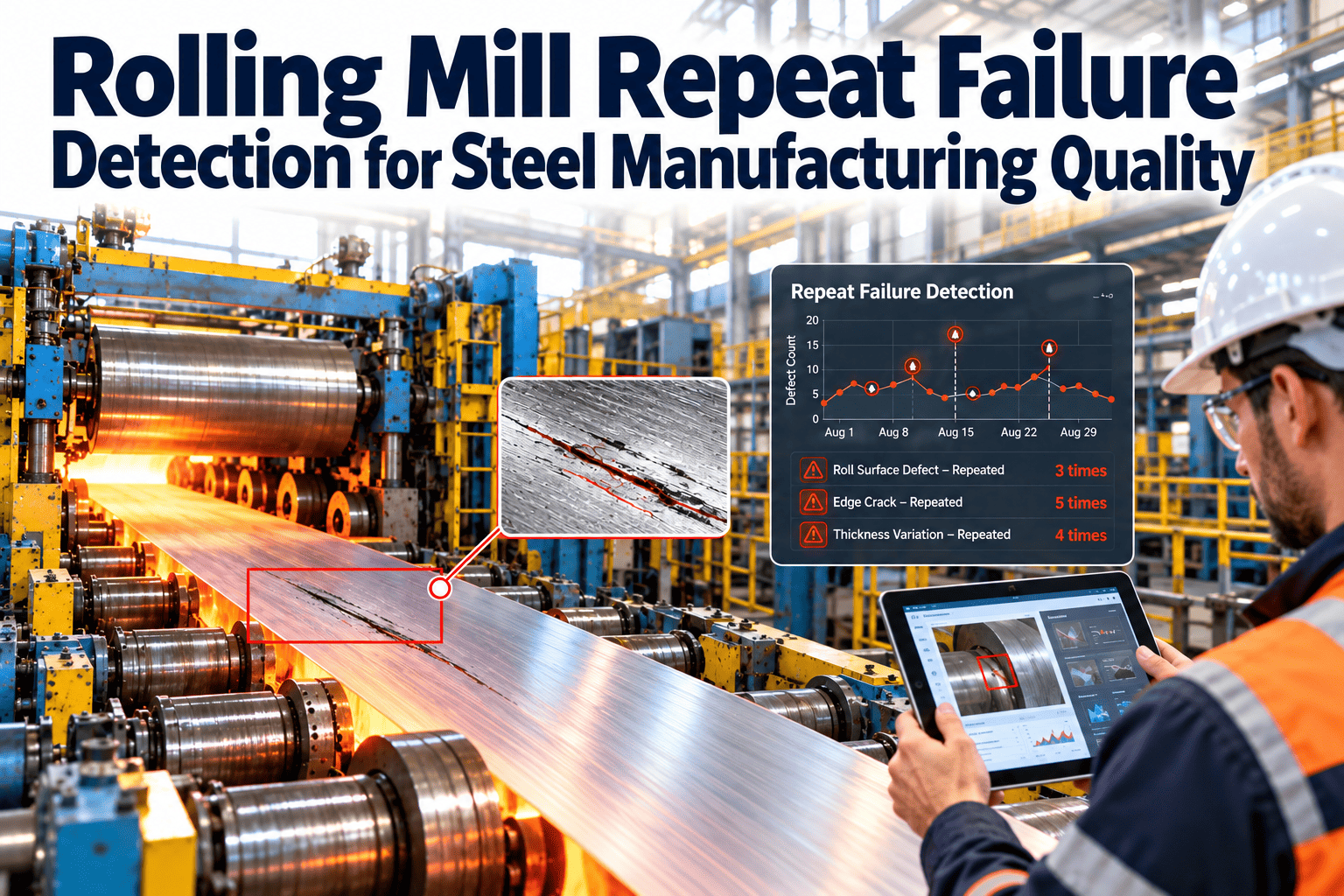
In a rolling mill producing steel at 15-20 meters per second, the human eye is physically incapable of detecting the surface defects that determine product grade. Robotic inspection systems — combining high-speed machine vision cameras, laser profilometers, eddy current arrays, and ultrasonic sensors — inspect 100% of the strip surface and 100% of the roll surface at full production speed, detecting and classifying defects that manual inspection misses entirely.
Machine Vision (Strip)
High-speed line-scan cameras at 16K+ resolution capture every square millimeter of strip surface at full line speed. AI classifies scratches, scale patterns, roll marks, and edge cracks in real-time.
Laser Profilometry (Roll)
Non-contact laser scanners measure roll crown, taper, and surface texture to sub-micron resolution during grinding and between campaigns, verifying profile accuracy before reinstallation.
Eddy Current Testing (Roll)
Non-contact electromagnetic sensors detect surface and near-surface cracks, fire cracks, and thermal fatigue networks on work rolls while rotating on the grinder — no manual NDT required.
Ultrasonic Subsurface (Roll)
Phased-array ultrasonic systems scan for internal voids, inclusions, and spall initiation zones beneath the roll surface that cause catastrophic failures during rolling campaigns.
The integration of these inspection systems with a CMMS creates a powerful feedback loop. When a machine vision system detects recurring roll marks on the strip, the CMMS correlates the defect pattern with the specific roll in the stand, cross-references that roll's grinding history and campaign hours, and automatically generates a work order to pull the roll for inspection and regrinding — all before the defect reaches a severity level that forces a grade downgrade or customer complaint.
CMMS Integration: The Digital Thread for Every Roll
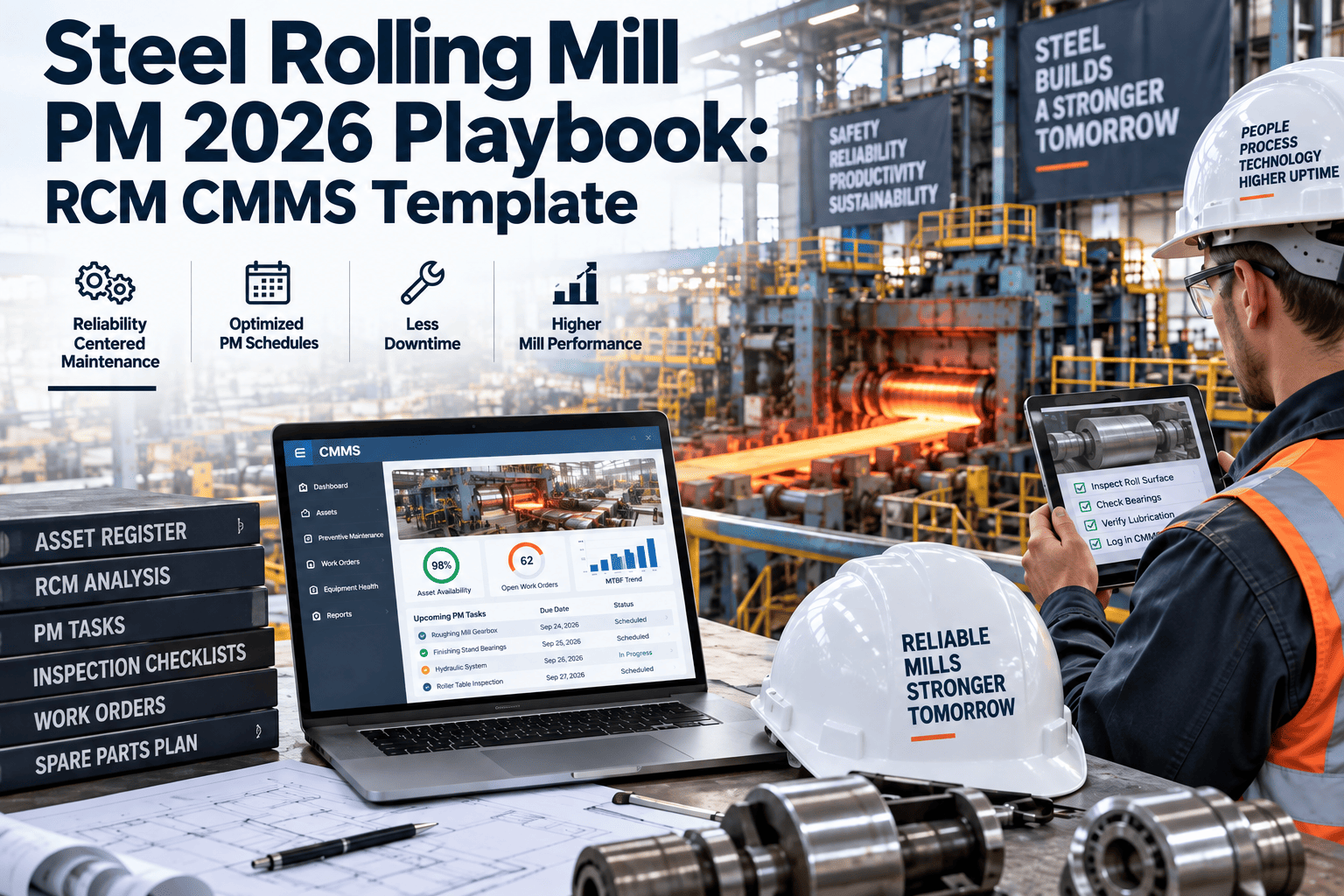
The true competitive advantage of robotic maintenance in rolling mills is not the robots themselves — it is the data they generate and what the CMMS does with it. Every grind profile, weld parameter, inspection result, and campaign performance metric is stored against the individual roll serial number, creating a complete digital lifecycle record that enables predictive roll management.
New Roll Receipt
Serial number, material grade, hardness, initial diameter, supplier certifications logged in CMMS asset register
Robotic Grinding
Crown profile, Ra/Rz roughness, diameter reduction, grinding wheel data, and thermal compliance recorded per cycle
Inspection & Certification
Eddy current crack maps, ultrasonic scan results, and profilometry verification stored before stand installation
Campaign Tracking
Tons rolled, strip grades produced, stand position, operating hours, and in-line strip quality data linked to roll
Robotic Weld Rebuild
Weld procedure, filler material, preheat temps, layer count, post-weld heat treatment, and UT verification recorded
End-of-Life Decision
CMMS calculates remaining useful life based on diameter, defect history, and campaign performance to trigger retirement
The Financial Impact: ROI of Robotic Rolling Mill Maintenance
The business case for robotic grinding, welding, and inspection in rolling mills is built on four revenue pillars: reduced roll inventory cost through extended life, reduced quality downgrades through precision grinding and real-time inspection, increased mill availability through faster roll shop turnaround, and reduced safety incidents through elimination of manual high-risk tasks.
Financial Impact Model: Single Hot Strip Mill
Based on a 4-stand finishing mill producing 3M tons per annum
Without Robotic Maintenance
Roll-Related Quality Downgrades$2.2M - $4.5M/yr
Premature Roll Scrap$1.0M - $2.2M/yr
Roll Shop Downtime Impact$800K - $1.8M/yr
Manual Inspection Labor & Safety$400K - $700K/yr
Total Exposure: $4.4M - $9.2M/yr
VS
With Robotic Grinding, Welding & Inspection
Robotics & CMMS Investment$500K - $1.2M/yr
Quality Defect Reduction60% - 80%
Roll Life Extension2x - 4x Campaigns
Roll Shop Throughput Gain30% - 50% Faster
Net Savings: $3M - $7M+/yr
Typical Payback Period:4 - 9 Months
Every 1% improvement in prime yield on a 3M ton mill equals approximately $1.5M in additional revenue
Automate Your Roll Shop & In-Line Inspection
Stop losing millions to roll-related quality defects and premature scrap. Oxmaint CMMS tracks every roll's complete lifecycle — from robotic grinding profiles to weld rebuild records to campaign performance — giving your mill the data to optimize roll management and maximize prime yield.
Implementation: Building a Robotic Roll Maintenance Program
Transitioning from manual to robotic roll maintenance is a capital-intensive but high-return investment. The most successful implementations follow a phased approach that delivers measurable ROI at each stage, building the operational confidence and data foundation needed for the next level of automation.
Foundation: Automated Grinding & CMMS (Months 1-4)
CNC grinder upgrade or procurementRoll asset register in CMMSAutomated profile measurementGrind-to-quality data linkage
Expansion: Robotic Welding & NDT Inspection (Months 5-9)
Robotic SAW/cladding cell installationEddy current & UT integration on grinderWeld parameter logging to CMMSRoll rebuild lifecycle tracking
Optimization: In-Line Vision & Predictive Analytics (Months 10-14)
Strip surface inspection systemAI defect-to-roll correlationPredictive roll change schedulingDigital twin roll modeling
Phase 1 delivers the fastest ROI because automated grinding immediately improves profile consistency and reduces roll-related strip defects. By Phase 3, the mill operates a fully closed-loop system where in-line strip quality data triggers automatic roll change decisions, predictive grind scheduling, and optimized campaign lengths — all managed through the CMMS without manual intervention. Book a Demo.
Lead the Next Generation of Rolling Mill Performance
Join the world's top steel producers using robotic grinding, welding, and inspection integrated with Oxmaint CMMS to maximize prime yield, extend roll life, and eliminate quality losses across hot strip, cold rolling, and long product mills.
Frequently Asked Questions
What types of rolling mills benefit most from robotic maintenance?
Hot strip mills see the highest ROI due to the extreme thermal and mechanical stress on rolls, but cold rolling mills, plate mills, section mills, and long product mills all benefit significantly. Any mill where roll surface quality directly affects product grade and where roll inventory costs are a major expense line will see a strong return. Hot strip finishing stands and cold mill skin-pass/temper stands typically deliver the fastest payback.
Can robotic welding truly restore a roll to original performance?
Modern robotic submerged arc welding and laser cladding systems deposit hardfacing alloys with metallurgical properties that often **exceed** the original roll material in wear resistance and thermal fatigue life. The key is consistent bead geometry, precise preheat/interpass temperature control, and proper post-weld heat treatment — all of which robotic systems control far more accurately than manual welding. Rebuilt rolls routinely achieve 90-100% of new roll campaign performance at 30-40% of the cost.
How does the CMMS connect grinding, welding, and inspection data?
Oxmaint CMMS uses the individual roll serial number as the master key. Every event in the roll's lifecycle — each grind cycle with profile data, each inspection result with defect maps, each weld rebuild with procedure parameters, and each campaign with tons rolled and quality metrics — is linked to that serial number. This creates a complete digital thread that enables predictive analytics: the CMMS can calculate remaining useful life, recommend optimal grind removal depths, and predict when a roll should be pulled for rebuild versus retired.
What is the typical investment required for a robotic roll shop?
A complete robotic roll shop modernization for a hot strip mill typically ranges from **$2M to $5M** in capital expenditure, covering CNC grinders with automated measurement, a robotic welding cell, and integrated NDT inspection. In-line strip inspection systems add $1M to $3M depending on mill width and speed. Annual operating costs including CMMS software, consumables, and maintenance run $500K to $1.2M. Against annual savings of $3M to $7M+, payback is typically achieved within 4 to 9 months.
Do we need to replace our existing grinders and welding equipment?
Not necessarily. Many existing CNC roll grinders can be retrofitted with modern measurement systems, adaptive grinding controls, and CMMS data interfaces. Similarly, existing welding positioners can be integrated with robotic welding heads and automated wire feed systems. A thorough assessment of your current equipment determines whether retrofit or replacement delivers the best ROI. The CMMS integration layer works with both new and retrofitted equipment, so the data infrastructure investment is preserved regardless of the hardware path chosen.