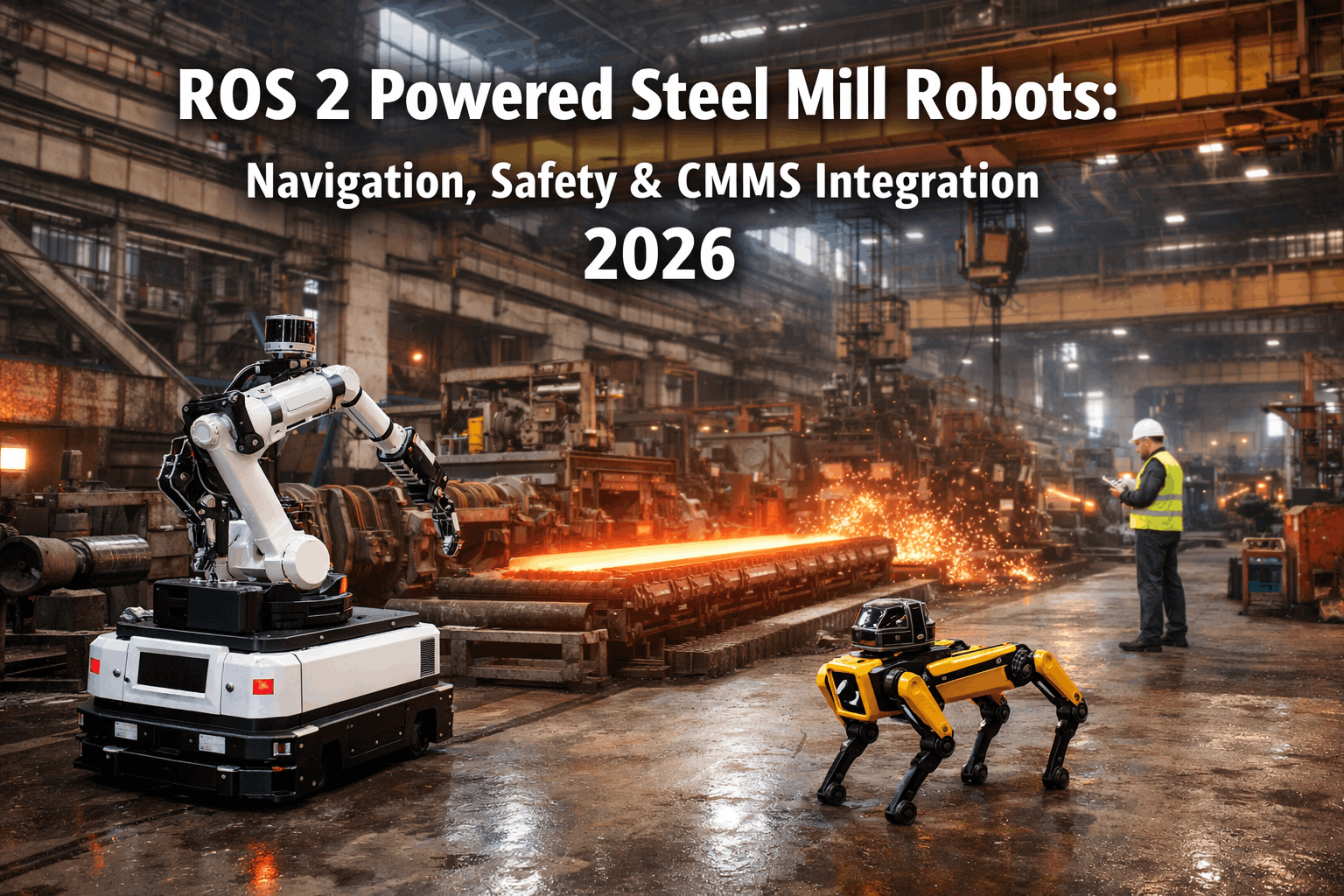
The Robot Operating System 2 (ROS 2) is rewriting the rules of industrial automation in steel manufacturing. Unlike proprietary robot controllers that lock plants into vendor-specific ecosystems, ROS 2 provides a modular, open-source framework that enables autonomous navigation, multi-robot coordination, real-time safety monitoring, and seamless CMMS integration—all on a single unified platform. In 2026, leading steel mills are deploying ROS 2-powered robots for everything from ladle tracking and refractory inspection to slab yard logistics and hazardous zone monitoring. Book a demo to see how CMMS integration turns ROS 2 robot data into predictive maintenance intelligence.
Why ROS 2 Is the Future of Steel Mill Robotics
Traditional industrial robots in steel plants operate as isolated islands—each with proprietary software, incompatible communication protocols, and limited ability to share data with maintenance or production systems. ROS 2 changes this fundamentally by providing a standardized middleware layer that allows any robot, sensor, or software module to communicate seamlessly, enabling truly intelligent, interconnected automation across the entire steel plant.
ROS 2 in Steel — 2026 Landscape
340+
Steel mills globally piloting or deploying ROS 2 robotics
5.8×
Faster robot application development vs. proprietary platforms
78%
Reduction in robot integration costs using open-source stack
$1.2B
Projected ROS 2 industrial robotics market in metals by 2027
ROS 2 Architecture Stack
Application Layer
Navigation · Inspection · Logistics
ROS 2 Middleware (DDS)
Real-time Pub/Sub · Service Calls · Actions
Safety & Coordination
Nav2 · MoveIt2 · micro-ROS · Safety Nodes
Hardware Abstraction
Sensors · Actuators · PLCs · CMMS API
Open-source robotics meets industrial-grade maintenance. Oxmaint integrates directly with ROS 2 robot diagnostics for automated health monitoring.
Sign Up Free
ROS 2 Core Capabilities for Steel Mill Environments
Steel mills present some of the harshest operating conditions for any robotic system—extreme heat, electromagnetic interference, abrasive dust, and dynamic obstacles like overhead cranes and molten metal transport vehicles. ROS 2's architecture is uniquely suited to these challenges through its real-time capable communication layer, distributed computing model, and battle-tested navigation stack.
Core Framework
⚙
DDS Real-Time Communication
ROS 2 uses the Data Distribution Service (DDS) middleware—an industrial-grade, real-time publish-subscribe protocol. In steel mills, this means robot sensor data, navigation commands, and safety alerts propagate across the network with deterministic latency under 10ms, even in electromagnetically noisy environments near arc furnaces and induction stirrers.
<10ms
Message latency
QoS
Quality of Service policies
256-bit
Encrypted transport
◎
Nav2 Autonomous Navigation
The Navigation 2 stack provides fully autonomous path planning and obstacle avoidance for mobile robots in steel mill environments. SLAM-based mapping handles the constantly changing layouts of slab yards, coil storage areas, and maintenance corridors. Dynamic obstacle avoidance prevents collisions with forklifts, cranes, and personnel.
⚠
Functional Safety (SIL-2)
ROS 2's safety-certified nodes enable SIL-2 rated emergency stop chains, zone-based speed limiting near personnel, and real-time hazard detection using LiDAR and thermal cameras. Safety lifecycle management integrates directly with plant-wide safety PLCs through OPC-UA bridges.
⇄
Multi-Robot Fleet Coordination
Fleet management nodes orchestrate multiple robots simultaneously—preventing path conflicts, optimizing task allocation, and managing charging schedules. In steel mills, this coordinates inspection robots, AGVs, and monitoring drones across vast plant footprints without centralized bottlenecks.
?
CMMS & Diagnostics Integration
ROS 2's
/diagnostics topic publishes real-time robot health data—motor temperatures, battery state, sensor status, and joint loads. Oxmaint ingests this data stream to automatically generate maintenance work orders when parameters exceed thresholds.
Sign up to connect your ROS 2 fleet.
Steel Mill Robot Applications Powered by ROS 2
From the blast furnace casthouse to the finished goods warehouse, ROS 2 robots are finding high-value applications across every stage of steel production. Each application leverages different combinations of navigation, perception, manipulation, and safety capabilities from the ROS 2 ecosystem.
Autonomous Refractory Inspection
Mobile robots equipped with 3D laser scanners and thermal cameras autonomously navigate to ladles and converters, scan refractory linings, and transmit wear maps directly to the refractory management system.
Nav2
PCL
SLAM
▲
4× faster inspection with 50,000+ data points per scan
Slab Yard AGV Management
Fleet of autonomous guided vehicles transport slabs between caster, reheat furnace, and storage locations. ROS 2 fleet management optimizes routing and prevents conflicts with overhead crane operations in real-time.
Nav2
Fleet Mgmt
OPC-UA
▲
30% reduction in slab yard transit time
Hazardous Zone Monitoring
ROS 2 patrol robots equipped with gas sensors, thermal cameras, and radiation detectors continuously monitor blast furnace casthouses, coke oven batteries, and confined spaces—replacing dangerous human rounds.
SLAM
Sensor Fusion
micro-ROS
▲
100% elimination of personnel exposure in high-risk zones
Surface Defect Detection & Grinding
Robotic arms running MoveIt2 motion planning autonomously locate surface defects on slabs and apply targeted grinding. Vision systems powered by ROS 2 perception pipeline classify defect types and calculate optimal grinding paths.
MoveIt2
OpenCV
Force Control
▲
87% defect detection accuracy with 35% less material removal
Predictive Equipment Inspection
Mobile robots perform scheduled vibration analysis, thermography, and ultrasonic inspections on rolling mill bearings, motors, and gearboxes. Inspection data streams directly to Oxmaint CMMS for automated trending and work order generation.
Nav2
ROS Diagnostics
CMMS API
▲
60% faster condition monitoring rounds with better data quality
Coil Warehouse Automation
Autonomous mobile robots with custom coil grippers handle finished coil storage and retrieval operations. Computer vision identifies coil IDs, checks for damage, and updates inventory systems while navigating dynamic warehouse environments.
Nav2
MoveIt2
ERP Bridge
▲
45% throughput increase with 99.7% inventory accuracy
Your ROS 2 robots generate rich diagnostic data. Oxmaint turns it into automated maintenance workflows—no coding required.
Book a Demo
ROS 2 vs. Proprietary Robot Platforms in Steel
The choice between ROS 2 and proprietary robot platforms has significant implications for flexibility, cost, integration capability, and long-term maintainability of steel mill robotic systems.
Vendor lock-in with single-source dependency
Flexibility
Mix and match best-in-class hardware and software
$50K-200K per robot for software licenses
Cost
Open-source software; pay only for hardware and support
Custom integration per vendor; months of development
Integration
Standardized interfaces; weeks to integrate with CMMS/MES
Dependent on vendor release cycles and roadmap
Innovation
Access to global open-source community and latest research
Proprietary diagnostics; limited CMMS connectivity
Maintenance
Open diagnostics API; native CMMS integration via /diagnostics
Requires vendor-certified technicians for service
Support
Growing pool of ROS 2 engineers; community + commercial support
Safety Architecture: ROS 2 in Steel Mill Environments
Safety is non-negotiable in steel mills where molten metal, heavy loads, extreme temperatures, and high-voltage equipment create life-threatening hazards. ROS 2's safety architecture implements defense-in-depth principles with multiple redundant protection layers.
Defense-in-Depth Safety Layers
L1
Hardware Safety Systems
Safety-rated PLCs, emergency stop circuits, safety LiDAR scanners, and physical bumper sensors provide the foundation. These operate independently of ROS 2 and enforce hard safety limits regardless of software state.
L2
ROS 2 Safety Nodes (SIL-2 Certified)
Dedicated safety lifecycle nodes monitor robot velocity, proximity to hazards, thermal exposure, and communication health. Safety heartbeat monitoring ensures nodes respond within defined time windows or trigger safe shutdown.
L3
Zone-Based Behavior Management
Virtual safety zones define speed limits, restricted areas, and required clearances around molten metal paths, crane operating zones, and personnel walkways. Robots automatically adjust behavior based on their current zone classification.
L4
Fleet-Level Coordination & Collision Avoidance
Multi-robot traffic management prevents path conflicts, enforces right-of-way rules around critical equipment, and coordinates with overhead crane management systems to prevent shared-space conflicts.
L5
CMMS Safety Compliance Tracking
All safety system inspections, sensor calibrations, and E-stop tests are tracked through CMMS work orders. Oxmaint ensures safety maintenance is never missed by auto-generating compliance tasks on schedule.
Sign up to automate safety compliance.
ROS 2 + CMMS Integration Architecture
The true power of ROS 2 in steel mills is realized when robot health diagnostics flow directly into CMMS maintenance workflows. This integration creates a closed loop from robot self-monitoring to automated maintenance action—eliminating the gap between detecting an issue and resolving it.
Data Flow: ROS 2 Robot → CMMS → Maintenance Action
1
Robot Self-Diagnostics
ROS 2 /diagnostics aggregator publishes motor temps, battery SOC, joint torques, sensor status, navigation errors, and safety system states every 100ms.
➞
2
Edge Analytics Node
On-robot edge computing filters noise, calculates rolling averages, detects anomalies against baseline profiles, and generates health scores per subsystem.
➞
3
CMMS API Bridge
Custom ROS 2 node translates diagnostics into Oxmaint API calls. Threshold exceedances trigger work order creation with full diagnostic context attached.
➞
4
Automated Work Orders
Oxmaint generates prioritized maintenance tasks, assigns technicians, reserves spare parts, and schedules interventions aligned with robot downtime windows.
➞
5
Feedback & Optimization
Maintenance outcomes feed back to refine diagnostic thresholds. ML models improve prediction accuracy over time, reducing false alerts and catching failures earlier.
Maintenance KPIs for ROS 2 Steel Mill Robots
Managing a fleet of ROS 2 robots in steel mill conditions requires tracking metrics that span both robotic system health and mission performance. These KPIs are natively available through ROS 2's diagnostics infrastructure and should feed directly into your CMMS dashboard.
Fleet Availability
● Healthy
96.4%
Target: >95% · Alert: <90%
Avg. Motor Temperature
● Normal
62°C
Target: <75°C · Alert: >85°C
Navigation Success Rate
● Monitor
94.1%
Target: >97% · Alert: <93%
Safety System Uptime
● Healthy
99.98%
Target: >99.9% · Alert: <99.5%
Battery Fleet Health
● Normal
88% SOH
Target: >80% SOH · Alert: <70% SOH
MTBF (Fleet Average)
● Healthy
1,240 hrs
Target: >1,000 hrs · Alert: <700 hrs
ROS 2 Adoption Maturity Model for Steel Mills
Steel mills don't need to go from zero to fully autonomous overnight. The ROS 2 adoption journey follows a maturity model that builds capability incrementally—starting with basic teleoperation and progressing through autonomous navigation, fleet management, and ultimately self-optimizing robotic ecosystems.
Stage 1
Teleoperation
Remote-controlled robots for hazardous zone inspection. Human-in-the-loop for all navigation. Basic ROS 2 joystick control with camera feeds.
Month 1-3
Stage 2
Assisted Autonomy
Semi-autonomous navigation with human supervision. SLAM-based mapping, waypoint following, and basic obstacle avoidance. Diagnostics → CMMS integration begins.
Month 3-6
Stage 3
Full Autonomy
Autonomous mission execution with dynamic obstacle avoidance. Safety-rated navigation in mixed human-robot zones. Automated maintenance via CMMS integration.
Month 6-12
Stage 4
Fleet Intelligence
Multi-robot coordination, task optimization, and self-scheduling. Fleet-level health management through CMMS. Cross-plant benchmarking and knowledge sharing.
Month 12-18
Stage 5
Self-Optimizing
AI-driven continuous improvement. Robots learn optimal paths, inspection strategies, and maintenance schedules from operational data. Digital twin simulation for scenario planning.
Month 18+
Implementation Roadmap
Deploying ROS 2 robotics in a steel mill requires a structured approach that addresses safety certification, environmental hardening, network infrastructure, and maintenance system integration alongside the core robotic application development.
Phase 1 · Weeks 1-4
Assessment & Infrastructure
Identify high-value robot applications and ROI targets
Assess network infrastructure (DDS requires reliable comms)
Define safety requirements per application zone
Plan CMMS integration architecture with Oxmaint
Phase 2 · Weeks 5-8
Pilot Development & Testing
Deploy first ROS 2 robot in controlled pilot area
Build and validate SLAM maps of operating environment
Test safety systems in simulated hazard scenarios
Configure diagnostics-to-CMMS data pipeline
Phase 3 · Weeks 9-14
Production Deployment
Expand to production environment with full safety certification
Train operators, maintenance teams, and safety personnel
Activate automated CMMS work order generation
Begin collecting operational performance baselines
Phase 4 · Week 15+
Scaling & Optimization
Scale fleet and expand to additional plant areas
Implement fleet management and multi-robot coordination
Optimize maintenance intervals using ROS 2 diagnostics data
Benchmark performance and plan next application rollouts
Robots + Data + CMMS = Steel Maintenance Transformation.
Join the plants that proved the model. Oxmaint connects every robot, finding, and repair into one platform delivering measurable results.
Frequently Asked Questions
➤
Is ROS 2 reliable enough for safety-critical steel mill applications?
ROS 2's DDS communication layer provides deterministic real-time messaging with configurable Quality of Service policies. For safety-critical applications, ROS 2 safety nodes run alongside (not replacing) hardware safety PLCs—creating a defense-in-depth architecture. Several ROS 2 safety packages have achieved SIL-2 certification for industrial mobile robot applications. The key is proper system architecture that never relies solely on software for life-safety functions.
Book a demo to discuss safety architecture.
➤
How does ROS 2 handle the extreme EMI environment near arc furnaces and induction equipment?
ROS 2's DDS layer supports multiple transport protocols including shared memory (for on-robot communication) and shielded Ethernet (for plant-level communication). Industrial ROS 2 deployments in steel mills use EMI-hardened networking equipment, shielded cable runs, and redundant communication paths. The DDS QoS reliability policies automatically handle packet loss and retransmission, maintaining system stability even in electromagnetically noisy environments.
➤
What skills does our maintenance team need to support ROS 2 robots?
Basic ROS 2 robot maintenance (sensor cleaning, mechanical checks, battery management) requires standard industrial maintenance skills. For deeper diagnostics, familiarity with ROS 2 command-line tools (
ros2 topic,
ros2 node) is helpful but not essential when a CMMS like Oxmaint translates robot diagnostics into plain-language work orders. Most steel mills train 2-3 maintenance technicians as ROS 2 specialists while the broader team follows standard CMMS-generated procedures.
Sign up to simplify robot maintenance workflows.
➤
Can ROS 2 robots integrate with our existing automation infrastructure?
Yes. ROS 2 provides bridges to OPC-UA (for PLC/SCADA connectivity), MQTT (for IoT platforms), and REST APIs (for CMMS/MES/ERP systems). This means ROS 2 robots can communicate with existing Siemens, Rockwell, or ABB automation systems, share data with historian databases, and trigger maintenance workflows in CMMS platforms—all without replacing existing infrastructure.
➤
What ROI timeline should we expect for ROS 2 robot deployment in a steel mill?
Pilot deployments typically show measurable results within 3-4 months—primarily through labor savings on inspection and monitoring tasks, and early detection of equipment issues that would have caused unplanned downtime. Full-scale fleet ROI including reduced maintenance costs, improved safety metrics, and throughput gains typically materializes within 10-14 months, with ongoing improvements as ML models mature and fleet coverage expands.