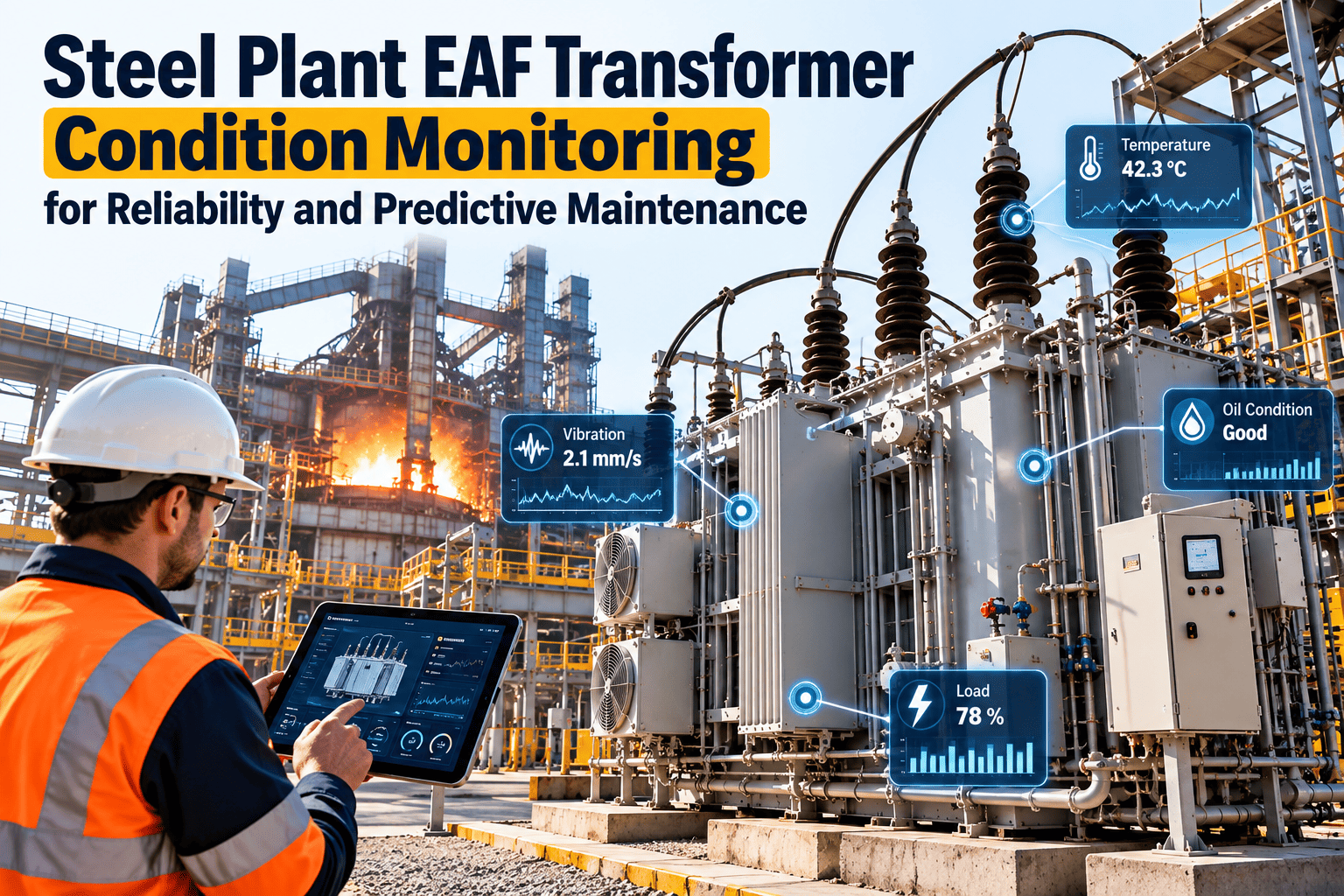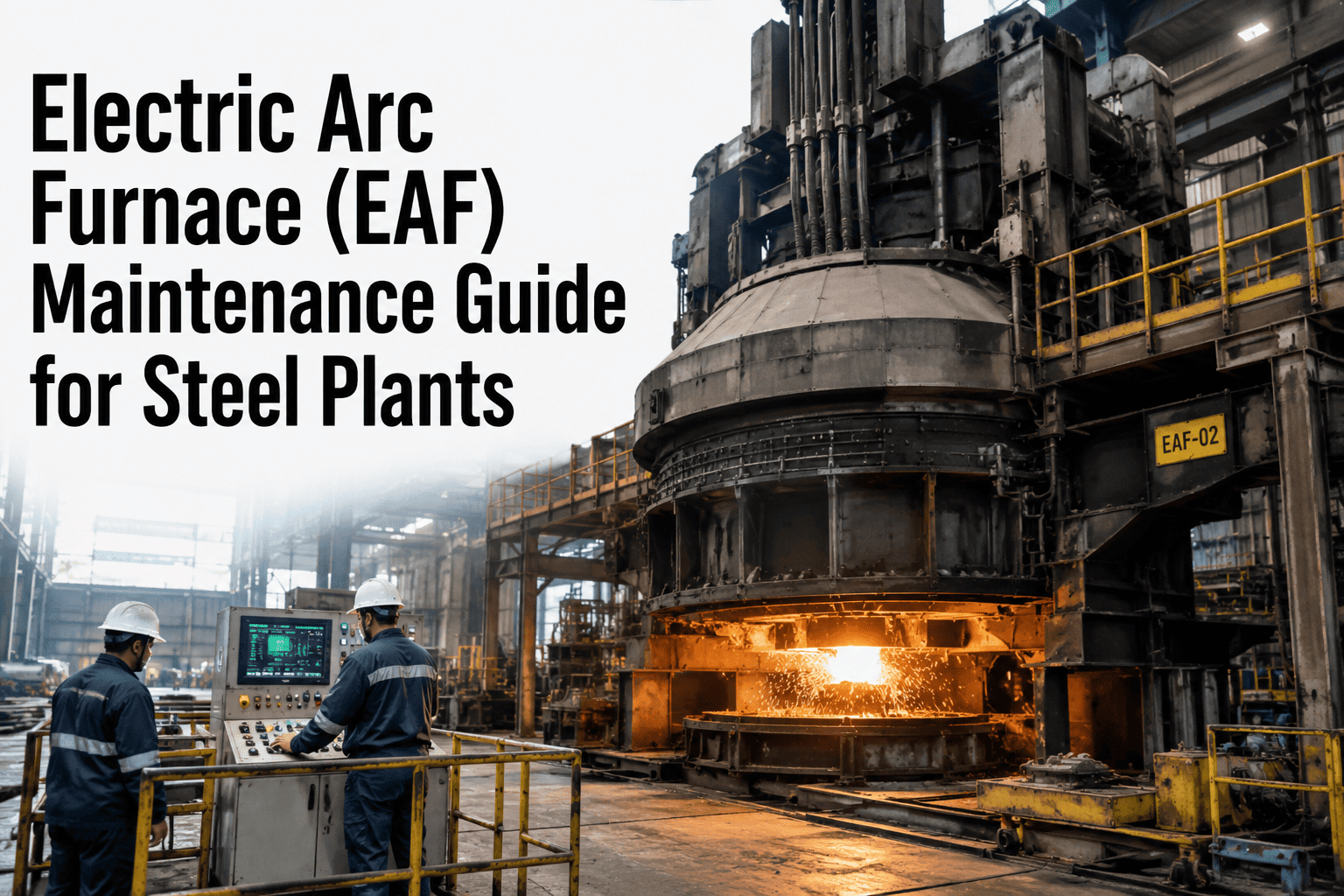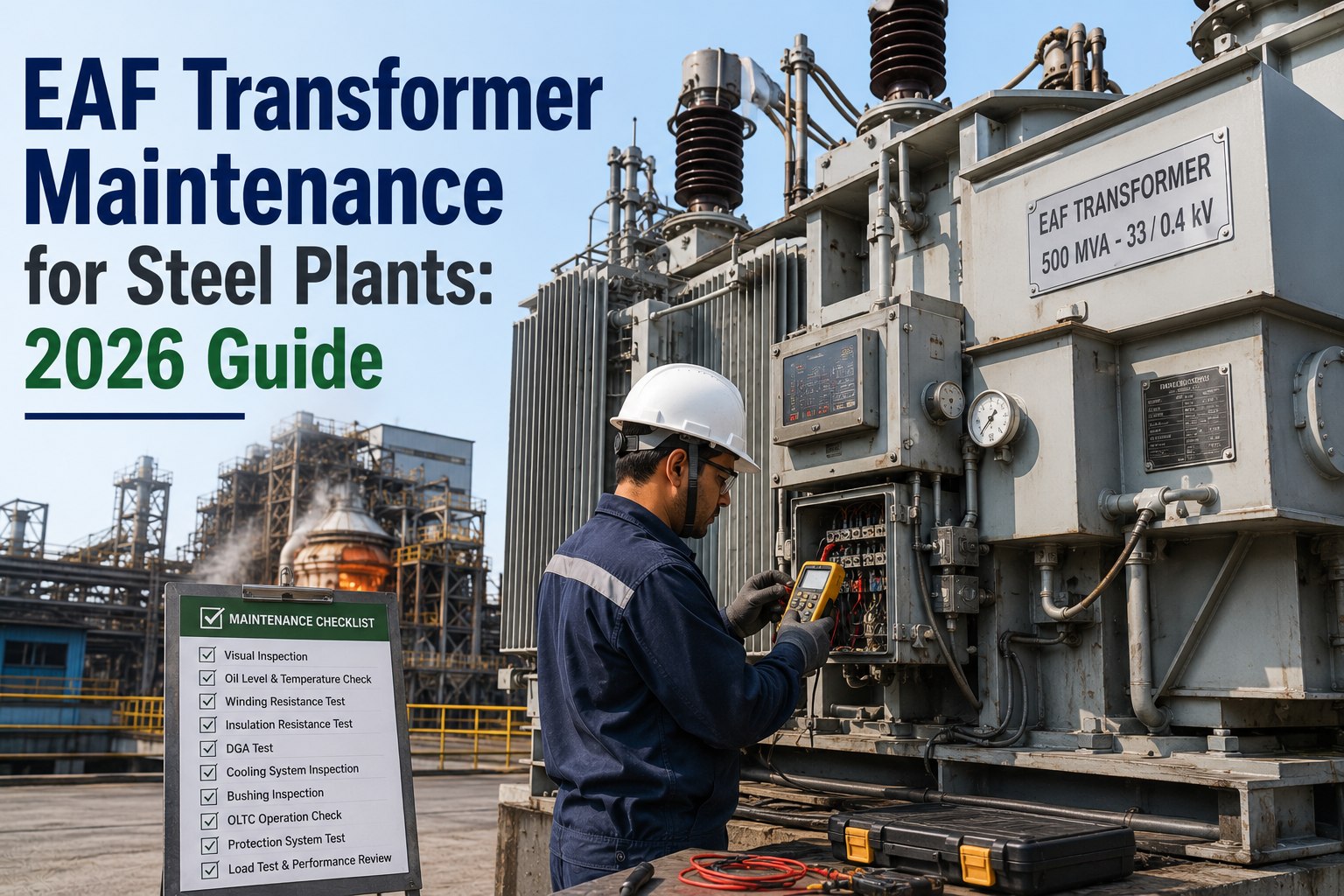
Electric arc furnace transformers sit at the violent electrical heart of every steel melt shop — absorbing switching surges, harmonic distortion, and thermal shocks that would destroy a standard grid unit within weeks. A single unplanned failure on an 80–120 MVA EAF transformer can idle a furnace for 3–7 days and erase $1.2M–$4.8M in lost production, scrap, and emergency repairs. This 2026 guide walks metallurgical maintenance leaders through the inspections, oil diagnostics, tap-changer service intervals, and CMMS workflows that keep these assets online — and you can put all of it into action by logging your first transformer in a Start Free Trial of Oxmaint.
What would 14 hours of unplanned furnace downtime cost your melt shop this quarter?
EAF transformers carry the highest electrical stress of any industrial asset. A disciplined maintenance program — built on DGA, oil testing, thermography, and tap-changer service — typically cuts transformer-driven outages by 60–80% and extends asset life from 18 to 30+ years. The playbook below shows exactly what to inspect, when, and how to track it.
The five stress factors unique to arc furnace duty
Unlike a network power transformer, an EAF unit sees load swings of 0–150% within seconds during bore-down, scrap cave-ins, and tap changes — repeatedly, every heat.
Winding hot-spot temperatures can swing 35–55°C in a single heat, accelerating cellulose insulation aging by up to 4× compared to steady-state loading per IEEE C57.91 aging models.
Furnace arc harmonics (2nd–7th) and unsymmetrical loading drive eddy-current losses in the tank and structural steel, raising no-load losses by 8–15% over nameplate if not filtered.
An OLTC on furnace duty may perform 15,000–25,000 operations per year versus 500–2,000 on a grid transformer — wearing contacts, springs, and divertor resistors aggressively.
Furnace wall cave-ins and electrode breakages produce through-faults up to 15× rated current. Each event cumulatively degrades winding clamping pressure and axial strength.
Sustained high top-oil temperatures (>85°C) accelerate oxidation, sludge formation, and moisture ingress — doubling the rate of dielectric breakdown if oil is not reconditioned.
High-current delta and furnace-end connections carry 30–80 kA. Loose joints develop 180–300°C hotspots within days, leading to arcing, insulation damage, and forced outages.
Dissolved gas analysis: the early-warning system that prevents 70% of failures
DGA is the single highest-value diagnostic on an EAF transformer. A quarterly sampling program catches developing faults — arcing, partial discharge, thermal hotspots — weeks before they escalate into catastrophic failures.
Key gases and what they reveal: Acetylene (C₂H₂) → arcing (>5 ppm = immediate action). Ethylene (C₂H₄) → high-thermal fault (>500°C). Hydrogen (H₂) → partial discharge or corona. Methane (CH₄) → low-thermal fault (150–300°C). CO + CO₂ → cellulose insulation degradation.
| Gas Indicator | Normal (ppm) | Caution (ppm) | Critical (ppm) | Likely Fault |
|---|---|---|---|---|
| Hydrogen (H₂) | < 100 | 100–700 | > 700 | Partial discharge |
| Acetylene (C₂H₂) | < 5 | 5–50 | > 50 | Internal arcing |
| Ethylene (C₂H₄) | < 50 | 50–100 | > 100 | Severe overheating |
| Methane (CH₄) | < 120 | 120–400 | > 400 | Low-thermal fault |
| Carbon Monoxide (CO) | < 350 | 350–1,400 | > 1,400 | Cellulose aging |
| Total Combustible Gas | < 720 | 720–4,640 | > 4,640 | Aggregate fault trend |
A 90 MVA EAF transformer at a Midwest mini-mill showed acetylene climbing from 3 to 28 ppm over three quarterly samples — still below the 50 ppm critical threshold. Trend analysis in the CMMS flagged the 833% rise rate. An internal inspection found a loose tap-selector contact within 6 hours; the $14K repair prevented an estimated $2.1M arc-fault failure.
The 12-month EAF transformer maintenance timeline
A tiered schedule aligns routine monitoring with deeper diagnostics. Steel plants running ISO 55001-aligned asset programs typically compress this into a CMMS-driven calendar with automatic work-order generation.
Top-oil temperature, winding temperature, oil level, silica gel breather color, audible noise, vibration, and leak inspection. Log all readings against baseline. Target: <15 minutes per unit.
IR scan of all busbar connections, tap-changer compartment, cooling radiators, and bushings. Flag any joint >20°C above ambient. Dielectric breakdown (BDV) test on oil sample — minimum 30 kV/2.5 mm gap per IEC 60156.
Full dissolved gas analysis (9-gas) plus moisture-in-oil (Karl Fischer), acidity, interfacial tension, and furan content. Trend all values in the CMMS. Moisture > 20 ppm at 60°C requires oil processing.
OLTC contact resistance measurement, divertor-switch oil drain and filter, transition-resistor inspection, mechanical timing test. Replace contact set if wear exceeds manufacturer limit (typically 25–40% of new thickness).
Sweep-frequency response analysis (SFRA), winding capacitance & tan-delta, bushing C1/C2 power factor, and core-to-ground current. Compare SFRA fingerprints against baseline to detect winding displacement from through-faults.
De-tanked inspection of core, windings, clamping structure, and lead insulation. Oil reclamation or full reconditioning. Degree-of-polymerization (DP) test on cellulose — DP below 450 indicates end-of-life planning should begin.
The EAF transformer daily & weekly inspection checklist
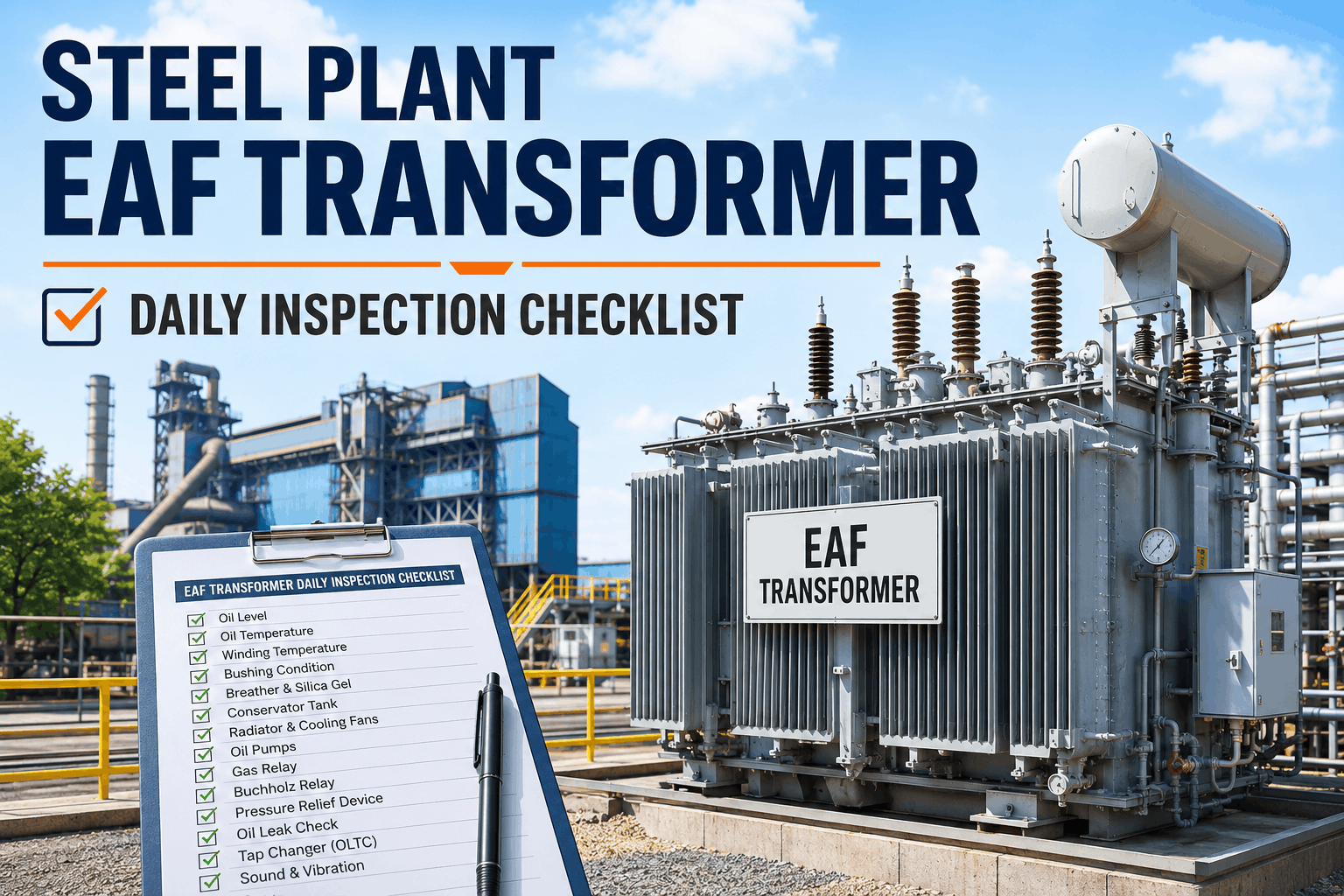
Print this, laminate it, and attach it to every transformer cell. These 16 checkpoints represent the minimum viable inspection for safe EAF transformer operation.
- Verify oil level in conservator tank (within green zone)
- Inspect silica gel breather — replace if >75% pink
- Check radiator valves open and fans operational
- Inspect gaskets, flanges, and weldments for seepage
- Record top-oil temperature (alarm >95°C, trip >105°C)
- Record winding hot-spot temperature vs. load curve
- Verify oil pump flow indicators (if forced-oil cooled)
- IR-scan cooling-loop connections and oil piping
- Verify Buchholz relay sealed and alarm/trip functional
- Check pressure-relief device indicator position
- Inspect bushing porcelain for cracks and contamination
- Verify tap-changer position indicator matches control
- Confirm earth-fault and overcurrent relay flags clear
- TestMarshalling box heaters and desiccant
- Verify fire-protection (water-spray or FM-200) armed
- Inspect fencing, grounding, and arc-flash labels
Maintenance spend vs. failure cost: the EAF transformer ROI
The arithmetic is brutal. A disciplined PM program costs $35K–$60K per transformer annually. A single avoided failure returns that investment 30–60 times over.
Where P_failure = probability of one major failure per year without PM (industry baseline for EAF duty: 8–14%), Cost_failure = lost production + emergency repair + scrap + overtime, and Annual_PM_Cost = labor + lab tests + consumables + CMMS.
A mini-mill operating three 100-ton EAFs (each with one 85 MVA transformer) spends $378K/year on a structured PM program across all three units. Before implementing the program, the plant averaged one transformer-driven outage every 14 months costing ~$2.6M per event. Post-implementation (3 years), zero major failures. Net three-year savings: approximately $5.6M in avoided losses, plus 6% reduction in insurance premiums.
Ready to digitize your EAF transformer maintenance program?
Oxmaint gives steel plants a purpose-built CMMS for asset registries, DGA trending, inspection checklists, and PM scheduling — deployed in days, not months.
EAF transformer maintenance — answers plant managers actually need
For EAF duty, sample dissolved gas analysis quarterly at minimum — monthly if the unit is >15 years old or shows trending gases. After any through-fault event or sustained overload, take a sample within 48 hours. Online DGA monitors are justified on transformers above 60 MVA where a single failure exceeds $2M in production loss. You can build automated sampling reminders and trend charts by starting a Start Free Trial of Oxmaint.
Moisture content should remain below 15 ppm at 60°C operating temperature for transformers above 69 kV class. Between 15–25 ppm, schedule oil processing within 30 days. Above 25 ppm, the dielectric strength is compromised and the unit should be de-energized for vacuum dehydration. Moisture accelerates cellulose aging exponentially — every 10 ppm above 20 ppm roughly halves remaining insulation life.
Most manufacturers specify inspection at 10,000–15,000 operations or annually, whichever comes first — whichever is sooner for EAF duty. On a typical arc furnace performing 20–25 operations per heat across 300 days, that threshold arrives in 8–10 months. Contact wear measurement should be documented against new-contact thickness; replace the contact set at 60% remaining or when pitting exceeds 0.5 mm depth.
Yes — primarily by enforcing PM compliance and surfacing trend data before it becomes a failure. Plants using a CMMS with automated work-order generation typically achieve 92–96% PM completion on time versus 65–70% under paper-based systems. The downstream effect is a 40–60% reduction in unplanned transformer outages within the first 18 months. To see the workflow in action, Book a Demo with our team.
With a rigorous PM program including annual electrical diagnostics, semi-annual OLTC service, and oil reclamation every 5–7 years, an EAF transformer can reliably reach 30–35 years. Without structured maintenance, the same asset typically fails between 15–18 years — and the final 2–3 years are marked by escalating forced outages. The cellulose insulation degree-of-polymerization (DP) value is the definitive life indicator: plan replacement when DP falls below 350.
Stop reacting to transformer failures. Start preventing them.
Join the steel plants using Oxmaint to track DGA trends, schedule tap-changer service, and keep their EAF transformers running past 30 years. Set up your asset registry in under an hour.
Free 14-day trial · No credit card