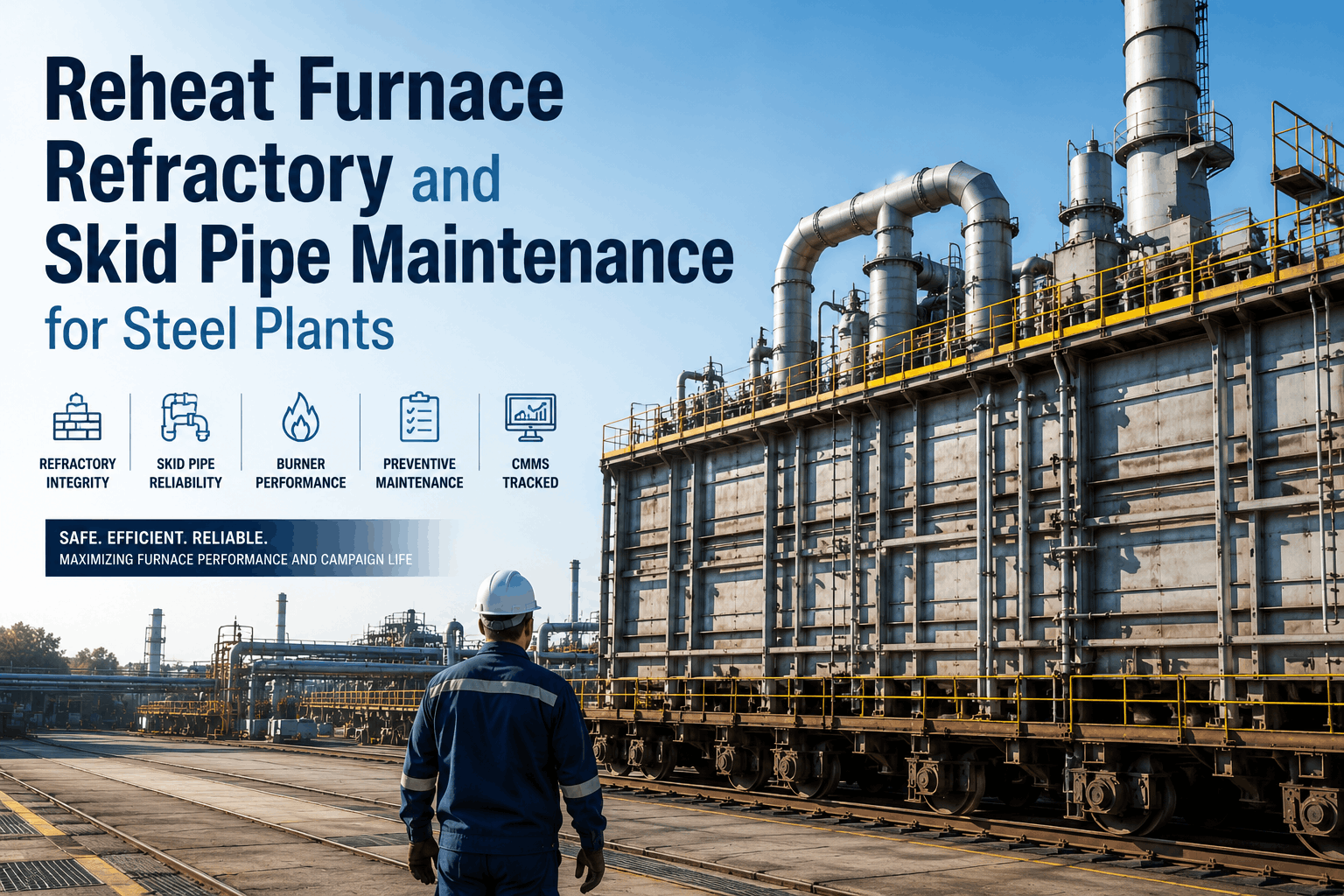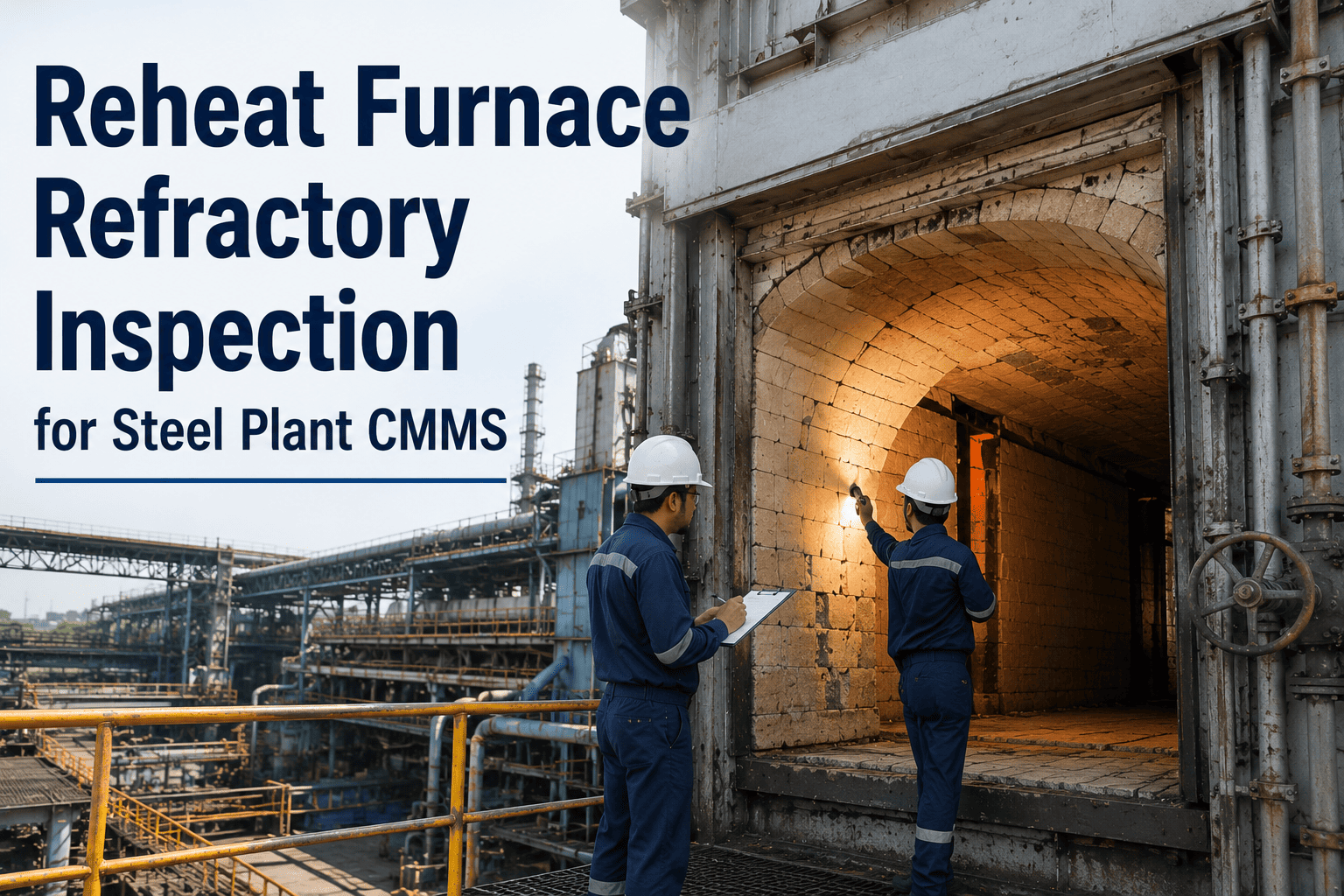
Reheat furnace refractory is the single largest determinant of fuel rate, slab quality, and campaign length in any hot strip mill or plate mill. A 1% lining loss can push fuel consumption up 3–5% and trigger surface defects on the first 20–30 slabs after a campaign restart, so inspection cadence directly controls both margin and customer claim exposure. This guide walks operations and reliability engineers through lining wear assessment, checker brick condition, hot spot detection, and the repair-versus-replace decision criteria that should live inside a CMMS like Oxmaint. Start Free Trial to turn each finding below into a tracked, scheduled work order.
Is your reheat furnace burning $280K a year through lining you can't see failing?
A 320 t/h walking-beam furnace with 8–12% refractory thinning loses roughly 4–6 GJ per tonne through the shell — about $280K in annual fuel overdraw before a single hot spot is ever logged. This checklist walks maintenance and reliability teams through the exact inspection zones, thresholds, and repair-decision criteria that belong in your steel plant CMMS.
The hidden cost chain behind every cracked brick
Refractory is not a consumable — it is the thermal envelope that defines whether your furnace hits 1250°C soak at 5 GJ/t or 6.8 GJ/t. Three downstream metrics move with it.
Six furnace zones, 24 inspection points, one CMMS record
Walk this list every shutdown and after every mid-campaign infrared sweep. Each point becomes a condition record in Oxmaint — with photo, thickness reading, and recommended action.
- Skewback brick displacement >3 mm
- Crown spring loading vs baseline
- Hot-face spalling along burner ports
- Ash-lag buildup at apex
- Remaining thickness <65% of original 230 mm
- Burner block concentricity & flame impingement marks
- Cold-face shell temperature >120°C
- Anchor crack propagation tracking
- Skid pipe refractory integrity (no exposed metal)
- Hearth brick erosion depth >40 mm
- Slide wear near discharge zone
- Clog detection in drainage ports
- Top 3 rows slagging / fusion inspection
- Flow blockage >15% of cell cross-section
- Reversal differential pressure drift
- Sub-grade condensate (alkali vapor) attack
- Door fibre gasket compression
- Cooling water leak traces near seals
- Air ingress >5% of stoichiometric air
- Castable spalling at jamb corners
- Infrared shell scan >140°C hotspot
- Internal camera mapping during firing
- Trend comparison to prior campaign
- Locate & log to CMMS asset record
From first detection to forced pull — the 14-month clock
Hot spots rarely appear suddenly. They progress through four severity bands, each with a defined CMMS trigger and maximum allowed response window. Skip a band and you trade a $9K gunning repair for a $220K emergency strip-and-relined outage.
| Severity | Shell Temp | Internal Symptom | CMMS Action | Max Response Window |
|---|---|---|---|---|
| Watch | 95–120°C | Faint IR glow on crown corners | Log reading, schedule 30-day recheck | 30 days |
| Monitor | 121–140°C | Visible thinning <10% in zone | Open WO, plan gunning at next outage | 60 days |
| Alert | 141–175°C | Sustained hot spot, >10% loss confirmed | Forced gunning within 14 days | 14 days |
| Critical | >175°C | Shell cherry-red, structural risk | Controlled ramp-down, emergency repair | 48 hours |
A 180-asset mill, $42K inspection, $1.1M avoided cost
A Midwest plate mill running two 280 t/h walking-beam furnaces spent $42K on a quarterly infrared + endoscope inspection program logged inside Oxmaint. In Month 9 the crew flagged a 138°C shell hotspot on Furnace 2 — Alert band. A $9K ceramic-fibre gunning repair during the next 8-hour rolling gap closed the zone. The alternative, projected from prior campaigns: a runaway failure within 14 months forcing a 9-day emergency reline at $1.1M in lost production and contractor cost. Payback ratio: 26:1.
The 1.5× rule for repair versus replace
When the projected cost of the next repair exceeds 1.5× the amortized cost of a full reline — adjusted for remaining campaign life — trigger a reline plan instead of another patch. Two formulas govern the decision.
RLI < 0.40 → plan reline within next outage window. RLI < 0.20 → forced pull.
Apply per zone, then aggregate. If more than 3 zones trigger "Replace," pull the entire campaign forward.
Turn every inspection finding into a tracked work order
Oxmaint logs thickness readings, IR scans, and photos against each furnace asset, then auto-routes severity triggers to the right technician — before a $9K problem becomes a $220K outage.
Reheat furnace refractory inspection, answered
Start your refractory inspection program this shutdown
Log thickness, photos, and severity triggers against every furnace asset. Auto-route repairs before a $9K gunning job becomes a $220K emergency reline.
Free 14-day trial · No credit card