
A steel plant is not a typical industrial facility. It is a cascade of interdependent, high-consequence production zones — blast furnace, steelmaking vessel, continuous caster, reheat furnace, rolling mill — where an unplanned failure at any point can shut down every zone downstream of it for hours. The maintenance challenge is proportionally complex: you are managing rotating equipment in extreme thermal environments, refractory lining with campaign-based replacement cycles, hydraulic and lubrication systems under continuous heavy load, and a workforce compliance and permit-to-work regime that carries criminal liability if not executed correctly. Most CMMS platforms were designed for facilities maintenance or light manufacturing — they work adequately when the highest consequence asset is a chiller or a conveyor. They struggle when the asset is a 300-tonne liquid steel ladle, a 2,000°C blast furnace tuyere, or a six-stand hot strip mill producing 200 metres of steel per second. Selecting a CMMS for a steel plant means evaluating platforms on steel-specific capability — not general maintenance management features — and understanding where general platforms fall short under steelmaking operating conditions.
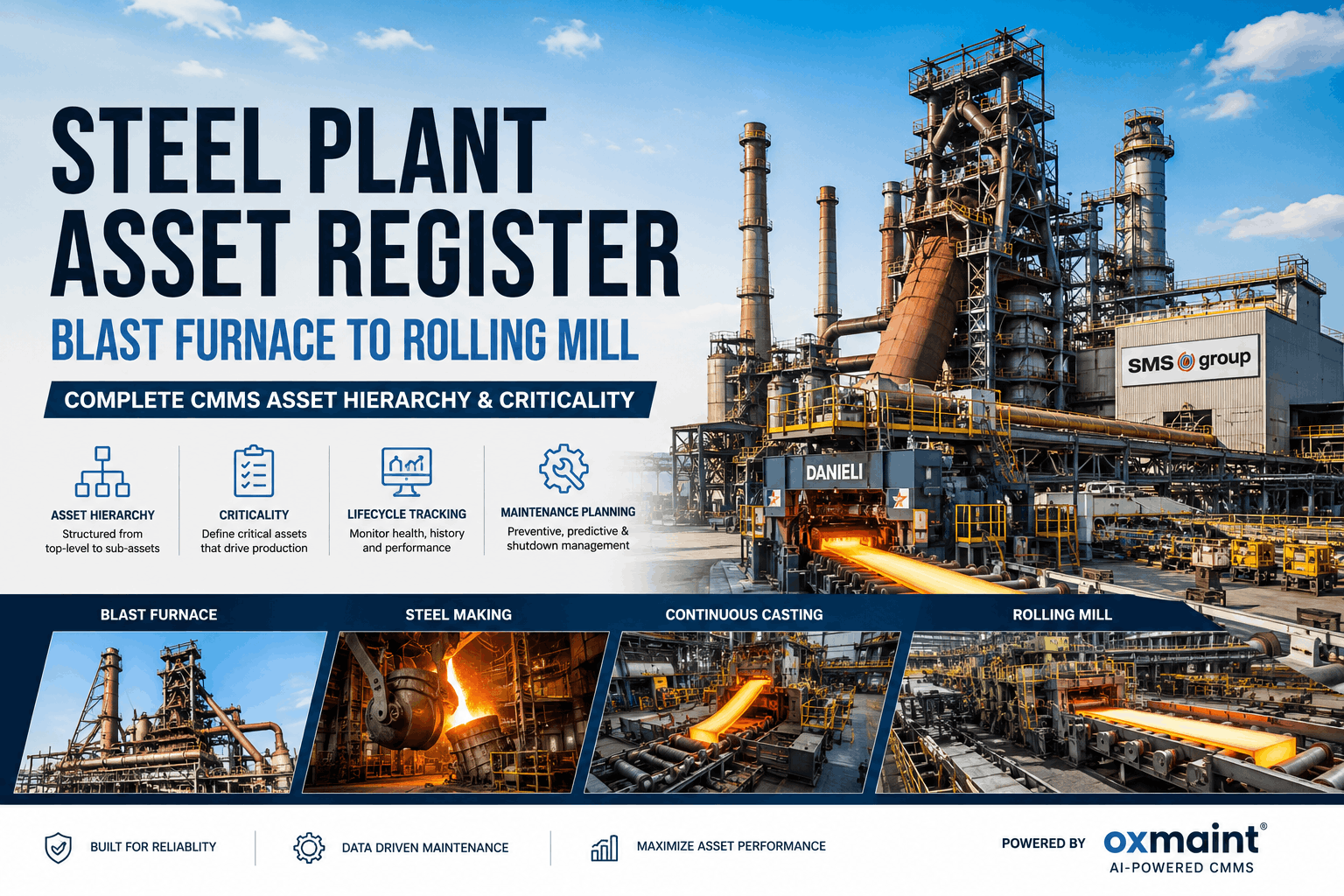
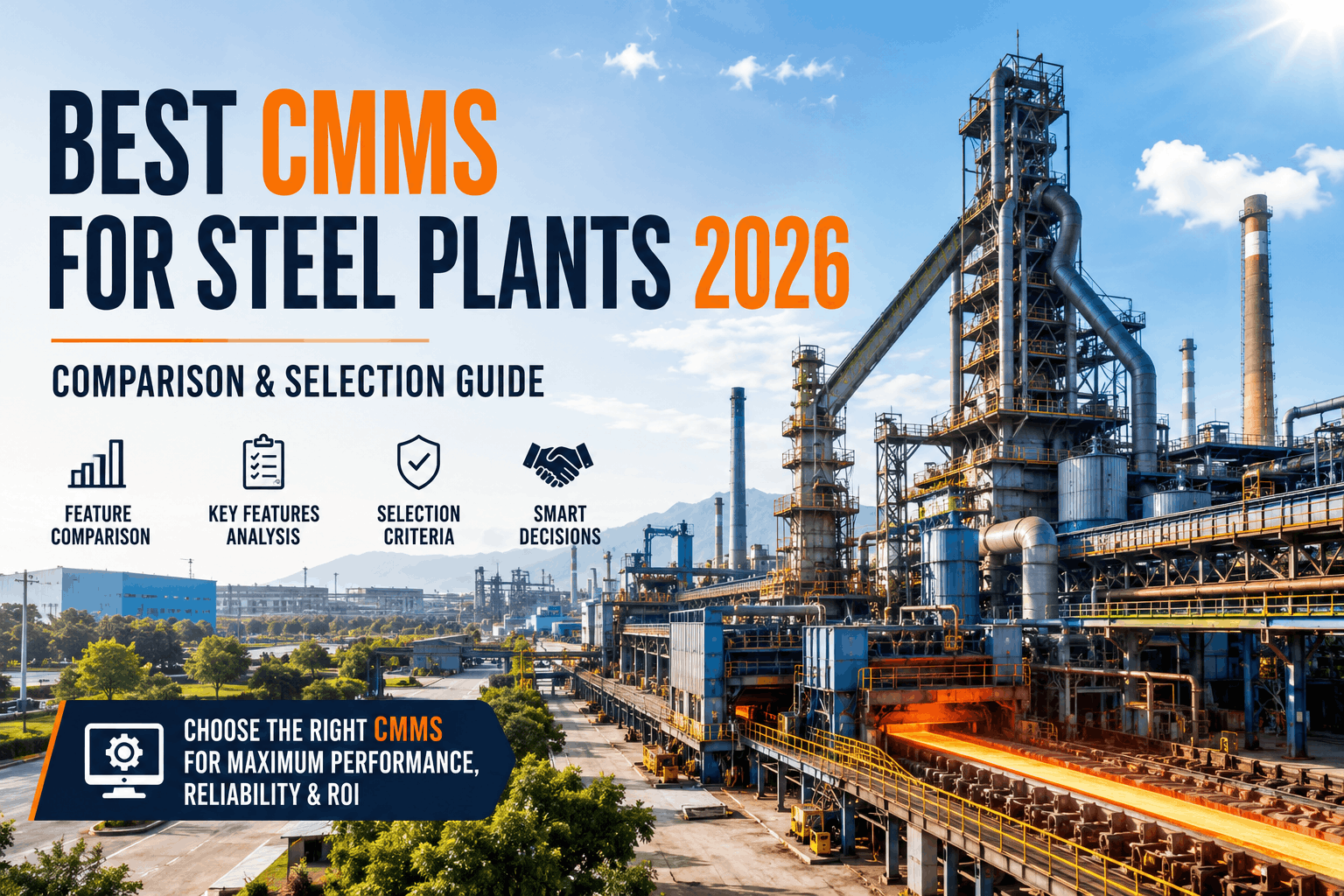
Best CMMS for Steel Plants 2026: Blast Furnace to Rolling Mill
How to evaluate CMMS platforms for the full steel production chain — covering steel-specific requirements, zone-by-zone asset management demands, and how OxMaint addresses each from raw materials handling through finished product.
What Makes CMMS Selection Different for Steel Plants
Eight requirements distinguish a CMMS that works in a steel plant from one that works in a warehouse or office building. Most platforms cover two or three. A platform built for steel production engineering covers all eight. Book a demo to walk through OxMaint's steel plant capability zone by zone.
Campaign-Based Asset Lifecycle Management
Blast furnace linings, torpedo ladle linings, converter linings, and tundish linings do not have calendar-based maintenance cycles — they have campaign cycles measured in heats cast, tonnes processed, or operating hours at temperature. A CMMS for steel must support throughput-triggered PM scheduling and asset lifecycle tracking by campaign, not by date.
High-Temperature Equipment Asset Hierarchy
Steel plant assets are not flat lists. A blast furnace has tuyeres, coolers, staves, raceways, and tapholes — each a maintainable sub-asset with its own PM schedule and failure mode. The CMMS asset hierarchy must support deep nesting of sub-components with individual maintenance records, not just top-level asset records.
Permit-to-Work Integration
Hot work permits, confined space entry permits, electrical isolation permits, and high-energy lockout/tagout are not administrative checkboxes in a steel plant — they are legally mandated safety-critical controls. The CMMS must enforce permit issuance, approval, and closure as part of the work order lifecycle, not as a separate paper-based process running alongside it.
Multi-Zone Production Awareness
Maintenance scheduling in a steel plant must account for production zone interdependencies. A planned outage on the continuous caster blocks work on the blast furnace and steelmaking vessel. The CMMS must surface production constraints when scheduling maintenance windows — a feature absent from most general-purpose platforms.
Predictive Maintenance Data Integration
Steel plant predictive maintenance is sensor-dense — vibration on rolling mill bearings, temperature on blast furnace cooling elements, oil particle count on drive gearboxes, infrared on electrical panels. The CMMS must receive sensor data from condition monitoring systems and trigger work orders when parameters cross action thresholds, not require manual data entry from separate condition monitoring platforms.
Mobile Execution in Harsh Environments
Steel plant maintenance is performed in temperatures from -20°C (raw materials storage) to +60°C (adjacent to furnace) with high dust and particulate loading. Mobile CMMS must work on ruggedised devices, function offline in shielded areas and below-grade locations, and be operable with gloves. A consumer-grade mobile UX designed for an office environment is not fit for the steel plant floor.
Statutory Inspection and Compliance Records
Lifting equipment (ladle cranes, overhead cranes), pressure vessels, rotating machinery, and fire suppression systems all carry statutory inspection requirements. The CMMS must generate, track, and store inspection compliance records with certificate attachments — retrievable instantly during regulatory audit. Paper-based statutory records are a compliance gap in most steel plants.
Refractory and Consumable Lifecycle Tracking
Refractory bricks, ladle linings, electrode sections, and roll consumables are high-cost, campaign-life assets that must be tracked from installation through retirement against throughput metrics. CMMS consumable tracking must connect the asset's current condition to its accumulated throughput record — not just to a calendar date.
Steel Plant CMMS Requirements by Production Zone
Each production zone in an integrated steel plant has a distinct asset profile, failure mode landscape, and maintenance management requirement. A CMMS that covers all zones from a single platform — with zone-specific asset hierarchies, PM templates, and reporting — eliminates the fragmented multi-system approach that most steel plants currently operate. Sign up to explore OxMaint's steel zone templates — free.
Blast Furnace Zone
The blast furnace is the most capital-intensive and campaign-critical asset in an integrated steel plant. Key CMMS requirements: campaign heat counter for lining wear tracking, tuyere temperature monitoring with individual tuyere asset records, stave cooler and cooling panel inspection history, hot blast valve and bleeder valve PM schedules, and casthouse equipment (taphole drill, mud gun, cast house crane) maintenance records with shift-level frequency PM work orders.
Steelmaking Vessel Zone (BOF / EAF)
BOF and EAF vessels operate on campaign cycles determined by refractory wear. CMMS requirements: heat count per campaign, refractory thickness measurement integration, vessel trunnion bearing condition monitoring, off-gas system maintenance (waste heat boiler, gas cleaning), electrode management for EAF (electrode length tracking per heat, tip condition records), and ladle pre-heating stand inspection records.
Continuous Casting Machine
CCM maintenance is the most checklist-intensive zone in steelmaking — mold oscillation, segment rolls, secondary cooling nozzles, and withdrawal rolls all require per-campaign inspection with measurements that determine serviceability. CMMS requirements: mold copper taper measurement records, segment roll diameter tracking, spray nozzle flow test records, strand guide alignment survey results, and torch cut-off blade life tracking.
Rolling Mill Zone (Hot and Cold)
Rolling mill CMMS complexity is driven by roll management — each roll is a tracked asset with a campaign history, regrind record, and bearing temperature log. CMMS requirements: individual roll ID asset records linked to stand and campaign, chock bearing temperature history, gearbox oil analysis records with threshold alerting, AGC calibration records, coiler mandrel wear tracking, and alignment survey results stored as campaign-end compliance records.
Crane Fleet (Ladle, Charging, Scrap)
Steel plant cranes carry the highest maintenance compliance obligation of any asset class — statutory annual certification, proof load tests, anti-drop device tests, and wire rope service life tracking. CMMS requirements: certification record storage with certificate attachment, proof load test compliance records, wire rope service life counter (heats or operating hours), anti-drop device monthly test records, and pre-shift operator inspection logs with supervisor sign-off.
Energy and Utilities (Power, Gas, Water, Compressed Air)
Steel plant utilities are production-critical infrastructure — a cooling water failure on a blast furnace or continuous caster has the same production consequence as a mechanical failure. CMMS requirements: transformer maintenance records with thermography history, compressed air system PM with pressure test records, cooling tower gearbox oil analysis, cooling water chemistry treatment records, and gas pipeline integrity inspection history.
Top CMMS Platforms for Steel Plants 2026: Evaluated on Steel-Specific Criteria
Five platforms evaluated against the eight steel-specific requirements defined above. General maintenance management features (work order management, PM scheduling, mobile app) are assumed capable across all five. The differentiation is on steel-specific capability. Sign up to evaluate OxMaint against your specific steel plant requirements — free.
The strongest steel plant CMMS choice for operations that need immediate results without enterprise-scale implementation overhead. OxMaint's multi-zone asset hierarchy, throughput-triggered PM scheduling, AI pattern detection, and mobile-first execution are all native to the platform — not add-on modules. Pre-built templates for blast furnace, CCM, rolling mill, and crane fleet compress deployment from months to days. Free to start with no implementation fee.
Maximo Application Suite (MAS) has deep industrial asset management capability and is deployed at several major integrated steel producers globally. Its strength is the breadth of asset hierarchy modelling and the depth of compliance record management. The limiting factors for most steel plants are implementation cost ($500K–$2M+), deployment timeline (12–24 months), and the operational complexity requiring dedicated Maximo administration staff. Best justified for 500+ technician operations with multi-year capital programmes.
SAP PM is the natural choice for steel plants already running SAP ERP — the integration between maintenance, procurement, and finance is native rather than built through connectors. Steel-specific functionality is available through the metals and mining industry solution. The limitation is that SAP PM is not a standalone maintenance platform — it is a module within a broader ERP deployment. Mobile execution in the field remains challenging without additional SAP Fiori or third-party mobile layer implementation.
Fiix has solid general CMMS capability and performs adequately for ancillary equipment and utilities maintenance in a steel plant environment. The steel-specific capability gaps are campaign-based asset lifecycle management (not natively supported), permit-to-work integration (requires add-on), and throughput-triggered PM scheduling. For a steel plant running both Rockwell automation hardware and Fiix for maintenance, the integration between the two platforms is an advantage. Not recommended as the primary maintenance platform for production-critical steel assets.
UpKeep is a capable mobile-first CMMS for facilities maintenance and light manufacturing — strong UX, good adoption rates, reasonable PM scheduling. For steel plant production-critical assets, the capability gaps are significant: no campaign asset lifecycle management, no permit-to-work, no throughput-based triggers, limited asset hierarchy depth, and no steel-specific templates. UpKeep is appropriate for maintenance of offices, workshops, and non-production infrastructure in a steel plant context, but should not be deployed as the primary maintenance platform for production assets.
Frequently Asked Questions
What CMMS features are most critical for blast furnace maintenance management?
How does OxMaint handle permit-to-work for high-risk steel plant maintenance?
Can OxMaint be deployed in a steel plant without a long IT implementation project?
From Blast Furnace to Rolling Mill. One Platform. No Implementation Fee.
OxMaint delivers campaign tracking, zone-by-zone asset hierarchy, permit-to-work integration, and AI predictive analytics for every production zone in your steel plant — free to start and live in days.
.png)
