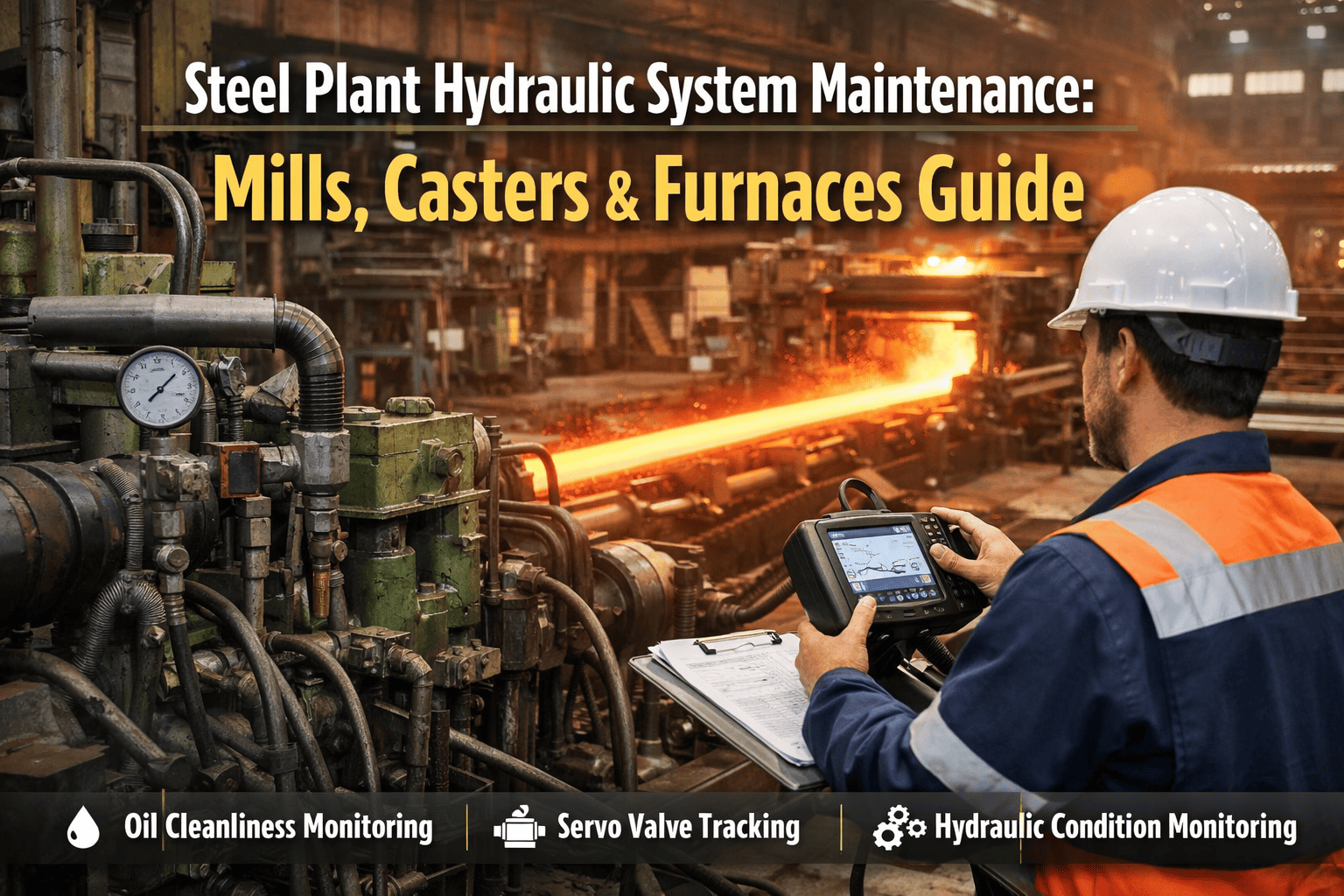
Hydraulic systems are the muscle of steel plant equipment. Rolling mill roll gap control, continuous caster segment drives, press and shear operations, blast furnace bell drives, converter tilting mechanisms, and ladle car movements all depend on hydraulic power to deliver the force, precision, and speed that steel production demands. In an integrated steel plant or large EAF facility, hundreds of hydraulic circuits operate simultaneously — from the 300-bar servo systems controlling roll force in a cold mill to the low-pressure circuits operating furnace door actuators. When hydraulic systems fail in this environment, the consequences are not limited to the hydraulic equipment itself: production lines stop, refractory damage can result from uncontrolled movements, fire risk escalates from high-pressure oil leaks near hot metal, and safety events occur from uncontrolled actuator movements. The difference between a steel plant that treats hydraulic maintenance as a priority and one that treats it as a reactive task is measured in planned tons per year — and the gap is substantial. Schedule a free hydraulic maintenance program review with our team and find exactly where your current program has gaps before your next unplanned rolling mill stoppage.
Why Hydraulic Failures Hit Steel Plants Harder Than Other Industries
Hydraulic system failures in steel plants carry consequences that go well beyond the immediate equipment involved. The combination of extreme operating pressures, high ambient temperatures, contaminated environments, and direct coupling to safety-critical processes creates a failure environment unlike any other industrial sector.
Production Impact
$150K–$800K
Cost per hour of unplanned hydraulic-related downtime in flat-rolled steel production
Rolling mill hydraulic failures — servo valve faults, pump failures, seal leaks on roll gap cylinders — stop production immediately with no workaround. A 4-hour hydraulic repair can cost more in lost production than an entire year of preventive maintenance for that system.
Safety Consequences
Flash Point
Mineral hydraulic oil ignites at 150–170°C — temperatures routinely present within 2 meters of EAF tapping and BOF blowing operations
High-pressure hydraulic oil leaks near hot metal, tapping operations, and reheating furnaces create fire risk. Uncontrolled actuator movement from hydraulic failure near casting operations or furnace charging can cause catastrophic safety incidents.
Quality Degradation
Before Failure
Hydraulic system degradation affects product quality before causing visible equipment failure
Contaminated hydraulic fluid causes servo valve spool stiction, leading to imprecise roll gap control and strip thickness variation. Partial pump displacement loss causes slow pressure response, creating strip profile deviations that appear as quality defects before any alarm activates.
Environmental and Regulatory
Reportable
Hydraulic oil spills above threshold quantities require EPA SPCC plan notification and state environmental reporting
A major hydraulic oil release into a plant drainage system, waterway, or soil creates environmental reporting obligations, cleanup costs, and potential regulatory enforcement that far exceed the cost of the maintenance that would have prevented the seal or hose failure.
Critical Hydraulic Systems in Steel Plants: A Complete Map
Steel plants contain hydraulic systems across every major process unit. Understanding which systems carry the highest criticality — and therefore deserve the most intensive maintenance investment — is the first step toward a risk-based hydraulic maintenance strategy.
Rolling Mill Roll Gap Servo Systems
250–350 bar • Servo-hydraulic • Sub-mm positioning accuracy
Failure = immediate strip thickness deviation and mill stop
Continuous Caster Strand Guide Segments
160–250 bar • Roll gap and oscillation control
Failure = casting strand breakout risk and product rejection
BOF / EAF Vessel Tilting Drive
200–320 bar • High-torque tilting cylinders or motors
Failure = furnace locked in position — production stopped
Blast Furnace Charging Equipment
160–250 bar • Bell and hopper actuation
Failure = burden charging stops — BF slowing begins immediately
Shear and Crop Shear Hydraulics
200–280 bar • Clamp, hold-down, and blade cylinders
Failure = downstream crop/cut operations delayed
Downcoiler and Coiler Mandrel Systems
160–200 bar • Mandrel expansion and wrapper arm control
Failure = coiling stopped — strip builds up on runout table
Ladle Turret and Transfer Car Systems
160–250 bar • Swing, lift, and locking cylinders
Failure = ladle positioning delayed — heat loss and casting gap
Reheating Furnace Door and Pusher Systems
100–160 bar • Door lift and slab pusher cylinders
Failure = furnace loading/unloading stopped — thermal soaking delays
Roll Bending and Shifting Systems
250–350 bar • Strip profile control
Failure = strip profile quality loss — product downgrade risk
Side Guide and Edge Masher Systems
100–160 bar • Strip edge positioning
Failure = edge quality issues — camber and trim loss
Scale Breaker and Descaler Systems
100–200 bar • Nozzle and header actuation
Failure = scale defects on strip surface — quality rejection
Crane and Hoist Hydraulic Brakes
80–160 bar • Fail-safe brake systems
Failure = safety incident — load drop or uncontrolled movement
Connect Every Hydraulic System to a Maintenance Plan That Matches Its Criticality
Oxmaint lets you classify every hydraulic system by criticality, assign the right inspection frequency and procedures, and track every maintenance event — so your highest-risk systems always get the attention they need.
Oil Contamination Control: The Foundation of Every Hydraulic Maintenance Program
Hydraulic system failures in steel plants are caused by oil contamination in over 70% of cases. Contaminated fluid degrades every component it touches — pumps, valves, seals, cylinders, and sensors — not at the moment of contamination, but gradually and silently over weeks and months until a component fails. Contamination control is not one element of hydraulic maintenance — it is the program that makes every other element effective.
Sources in Steel Plants
New oil (inherently contaminated during manufacture)
System component wear debris — pumps, motors, valves
Ingression through cylinder rod seals during mill scale exposure
Reservoir breather contamination in dusty environments
Contaminated oil added during top-up operations
Damages: Servo valve spools, pump vanes and pistons, cylinder bore scratching, valve seat erosion
Sources in Steel Plants
Water-cooled cylinder gland seal leakage — common in caster segments
Reservoir condensation in temperature-cycling environments
High-pressure water descaler spray ingression through rod seals
Contaminated replacement oil with water emulsion
Damages: Additive depletion, microbial growth, corrosion of steel components, cavitation in pumps
Causes in Steel Plants
Inadequate heat exchanger capacity during peak production
Blocked cooler cores from mill scale and dust ingression
Overloaded circuits operating above rated pressure continuously
Extended operation with high ambient temperatures near furnaces
Damages: Oxidation varnish on valve spools, additive thermal breakdown, accelerated seal aging
Rolling mill servo systems
Servo valve (5 µm critical clearance)
16/14/11
Monthly
Caster segment hydraulics
Proportional valve (10 µm clearance)
17/15/12
Monthly
General industrial circuits
Directional control valve (25 µm)
18/16/13
Quarterly
High-pressure clamp / shear circuits
Cartridge valve (15 µm clearance)
17/15/12
Quarterly
Low-pressure utility circuits
Spool valve (40 µm clearance)
20/18/15
Biannually
Hydraulic Pump Maintenance: The Heart of Every Circuit
Hydraulic pumps are the most maintenance-critical component in any hydraulic system — and the most expensive to replace unplanned. In steel plant environments, pump reliability is challenged by contamination, temperature cycling, cavitation from undersized inlet piping, and pressure transients from sudden load changes. A well-maintained pump lasts 20,000–40,000 hours; a neglected one fails at 3,000–8,000.
Variable Displacement Piston
Rolling mills, servo systems, caster drives
Up to 350 bar operating
Critical Maintenance
Case drain flow rate monitoring — rising flow = worn piston/barrel interface
Shaft seal leakage inspection every 500 hours
Control servo valve cleanliness and response testing
Inlet pressure monitoring — cavitation threshold above -0.3 bar
Fixed Displacement Vane
General industrial circuits, lubrication systems
Up to 175 bar operating
Critical Maintenance
Vane tip and ring wear inspection at 8,000-hour intervals
Shaft seal and bushing replacement on condition
Oil viscosity verification — vane pumps sensitive to cold start
Noise and flow rate comparison against baseline at startup
External Gear Pump
Low-pressure utility circuits, cooling, lubrication
Up to 250 bar operating
Critical Maintenance
Gear and bushing clearance inspection at overhaul
Shaft seal replacement on first evidence of external leakage
Suction strainer cleaning every 1,000 hours in dirty environments
Coupling alignment check after any motor or pump replacement
Pump Degradation Indicators — Detect Before Failure
Rising case drain flow
Internal wear between piston/barrel or vane/ring — fluid bypassing back to tank internally
Trending: establish baseline at installation; investigate when flow doubles
Increased system cycle time
Pump volumetric efficiency falling — same flow demand takes longer to fill actuator
Compare cycle times against commissioning baseline every 3 months
Elevated noise level
Cavitation, aeration, bearing wear, or internal component contact
Monthly noise baseline comparison; vibration analysis at quarterly intervals
Abnormal fluid temperature
Internal bypass heating fluid — loss of pressure-generating efficiency converted to heat
Continuous temperature monitoring with high-limit alarm at reservoir and return line
Stop Replacing Pumps in Emergencies. Start Predicting Their Condition.
Oxmaint's equipment condition tracking, fluid analysis records, and cycle-time trending give your maintenance team the early warning signals needed to replace hydraulic pumps on a planned schedule — not after a production stoppage.
Servo Valve and Proportional Valve Maintenance
Servo and proportional valves are the most precision-critical components in steel plant hydraulic systems — and the most vulnerable to contamination, temperature, and vibration. A single failed servo valve on a rolling mill roll gap system stops strip production immediately. These components require dedicated maintenance procedures that are distinctly different from standard hydraulic valve servicing.
Spool Clearance2–5 µm
Required CleanlinessISO 16/14/11 or better
Temperature Sensitivity±30°C affects response curve
Typical Service Interval2,000–5,000 hours
Overhaul RequirementSpecialist facility only
Maintenance Actions
Servo amplifier calibration verification quarterly
Null bias check and adjustment per manufacturer schedule
Valve frequency response test annually or after any circuit work
Immediate replacement on evidence of spool hysteresis or leakage
Exchange service pool of pretested valves maintained on-site
Spool Clearance10–15 µm
Required CleanlinessISO 17/15/12 or better
Temperature SensitivityModerate — solenoid temperature matters
Typical Service Interval5,000–10,000 hours
Overhaul RequirementOEM or certified repair
Maintenance Actions
Solenoid resistance and current draw measurement quarterly
Valve response ramp testing against commissioning data
Manual override function test every 6 months
Spool cleanliness inspection during any planned outage
Position feedback sensor calibration verification
Never clean servo valves with compressed air or solvent flushing in the field. Any field-level intervention risks further contamination and spool damage. The only correct field response to a suspect servo valve is immediate exchange with a pretested spare from the valve pool. Condemned valves are returned to a specialist repair facility — not disassembled at the plant.
Hydraulic Cylinder and Seal Maintenance
Hydraulic cylinders in steel plants operate under conditions that attack seal integrity continuously: scale and abrasive particles on cylinder rods, thermal cycling, side-load forces from structural settling, and the vibration environment of rolling mills. A comprehensive cylinder maintenance program extends seal life, prevents oil contamination from external leakage, and catches bore damage before it destroys an expensive cylinder body.
Cylinder Inspection Schedule by Application
Rolling mill pressing cylinders
Severe — scale, water, vibration
6–12 months
Annual
Rod scoring from scale ingestion; seal failure creates thickness control loss
Caster segment gap cylinders
Severe — water spray, thermal cycling
8–12 months
At segment change
Water contamination via rod seal; cooling water diluting hydraulic fluid
Furnace door lift cylinders
High — heat, scale
12 months
Annual
High-temp seal degradation; fire risk from oil weeping near furnace opening
BOF converter tilt cylinders
High — heat, spatter exposure
12–18 months
Major outage
Seal failure creates uncontrolled tilt under load — critical safety item
General utility cylinders
Moderate — normal industrial
18–24 months
2 years
Gradual leakage; environmental and slip-hazard risk
Rod Surface and Wiper Maintenance — The First Line of Seal Protection
The cylinder rod wiper seal is the only barrier between the contaminated external environment and the rod seal and bore. In rolling mill environments, chrome-plated rods are exposed to mill scale, water jet spray, metallic swarf, and abrasive rust particles. Even hardened chrome plating scratches under these conditions — and scratched rods destroy rod seals within weeks of seal replacement. Rod surface condition must be inspected every time a cylinder is accessible during maintenance windows. Damaged chrome must be repaired or the cylinder replaced before seal work is performed.
→Chrome plating condition — no pitting, scoring, or bare metal areas
→Rod straightness — any bend creates side load that accelerates seal wear
→Wiper seal condition — torn or absent wipers admit scale directly to rod seal
→Rod boot or guard condition where fitted — protects rod from direct impact
Hydraulic Maintenance KPIs for Steel Plants
Hydraulic system performance in steel plants must be measured with metrics that connect fluid condition, equipment reliability, and production impact — not just maintenance activity counts. These KPIs give maintenance managers the indicators needed to demonstrate program effectiveness and detect deterioration before it causes downtime.
ISO 16/14/11
Target Servo Circuit Cleanliness
The single most predictive indicator of servo valve life and rolling mill hydraulic performance. Circuits consistently achieving this cleanliness target have servo valve replacement rates 4–6× lower than those operating at ISO 18/16/13.
0 PPM
Target Water Content (Servo Systems)
Even 200 PPM water in hydraulic oil causes corrosion and additive depletion in servo-grade circuits. Target is effectively zero measurable water — anything above 100 PPM triggers immediate investigation for ingression source.
99.2%+
Rolling Mill Hydraulic Availability
The percentage of scheduled production hours during which rolling mill hydraulic systems are fully operational. Below 99% represents over 87 hours of hydraulic-related downtime per year — a clear program failure signal.
MTBF by Hydraulic System
Trending up
Mean time between failures tracked per circuit — reveals which systems need targeted attention
Fluid Analysis Compliance
100%
All scheduled fluid samples taken and results within cleanliness targets — no overdue samples
Servo Valve Exchange Rate
Declining trend
Number of servo valve replacements per quarter — rising rate indicates contamination control failure
Unplanned Hydraulic Downtime
< 0.5% of hours
Hydraulic-caused unplanned stoppages as percentage of total production hours — world-class benchmark
Hydraulic Performance Data Across Every Circuit, Every Shift
Oxmaint links fluid analysis results, inspection findings, pump condition data, and servo valve history into a single dashboard that shows exactly which hydraulic circuits are trending toward failure — and when to act.
Common Hydraulic Maintenance Failures in Steel Plants
Most unplanned hydraulic failures in steel mills trace back to a small number of recurring maintenance program failures. Each of the following patterns is documented repeatedly in post-incident reviews — and each is preventable with the right program in place.
01
New Oil Added Without Verification of Cleanliness
Hydraulic oil as delivered from suppliers is typically at ISO 18/16/13 or worse — far too contaminated for servo systems. Most steel plants add oil directly from drums without pre-filtering through a kidney-loop system to the required cleanliness level. The result is contamination ingression events that cost ten times more in servo valve damage than the filtration rig that would have prevented them.
Required: All new oil filtered to target circuit cleanliness before addition. Dedicated top-up filtration unit with particle counter verification before use.
02
Reservoir Breathers Not Replaced on Schedule
Hydraulic reservoirs breathe in and out as oil temperature and level change — and every breath pulls air through the breather element. In a steel mill environment with ambient particulate levels of 1–10 mg/m³, a saturated breather provides almost no filtration. Most plants have no scheduled breather replacement program — the breather is replaced only when it is noticed to be visibly clogged, by which time ingression has been occurring for months.
Required: Breather replacement interval based on ambient dust levels — quarterly in melt shops, biannually in cleaner areas. High differential pressure indicators on desiccant breathers trigger replacement.
03
Fluid Analysis Samples Taken at the Wrong Point
Fluid samples drawn from reservoir drain plugs or return lines downstream of filters give optimistic cleanliness readings that do not represent conditions at the servo valve. Samples must be taken from live pressure-side sampling valves at the point of use — upstream of the valve manifold — to reflect actual working conditions. Incorrect sampling routines give false confidence while servo valves operate in degraded fluid.
Required: Dedicated ISO 4021-compliant sample points installed at the inlet of each servo and proportional valve manifold. Sampling procedure specifies purging 3× sample volume before collection.
04
Cylinder Rod Seals Replaced Without Addressing Rod Damage
A rolling mill pressing cylinder presents with external leakage past the rod seal. The seal is replaced. Within six weeks, the new seal is leaking again. The root cause — a scored chrome rod with a 0.15 mm scratch — was not addressed because no one checked rod condition before re-sealing. Each damaged cylinder in a population can cycle through four or five seal replacement events before someone investigates why the new seals keep failing.
Required: Mandatory rod condition inspection before any seal replacement. Scored rods are repaired or cylinders replaced — new seals are never fitted on damaged rods regardless of schedule pressure.
05
No Formal Flush Procedure After Circuit Work
A hose assembly is replaced on a rolling mill servo circuit. The replacement hose is dragged across the mill floor, briefly connected, and the system is returned to service. Contamination introduced during hose installation exceeds the target cleanliness level for the servo valve by three ISO codes — equivalent to adding one million extra particles per milliliter of fluid. Without a formal flush procedure and cleanliness verification before returning to service, contamination events from circuit work are routine.
Required: Written flush procedure for every circuit type specifying flush flow rate, duration, and particle count verification before return to service. No servo system returned to production without particle count confirmation.
Frequently Asked Questions
How frequently should hydraulic oil be sampled in a steel plant rolling mill?
Servo hydraulic circuits on rolling mills should be sampled monthly, with samples taken from live pressure-side sampling points at the valve manifold inlet — not from the reservoir. High-cycle proportional valve circuits should also be sampled monthly. General industrial circuits can be sampled quarterly. The sampling frequency reflects risk, not convenience — a month of operating at the wrong cleanliness level in a servo system causes more damage than a year in a low-pressure utility circuit. Any abnormal result (cleanliness worse than target by more than one ISO code, or water content above 100 PPM) should trigger immediate investigation and re-sampling within two weeks after corrective action.
What is the most cost-effective investment in hydraulic maintenance for an EAF or rolling mill operation?
A kidney-loop offline filtration system with a particle counter, used to pre-filter all new oil to target cleanliness before addition to any servo circuit, consistently delivers the highest return on investment in hydraulic maintenance programs. The capital cost is $5,000–25,000 depending on capacity. The avoided cost — in terms of reduced servo valve replacement, extended pump life, and reduced contamination-related downtime — typically pays back within 6 to 12 months in an active rolling mill environment. This single intervention addresses the most common contamination ingression pathway and is therefore the highest-leverage preventive investment available before any other technology or monitoring system.
Should steel plants use mineral oil or fire-resistant hydraulic fluid near hot metal areas?
Near hot metal operations — including EAF tapping areas, BOF tapping floors, and casting platforms — fire-resistant hydraulic fluids (HF fluids) should be used wherever hydraulic systems are present and cannot be fully isolated from potential oil contact with molten metal or hot surfaces. The most commonly used options are water glycol (HFC), phosphate ester (HFDR), and polyol ester fluids. Each has different maintenance requirements: water glycol fluids require regular concentration monitoring and pH control; phosphate ester fluids are incompatible with mineral oil and require dedicated systems and seals. The maintenance program must be matched to the specific fluid type, as mineral oil maintenance procedures will damage HF fluid systems and vice versa.
How does a CMMS improve hydraulic system maintenance in steel plants?
A maintenance management system addresses the specific operational challenge of hydraulic maintenance in steel plants — the large number of circuits, the frequency of required interventions, and the documentation requirements for fluid analysis and inspection records. It schedules fluid sampling and inspection events for every circuit on the correct interval, with overdue alerts that prevent the sampling gaps that accumulate silently in busy maintenance environments. It stores fluid analysis results with trend charts that surface circuits heading in the wrong direction before they reach failure thresholds. It tracks servo valve exchange history per circuit, making contamination patterns visible at the system level rather than treating each valve replacement as an isolated event. And it links hydraulic maintenance events to production downtime records, quantifying the business impact of specific maintenance gaps in terms maintenance managers can use to justify program investment.