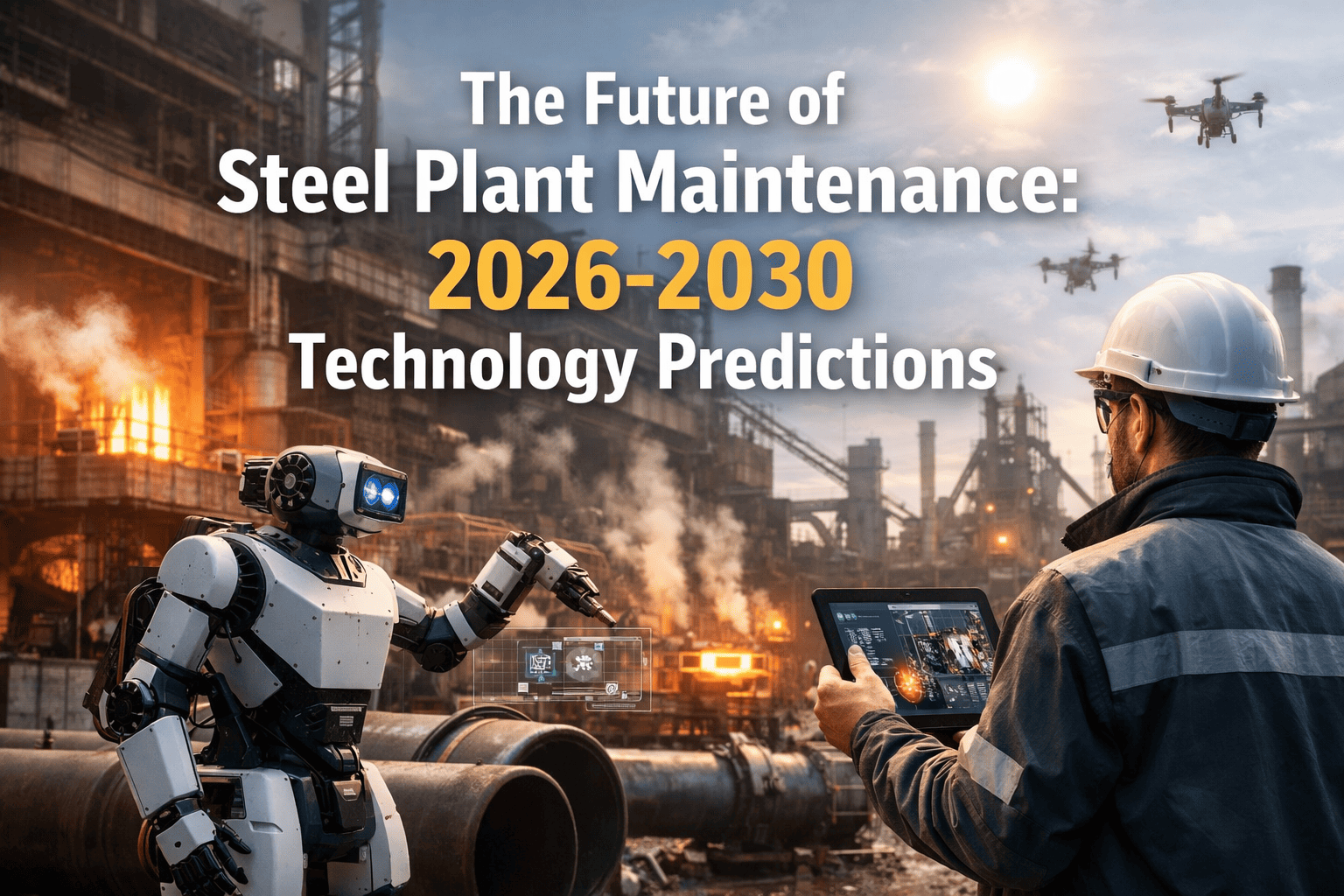
Industry 4.0 gave steel plants connected sensors. It gave them data historians, IoT dashboards, and condition monitoring alerts that replaced physical rounds with remote visibility. It was a significant step. It was not the destination. The plants that are quietly pulling away from their peers in 2026 are not the ones who finally completed their Industry 4.0 rollout — they are the ones who recognised that connectivity was the prerequisite, not the objective. The objective is autonomous maintenance: systems that do not merely report equipment condition but act on it — diagnosing probable root causes before a human opens a work order, scheduling maintenance windows in the production calendar before a scheduler reviews it, and adjusting PM intervals based on actual asset behaviour rather than manufacturer-recommended calendar intervals. This is the architecture of Manufacturing 6.0 in steel. It is not a distant roadmap item. The foundational technology is deployed and operational at leading plants today.
Manufacturing 6.0 in Steel: Beyond Industry 4.0 with Autonomous Maintenance
While most steel plants are still completing Industry 4.0 implementations, forward-thinking manufacturers are already designing for the architecture that comes next — where AI-driven maintenance systems self-diagnose, self-schedule, and self-optimise without waiting for a human decision at each step.
From Industry 3.0 to Manufacturing 6.0: The Maintenance Architecture Shift
Each industrial generation added a new capability layer on top of the previous one. The capability itself was not the advance — the advance was what became possible when that capability was combined with the ones before it. Manufacturing 6.0 is the generation in which maintenance stops being something humans do to machines and becomes something the system does to itself, continuously, at a speed and precision no human-directed process can match.
Automated Control
PLCs and SCADA automate process control. Maintenance is scheduled by calendar and executed by humans using paper work orders. Equipment runs until failure or scheduled service window.
Connected Intelligence
IoT sensors, data historians, and CMMS platforms connect physical assets to digital records. Condition monitoring surfaces anomalies. Predictive maintenance alerts require human review before action.
Collaborative AI
AI analyses work order history, sensor data, and production context simultaneously. AI-generated recommendations reach maintenance planners with supporting evidence. Humans approve; AI executes the logistics.
Autonomous Maintenance
AI systems self-diagnose developing faults, self-schedule maintenance within production windows, self-optimise PM intervals from actual asset behaviour, and close the loop with self-generated compliance records — all without waiting for a human decision at each step.
The Three Pillars of Manufacturing 6.0 Autonomous Maintenance
Manufacturing 6.0 autonomous maintenance is built on three interlocking capabilities. Each one requires the previous to function — self-optimisation depends on self-scheduling, which depends on self-diagnosis. A plant that deploys all three is operating a genuinely autonomous maintenance system. A plant that deploys only the first is operating a more sophisticated version of Industry 4.0. Book a demo to see where OxMaint places your plant on this capability spectrum.
Self-Diagnosis
The AI maintenance layer analyses sensor telemetry, work order history, production context, and environmental data simultaneously to identify the probable root cause of a developing fault — before the technician receives a work order. When an anomalous vibration signature appears on a caster roll bearing, the system cross-references it against historical failure signatures for that asset class, current production load, and the maintenance history of that specific unit to produce a probability-weighted diagnosis: bearing wear at 73% probability, misalignment at 19% probability, lubrication failure at 8%.
The technician who responds to this work order arrives already oriented to the most probable fault mode — not diagnosing from zero. Mean time to diagnosis collapses. First-time fix rate increases. The knowledge that previously lived only in experienced technicians' pattern recognition is now encoded in the AI layer and available to every technician at every skill level.
Self-Scheduling
Once a fault is diagnosed and a maintenance action identified, the self-scheduling layer identifies the optimal window in the production calendar — not the next available maintenance window, but the window where the intervention cost (downtime, production disruption, technician allocation) is minimised given the current production sequence, campaign commitments, and asset condition urgency. For a non-critical fault detected 18 days before the next scheduled campaign break, the system proposes the campaign break as the intervention window. For a fault at 90% of its failure threshold with two days remaining in the current campaign, it proposes an emergency window at the lowest-cost production moment in the next 48 hours.
Self-Optimisation
The third pillar is the one that creates compounding improvement rather than steady-state benefit. Self-optimisation means the AI maintenance layer continuously recalibrates PM intervals based on actual observed asset behaviour rather than manufacturer-recommended calendar schedules. A motor that consistently shows healthy parameters at its 90-day service interval gets extended to 120 days; one that shows early degradation signals at 45 days gets compressed to 40. The system learns the actual behaviour of each individual asset in its specific operating environment — not the statistical average of that asset class across all installations.
The compounding effect comes from the interaction between self-optimisation and self-diagnosis: as the AI accumulates more work order closure data, its diagnosis accuracy improves. As diagnosis accuracy improves, self-scheduling decisions become more precise. As scheduling decisions become more precise, assets spend more time operating in their optimal condition range — which generates even cleaner condition data for the next optimisation cycle. Sign up to see OxMaint's self-optimisation capability architecture — free.
Is Your Steel Plant Ready for Autonomous Maintenance? Five Readiness Signals
The five readiness signals below distinguish plants that can begin the Manufacturing 6.0 transition in 2026 from those that need to build the prerequisite foundation first. Both paths lead to the same destination — the timeline differs based on current data architecture maturity. Sign up for OxMaint and begin closing your readiness gaps today — free.
Ready Signal 1
All maintenance work orders are created in a structured CMMS and closed with asset link, completion notes, and photo documentation. You have 12+ months of complete work order history for your top 20 critical assets.
Ready Signal 2
At least three critical assets (blast furnace, caster, or hot mill drive) have continuous condition monitoring sensors feeding data into your CMMS or a connected historian. Anomaly alerts are generated automatically — not manually triggered.
Ready Signal 3
Your PM schedules are stored as parametric work order templates in your CMMS — not in a binder, shared calendar, or spreadsheet. The interval is a configurable variable, not a fixed calendar date.
Readiness Gap 4
Your CMMS and production scheduling system share data — maintenance planners can see production campaign calendars when proposing maintenance windows, and production schedulers can see open maintenance work orders and PM due dates when building campaign sequences.
Readiness Gap 5
Your planned-to-unplanned maintenance ratio is above 65%. A ratio below this threshold indicates that the reactive maintenance volume is too high for self-scheduling optimisation to function effectively — the system needs a baseline of planned work to optimise from.
We spent three years doing Industry 4.0. We connected sensors. We built dashboards. We hired a data analyst. At the end of three years, we had better visibility and exactly the same maintenance outcomes — because visibility without autonomous action is just a more expensive version of the whiteboard. The shift that mattered was when we stopped asking our system to tell us what was happening and started asking it to do something about it. That is the distinction between 4.0 and 6.0. The AI is not a reporting tool. It is a decision-making agent that executes within boundaries we define. That took us from a 52% planned ratio to 74% in 14 months — without adding a single maintenance headcount.
Frequently Asked Questions
What is Manufacturing 6.0 and how does it differ from Industry 4.0?
How long does it take to reach Manufacturing 6.0 capability from a standard Industry 4.0 baseline?
Does autonomous maintenance eliminate the need for experienced maintenance technicians?
How does OxMaint position in the Manufacturing 6.0 architecture?
The Plants Building the Foundation Today Will Operate Autonomously in 2028.
Every structured work order OxMaint closes today is a data point in the autonomous maintenance AI of tomorrow. Start building the foundation — the data, the architecture, and the integration — that makes self-diagnosis, self-scheduling, and self-optimisation possible at your plant.