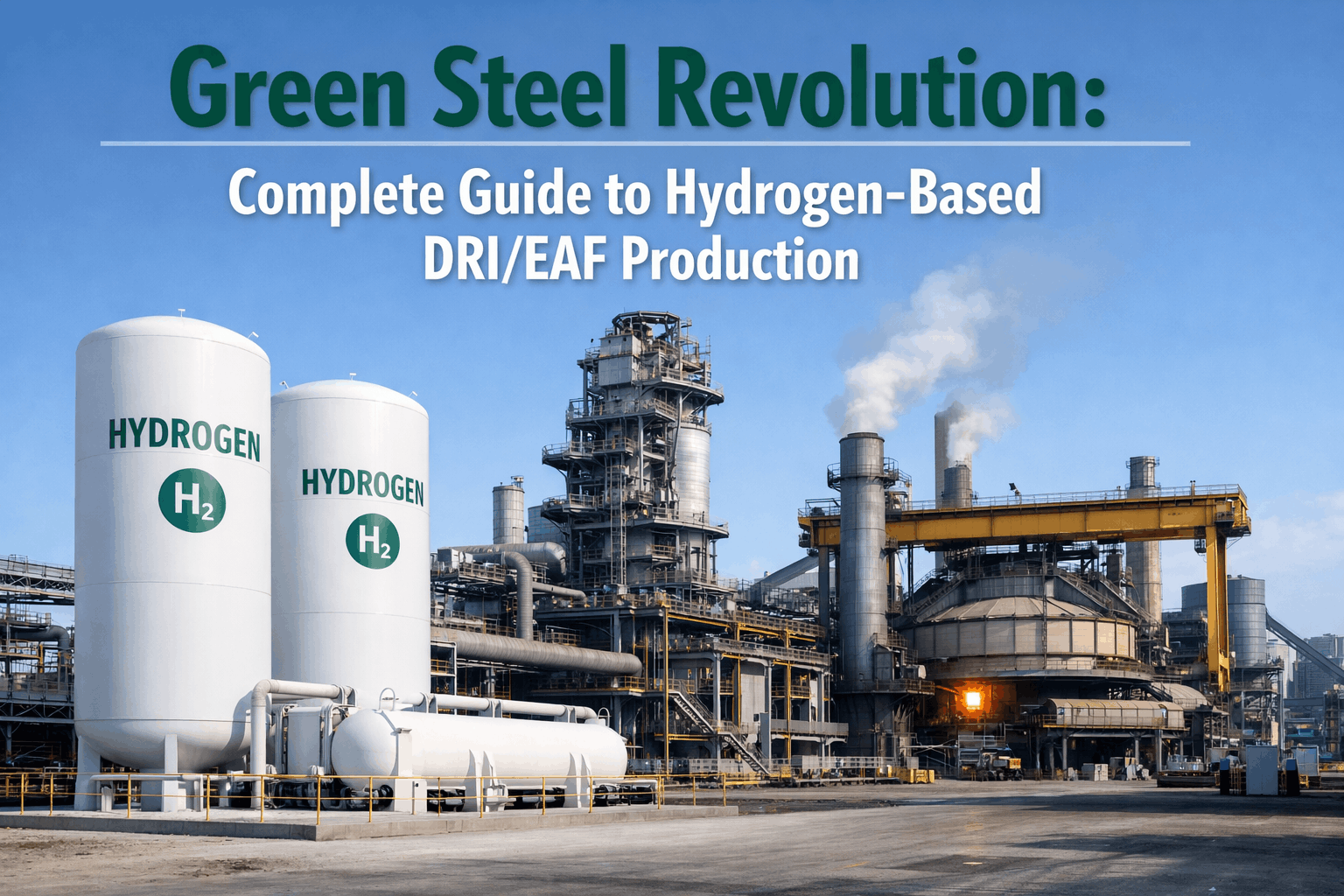
Green Steel Manufacturing: Maintenance Strategies for Hydrogen-Based Steelmaking
By John Mark on March 13, 2026
Hydrogen-based steelmaking is the most significant technological shift the steel industry has undergone in a century. Direct reduction of iron ore using green hydrogen—replacing coal and coke entirely—eliminates up to 95% of the CO₂ emissions from primary steel production. But the equipment, process chemistry, and failure modes in a hydrogen direct reduction plant are fundamentally different from those in a blast furnace facility. Maintenance teams trained on conventional steel plant assets are stepping into an environment where hydrogen embrittlement, high-pressure gas systems, electrolyzer stack degradation, and novel refractory behavior demand entirely new inspection protocols, spare parts strategies, and predictive monitoring approaches. Schedule a free green steel maintenance readiness assessment with our team and find out how to build the maintenance infrastructure your hydrogen plant needs before commissioning begins.
Why Green Hydrogen Steel Plants Demand a Different Maintenance Model
Every maintenance program inherited from conventional blast furnace operations carries assumptions that do not hold in a hydrogen-based steelmaking environment. The energy vectors, chemical processes, process temperatures, and equipment failure modes are different enough that applying existing maintenance frameworks without modification creates safety gaps, unplanned downtime risks, and asset life shortfalls that will not be visible until they occur in production.
Hydrogen Embrittlement Risk
High-pressure hydrogen exposure degrades carbon and low-alloy steels through hydrogen-assisted cracking—a failure mode absent in conventional steel plants. Every pressure vessel, pipe, valve, and fastener in the hydrogen circuit requires material qualification and periodic inspection protocols not found in standard CMMS templates.
Electrolyzer Maintenance Complexity
Alkaline and PEM electrolyzers that produce green hydrogen have stack degradation curves, membrane replacement intervals, and electrolyte management requirements that no conventional steel plant maintenance team has encountered. These assets are both capital-intensive and production-critical, demanding purpose-built PM programs from day one.
Novel Safety Hazard Profile
Hydrogen is the lightest element—it leaks through seals that retain nitrogen or natural gas, accumulates in ceiling spaces, and has a wide flammability range of 4–75% in air. Leak detection, ventilation adequacy, and ignition source control requirements in a green steel plant are fundamentally stricter than in any conventional steel facility.
Digitally Native Asset Base
Green steel plants are built with modern DCS, IoT sensor networks, and digital twin infrastructure from the ground up. Maintenance programs must match this digital maturity—with CMMS integration, sensor-triggered work orders, and condition-based maintenance protocols that leverage real-time process data rather than fixed-interval scheduling.
95%
CO₂ reduction achievable with green hydrogen DRI vs. blast furnace route
40%
Of unplanned downtime in early hydrogen plant operations attributed to unfamiliar failure modes
$3.2M
Average cost per hour of unplanned downtime on a green hydrogen DRI shaft furnace
2.8x
Higher spare parts cost in first two years of green steel plant operation vs. steady-state
Critical Asset Classes in Hydrogen-Based Steelmaking and Their Maintenance Priorities
A hydrogen-based direct reduction iron (DRI) plant integrates asset classes from three distinct industries—power generation, chemical processing, and steelmaking—each bringing its own maintenance discipline, failure mode library, and inspection standard. Building a unified maintenance program requires understanding what each asset class demands independently and how they interact in operation.
01
Green Hydrogen Production — Electrolyzer Systems
Alkaline (AEL) and Proton Exchange Membrane (PEM) electrolyzers
Production Critical
Key Failure Modes
Membrane degradation and pinhole formation in PEM stacks
Electrolyte concentration drift in alkaline systems
Electrode catalyst layer depletion and performance drop
Cell frame seal failure causing electrolyte cross-contamination
Balance-of-plant pump and heat exchanger fouling
Rectifier transformer thermal degradation under variable load
Maintenance Priorities
Cell voltage monitoring across all stacks — degradation trending
Weekly electrolyte analysis for alkaline systems
Stack replacement planning based on kWh/kg efficiency curves
BOP pump vibration and seal condition quarterly inspection
Transformer oil sampling and thermal imaging annually
Hydrogen Embrittlement: The Maintenance Risk Unique to Green Steel Plants
Hydrogen embrittlement is the most consequential new failure mode that green steel maintenance teams must understand. It occurs when atomic hydrogen diffuses into the crystal lattice of metallic materials under mechanical stress—reducing ductility, initiating cracks at stress concentrations, and causing sudden fracture at loads well below the material's rated yield strength. The risk is not obvious during routine inspection because embrittled components appear undamaged until they fail catastrophically.
Severe Risk
High-Strength Fasteners
Bolts and studs with tensile strength above 1000 MPa are highly susceptible to hydrogen-assisted stress corrosion cracking in flange joints and pressure vessel connections. Standard galvanic zinc coatings accelerate hydrogen ingress. Stainless or PTFE-coated fasteners with controlled torque limits required for all hydrogen service flanges.
Mitigation: Material upgrade to A4-80 stainless or hydrogen-service-rated alloy bolting. Torque records mandatory for all hydrogen circuit flanges.
Severe Risk
Pressure Vessel Welds
Weld heat-affected zones in carbon steel pressure vessels are particularly vulnerable to hydrogen-induced cracking, especially if post-weld heat treatment was inadequate or if welds were made with high hydrogen content consumables. Hydrogen service vessels require weld procedure qualification specifically for hydrogen service per ASME and API standards.
Mitigation: Hydrogen service weld qualifications, PWHT verification records, and periodic wet fluorescent magnetic particle inspection of critical welds.
Moderate Risk
Pipeline Seals and Gaskets
Elastomeric seals and gaskets that perform acceptably with nitrogen or natural gas can degrade rapidly under hydrogen service. Many elastomers absorb hydrogen under pressure and blister on depressurization (explosive decompression). Sealing materials must be specifically qualified for hydrogen service and re-evaluated whenever operating pressure or temperature changes.
Mitigation: Approved materials list for hydrogen service sealing. Seal change interval set by operating hours rather than calendar period.
Moderate Risk
Compressor Components
Hydrogen compressor internals—valve plates, piston rings, and rod packings—experience accelerated wear and material degradation compared to equivalent components in natural gas service. Reciprocating compressors require shorter valve inspection intervals, rod seal replacement on operating-hours basis, and rod runout measurement at each maintenance stop.
Mitigation: Valve inspection every 2,000 hours. Rod seal replacement at 8,000 hours. Vibration and rod drop monitoring continuous.
Preventive Maintenance Strategy for Green Steel Assets
The PM strategy for a hydrogen-based steel plant must be built from first principles rather than adapted from blast furnace maintenance schedules. Three maintenance philosophies should be applied in combination, with asset criticality and failure mode characteristics determining which approach governs each asset class.
Time-Based PM
Regulatory and safety-critical
Fixed-interval maintenance driven by regulatory requirements, manufacturer specifications, and statutory inspection obligations. Applied to safety-critical components where failure consequence is catastrophic regardless of condition—pressure vessel statutory inspections, PRV set-point verification, hydrogen leak detector calibration, and electrical safety isolation testing. These intervals cannot be extended regardless of observed condition and must be tracked with full documentation for regulatory compliance.
Pressure vesselsPRVs and safety valvesH₂ leak detectorsElectrical safety systems
Condition-Based Monitoring
High-value rotating and process assets
Continuous or periodic condition monitoring that triggers maintenance when asset condition deteriorates beyond defined thresholds—rather than on a fixed calendar basis. Applied to electrolyzer stacks (cell voltage and efficiency trending), compressors (vibration, rod drop, valve temperature), DRI shaft furnace (shell temperature, pressure differential, gas composition), and EAF transformers (dissolved gas analysis). Requires sensor integration with CMMS to auto-generate work orders when condition limits are breached.
Deliberate decision to operate assets until failure where the consequence of failure is negligible, redundancy exists, and preventive maintenance cost exceeds the cost of failure and replacement. Applied selectively to instrumentation with redundant backup, lighting systems, non-critical fans with standby units, and consumable items with short replacement times. Requires explicit asset criticality classification and spare parts stocking to support rapid replacement when failure occurs.
Hydrogen circuit inspection checklists — seal verification, leak detection calibration, vessel statutory records
Sensor-triggered work orders — auto-generate PM tasks when condition thresholds are breached in real time
Asset criticality matrix — classify every asset by failure consequence and apply the right maintenance strategy
Spare parts strategy — stock levels calibrated to lead times for long-delivery hydrogen service components
Spare Parts Strategy for Hydrogen-Based Steel Plants
Spare parts management for a green steel plant differs from conventional steel plant inventory in three critical ways: lead times for hydrogen-compatible components are significantly longer than standard equivalents, the asset base is largely new-to-industry with limited failure history for demand forecasting, and the consequence of a critical spare parts stockout is production halt on a capital-intensive facility with no fallback process route. Getting the initial spares holding strategy right before commissioning avoids the most expensive lessons.
Tier 1 — Insurance Spares
Always In Stock — No Exceptions
Components where a stockout causes immediate production halt, with lead times exceeding four weeks. The holding cost is justified by the avoided downtime cost on a single event.
Critical H₂-rated pressure control valves (full assemblies)
Tier 2 — Operational Buffer
Min/Max Stock with Auto-Reorder
Components consumed regularly or with two- to four-week lead times. Stock levels set using consumption history plus lead time buffer, with automated reorder triggers in the CMMS.
Hydrogen service gasket and seal kits (by pipeline size)
Electrolyzer membrane sheets (PEM plants)
H₂-rated pressure relief valve internals
EAF electrode clamp jaw liners
Compressor piston rings and rod packing sets
Tier 3 — Consumables
Economic Order Quantities
High-volume, short-lead-time items consumed during routine PM. Managed with bulk purchasing agreements to reduce per-unit cost without excessive holding volume.
Hydrogen detector sensor cells and calibration gas
Lubricants qualified for hydrogen service environments
EAF water-cooled panel O-ring kits
Filter cartridges for electrolyte purification circuits
H₂-rated PTFE thread seal tape and pipe dope
Key Maintenance KPIs for Green Steel Plant Operations
Green steel plants need a KPI framework that reflects the unique performance drivers of hydrogen-based production—including electrolyzer efficiency, hydrogen system integrity, and the condition of novel process assets. These indicators give operations and maintenance leaders quantitative targets that connect maintenance performance directly to production cost and environmental outcome.
Electrolyzer Stack Efficiency
Target: below 54 kWh/kg H₂
Tracks energy consumption per kilogram of hydrogen produced. Rising consumption indicates membrane degradation, catalyst depletion, or electrolyte contamination—all of which are maintenance-addressable. This KPI directly connects maintenance performance to energy cost and CO₂ emissions intensity.
Hydrogen System Leak Rate
Target: Zero detected leaks
Total number of hydrogen leak events detected across the plant per month, including minor flange seepages. Even small leaks represent both safety risk and hydrogen loss that reduces production efficiency. A zero-leak target is achievable with rigorous seal management and regular leak detection surveys.
DRI Plant Availability
Target: above 92%
Percentage of scheduled operating hours during which the DRI shaft furnace is available for production. Includes both unplanned downtime and planned maintenance outage time. World-class DRI operations achieve above 92% availability—this requires aggressive predictive maintenance on refractory, gas circuit, and burden discharge systems.
PM Compliance Rate
Target: above 95%
Percentage of scheduled preventive maintenance tasks completed within the required window. In a new plant with unfamiliar equipment, PM slippage is highest in the first two years—making close tracking of this metric essential during the period when asset failure risk is greatest due to limited operating history.
Mean Time Between Failures
Target: trending upward annually
Average operating hours between unplanned equipment failures per asset class. In a first-of-kind facility, MTBF data in the first year of operation is the foundational dataset for calibrating PM intervals to actual plant conditions rather than vendor estimates. Tracking this by asset class reveals where PM programs are correctly calibrated and where they need adjustment.
Hydrogen Service Component Life
Target: vs. vendor specification
Tracks actual service life achieved for critical hydrogen-compatible components—seals, compressor internals, electrolyzer membranes—against OEM specifications. Systematic underperformance signals either material incompatibility, operating condition deviation, or installation quality issues that must be investigated and corrected before they escalate to failures.
Frequently Asked Questions
How different is maintenance on a hydrogen DRI plant from a conventional blast furnace operation?
The differences are substantial enough that conventional blast furnace maintenance programs cannot be directly applied without significant modification. The primary differences are: the complete absence of coke handling and hot blast stove systems (replaced by electrolyzer and gas compression assets), the introduction of hydrogen embrittlement as a new failure mode category with no equivalent in conventional steel plants, the replacement of combustion chemistry-based refractory wear mechanisms with reducing-atmosphere chemistry in the DRI shaft, and the fundamentally different electrical load profile of an EAF fed with pre-reduced DRI compared to scrap-based operation. Maintenance teams transitioning from blast furnace operations need structured training in electrolyzer technology, hydrogen system maintenance, and condition monitoring for the new asset classes before commissioning begins.
What is the biggest maintenance challenge in the first two years of a green steel plant?
The biggest challenge is the absence of site-specific failure history for calibrating PM intervals. Every PM schedule in the first two years is based on OEM recommendations and industry data from other facilities—not on data from your plant with your operating conditions, your feedstock quality, and your production patterns. The result is that some PMs are performed too frequently (wasting maintenance resources) while others are not performed frequently enough (leading to unexpected failures). A rigorous CMMS-based failure tracking program from day one—recording every failure, its mode, its lead time, and the operating hours at failure—is what enables PM interval optimization during years two and three. Plants that invest in this data infrastructure early consistently outperform those that wait until failures accumulate before adjusting their programs.
What are the most critical spare parts to hold in inventory for a green hydrogen steel plant?
The highest-priority insurance spares are the assets with the longest lead times and the highest production impact on failure. For an alkaline electrolyzer plant, this means at minimum one complete spare stack assembly—lead times for custom-built stacks can exceed sixteen weeks, and electrolyzer downtime directly limits hydrogen availability for the DRI shaft. For hydrogen compression, a complete valve set for each compressor frame should be held on-site given two- to four-week typical delivery times and the production impact of compressor downtime. For the DRI shaft furnace, critical spare parts are those with long manufacturing lead times: bustle pipe sections, tuyere assemblies, and DRI discharge screw wear segments. The spare parts strategy should be reviewed and updated every six months in the first two years as actual consumption rates become clear and early-life failure patterns are identified.
How does a CMMS support maintenance in a green steel plant specifically?
A CMMS provides three critical functions for green steel plant maintenance. First, it serves as the central repository for all asset data, PM schedules, and failure history—the data infrastructure that enables PM interval optimization as plant-specific failure patterns emerge. Second, it enables condition-based maintenance by integrating with sensor and DCS data to automatically trigger work orders when condition thresholds are breached—essential for assets like electrolyzer stacks and compressors where the optimal maintenance intervention point is condition-defined rather than calendar-defined. Third, it provides the documentation trail required for regulatory compliance—hydrogen service vessels require documented inspection histories, and green steel plants operating under carbon credit or emissions certification frameworks need comprehensive maintenance records to support audit verification of asset performance and availability claims.
Start Before Commissioning
Your Green Steel Plant Needs a Maintenance Program as Advanced as Its Technology.
Oxmaint gives hydrogen-based steel plants the CMMS infrastructure to build condition-based PM programs, track electrolyzer performance, manage hydrogen service inspection records, and generate the compliance documentation that green steel operations require from day one of production.