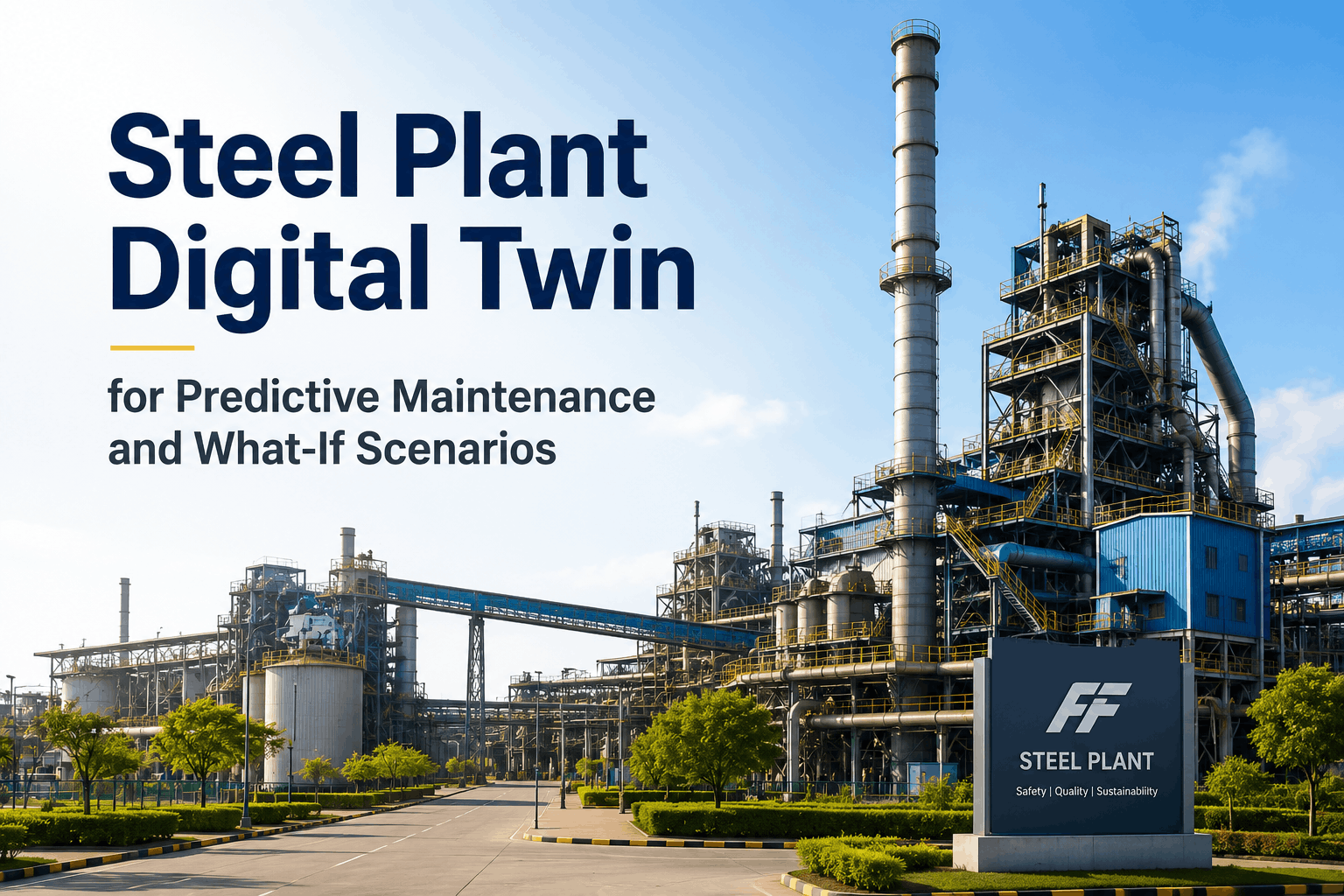
In 2026, the gap between steel plants that predict failures and those that react to them has become the defining competitive divide in the industry. ArcelorMittal, POSCO, and Tata Steel are running hundreds of AI algorithms simultaneously across blast furnaces, rolling mills, and continuous casters — not as pilot programs, but as production-grade systems replacing human guesswork with machine-speed pattern recognition. The plants still operating on scheduled PM intervals and manual inspection rounds are not just inefficient; they are structurally disadvantaged against competitors whose maintenance cost per tonne is falling while theirs holds flat. Sign up for Oxmaint to start building your predictive foundation today.
Six Technology Trends Reshaping Steel Plant Maintenance in 2026
The maintenance strategies that dominated steel operations in 2020 are being displaced by a convergence of six accelerating technology trends. Each trend is mature enough to deploy in production today — but plants that wait another 12 months will be playing catch-up against competitors already measuring results.
Machine learning models are moving from cloud servers to edge computing hardware installed directly in the plant — processing vibration, temperature, and current data in under 10 milliseconds without a round trip to a data center. For steel plants with intermittent network connectivity in furnace and rolling mill areas, edge AI delivers continuous prediction even during communication outages. POSCO deployed edge inference nodes on 180 rolling mill assets in 2024; failure detection now runs independently of corporate network availability.
Digital twins in 2026 are not static CAD models — they are continuously-updated physics-based simulations that mirror equipment condition in real time. A blast furnace digital twin ingests stave cooler temperatures, gas pressure readings, and tap hole wear data to project remaining refractory life with 3–6 week forecasting accuracy. ArcelorMittal runs live digital twins on blast furnaces at four sites, with each model alerting the maintenance CMMS when its simulation predicts equipment reaching a critical degradation threshold. Sign up for Oxmaint to connect your digital twin outputs to automated work orders.
Single-sensor predictive maintenance generates high false-positive rates. Multi-sensor fusion combines vibration, temperature, oil quality, current draw, and acoustic data into a composite health score — dramatically improving prediction accuracy while reducing alarm fatigue. A rolling mill gearbox health model that fires only when vibration is elevated AND oil particle count is rising AND motor current is above normal is 4–6x more precise than vibration alone. Steel plants running multi-sensor models report false-positive rates below 8% versus 35–40% for single-sensor systems.
Predictive maintenance tells you a failure is coming. Prescriptive maintenance tells you the optimal repair action, the right time to execute it relative to production schedules, and which parts to pre-order. In 2026, leading steel plants are deploying prescriptive systems that score repair urgency against current production commitments — recommending bearing replacement during this weekend's planned maintenance window rather than the next one. Tata Steel's prescriptive system at Jamshedpur reduced maintenance planning time by 40% while improving on-time execution rates. Book a demo to see Oxmaint's prescriptive analytics.
Quadruped robots and tethered inspection drones are entering routine deployment in steel plants — eliminating the need for human inspectors in blast furnace perimeters, coke oven corridors, and elevated rolling mill catwalks. Outokumpu operates ANYmal robots across three European steel sites, each covering 270+ inspection points per shift with thermal, acoustic, and visual sensors. Inspection data feeds directly into CMMS work order systems. Drone inspection of reheating furnace roofs and ladle storage areas is becoming standard at large integrated mills where conventional access requires equipment shutdown.
As EU CBAM charges and SBTi decarbonization commitments intensify pressure on steel operations, a new integration trend is emerging: linking maintenance scheduling directly to carbon intensity outcomes. Poorly maintained combustion equipment runs 15–25% less efficiently — every deferred burner PM has a measurable CO2 cost. Steel plants connecting their CMMS to ESG reporting systems are discovering that maintenance optimization and carbon reduction are the same project. In 2026, leading producers are scoring maintenance deferrals by their carbon impact alongside production impact. Sign up to track carbon impact from your maintenance records.
How the Most Impactful Trends Work in Practice
Two trends stand out for their immediate operational impact in steel plant environments: multi-sensor fusion models and digital twin-driven maintenance scheduling. Understanding how they work — not just what they are — is what separates plants that deploy them successfully from those that struggle with pilot programs that never scale.
| Signal Source | Fault Mode Detected | Weight |
|---|---|---|
| Vibration RMS | Bearing wear, imbalance, misalignment | 35% |
| Motor Current | Rotor bars, winding degradation, load increase | 25% |
| Oil Particle Count | Gear wear, contamination, lubrication failure | 20% |
| Temperature Delta | Cooling restriction, friction increase | 12% |
| Acoustic Emission | Surface fatigue, crack propagation | 8% |
Multi-Sensor Fusion: Why Combining Signals Beats Any Single Sensor
A rolling mill gearbox generates multiple overlapping degradation signals before it fails. Vibration rises as bearing surface fatigue progresses. Oil particle count climbs as gear mesh wear increases. Motor current draws higher as mechanical friction grows. No single signal is definitive — but their combination, weighted by a trained ML model, produces a composite health score that fires with 94% accuracy at 3–5 weeks pre-failure.
The practical result: maintenance teams stop chasing individual high-vibration readings that turn out to be normal operating variation, and start responding to composite health scores that represent genuine degradation trends. Sign up for Oxmaint to configure multi-sensor health models on your critical rotating assets.
- Composite score reduces false-positive alarm rate from 35% to below 8%
- Each sensor's weight is calibrated to historical failure data from your asset class
- Models retrain automatically as new failure/non-failure data accumulates
Digital Twins in Practice: Blast Furnace Refractory Life Prediction
A blast furnace digital twin models the thermal and mechanical state of the refractory lining using stave cooler temperature differentials, heat load distribution, cooling water flow rates, and burden distribution data. The physics engine simulates lining wear progression under current operating conditions — projecting remaining lining thickness at any point in the furnace at 6-week forecast horizons.
When the simulation projects a stave region reaching critical wear within the forecast window, it automatically creates a CMMS inspection work order — before any observable symptom appears at the HMI. Steel plants running digital twin-integrated CMMS workflows have eliminated unplanned blast furnace shutdowns related to refractory failure in their first full year of deployment. Book a demo to see how Oxmaint receives digital twin condition data.
- Twin ingests stave cooler T-delta and burden distribution data continuously
- Physics model runs forward simulation of lining wear under current heat pattern
- CMMS work order auto-created when simulation crosses maintenance threshold
Where Steel Plant Predictive Maintenance Stands in 2026
Not every trend is at the same deployment maturity. This table maps each major technology to its current adoption status across the steel industry — helping you prioritize where to invest first. Sign up for Oxmaint to access all maturity levels from a single platform.
| Technology | 2026 Adoption Status | Typical Deployment Time | Primary Steel Application | Oxmaint Support |
|---|---|---|---|---|
| IIoT Vibration Sensors + CMMS | Production Standard | 2–6 weeks | Rolling mills, compressors, pumps | Native integration |
| SCADA Alarm-to-Work-Order | Production Standard | 2–4 weeks | All process areas via OPC-UA | Native integration |
| Multi-Sensor Fusion Models | Rapid Adoption | 4–8 weeks | Gearboxes, drive trains, critical motors | Built-in analytics engine |
| Edge AI Inference | Emerging — Fast Growth | 6–12 weeks | Furnace areas with network limitations | Edge gateway compatible |
| Digital Twins — Equipment Level | Emerging — Leader Adoption | 12–20 weeks | Blast furnaces, continuous casters | API integration for twin outputs |
| Prescriptive Maintenance | Emerging — Mid-Market | 8–16 weeks | Production-integrated repair scheduling | Prescriptive analytics module |
| Autonomous Robotic Inspection | Early Deployment | 16–24 weeks | Blast furnace, coke oven perimeters | Robotic data API integration |
| Maintenance-Carbon Integration | Early Deployment | 8–14 weeks | Combustion equipment, ESG reporting | Carbon tracking module |
Swipe horizontally to view full table
The steel plants that are winning on maintenance in 2026 are not the ones with the most sensors — they are the ones that have connected their sensor data to their maintenance workflows. Data without action is just cost. A CMMS that receives IIoT alerts, SCADA alarms, and digital twin forecasts and converts them automatically into work orders is what separates the top quartile from everyone else.
Your Competitors Are Already Three Trends Ahead. Close the Gap.
ArcelorMittal, Tata Steel, and POSCO have been running AI maintenance programs at scale for two years. The window to catch up without major capital disadvantage is 2026 — and it starts with connecting your existing SCADA and IIoT data to automated CMMS work orders.
How Oxmaint Delivers Every Major 2026 Predictive Maintenance Trend
Oxmaint is built to be the operational layer that connects every emerging trend — IIoT sensors, SCADA alarm feeds, digital twin outputs, and robotic inspection data — into a single maintenance workflow engine. You do not need to build separate integrations for each technology.
Real-time asset health scores updated from IIoT sensor streams, SCADA feeds, and multi-sensor fusion models. See which assets are deteriorating and how fast — ranked by production impact so maintenance planners act on the right thing first. Alert queues update within seconds of threshold crossings across all connected data sources.
Configurable composite health rules combining up to eight sensor signals per asset — with Boolean logic, rate-of-change triggers, and time-persistence conditions. Edge gateway compatible for plants with intermittent connectivity near furnace areas. Models retrain automatically from resolved work order outcomes, improving accuracy without manual ML intervention.
Auto-generated work orders that include not just the detected fault but the recommended repair action, required parts, optimal scheduling window relative to production, and assigned technician based on skill matrix and shift. Prescriptive recommendations are scored against current production schedules — reducing planning time by up to 40% while improving on-time execution. Book a demo to see prescriptive scheduling in action.
Oxmaint receives digital twin condition outputs via REST API — creating CMMS work orders when simulation thresholds are crossed without requiring custom integration work. Robotic inspection data from ANYmal and drone systems feeds in through the same API layer, generating work orders with thermal maps, acoustic signatures, and GPS-tagged defect locations attached. All evidence is preserved in the asset maintenance history for lifecycle analysis.
2026 Steel Maintenance Trends — Frequently Asked Questions
For most steel plant areas with reliable connectivity, cloud-based analytics is sufficient and simpler to manage. Edge AI becomes necessary in specific zones — blast furnace cast houses, coke oven corridors, and areas behind electromagnetic shielding — where wireless connectivity is intermittent or where the 100–300ms cloud round-trip latency is too slow for the failure window. Edge inference nodes in these zones ensure continuous protection even during network outages, while cloud analytics handles the broader fleet. Most plants run a hybrid architecture: edge nodes on 15–20% of assets, cloud analytics on the rest. Sign up for Oxmaint to configure your hybrid sensor architecture.
Initial model training requires 4–8 weeks of historical sensor data with at least 3–5 known failure events for the target asset class. For assets with limited failure history, transfer learning from similar asset classes (e.g., adapting a motor health model trained on compressors to rolling mill drives) can accelerate deployment significantly. Oxmaint's fusion models begin generating health scores from day one using baseline rules, and shift to ML-trained scoring once sufficient data accumulates. Model accuracy improves continuously as resolved work orders provide labeled failure/non-failure data. Book a technical session to review your asset failure history coverage.
Predictive maintenance answers the question: will this asset fail, and when? Prescriptive maintenance answers the follow-on question: what should we do about it, and when is the optimal time to act? Prescriptive delivers more business value because it eliminates the planning gap between alert and action. A predictive alert that generates a work order completed three weeks after the optimal repair window costs nearly as much as no prediction at all. Prescriptive systems that score urgency against production schedules and auto-assign work to available technicians close this gap — reducing maintenance planning time by 40% in documented steel plant deployments.
Yes — and this is one of the most important clarifications about 2026 maintenance technology. Retrofit wireless sensors (vibration, temperature, current clamps) can be installed on equipment from any era without PLC integration or control system modification. These sensors plus a CMMS connection deliver the core predictive benefit regardless of equipment age. Digital twins and edge AI require more data infrastructure, but the first deployment tier — IIoT sensors on critical rotating assets connected to automated CMMS work orders — works equally well on a 30-year-old rolling mill gearbox and a new EAF transformer. Sign up to map your existing assets to a sensor deployment plan.
Oxmaint closes the full loop from alert to execution to verification. When a predictive model generates an alert, the platform creates a work order with the sensor evidence and recommended action attached, assigns it to a qualified technician based on skill and shift schedule, notifies the maintenance planner with production context, tracks execution status in real time, and closes the loop when the technician completes the repair and uploads post-repair sensor readings confirming the asset has returned to normal. The completed work order feeds back into the predictive model as a labeled data point, continuously improving prediction accuracy. Book a demo to see the full alert-to-closure workflow.
2026 Predictive Maintenance Starts With One Connected Asset
The steel plants running AI maintenance programs at scale did not start with everything connected at once. They started with their highest-risk asset, their most critical sensor, and one automated work order rule. Oxmaint makes that first step faster than any other platform — and every subsequent step compounds on it.