The steel maintenance team of 2030 will not look like the one of 2024. Not because the work has changed — assets still degrade, bearings still wear, refractory still erodes. But the system surrounding that work will be unrecognisable to anyone managing maintenance today with paper work orders, radio dispatch, and a shared calendar for PM scheduling. The predictions in this article are not speculative futures — they are extrapolations of technologies already operating at pilot or early-deployment scale in 2025. The question is not whether these changes arrive. It is whether your plant is building the data foundation and operational architecture to adopt them when they reach mainstream deployment — or whether it arrives at 2028 with a decade-old CMMS and a maintenance team still working from a whiteboard.
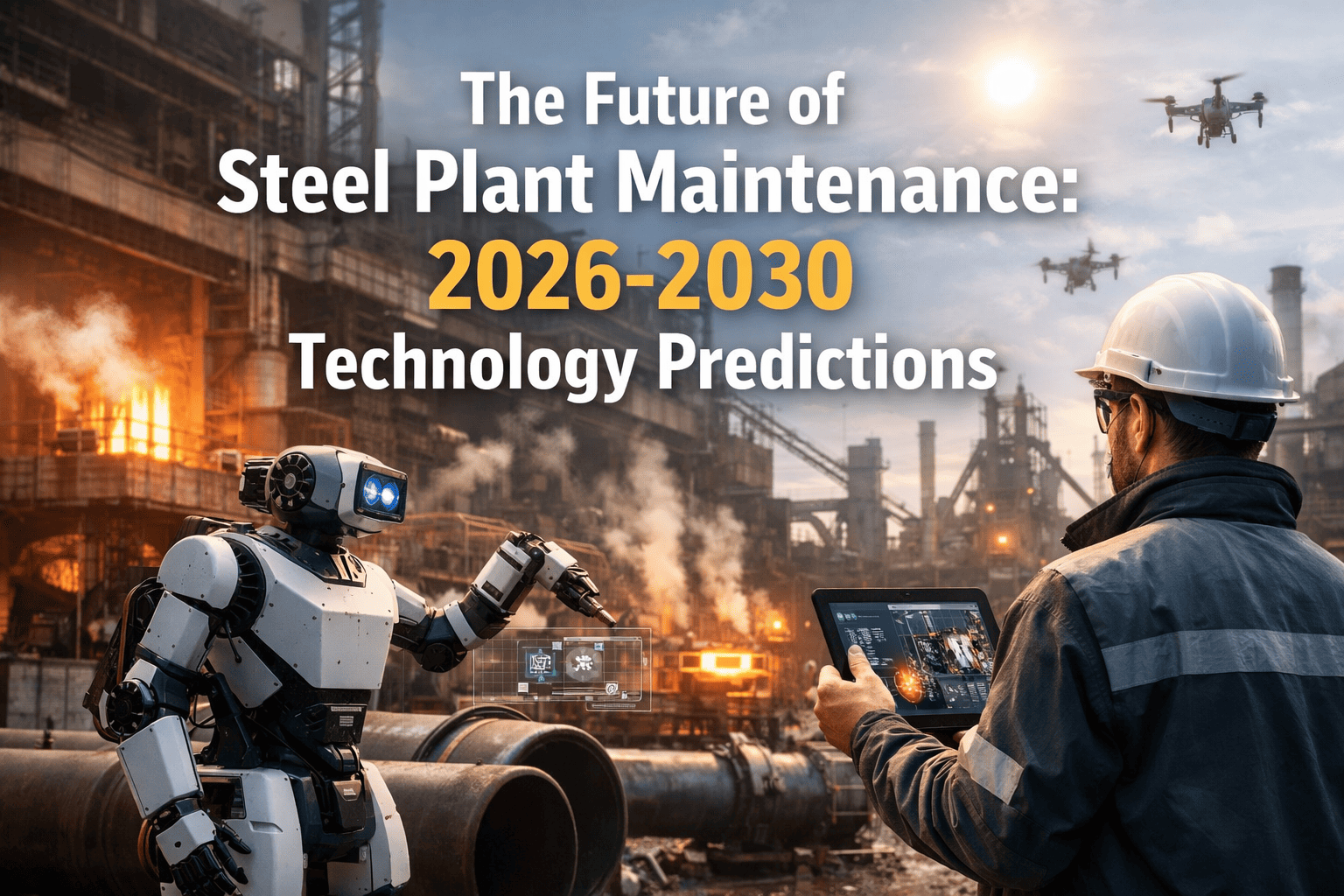
The Future of Steel Plant Maintenance: 2026–2030 Technology Predictions
Eight technology predictions from AI-generated diagnosis to quantum-optimised schedules — what arrives when, which are near-certain, and what your plant needs to do today to be ready for each one.
Why the 2026–2030 Window Is Different From Previous Technology Cycles
Steel maintenance has absorbed new technology in every decade since the 1970s. PLCs, SCADA, condition monitoring, CMMS, IoT sensors — each generation promised transformation and delivered improvement. None delivered transformation. The 2026–2030 window is different for three structural reasons that did not apply to any previous technology cycle.
The Data Volume Has Crossed the AI Threshold
AI-based maintenance intelligence requires training data at scale — thousands of work orders per asset class with complete fault-to-resolution records. For the first time in steel maintenance history, that data volume exists at a significant number of plants. The AI tools that required specialised data science teams in 2020 now run on accumulated CMMS records that leading plants have been building for 3–5 years. The data barrier has fallen.
Sensor Costs Have Crossed the Deployment Threshold
Industrial IoT sensor costs have fallen 73% since 2018. A vibration sensor that cost $800 in 2018 costs $215 in 2025. The economic case for instrumenting every critical rotating asset in a steel plant — not just the highest-value machines — now closes comfortably. The sensor infrastructure that autonomous maintenance requires is no longer a capital project. It is a maintenance budget line item.
Workforce Demographics Have Created an Adoption Imperative
38% of the current steel maintenance workforce retires by 2028. The knowledge cliff this creates is not addressable by recruitment volume alone. AI-assisted maintenance is no longer a competitive advantage option — it is a survival requirement for plants that need to maintain output quality with a less experienced workforce and declining institutional knowledge. The urgency is demographic, not technological.
Eight Technology Predictions for Steel Plant Maintenance: 2026–2030
Each prediction below includes a confidence classification, the enabling technology that makes it possible, what it replaces in current maintenance practice, and the preparation action required to capture it. Book a demo to discuss how OxMaint positions your plant for each prediction.
AI-Generated Fault Diagnosis Becomes Standard at Point of Work Order Creation
When a technician receives a work order for a caster roll bearing anomaly, the work order already contains an AI-generated diagnosis: probable fault mode (73% bearing wear, 19% misalignment, 8% lubrication failure), historical precedents from similar fault signatures on identical asset classes, recommended tools and parts to bring, and estimated repair time based on prior comparable jobs. The technician does not arrive and diagnose from zero. They arrive oriented and resourced.
This prediction is near-certain because the technology is already operational at early-adopter plants today. What changes in 2026 is scale: AI diagnosis moves from pilot programme to standard feature in tier-one CMMS platforms. Plants with 12+ months of structured work order history on critical assets can enable this capability immediately. Plants without structured work order history cannot — making the work order data quality investment made in 2025 the direct prerequisite. Sign up to begin building your AI-ready work order history in OxMaint — free.
Autonomous Inspection Robots Deploy at Scale in Hazardous Steel Plant Zones
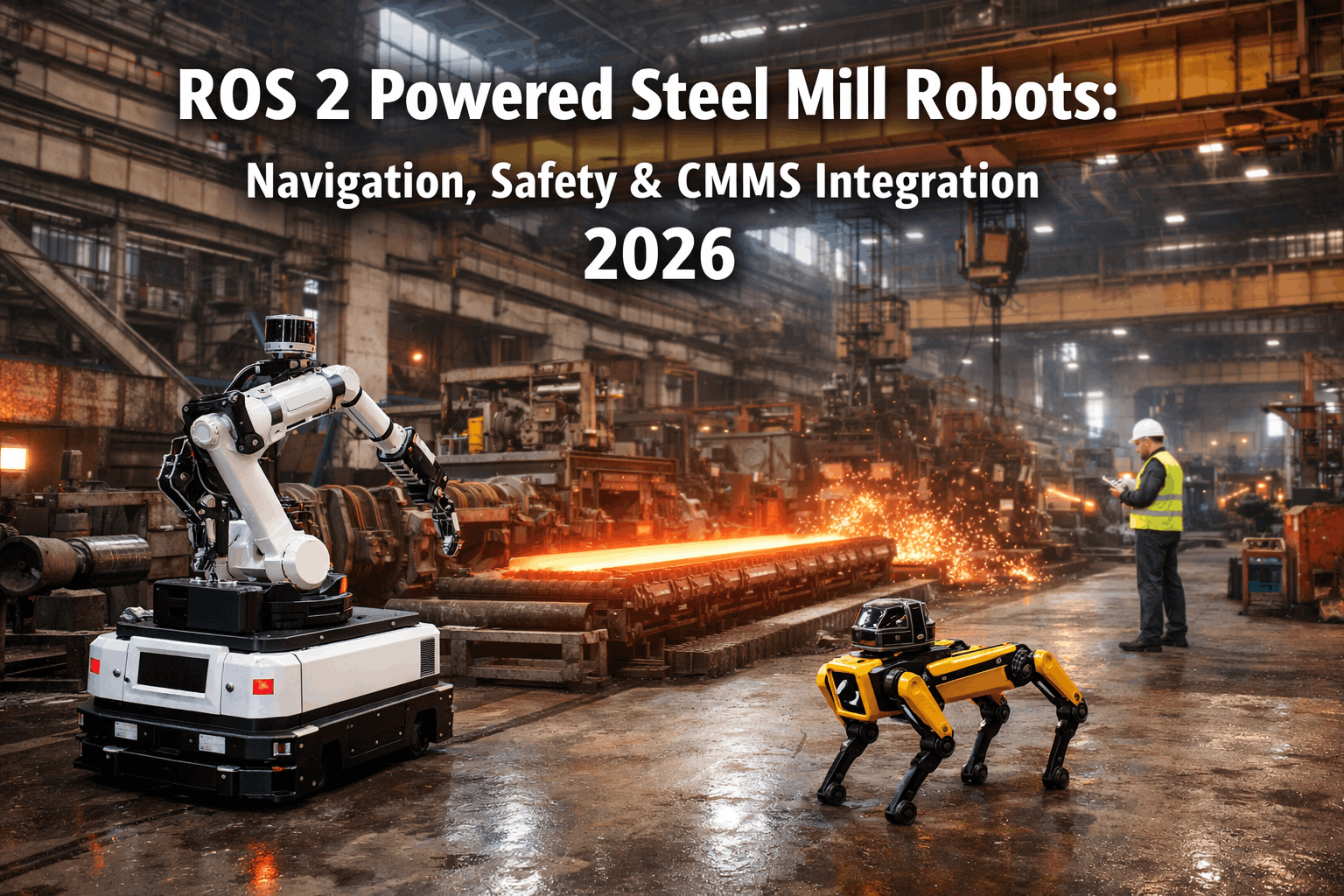
Following Outokumpu's 2023 ANYmal deployment across three European plants — Krefeld, Avesta, and Tornio — autonomous robotic inspection becomes standard practice at blast furnace perimeters, coke oven corridors, and high-temperature continuous casting zones. The economic model is proven: one robot covering 1,890 inspection points weekly at the Avesta facility, reducing human exposure to hazardous substances by 80%+ in the zones it patrols.
The 2026–27 deployment wave is driven by two convergent forces: robot unit costs falling to the level where the ROI closes on routine industrial deployment, and the regulatory trajectory in the EU and US moving toward mandated reduction of human exposure in high-hazard environments. The CMMS integration — every robotic inspection finding automatically generating a CMMS work order — is the critical link that turns inspection data into maintenance action. Book a demo to see OxMaint's robotic inspection integration architecture.
Generative AI Produces First-Draft Work Instructions, Procedures, and RCAs Automatically
Generative AI — the technology behind large language models — will be embedded in CMMS platforms to produce first-draft maintenance procedures, work instructions, and root cause analysis reports from structured work order data. When a technician closes a work order for a recurring fault on a blast furnace cooling circuit, the AI generates a draft root cause analysis report, a revised PM procedure incorporating the lessons from this fault, and an updated work instruction for the next technician who encounters the same fault — all from the completion notes and sensor data attached to the closed work order.
Digital Twin Maintenance Becomes Operational Standard for Bottleneck Assets
Digital twin technology — real-time virtual models of physical assets fed by continuous sensor data — moves from pilot to operational standard for the three to five assets that represent the production throughput bottleneck in each plant. At an integrated steel plant, this typically means the continuous caster, the hot strip mill finishing stand, and the blast furnace itself. The digital twin provides a real-time simulation of asset condition that surfaces maintenance requirements before sensor threshold alerts fire — because the twin models the physics of degradation, not just the symptoms. Sign up to see how OxMaint integrates with digital twin data sources — free.
Zero-Unplanned-Stoppage Operations at Bottleneck Assets Becomes Achievable
The combination of digital twin condition modelling, AI fault diagnosis, and autonomous scheduling will make zero unplanned stoppages a realistic operational target for individually critical assets — not across the entire plant simultaneously, but for specific bottleneck equipment where the sensor infrastructure, work order data history, and maintenance integration architecture are all mature. A continuous caster with 3+ years of complete work order history, continuous vibration and thermal monitoring on all critical subcomponents, and a digital twin running in parallel will have a failure prediction accuracy high enough to schedule every intervention before the fault reaches a production-impacting threshold.
Self-Healing Materials Change the PM Interval Model for Refractory and Wear Surfaces
Microencapsulated self-healing compounds embedded in refractory linings and wear-resistant surfaces — already deployed in aerospace and automotive applications — will reach commercial viability for steel plant environments by 2028–29. These materials autonomously repair micro-cracks and surface degradation, extending the interval between refractory relining and wear surface replacement. For steel plants, where blast furnace refractory relining is a $15–40M event occurring every 15–20 years, extending the campaign length by even 10–15% through self-healing material integration represents hundreds of millions of dollars in deferred capital cost across the industry.
The maintenance implication: PM intervals for refractory inspection and wear surface monitoring will need recalibration. CMMS PM templates will need to account for self-healing material presence — both in the inspection criteria (what does a healing surface vs. a degrading surface look like in thermal imaging) and in the interval parameters (how often to verify healing function versus checking for degradation).
Quantum Computing-Optimised Maintenance Schedules for Full-Plant Constraint Resolution
Maintenance scheduling at the plant level is a combinatorial optimisation problem of significant complexity: hundreds of assets, dozens of technicians with varying skill profiles, production campaign constraints, parts availability, contractor lead times, and regulatory intervals — all interacting simultaneously. Classical computing algorithms produce good solutions to this problem. Quantum computing — when it reaches operational reliability at the required qubit scale — produces optimal solutions: the single schedule that minimises total cost across all constraints simultaneously, recalculated in real time as conditions change.
This prediction is classified as speculative because the timeline to operational quantum reliability at the required scale is genuinely uncertain. But the theoretical capability is not speculative — quantum annealing algorithms are already producing superior scheduling solutions for subset problems in research environments. The question is when the hardware catches up with the algorithm. The 2029–30 window is an optimistic estimate; 2032–35 is equally plausible.
Fully Autonomous Maintenance: The System Manages Itself Within Human-Defined Boundaries
The convergence of all preceding technologies — AI diagnosis, autonomous inspection robots, generative AI documentation, digital twins, and quantum-optimised scheduling — produces a fully autonomous maintenance system: one that self-diagnoses, self-schedules, self-executes (via robotic repair platforms and AI-guided technician augmentation), self-documents, and self-optimises continuously. Human maintenance engineers become boundary-setters, exception managers, and strategic advisors — not work order dispatchers, paperwork completers, or calendar managers.
This is a directional prediction rather than a timestamped forecast because the convergence of all enabling technologies at the required maturity level involves dependencies — some technical, some economic, some regulatory — that are not all on the same timeline. What is not directional is the endpoint itself. The trajectory is clear. The only variable is the pace. Sign up for OxMaint and position your plant on the trajectory toward fully autonomous maintenance — starting with the data foundation today.
Three Actions Your Plant Should Take in 2026 to Capture Every Prediction Through 2030
Deploy a Structured CMMS and Close Every Work Order With Photo Documentation
Every prediction from P1 through P5 requires structured work order history as its data foundation. The AI diagnosis system (P1) trains on completion notes. The generative AI layer (P3) drafts RCAs from structured records. The zero-unplanned target (P5) requires three years of complete work order history to calibrate. Plants that deploy OxMaint in 2026 and close every work order with asset link, completion notes, and photo will have that history available when P1–P5 reach mainstream deployment. Plants that wait accumulate debt. Sign up for OxMaint — free to start, live within days.
Instrument Your Top Three Throughput-Critical Assets With Continuous Condition Monitoring
Digital twin deployment (P4), zero-unplanned operations (P5), and eventually fully autonomous maintenance (P8) all require sensor baseline data on critical assets. With IoT sensor costs down 73% since 2018, the economic barrier to full instrumentation of blast furnace, caster, and hot strip mill critical subcomponents no longer exists. Every month of sensor baseline data collected in 2026 is one month closer to the 6–12 month calibration period required before a digital twin can be deployed reliably. Book a demo to see OxMaint's sensor integration architecture for steel plant critical assets.
Integrate Your Maintenance Scheduling With Your Production Planning Calendar
Every prediction involving autonomous or AI-assisted scheduling requires visibility into both asset condition and production calendar simultaneously. Plants whose CMMS operates independently from production planning cannot deploy self-scheduling (Manufacturing 6.0 Pillar 2) or any of the advanced scheduling optimisation technologies that follow. The integration architecture — not the AI itself — is the 2026 prerequisite. OxMaint's production-aware maintenance scheduling provides exactly this integration layer, and it is available today. Start building the integration foundation today — free.
We spent 2022 and 2023 debating whether AI maintenance was real or hype. We decided it was real and deployed OxMaint in late 2023 as our data foundation — not because we had immediate AI use cases, but because we recognised that every prediction our technology team was making about 2027–2028 maintenance capability required 3–4 years of structured CMMS data to function. We are now 18 months into that data accumulation. Our AI diagnosis pilot went live this quarter on our caster rolls and it is already producing first-time fix rates 22% higher than our unassisted technicians on the same fault types. We got there because we started the data investment when it felt too early.
Frequently Asked Questions
Which steel maintenance technology prediction has the highest near-term impact?
What does "self-healing materials" mean for steel plant PM schedules?
How does quantum computing change maintenance scheduling in steel plants?
The Predictions Are Coming. The Foundation Determines Who Captures Them.
Every technology on this list requires structured work order history, sensor data, and production-maintenance integration as its prerequisite. OxMaint builds all three — starting on day one, at no upfront hardware cost, with deployment measured in days.