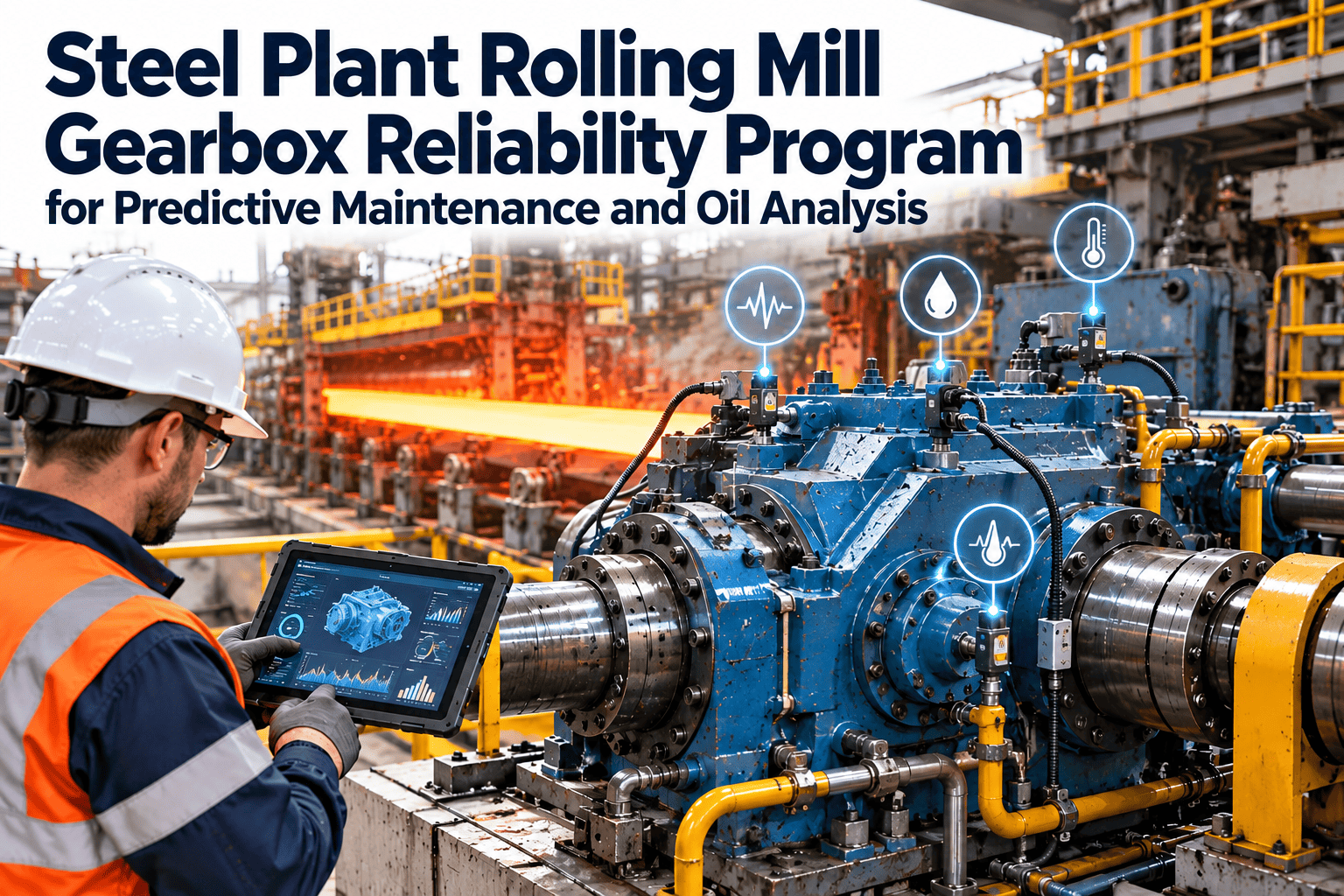
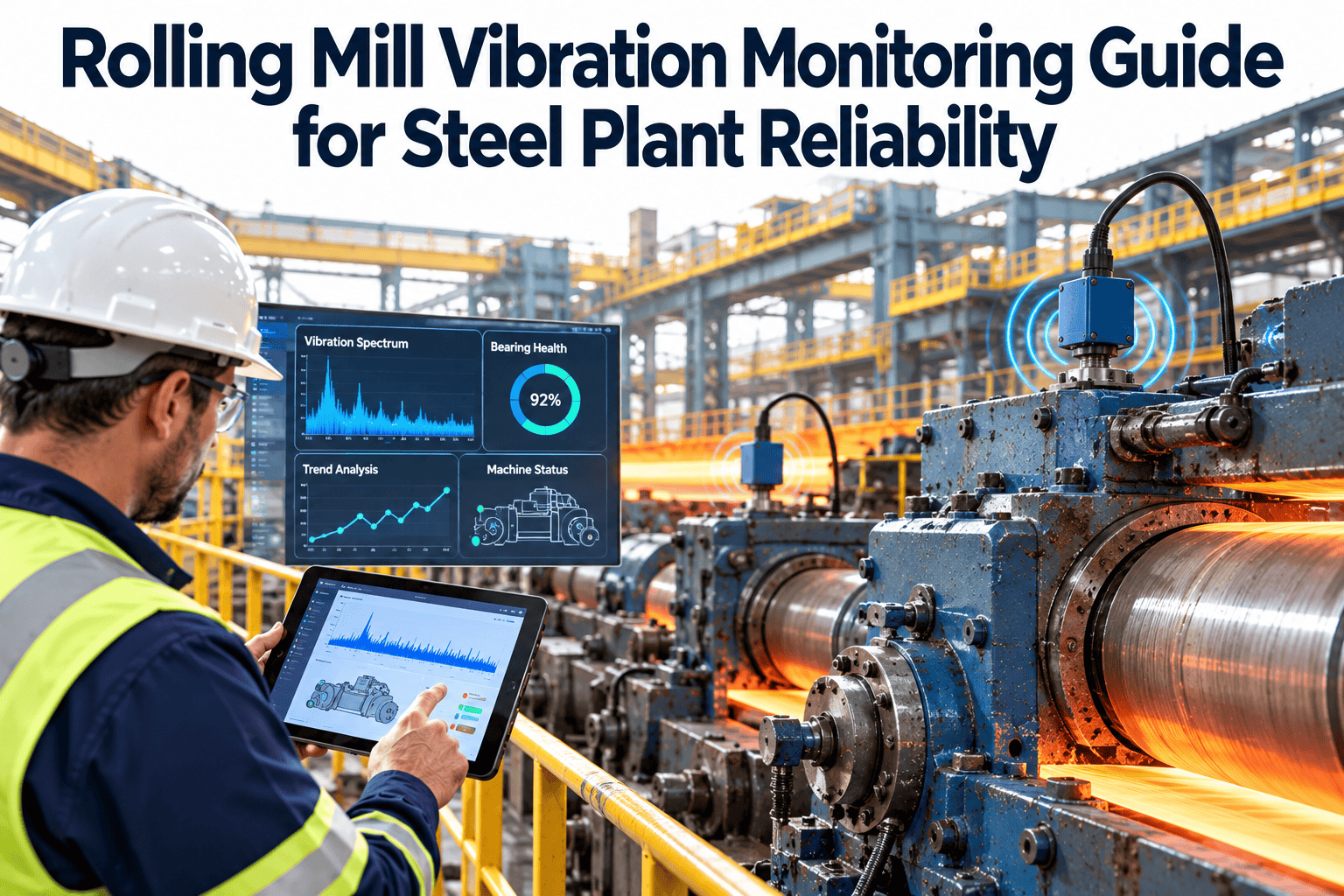
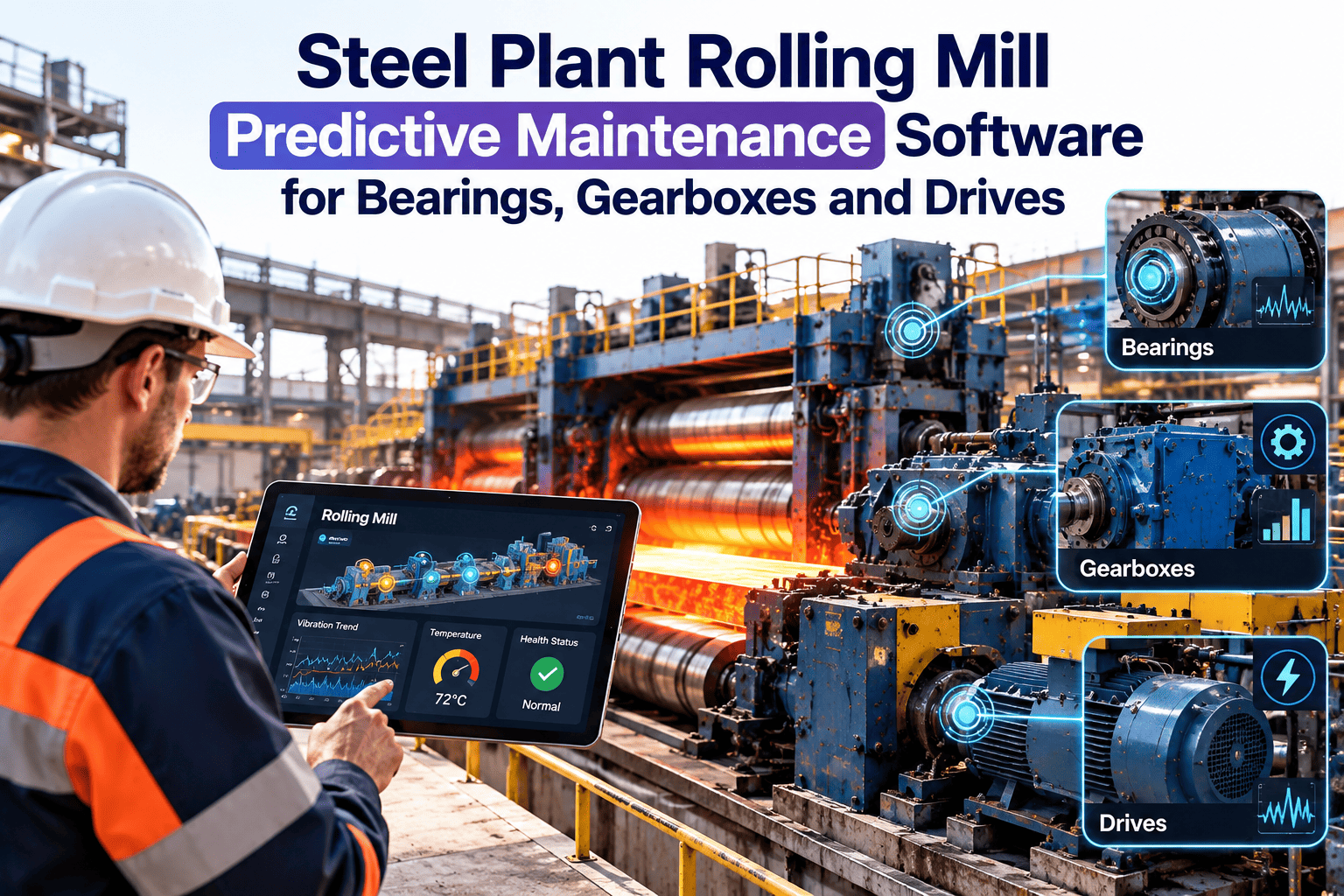
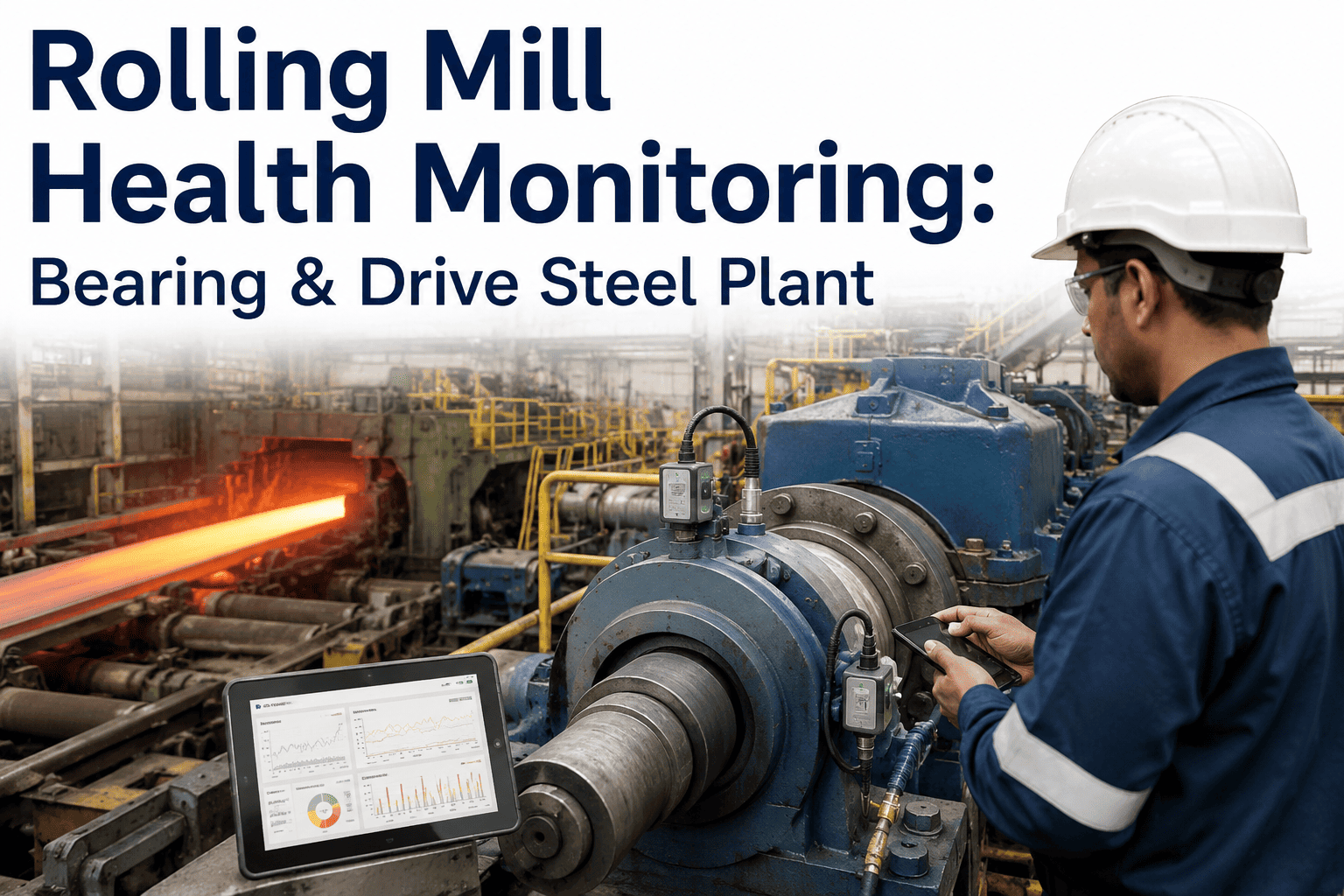
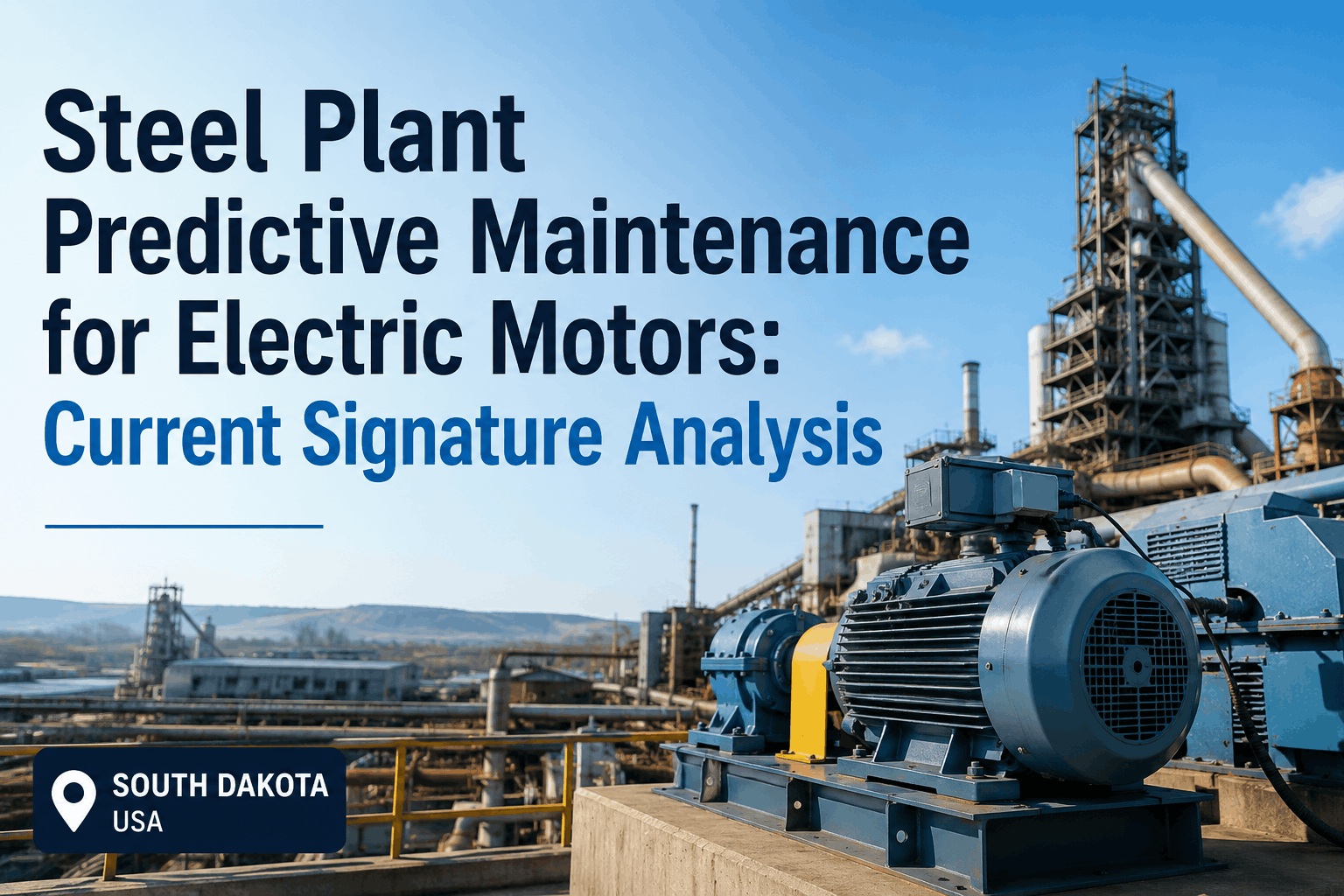
Rolling mill gearboxes and drive systems are the mechanical heart of steel production—transmitting thousands of horsepower through gear trains, spindles, and couplings that operate under extreme torque loads, thermal cycling, and shock forces with every pass of steel through the mill. A single gearbox failure on a hot strip mill can shut down production for 5–21 days and cost $500,000–$3 million in lost output, emergency repairs, and downstream schedule disruption. A main drive motor failure on a plate mill can exceed $1 million in replacement costs alone before accounting for the 2–4 weeks of lost production while a replacement is sourced, installed, and commissioned. Yet most steel producers still maintain these critical assets on calendar-based schedules—changing oil every six months, inspecting gears annually, replacing bearings on a fixed interval regardless of actual condition. This approach either replaces components too early (wasting 30–50% of their useful life) or too late (after the damage has already begun cascading through the gear train). Predictive maintenance transforms this equation by continuously monitoring the actual condition of gearbox and drive components through vibration analysis, oil analysis, thermography, motor current signature analysis, and acoustic emission monitoring. Instead of asking "when was this last serviced?" predictive maintenance answers the question that actually matters: "what is the current condition of this component, and how much useful life remains?" The answer determines whether you run confidently for another six months, schedule a planned repair during the next outage, or take immediate action before a $200 bearing failure becomes a $2 million gearbox replacement.
5–21 days
Typical unplanned gearbox repair shutdown duration
$0.5–3M
Total cost per unplanned gearbox failure event
30–50%
Of component useful life wasted by calendar-based replacement
85%
Of gearbox failures that show detectable warning signs weeks before failure
The Failure Cascade: Why Gearbox Failures Are So Expensive
A rolling mill gearbox failure is never just a gearbox failure. The extreme forces involved mean that damage cascades through the entire drivetrain—from the initial bearing or gear tooth failure through the housing, shafts, seals, couplings, and into adjacent components. Understanding this cascade explains why early detection through predictive maintenance is worth orders of magnitude more than reactive repair. Facilities that sign up to track their drivetrain maintenance and condition data on a centralized platform build the historical baseline that makes predictive analytics actionable.
Stage 1
Detection Window: 3–6 months before failure
Micro-Damage Initiation
Subsurface fatigue cracks begin forming in bearing races or gear tooth roots. No audible noise. No temperature change. No oil debris visible to the eye. Detectable only through high-frequency vibration analysis (enveloping/demodulation) and ultrasonic acoustic emission monitoring.
Repair cost at this stage: $5K–$20K — bearing replacement during planned outage, zero secondary damage
Stage 2
Detection Window: 4–12 weeks before failure
Progressive Wear & Spalling
Fatigue cracks propagate to the surface, producing spalling on bearing races and pitting on gear teeth. Metallic wear particles appear in oil samples. Vibration amplitudes increase at bearing fault frequencies. Temperature begins to rise. Still no audible abnormality under normal production noise.
Repair cost at this stage: $20K–$80K — bearing and potentially damaged gear replacement during scheduled outage
Stage 3
Detection Window: 1–4 weeks before failure
Accelerating Degradation
Spalled material circulates through the oil system, damaging other bearings and gear surfaces. Clearances increase, causing misalignment and additional stress on shafts and housings. Oil temperature rises noticeably. Vibration levels are now elevated across multiple frequencies. Experienced operators may notice abnormal noise at close range.
Repair cost at this stage: $80K–$300K — multiple bearing and gear replacements, shaft inspection, extended outage
Stage 4
No detection window — catastrophic
Catastrophic Failure
Bearing seizure, gear tooth fracture, or shaft failure causes immediate, uncontrolled stoppage. Fractured components damage housing bores, adjacent gear meshes, seals, and couplings. Secondary damage often exceeds primary failure cost by 5–10x. Emergency procurement of long-lead-time components extends downtime to weeks.
Total cost at this stage: $500K–$3M+ — complete gearbox rebuild or replacement, 5–21 days production loss, emergency logistics
The Five Monitoring Technologies for Drivetrain Health
No single monitoring technology provides a complete picture of gearbox and drive condition. The most effective predictive maintenance programs combine multiple complementary technologies—each detecting different failure modes at different stages of development—to create comprehensive drivetrain health visibility.
What it detects: Bearing defects (inner race, outer race, rolling element, cage), gear mesh abnormalities (tooth wear, pitting, cracking, misalignment), shaft imbalance, looseness, resonance conditions, coupling misalignment
Detection lead time: 3–6 months for bearing defects via envelope analysis; 1–3 months for gear defects via order tracking and cepstrum analysis
Accelerometers mounted on gearbox housings at each bearing location and mesh point. Continuous online monitoring for critical mill drives; route-based portable collection for secondary equipment. Minimum frequency range: 10 Hz–20 kHz with envelope demodulation capability.
What it detects: Wear metal particles (iron, copper, tin, lead indicating specific component wear), lubricant degradation (viscosity, oxidation, contamination), water intrusion, particle count distribution, ferrous debris concentration
Detection lead time: 2–4 months for progressive wear; immediate confirmation of abnormal wear events detected by vibration
Monthly laboratory samples for routine trending. Online ferrous debris monitors on critical gearboxes for real-time particle detection. Analytical ferrography for wear mode identification (cutting, sliding, fatigue, corrosion). ISO cleanliness targets for rolling mill gear oils: 16/14/11 or better.
What it detects: Rotor bar defects, stator winding faults, air gap eccentricity, broken rotor bars, bearing defects in drive motors, torque oscillations from mechanical faults transmitted through the drivetrain
Detection lead time: 2–6 months for rotor defects; 1–3 months for stator insulation degradation
Non-invasive monitoring through current transformers on motor supply cables — no need to access or instrument the motor itself. Particularly valuable for rolling mill main drive motors (1,000–15,000 HP) where vibration sensor installation is physically challenging.
What it detects: Bearing overheating, lubrication deficiency, coupling misalignment heat patterns, electrical connection hot spots in motor terminals, VFD component overheating, uneven thermal distribution indicating internal gearbox problems
Detection lead time: 2–6 weeks for bearing thermal anomalies; immediate for lubrication and electrical faults
Route-based portable thermal imaging during production. Fixed thermal cameras on critical main drives for continuous temperature trending. Baseline thermal profiles established for each gearbox under standard operating load for anomaly comparison.
What it detects: Subsurface crack initiation and propagation in gear teeth and bearing races — the earliest detectable stage of fatigue damage, weeks to months before conventional vibration analysis can identify the fault
Detection lead time: 4–8 months — the longest advance warning of any monitoring technology for fatigue-initiated failures
High-frequency sensors (100 kHz–1 MHz) mounted on gearbox housings. Requires specialized signal processing to distinguish fault emissions from background process noise. Most valuable on slow-speed, high-torque gearboxes where conventional vibration analysis has limited sensitivity.
Connect Your Monitoring Data to Your Maintenance Workflow
OxMaint integrates condition monitoring data with work order management — when vibration analysis flags a developing bearing defect, the system automatically generates a planned repair work order with the right parts, the right priority, and the right timing to prevent the failure cascade.
Rolling Mill Drivetrain Components: Failure Modes & Monitoring Strategy
Each component in the rolling mill drivetrain has distinct failure modes that require specific monitoring approaches. A comprehensive predictive maintenance program maps the right technology to the right component and the right failure mode.
Scroll horizontally on mobile
Implementation: From Calendar-Based to Condition-Based
Transitioning from calendar-based to predictive maintenance for rolling mill drivetrains follows a structured approach that delivers measurable results within 90 days while building toward full predictive capability over 12–18 months.
Months 1–3
Asset Criticality & Baseline Assessment
Identify every gearbox, drive motor, coupling, and spindle in the rolling mill drivetrain. Rank by criticality based on production impact, replacement cost, and lead time. Collect baseline vibration signatures, oil samples, and thermal profiles for each critical asset. Establish alarm thresholds based on ISO 10816 and equipment-specific experience.
Deliverable: Prioritized asset registry with baseline condition data, monitoring schedule, and alarm thresholds for top 20% critical drivetrains
Months 4–8
Online Monitoring & Integration
Install continuous online vibration monitoring on the most critical gearboxes and main drive motors. Deploy online oil particle counters on gearboxes with the highest consequence of failure. Integrate monitoring data with the CMMS to automatically generate condition-based work orders when thresholds are exceeded.
Deliverable: Real-time drivetrain health dashboard, automated alert-to-work-order workflow, first condition-based maintenance decisions replacing calendar tasks
Months 9–14
Predictive Analytics & Remaining Life Estimation
With 6–12 months of condition data, machine learning models begin predicting failure timelines based on degradation trends. Remaining useful life estimates for individual components enable precise maintenance scheduling — not too early, not too late. Extend monitoring to secondary drivetrains based on lessons learned.
Deliverable: Remaining useful life predictions for critical components, optimized spare parts planning, documented cost avoidance from prevented failures
Month 15+
Full Predictive Operation & Continuous Improvement
All critical drivetrains monitored with condition-based maintenance fully replacing calendar-based tasks. Predictive models continuously refined from accumulated failure and survival data. Maintenance planning integrated with production scheduling for zero-impact outage coordination.
Deliverable: Mature predictive maintenance program with documented 40–60% reduction in unplanned drivetrain downtime
The transition to predictive maintenance doesn't require replacing your existing maintenance program overnight. It starts by augmenting calendar-based maintenance with condition data on the most critical assets and progressively expanding as results validate the approach. Facilities that sign up to manage their maintenance workflows on a platform that integrates condition monitoring accelerate this transition by connecting monitoring alerts directly to maintenance execution.
ROI: Predictive Maintenance for Rolling Mill Drivetrains
$2.8M
Avoided Catastrophic Failures
Prevention of 1–2 major gearbox failures per year through early detection and planned intervention
$1.2M
Extended Component Life
Running components to actual end-of-life instead of fixed intervals extends useful life by 30–50%
$850K
Optimized Outage Planning
Combining condition-based repairs into planned outages reduces total shutdown duration by 25–40%
$450K
Spare Parts Optimization
Predictable failure timelines eliminate emergency procurement premiums and enable strategic inventory
$300K
Secondary Damage Prevention
Early bearing intervention prevents cascading damage to gears, shafts, housings, and couplings
Expert Perspective: Making Predictive Maintenance Work for Mill Drivetrains
"
I've managed rolling mill reliability programs for 22 years, and the single biggest lesson is that predictive maintenance for drivetrains is not about the monitoring technology—it's about what you do with the data. I've seen plants with $2 million in monitoring equipment that still suffer catastrophic gearbox failures because the vibration data sits in a software database that nobody looks at, the oil analysis results arrive by email and get filed, and nobody connects the developing bearing defect to a work order until the gearbox is screaming. The plants that get the best results are the ones that close the loop: monitoring data triggers an automated alert, the alert generates a work order in the CMMS, the work order is prioritized based on the severity and progression rate of the defect, and the maintenance planner schedules the repair during the next available production window—all without waiting for someone to remember to check the vibration database. We prevented a $1.8 million finishing stand gearbox failure last year because the online vibration system detected an inner race defect at Stage 1, automatically created a work order, and the planner had the replacement bearing on site and the repair scheduled within two weeks. The total repair cost was $12,000. That's the ROI of connecting monitoring to action.
Monitor the most expensive failures first — don't try to instrument everything at once
Close the loop between monitoring and maintenance — data without action is just expensive data collection
Combine vibration with oil analysis — together they catch 95% of gearbox failure modes
Keep baseline records — you can't identify abnormal if you don't know what normal looks like
Predictive maintenance for rolling mill gearboxes and drives is the highest-ROI reliability investment a steel producer can make—turning catastrophic, unplanned failures into planned, controlled repairs at a fraction of the cost. If you're ready to close the loop between monitoring and maintenance, book a free demo to see how condition-based work orders integrate with your maintenance workflow.
Detect Early. Plan Smart. Prevent the Cascade.
OxMaint connects condition monitoring alerts to maintenance execution — automatically generating work orders when drivetrain health data crosses thresholds, tracking parts and labor costs, and building the equipment history that makes predictive analytics smarter with every repair.
Frequently Asked Questions
What is the minimum monitoring investment needed to start predictive maintenance on mill drivetrains?
A meaningful predictive maintenance program for rolling mill drivetrains can start with an investment of $80,000–$150,000 covering the most critical assets. The minimum viable program includes permanent online vibration sensors on the 3–5 most critical gearboxes (main drive, finishing stand drives) at approximately $3,000–$8,000 per monitoring point including sensors, cabling, and data acquisition hardware — typically 8–16 monitoring points per gearbox for $25,000–$60,000 total. Add a quarterly oil analysis program for all gearboxes at approximately $150–$300 per sample, $5,000–$15,000 annually. A portable vibration data collector for route-based monitoring of secondary drivetrains at $15,000–$25,000. And software for data management and analysis at $10,000–$30,000 annually. This baseline investment protects the assets whose failure would cause the most expensive production losses while building the experience and data foundation to expand the program. The first prevented failure typically pays for the entire initial investment.
How do we prioritize which gearboxes and drives to monitor first?
Prioritization should be based on a criticality matrix that considers three factors: consequence of failure (production loss rate, repair cost, lead time for replacement components), probability of failure (equipment age, historical failure frequency, current condition), and detectability (whether existing monitoring can provide adequate warning). The highest priority assets are those with high consequence, moderate-to-high probability, and low current detectability — these are the assets where predictive monitoring adds the most value. In a typical hot strip mill, the priority order is usually: finishing mill main gearboxes and drives (highest production impact, most expensive to repair), roughing mill drive (single point of failure for the entire line), coiler drives (frequent high-impact loading), and edger drives. For a cold rolling mill: main mill drive gearbox, tension reel drives, and process line drives. Start with the top 3–5 assets, demonstrate results, then expand based on documented ROI.
What skills does our maintenance team need for vibration analysis on mill drivetrains?
Effective vibration analysis for rolling mill drivetrains requires two levels of capability. The first level is automated monitoring and alerting — modern vibration monitoring systems can automatically detect threshold exceedances and basic fault patterns without specialized analyst skills. This level requires a technician trained in sensor installation, data collection, and basic system operation (2–3 days of training). The second level is diagnostic analysis — interpreting vibration spectra, performing envelope analysis for bearing defects, identifying gear mesh problems through order tracking, and determining fault severity and remaining life. This requires a vibration analyst certified to ISO 18436 Category II or equivalent (typically 40–80 hours of training plus 6–12 months of mentored experience). For most steel plants, the recommended approach is to develop internal Category II capability for routine analysis while using external Category III/IV specialists for complex diagnostics on critical assets. Many plants start by outsourcing analysis to a reliability services firm while training internal staff, then gradually transitioning to in-house capability over 12–18 months.
How does predictive maintenance change spare parts strategy for mill drivetrains?
Predictive maintenance fundamentally transforms spare parts strategy from insurance-based to intelligence-based. Under calendar-based maintenance, plants stockpile critical spares because failure timing is unpredictable — a complete set of gearbox bearings, spare gear sets, coupling components, and motor spares representing $500,000–$2 million in inventory for a single mill. Under predictive maintenance, you know which components are degrading, how fast they're degrading, and approximately when they'll need replacement — typically with 2–6 months of advance notice. This enables three strategic changes. First, you can reduce safety stock on long-lead-time items because you have enough warning to procure them after detecting a developing defect rather than pre-stocking them speculatively. Second, you can negotiate better pricing through planned procurement rather than emergency orders (emergency premiums typically add 30–80% to component costs). Third, you can eliminate inventory of spares for components that monitoring shows are in excellent condition — freeing capital that was tied up insuring against failures that aren't developing. Typical spare parts inventory reductions of 20–35% are achievable within 18–24 months of implementing predictive monitoring.
Can predictive maintenance detect problems in slow-speed gearboxes used in heavy plate mills?
Slow-speed gearboxes (below 100 RPM) present a significant challenge for conventional vibration analysis because the low rotational speeds generate very low vibration energy, making bearing and gear defects difficult to detect against background noise. However, several specialized techniques have been developed specifically for this application. Acoustic emission monitoring operates in the 100 kHz–1 MHz frequency range where slow-speed bearing defects produce detectable stress waves even at very low RPMs — this technology provides the longest advance warning for fatigue-initiated failures in slow-speed applications. Envelope analysis with extended averaging (60+ seconds per measurement) can extract bearing defect frequencies from low-speed signals that would be invisible in standard measurements. Oil analysis with analytical ferrography is particularly valuable for slow-speed gearboxes because wear debris accumulates over longer periods and provides clear evidence of developing faults. Shock pulse measurement (SPM) and similar impact-based technologies can detect bearing surface damage at speeds as low as 1 RPM. The most effective approach for heavy plate mill gearboxes combines acoustic emission for early detection with oil analysis for confirmation and progression tracking, supplemented by low-speed vibration techniques for specific fault identification.