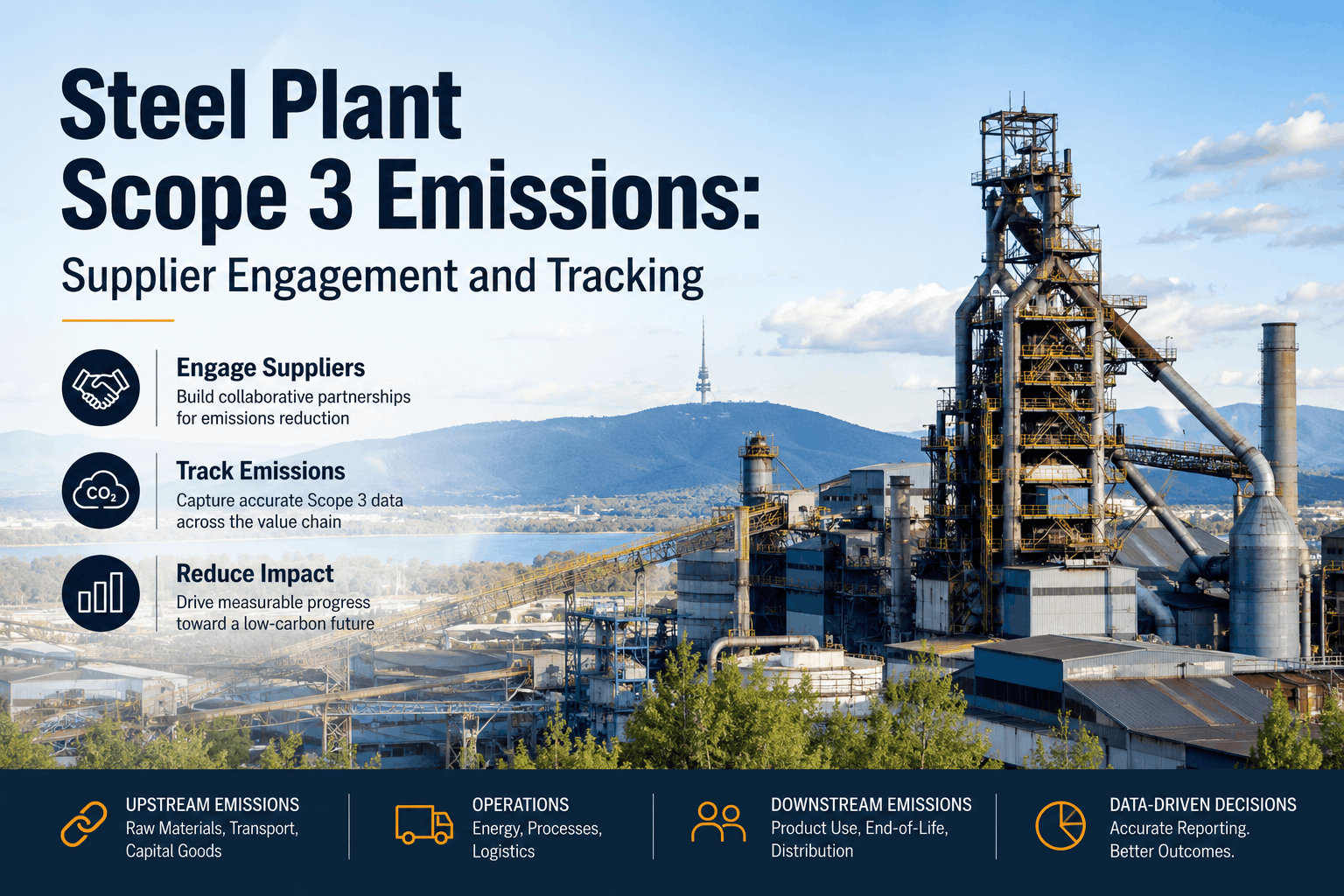
Scope 3 Emissions for Steel: Supplier Engagement and CMMS-Backed Evidence

By Alex Jordan on May 15, 2026

scope-3-emissions-for-steel-supplier-engagement-and-cmms-backed-evidence

For an integrated steel producer, Scope 3 emissions dwarf Scope 1 and Scope 2 combined. Iron ore, coking coal, limestone, scrap, and alloying material supply chains — Category 1 purchased goods alone — typically represent 60–75% of a BF-BOF steel plant's total GHG inventory. When investors, customers, and regulators ask for your Scope 3 disclosure, they are asking about the vast majority of your emissions footprint. Yet most steel plants are still submitting spend-based estimates for Category 1 — because they have no primary data infrastructure to do better. OxMaint builds the operational data infrastructure that supports material Scope 3 categories with CMMS-backed evidence — from capital goods asset records to maintenance-linked consumption data that feeds directly into your Category calculations.

Steel Decarbonisation · GHG Protocol · Supplier Engagement

Scope 3 Emissions for Steel Producers: Category-by-Category Evidence, Supplier Engagement Programs, and CMMS-Backed Disclosure for GHG Protocol Compliance

Steel's Scope 3 challenge is both a reporting problem and a supplier engagement problem. Calculating credible Category 1 emissions requires primary data from iron ore miners, coal producers, and scrap processors. Calculating accurate Category 2 emissions requires capital goods asset records with embodied carbon documentation. OxMaint structures the operational records that feed multiple material Scope 3 categories — and gives your sustainability team the asset data they need to move beyond spend-based approximations.

60–75%
Of a BF-BOF steel plant's total GHG inventory sits in Scope 3 Category 1 purchased goods — iron ore and coking coal supply chains
15
GHG Protocol Scope 3 categories — steel producers have material obligations in at least 6 of them
Primary
Data from suppliers and operational records — the only path from spend-based estimates to credible Scope 3 disclosure
The Scope 3 Data Gap

Why Steel Producers Struggle to Report Scope 3 Credibly

Steel Scope 3 reporting faces three compounding problems: the volume of emissions is enormous, the data is controlled by suppliers who have their own disclosure limitations, and the operational records that could support material categories often sit in disconnected maintenance systems that sustainability teams cannot access.

Supplier Emission Factors Are Unavailable or Unverified
Category 1 accuracy depends entirely on having supplier-specific emission factors for iron ore, coking coal, limestone, and alloying materials. Most steel plant procurement teams are still working with generic industry-average emission factors from databases like ecoinvent or worldsteel sector averages — because their iron ore and coal suppliers have not yet developed product-level carbon disclosures. Spend-based calculations using these averages are acceptable for initial disclosure, but carry substantial uncertainty ranges that investors and CDP reviewers increasingly challenge.
Disclosure risk: Spend-based Scope 3 reports carry ±30–50% uncertainty — investors know this
Capital Goods Embodied Carbon Records Don't Exist
GHG Protocol Category 2 requires steel producers to account for the embodied carbon in capital goods — blast furnace relining material, major equipment installations, conveyor systems, and large plant assets. Most maintenance and procurement systems do not capture embodied carbon data at the point of asset creation. Category 2 is therefore either omitted, estimated at high uncertainty, or submitted as "not material" — a claim that becomes increasingly difficult to sustain as disclosure scrutiny intensifies.
Omission risk: Undisclosed Category 2 leaves a material gap in Scope 3 inventory completeness
Operational Data for Categories 3 and 4 Is Fragmented
Category 3 (fuel and energy related activities not included in Scope 1/2 — upstream emissions from purchased fuels and electricity generation) and Category 4 (upstream transportation) require activity data — actual energy quantities purchased, actual material transport distances and modes. This data exists in plant procurement and logistics systems, but is rarely connected to the maintenance records that confirm what equipment consumed that energy. The Scope 3 calculation therefore treats energy consumption as a procurement exercise rather than an engineering one — losing the equipment-level granularity that primary data calculation provides.
Data quality: Equipment-level consumption data would substantially improve Category 3 accuracy
6 Material Categories
of Scope 3 emissions where integrated steel producers have primary reporting obligations — and where CMMS-backed operational records provide evidence that spend-based calculations cannot match
OxMaint Capabilities

How OxMaint Supports Your Steel Plant's Material Scope 3 Categories

OxMaint is not a carbon accounting platform — but it generates and stores the operational records that feed several material Scope 3 categories with primary data quality. Book a walkthrough to see how OxMaint's asset data maps to your Scope 3 disclosure methodology.

Category 1 Support
Raw Material Consumption Records Linked to Production Periods
OxMaint's campaign and period tracking links material consumption work orders — blast furnace coke charge records, iron ore batch documentation, limestone and flux usage — to specific production campaign periods. This creates the consumption quantity data that is the foundation of primary activity-based Category 1 calculation. When paired with supplier emission factors, even industry-average ones, this approach produces substantially lower uncertainty than spend-based estimation alone. As your suppliers develop product-level carbon disclosures, the OxMaint consumption data is already structured to accept and use supplier-specific emission factors at the product or batch level.
Category 2 Support
Capital Equipment Asset Records with Embodied Carbon Documentation
Every major capital installation managed in OxMaint — blast furnace relining, major equipment purchases, infrastructure upgrades — is created as an asset record with installation date, supplier, material specifications, and a document attachment field. Embodied carbon declarations from equipment suppliers and refractory contractors can be attached directly to the capital asset record in OxMaint. This creates a structured, searchable Category 2 evidence base that persists across the full asset lifecycle — accessible to sustainability teams during annual disclosure periods without requiring data to be reconstructed from procurement files. Try it free.
Category 3 Support
Equipment-Level Energy Consumption Records for Upstream Emission Factors
Category 3 upstream emissions from purchased fuels and electricity require activity data — quantities of natural gas, coke oven gas, blast furnace gas, and purchased electricity consumed during the reporting period. OxMaint's maintenance work orders, PM checklists, and operational records can include energy meter readings and fuel consumption data per equipment and per production period. This provides the equipment-level granularity that allows Category 3 calculation to be based on actual consumption rather than top-line procurement invoices — improving accuracy and reducing reliance on industry-average allocation factors.
Supplier Engagement
Supplier Emission Factor Documentation Storage
As your procurement team engages iron ore, coal, scrap, and limestone suppliers to provide product-level carbon data, those supplier emission factor documents — EPDs, product carbon footprint declarations, CDP disclosures — need a home that is connected to your consumption records. OxMaint's supplier and asset document management allows supplier carbon documentation to be attached to the relevant purchase material or supplier record, so your Scope 3 calculation team can access the most current verified emission factor for each material without hunting through email archives before every reporting cycle. Request a supplier documentation demo.
Audit Evidence
Scope 3 Reporting Period Export for Verifier Review
Third-party Scope 3 verification — whether for CDP, TCFD reporting, SBTi commitment, or customer due diligence — requires auditors to trace reported activity data back to operational records. OxMaint generates date-range reports covering capital asset installations, material consumption work orders, energy reading records, and equipment maintenance completions for any specified reporting period. This structured evidence package reduces verification time and gives your sustainability team confidence that the operational data supporting your Scope 3 submission is auditable and complete.
Baseline Building
Historical Record Depth for Scope 3 Baseline Year Establishment
Establishing a robust Scope 3 baseline year — required for SBTi target setting and CDP year-on-year comparison — needs several years of consistent operational data. Steel plants starting OxMaint today begin building that record depth immediately. Every material consumption record, capital asset installation, and energy reading captured in OxMaint from the first day of deployment contributes to the historical data foundation that makes future baseline years defensible and future target-setting credible. Starting now delivers maximum baseline data depth by the time your SBTi or net-zero commitment requires formal submission.
From Spend-Based to Primary Data
Your Scope 3 Disclosure Is Only as Credible as the Operational Records Behind It — OxMaint Builds Those Records
Spend-based Scope 3 estimates are a starting point, not a destination. Primary activity-based data — consumption quantities per campaign, capital asset records with embodied carbon, supplier emission factor documentation — is what your investors, customers, and CDP reviewers are increasingly demanding. OxMaint structures exactly this data, as a natural output of your day-to-day maintenance operations.
Category Relevance Reference

GHG Protocol Scope 3 Categories — Relevance and CMMS Evidence Applicability for Steel Producers

Not all 15 Scope 3 categories are equally material for steel producers. This reference matrix shows typical relevance levels for integrated BF-BOF and EAF steel plants, and where OxMaint-generated records provide direct evidence support.

Category
Category Name
BF-BOF
EAF
OxMaint Evidence
Upstream Categories (1–8)
Cat 1
Purchased goods & services
Iron ore, coking coal, scrap, limestone, alloys
High
High
Material consumption records per campaign
Cat 2
Capital goods
Blast furnace relining, major equipment
High
Medium
Asset records with embodied carbon docs
Cat 3
Fuel & energy related activities
Upstream from purchased fuels and electricity
High
Medium
Equipment energy consumption work orders
Cat 4
Upstream transportation
Iron ore, coal, scrap inbound logistics
High
Medium
Partial — links to procurement data
Cat 5
Waste generated in operations
Slag, dust, sludge, scale disposal
Medium
Medium
Partial — by-product disposal work orders
Cat 6
Business travel
Low
Low
Outside CMMS scope
Cat 7
Employee commuting
Low
Low
Outside CMMS scope
Cat 8
Upstream leased assets
Low
Low
Plant-specific assessment required
Downstream Categories (9–15)
Cat 9
Downstream transportation
Finished steel product logistics
Medium
Medium
Logistics data outside CMMS scope
Cat 10
Processing of sold products
Rolling, forming, coating by customers
Medium
Medium
Customer operations data required
Cat 11
Use of sold products
Steel in buildings, vehicles, infrastructure
High
High
Product specification data — outside CMMS scope
Cat 12
End-of-life treatment
Steel recycling, landfill, incineration
Medium
Medium
Industry recycling rate data applied
Cat 13
Downstream leased assets
Low
Low
Plant-specific assessment required
Cat 14
Franchises
N/A
N/A
Not applicable for steel producers
Cat 15
Investments
Joint ventures, project finance
Medium
Medium
Finance team data required
High Material for GHG inventory
Medium Assess for materiality
Low Typically immaterial
N/A Not applicable
Green OxMaint provides direct evidence
Amber Partial CMMS support

Category relevance is indicative for a typical integrated BF-BOF or EAF steel producer. Actual materiality assessment should follow GHG Protocol Corporate Value Chain (Scope 3) Standard methodology and consider your plant's specific production processes, supply chain structure, and downstream market. OxMaint does not provide carbon accounting or regulatory compliance advice.

Supplier Engagement Program

Building a Scope 3 Supplier Engagement Program with OxMaint as Your Evidence Backbone

Supplier engagement is the only path from spend-based Category 1 estimates to primary data accuracy. Here is how a structured steel plant Scope 3 program uses OxMaint records as the foundation for supplier engagement and progressive data quality improvement.

Year 1
Q1–Q2
Establish Consumption Baseline in OxMaint
Configure OxMaint with material consumption work order templates for all Category 1 inputs — iron ore, coking coal, pellets, scrap, limestone, alloys, refractories. Begin capturing actual consumption quantities per production campaign period. This activity-based consumption data, combined with industry-average emission factors initially, immediately improves Category 1 accuracy relative to spend-based calculation and establishes the baseline year data foundation for future SBTi target setting.
Year 1
Q3–Q4
Capital Asset Embodied Carbon Records Created
Sustainability and engineering teams collaborate to attach Environmental Product Declarations (EPDs) and embodied carbon declarations from major equipment suppliers and refractory contractors to capital asset records in OxMaint. The current year's major capital projects — blast furnace relines, equipment overhauls, infrastructure upgrades — are documented in OxMaint with embodied carbon data attached. Category 2 reporting moves from estimated to primary data for these assets immediately.
Year 2
Q1–Q2
First Supplier Engagement Round Initiated
Using OxMaint's consumption data to demonstrate the volume of material purchased from each supplier, the procurement team initiates a formal supplier carbon engagement program — requesting product-level carbon footprint declarations from top-5 Category 1 suppliers by value. The OxMaint consumption records provide the credible, verifiable purchase volume data that gives suppliers a compelling reason to provide their emission factors: their data will actually be used in a verified disclosure, not just filed in a sustainability questionnaire.
Year 2
Q3–Q4
Supplier Emission Factors Stored in OxMaint — Category 1 Quality Improves
As suppliers provide product carbon footprint data — whether as EPDs, CDP supply chain disclosures, or direct data sharing — those documents are attached to the relevant supplier or material records in OxMaint. The sustainability team's carbon accounting tool pulls OxMaint's consumption quantities and applies the now-verified supplier emission factors. Category 1 uncertainty narrows from ±40% to ±15% for the covered suppliers. The OxMaint team can advise on structuring this data workflow during onboarding.
Year 3+
SBTi Submission and Verified Scope 3 Baseline
With two years of OxMaint-backed consumption records, supplier emission factors attached to material records, and capital goods embodied carbon documentation in place, the steel plant has a defensible Scope 3 baseline year. SBTi Corporate Net-Zero Standard requires Scope 3 target coverage of at least 67% of total value chain emissions — and requires that the baseline inventory is "transparent, consistent, and complete." The OxMaint record foundation delivers exactly these properties for the material categories it covers.
Measurable Impact

What Steel Plants Gain from OxMaint-Supported Scope 3 Programs

±15%
Category 1 Uncertainty vs ±40–50% Spend-Based
Activity-based consumption data from OxMaint combined with supplier emission factors reduces Category 1 uncertainty to ranges that investors and CDP reviewers accept as credible primary data.
Cat 2
Capital Goods Now Reported with Primary Data
Embodied carbon documentation attached to capital asset records in OxMaint converts Category 2 from a blank or estimated disclosure to a primary data submission — closing a material disclosure gap.
2yr
Baseline Data Depth Within Two Years of Deployment
Plants deploying OxMaint today build the operational record depth needed for a defensible Scope 3 baseline year within two annual reporting cycles — the minimum required for SBTi submission.
100%
Traceability for Verified Categories
Every consumption record and capital asset document in OxMaint is timestamped, role-attributed, and audit-exportable — meeting the GHG Protocol's completeness and transparency requirements for verified Scope 3 submissions.
SBTi
Foundation for Net-Zero Target Setting
SBTi Corporate Net-Zero requires coverage of at least 67% of Scope 3 with verified data. OxMaint's Category 1, 2, and 3 evidence support provides a solid foundation for that coverage requirement.
CDP
Higher CDP Score for Supply Chain Questionnaire
CDP's Supply Chain program scores suppliers higher for primary data Scope 3 disclosure — directly impacting customer relationship scores and access to sustainability-linked procurement programs for your steel business.
Customer Experience

From the Field

Our sustainability team was submitting CDP responses with spend-based Category 1 estimates that had uncertainty ranges of plus or minus forty percent. Two of our largest European steel customers flagged this specifically in their supplier carbon assessments — they wanted activity-based consumption data, not spend-based estimates. The problem was that our consumption data for iron ore and coking coal existed in the MES but was not structured in a way that could be easily linked to production periods or verified by a third party. We implemented OxMaint to structure our material consumption work orders per campaign period, and within twelve months we had the primary activity data that let us move to activity-based Category 1 calculation. We also started attaching EPDs from our refractory contractor and major equipment suppliers to capital asset records in OxMaint for Category 2. Our last CDP response received a full score improvement for data quality on both categories, and we are now on track to submit our SBTi commitment next year with a defensible baseline.

Head of Sustainability and ESG Reporting
Integrated BF-BOF steel producer, Eastern Europe — 2.1 Mtpa, CDP participant since 2019
Technical Questions Answered

Scope 3 Emissions for Steel — Frequently Asked Questions

Which GHG Protocol Scope 3 categories are most material for a BF-BOF steel producer?
For an integrated BF-BOF steel producer, Category 1 (purchased goods — iron ore, coking coal, limestone, scrap) is typically 60–75% of total Scope 3 emissions and always material. Categories 2 (capital goods), 3 (upstream fuel and energy), 4 (upstream transport), 11 (use of sold products in construction and manufacturing), and 12 (end-of-life treatment) are also typically material and require inclusion in a complete GHG inventory.
What is the difference between spend-based, activity-based, and supplier-specific Scope 3 calculation methods?
Spend-based calculation multiplies procurement spend by an industry-average economic emission factor — fast but highly uncertain (±40–50%). Activity-based calculation multiplies actual consumption quantities (tonnes of iron ore, tonnes of coal) by average emission factors per unit — more accurate (±15–25%). Supplier-specific calculation uses verified emission factors provided directly by each supplier for their specific product — most accurate (±5–15%) but requires active supplier engagement programs.
What emission intensity should steel producers use for iron ore in Category 1 if supplier data is unavailable?
Industry-average emission factors for iron ore typically range from 0.07 to 0.13 tCO₂e per tonne of ore, depending on mining method, ore grade, and beneficiation process — with higher factors for pellets (0.12–0.18 tCO₂e/t) due to the energy-intensive induration process. The worldsteel Association and ecoinvent databases both provide sector-average factors that are accepted as starting points for Scope 3 Category 1 calculation while supplier engagement programs develop primary data.
How does scrap steel's Scope 3 footprint compare to virgin iron ore and coking coal?
Scrap steel carries a dramatically lower Category 1 footprint than virgin raw materials — typically 0.02–0.06 tCO₂e per tonne under GHG Protocol cut-off allocation methodology — because it enters the system boundary as a recycled material with no upstream primary production burden allocated to it. This is the core reason EAF steel plants with high scrap rates can achieve substantially lower total GHG intensities than BF-BOF plants, even before Scope 1 differences are considered.
Does GHG Protocol require Scope 3 reporting for all 15 categories?
The GHG Protocol Corporate Value Chain (Scope 3) Accounting and Reporting Standard requires companies to account for all relevant and material Scope 3 categories, but allows omission of categories that are not relevant or material — provided the basis for exclusion is disclosed. For steel producers, the material categories are well-established; excluding Categories 1, 2, 4, and 11 without a substantiated materiality rationale would not pass disclosure scrutiny under CDP or third-party verification.
What does SBTi require for Scope 3 target coverage for steel companies?
The SBTi Corporate Net-Zero Standard requires companies to set Scope 3 targets covering at least 67% of total Scope 3 emissions, and requires that targets are based on a complete, verified inventory. For steel producers, this means Category 1 must be included — it alone typically represents over 60% of Scope 3 — making OxMaint-backed primary data for purchased goods consumption a prerequisite for credible SBTi target submission.
How does OxMaint specifically support Category 2 (capital goods) Scope 3 reporting?
OxMaint allows embodied carbon documentation — EPDs, carbon footprint declarations, supplier certificates — to be attached to capital asset records at the point of installation. This links the physical asset (blast furnace lining, major equipment installation) to its embodied carbon data, creating a structured, auditable Category 2 record that persists across the asset lifecycle and is accessible to sustainability teams at reporting time without reconstructing procurement files.
How do we engage our iron ore and coal suppliers to provide product-level emission factors?
The most effective approach is a tiered supplier engagement program: start with your top-5 suppliers by Category 1 spend, provide them with a structured data request template aligned to GHG Protocol Scope 3 Category 1 requirements, and offer to share your consumption data in return — giving them a credible disclosure use case for their own carbon reporting. Schedule a consultation to discuss how OxMaint's consumption records structure the supplier engagement data exchange.
Scope 3 Evidence Infrastructure
Your Investors and Customers Are Already Asking About Scope 3 — The Question Is Whether Your Records Can Answer
OxMaint builds the operational record infrastructure that converts steel Scope 3 disclosure from spend-based approximation to primary activity data — consumption records per campaign, capital goods embodied carbon documentation, and supplier emission factor storage, all in one auditable, exportable system. Start your free trial today or schedule a 30-minute demo with our steel sustainability specialist.

Share This Story, Choose Your Platform!