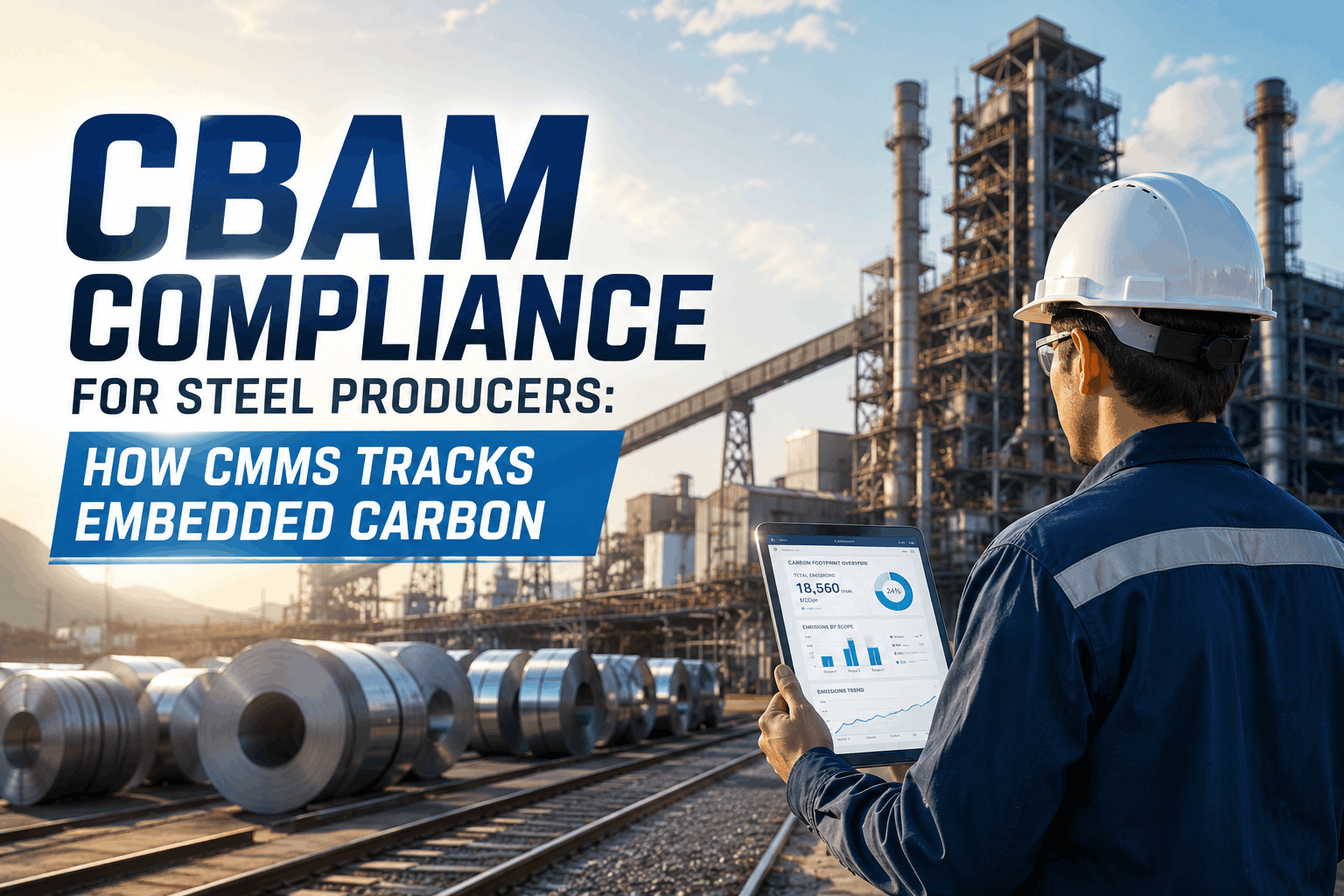
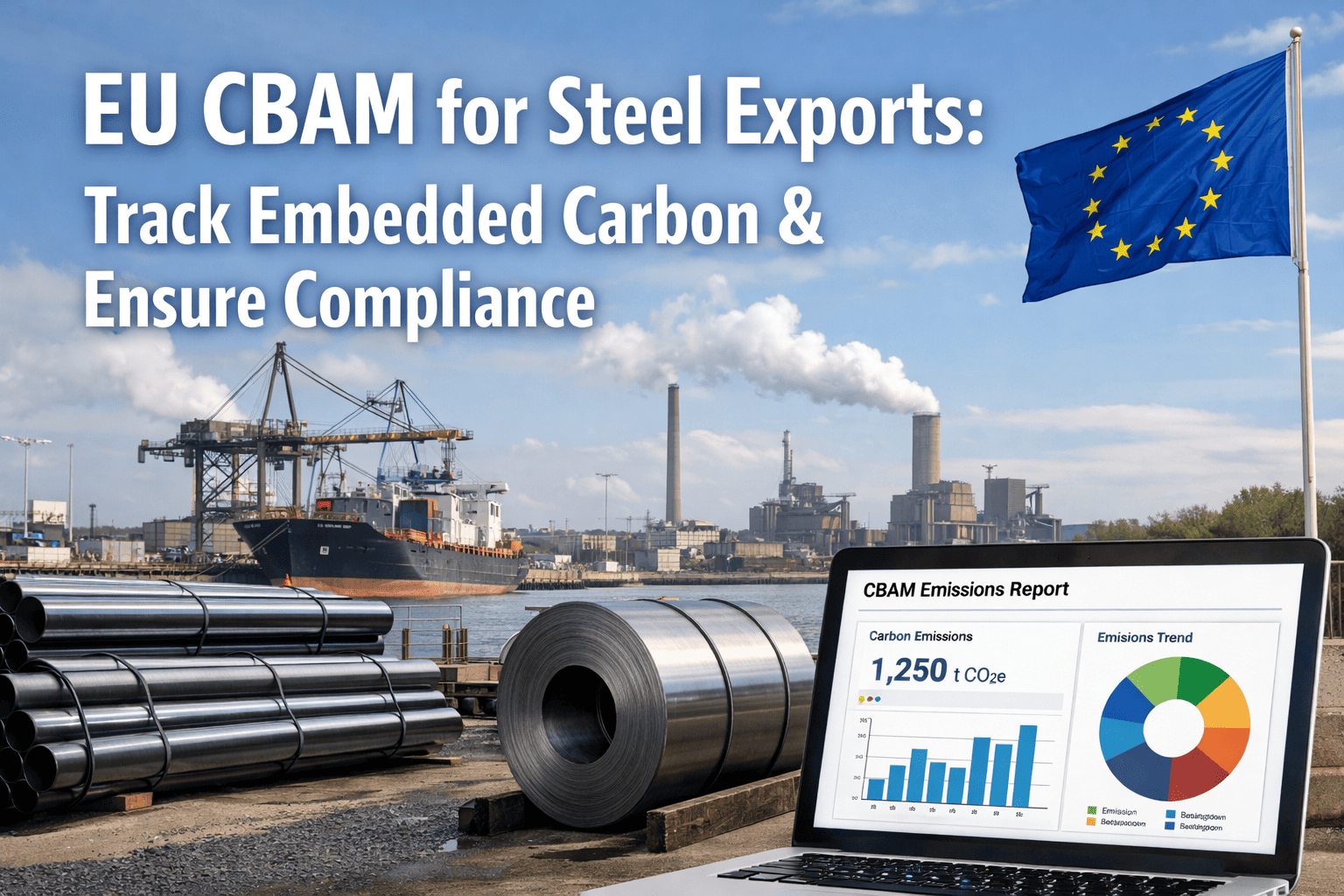
CBAM Compliance for Steel Producers: How CMMS Backs Embedded Emissions Reporting
By Alex Jordan on May 15, 2026
The EU Carbon Border Adjustment Mechanism is not a future concern for steel exporters — the transitional reporting phase has been live since October 2023, and full financial obligations begin in January 2026. For steel producers selling into EU markets, the difference between reporting embedded emissions using EU-prescribed default values versus plant-specific actual values is significant: default values are deliberately set at conservative high levels, meaning producers who cannot substantiate their actual lower emission intensity pay more. Substantiating actual values requires auditable, timestamped production and maintenance records that most steel plants do not have in the format CBAM verification demands. OxMaint gives steel producers the CMMS infrastructure to generate, store, and present those records in a form that withstands third-party verification.
CBAM Compliance for Steel Producers: How a CMMS Backs Your Embedded Emissions Reporting and Protects Your EU Market Access
CBAM actual value reporting requires you to prove what your embedded emissions actually are — per production route, per heat, per campaign period — with measurement records, fuel consumption logs, and calibration evidence that a third-party verifier will scrutinise. OxMaint structures and stores exactly these records, in a timestamped, photo-documented, role-audited system that was built for industrial operational environments — not for spreadsheets.
Per tonne of steel: estimated CBAM certificate cost at 2025–2026 carbon price levels for default-value reporters vs actual-value reporters
Jan 2026
Full CBAM financial obligation start date — certificate purchase mandatory from this date
3rd Party
Third-party verifier sign-off required for actual value reporting — audit-quality records are non-negotiable
The Compliance Documentation Gap
Why CBAM Actual Value Reporting Fails Without Structured CMMS Records
CBAM allows steel producers to use plant-specific actual emissions values rather than EU default values — but only if those values can be verified. Verification means a qualified third party must be able to trace your reported emissions intensity back to measured production data, calibrated instruments, and documented operational records. Here is where most steel plants fall short.
Fuel Consumption Data Not Linked to Production Records
CBAM embedded emissions for BF-BOF steel require fuel consumption data per production period to be traceable to actual production output — tonnes of hot metal, heats tapped, campaigns run. When fuel meter readings are in one spreadsheet, production tonnage is in the MES, and maintenance records that affect combustion efficiency are in paper files, the chain of custody that a CBAM verifier requires does not exist. The consequence is default value reporting, or an expensive last-minute data reconciliation exercise before every reporting deadline.
Financial impact: Default value reporting adds €15–25/t of steel on exported tonnes
No Calibration Records for Measurement Instruments
Actual value CBAM reporting requires that the instruments used to measure fuel quantities, electricity consumption, and process gas flows were properly calibrated and maintained during the reporting period. A CBAM verifier will ask for calibration certificates and maintenance records for flow meters, gas analysers, energy meters, and related instrumentation. Plants that cannot produce complete calibration records for their measurement equipment are forced back to default values — regardless of how accurate their production data actually is.
Compliance failure: Missing calibration records invalidate otherwise solid production data
No Structured Evidence for Equipment Efficiency Claims
A blast furnace operating with well-maintained hot blast stoves, properly calibrated tuyeres, and a functioning top gas recovery system will have lower embedded emissions than one operating with degraded equipment. But claiming these operational factors in your actual emissions calculation requires maintenance records that prove the equipment was functioning as claimed during the reporting period. Without structured PM completion records, work orders, and inspection evidence, these claims cannot be substantiated.
in additional CBAM certificate costs that steel exporters will face from 2026 if they cannot substantiate actual values — the premium paid for operating without audit-quality production and maintenance records
OxMaint Capabilities
How OxMaint Backs Your CBAM Actual Value Reporting
OxMaint does not replace your energy management system or MES — it provides the layer of auditable maintenance and operational evidence that CBAM verification requires and that those systems do not generate. Schedule a walkthrough to see how CBAM evidence packages are assembled in OxMaint.
Measurement Integrity
Instrument Calibration Record Management
Every flow meter, gas analyser, energy meter, and measurement instrument critical to your CBAM embedded emissions calculation is managed as an asset in OxMaint — with its calibration schedule, calibration certificates, and maintenance history stored against the instrument's asset record. When a CBAM verifier requests proof that your blast furnace top gas flow meter was in calibration during Q3 of the reporting year, OxMaint generates the timestamped certificate record and PM completion log in under two minutes. No filing cabinet searches. No missing documentation that forces reversion to default values.
Production Linkage
Maintenance Records Linked to Production Campaign Periods
OxMaint's campaign and period tracking allows maintenance work orders to be linked to production campaign periods — so your blast furnace hot blast stove maintenance records, tuyere replacement logs, and refractory repair work orders are all timestamped within the production period they correspond to. This creates the documented chain between equipment condition, operational efficiency, and emissions intensity that CBAM actual value reporting requires. Start your free trial to configure your plant's campaign structure.
PM Compliance Evidence
Preventive Maintenance Completion Records as Efficiency Evidence
CBAM verifiers assessing actual value submissions want evidence that reported equipment efficiencies are substantiated. OxMaint's PM completion records — timestamped, completed on mobile, photo-documented, and role-attributable — demonstrate that the blast furnace auxiliaries, energy recovery systems, and combustion equipment operated within their design parameters during the reporting period. This body of evidence directly supports lower fuel consumption claims relative to default values and gives your verifier confidence in the actual value methodology.
Audit Package Assembly
CBAM Reporting Period Evidence Export
When your CBAM reporting deadline approaches, OxMaint generates a date-range report covering any specified reporting period — all work orders completed, all PM tasks closed, all calibration records active, and all inspection findings relevant to energy measurement equipment and emissions-intensive equipment. This structured evidence package — timestamped, complete, and exportable as PDF — is the documentation that your CBAM verifier needs and that your current systems almost certainly cannot produce in this format without significant manual effort.
Continuous Readiness
Always Audit-Ready — Not Just at Reporting Deadlines
CBAM verification does not work like a year-end audit where you have months to compile records retrospectively. Quarterly reporting during the transitional phase, and continuous record currency under full implementation, mean your documentation must be current and complete at all times. OxMaint's continuous PM scheduling and completion tracking means your calibration records, maintenance evidence, and inspection documentation are never more than a few hours out of date — so you are always audit-ready, not just at the deadline. Request a compliance demo.
Multi-Route Support
BF-BOF, EAF, and DRI-EAF Production Route Records
CBAM embedded emissions calculations differ significantly by production route — BF-BOF carries substantially higher direct emissions than EAF or DRI-EAF, but each route requires specific measurement and documentation protocols. OxMaint supports asset hierarchies for all steel production routes — blast furnace and basic oxygen steelmaking, electric arc furnace steelmaking, and direct reduction plant configurations — with route-specific PM templates, equipment asset records, and reporting period structures that align with your CBAM submission methodology.
CBAM Readiness from Day One
The Gap Between Default Values and Actual Values Is Your Maintenance Records — OxMaint Fills It
Every calibration record, PM completion log, inspection finding, and work order that OxMaint captures in your day-to-day maintenance operations is simultaneously building the CBAM audit evidence package that protects your actual value reporting. No separate compliance system. No last-minute document compilation. No default value exposure because your records were not in order.
The Three Phases of CBAM — What Each Phase Means for Your Steel Plant Records
CBAM implementation is phased. The financial stakes escalate with each phase — and so does the documentation standard your records must meet. Here is the complete timeline and what your CMMS needs to be doing at each stage.
Phase 1
October 2023 – December 2025
Transitional Reporting Period
Currently Active
Quarterly CBAM reports required
Embedded emissions data submitted by EU importer
No certificate purchase obligation yet
Default, actual, or equivalent values accepted
Your Records Now
Begin capturing PM completion records, calibration certificates, and production period maintenance logs in OxMaint. Every record captured now is a CBAM asset from January 2026 onwards.
Phase 2
January 2026 – December 2029
Full Implementation — Certificate Purchase Begins
Begins January 2026
Annual CBAM declaration by May 31 each year
CBAM certificates purchased for embedded tonnes CO₂
Third-party verification required for actual values
EU ETS free allocations begin phasing out
Your Records Must Deliver
Calibration records, PM completion evidence, and production-period maintenance logs must be current and verifier-ready before each annual declaration. Default values cost you real money from this date — every month of actual value reporting saves measurable certificate cost.
Phase 3
2030 – 2034
Free Allowance Phase-Out — Full Carbon Cost Exposure
Progressive Escalation
EU ETS free allocations for steel reach zero by 2034
Full carbon cost applied to all embedded tonnes
Actual value reporting becomes commercially critical
Documentation standards tighten with increased enforcement
Your Competitive Position
Steel producers with 8+ years of structured CMMS records, verified actual value submissions, and documented decarbonisation evidence will have a structural cost advantage over peers still reporting at default values. The records you build from today are the competitive asset of 2030.
CBAM timelines are based on EU Regulation 2023/956 and implementing regulations as of the knowledge period. Phase-specific requirements may be subject to amendment — consult your CBAM compliance advisor and confirm current obligations with official EU sources. OxMaint does not provide regulatory or legal advice; it provides the maintenance and operational record infrastructure that compliance requires.
Compliance Operations
How a Steel Plant Builds Its CBAM Evidence Record in OxMaint — Month by Month
CBAM compliance is not a year-end activity. It is the by-product of a well-run CMMS maintenance program. Here is how a blast furnace plant's day-to-day OxMaint operations generate CBAM evidence continuously.
Week 1
Measurement Instrument Calibration Scheduled and Completed
OxMaint PM scheduler dispatches the quarterly calibration work order for the blast furnace top gas flow meter — a critical measurement instrument for CBAM embedded emissions calculation. The technician completes the calibration, attaches the calibration certificate as a PDF to the work order, and closes the task on mobile. The instrument's calibration record in OxMaint is now current, timestamped, and audit-ready — exactly the evidence a CBAM verifier will request when reviewing the top gas heat credit in your actual value submission.
Week 3
Hot Blast Stove PM Completed — Combustion Efficiency Documented
The scheduled hot blast stove dome inspection and valve leak check is completed and closed in OxMaint — all findings within tolerance, valve leak rates within specification. This PM completion record is evidence that the hot blast stove was operating at design combustion efficiency during this period, supporting the fuel consumption rate used in your embedded emissions calculation. The timestamps, technician identity, and checklist completion record create an unbroken audit chain linking equipment condition to energy consumption claims.
Month 2
Energy Meter PM Completed — Measurement Continuity Demonstrated
Electricity consumption measurement is a Scope 2 component of CBAM embedded emissions for steel. The quarterly PM on electricity meters and sub-meters across the steel plant is completed in OxMaint, with calibration verification and any anomalous readings logged and corrected. The PM completion record covers all meters in the reporting boundary — demonstrating continuous, calibrated measurement across the full quarterly reporting period with no unexplained gaps.
Month 3
CBAM Reporting Period Export Generated in Minutes
The quarterly CBAM reporting deadline approaches. The compliance team requests an OxMaint report for the reporting period — covering all calibration records active during the quarter, all PM completions for emissions-relevant equipment, all corrective work orders raised and closed on measurement instrumentation, and any maintenance interventions that affected fuel consumption or energy use during the period. The report is generated in under five minutes, exported as a structured PDF, and handed to the CBAM verifier. No manual compilation. No missing records. No default value exposure.
Measurable Impact
What Steel Plants Gain from OxMaint-Backed CBAM Actual Value Programs
€15–25
Per Tonne Saved vs Default Value Reporting
At current EU ETS carbon prices, actual value reporting for a well-operated BF-BOF plant saves €15–25 per tonne of exported steel versus EU-prescribed default values — a commercially significant saving at scale.
<10min
CBAM Evidence Package Assembly Time
Generating a complete reporting period evidence export from OxMaint takes under 10 minutes — versus the multi-day manual compilation exercise typical of plants without structured CMMS records.
100%
Calibration Record Completeness
OxMaint's PM scheduling ensures every measurement instrument critical to CBAM reporting has its calibration work order dispatched, completed, and documented on schedule — no gaps that would force reversion to default values.
Zero
Last-Minute Compliance Scrambles
Because OxMaint captures evidence continuously during routine maintenance operations, there is nothing to assemble at reporting time — the evidence package exists already, waiting only to be exported for the period in question.
8yr
Compliance Evidence Horizon
Records captured in OxMaint from today build the historical evidence base that becomes commercially critical when CBAM certificate costs escalate through 2030–2034 and actual value verification scrutiny intensifies with enforcement.
3rd Party
Verifier-Ready Documentation Standard
OxMaint records meet the documentation standard that CBAM third-party verifiers apply — timestamped, role-attributed, photo-documented work orders and inspection records that create an unambiguous audit trail.
Customer Experience
From the Field
When our EU customers' procurement teams started asking us for CBAM actual value documentation, we quickly realised that our maintenance records — spread across paper files, Excel, and the plant DMS — would not pass a third-party verifier review. We could not connect our blast furnace fuel data to our maintenance history in any systematic way, and our calibration records were in a physical binder that nobody had updated properly for two years. We implemented OxMaint specifically to address this gap. Within six months, every flow meter calibration, every PM completion on hot blast stoves and energy monitoring equipment, and every corrective work order on our top gas system was captured in one place, timestamped, and exportable. Our first actual value CBAM report was verified cleanly on the first pass. The saving on CBAM certificates for our EU export volume covers the OxMaint subscription cost many times over.
Head of Energy and Carbon Compliance
Integrated BF-BOF steel producer, Central Europe — exporting 1.8 Mtpa into EU markets
Technical Questions Answered
CBAM Compliance for Steel Producers — Frequently Asked Questions
What are CBAM embedded emissions for steel, and what do they include?
CBAM embedded emissions for steel are the total greenhouse gas emissions released in the production of one tonne of steel product — covering direct process emissions (Scope 1, from fuel combustion and chemical reactions) and indirect electricity emissions (Scope 2). For BF-BOF steel, this includes coke oven gas combustion, blast furnace top gas, basic oxygen furnace off-gas, and any purchased electricity not generated from certified zero-carbon sources.
What is the difference between CBAM default values and actual values for steel?
Default values are EU-prescribed emissions intensities for each steel product category, set conservatively above typical actual plant performance — meaning default-value reporters pay for more carbon than they actually emit. Actual values are your plant's own measured emissions intensity, which can be substantially lower if you have the production data and maintenance records to substantiate them with a third-party verifier.
What maintenance records specifically does a CBAM verifier ask for?
CBAM verifiers reviewing actual value submissions typically request calibration records for all measurement instruments in the emissions calculation boundary — flow meters, gas analysers, energy meters — plus maintenance records demonstrating that emissions-relevant equipment operated within design parameters during the reporting period. They also check for documented procedures confirming how measurements were taken, by whom, and with what instrumentation.
Does CBAM apply to steel semi-products, not just finished steel?
Yes. CBAM covers steel products across a range of CN codes including iron and steel (Chapter 72) and certain articles of iron or steel (Chapter 73) — including hot-rolled coil, cold-rolled coil, sections, wire rod, and certain downstream products. Steel exporters should confirm their specific product codes against the current CBAM regulation and implementing regulation product lists, as the scope has evolved during the transitional phase.
How does CBAM interact with EU ETS free allocations for steel producers?
CBAM is designed to be phased in as EU ETS free allocations for steel are phased out — meaning the financial burden of CBAM certificate costs escalates progressively as ETS free allowances reduce from 2026 to 2034. Steel plants that have the actual value documentation infrastructure to report lower-than-default embedded emissions will face structurally lower CBAM costs throughout this escalation period compared to competitors reporting at default values.
Who is responsible for CBAM reporting — the steel exporter or the EU importer?
The CBAM declarant is the EU-authorised importer — the company importing the steel into the EU. However, the emissions data used in the CBAM declaration comes from the steel producer, and if the producer cannot supply actual value data in a verifiable format, the importer falls back to default values and faces higher costs. Steel exporters are therefore under strong commercial pressure from their EU customers to supply auditable actual value emissions data.
Can OxMaint replace our energy management system for CBAM purposes?
OxMaint complements your energy management system and MES — it does not replace them. OxMaint provides the maintenance and operational evidence layer that those systems do not generate: calibration records, PM completion documentation, equipment condition history, and audit-quality maintenance logs. Together, the systems create the complete evidence package that CBAM actual value verification requires.
How quickly can we get CBAM-relevant records into OxMaint if our first CBAM deadline is approaching?
An OxMaint deployment for CBAM-priority assets — measurement instruments, key energy-consuming equipment, hot blast stoves, top gas systems — can be configured and live within 5–7 working days. Contact our team to discuss an accelerated compliance-focused deployment timeline.
Audit-Ready from Today
Every Month Without Structured CMMS Records Is a Month of CBAM Evidence You Cannot Recover
CBAM actual value reporting requires a documented history of calibrated measurements and maintained equipment — not a snapshot. The records you capture in OxMaint from today build the evidence base that protects your EU market access and reduces your certificate costs from January 2026 onwards. Start your free trial today or schedule a 30-minute compliance demo with our steel industry specialist.