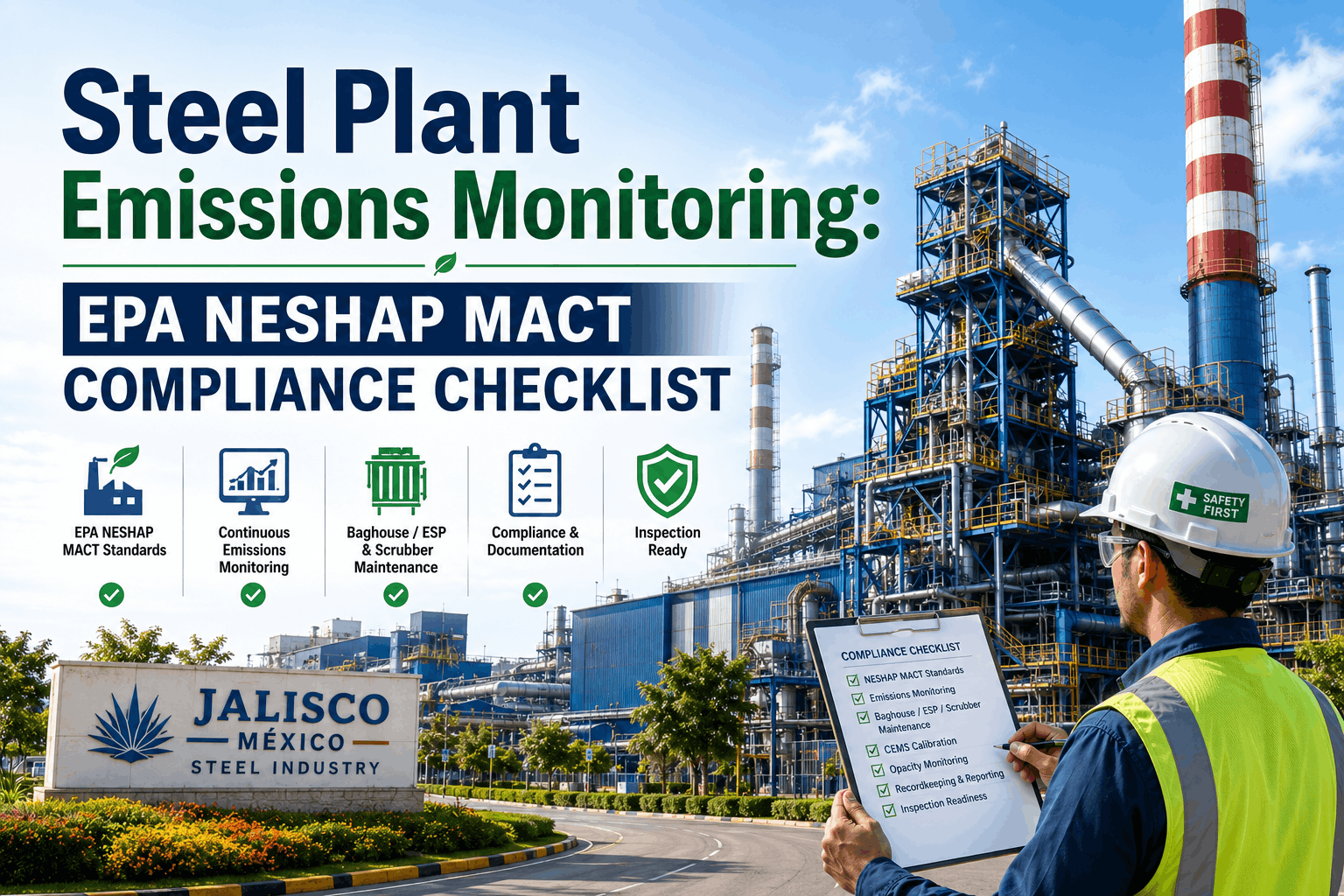
An EPA inspector arriving at an integrated iron and steel manufacturing facility under 40 CFR Part 63, Subpart FFFFF does not ask how committed your facility is to environmental compliance — the inspector asks for records. Specifically: continuous emissions monitoring system (CEMS) calibration logs, startup-shutdown-malfunction (SSM) records, performance test reports, deviation notifications, and the maintenance records that demonstrate your pollution control equipment operated as designed during every regulated operating period. Under Subpart FFFFF — the NESHAP MACT standard for integrated iron and steel manufacturing facilities covering sinter plants, blast furnaces, and basic oxygen process furnace (BOPF) shops — recordkeeping requirements mandate that these records be retained for a minimum of five years, be organised and accessible, and accurately reflect every exceedance, every corrective action, and every monitoring system outage. Under Subpart CCC — the NESHAP for steel pickling HCl process facilities — the compliance record burden for HCl emission controls, scrubber performance, and reagent addition is equally specific. The difference between a plant that passes an EPA audit without findings and a plant that receives a Notice of Violation is, almost always, a record-keeping and work-order tracking difference — not an emissions performance difference. OxMaint's CMMS connects CEMS maintenance records, pollution control equipment PM schedules, corrective action work orders, and compliance documentation into a single auditable system that gives your environmental compliance team the records they need before the inspector arrives. Configure your EPA NESHAP compliance record program in OxMaint — free trial.
Blog · EPA Compliance · NESHAP MACT · Steel Plants
EPA NESHAP MACT for Steel Plants: How CMMS Removes Audit Risk
40 CFR Part 63 Subpart FFFFF · Subpart CCC Steel Pickling · CEMS Maintenance Records · SSM Recordkeeping · Performance Test Documentation · Deviation Reporting · MACT Compliance CMMS · HAP Monitoring Records · Steel NESHAP Audit-Readiness
NESHAP Compliance Record Status — Subpart FFFFF
CEMS
Sinter Plant CEMS Calibration
Current · Calibrated 3 days ago
SSM
BOPF SSM Log
1 Entry Pending Approval
DEV
Deviation Notification — Baghouse
Corrective Action WO Open
PT
Performance Test Records
5-Year Archive Complete
5 years
Minimum recordkeeping retention period under 40 CFR Part 63, Subpart FFFFF — all CEMS data, SSM records, corrective actions, and performance tests must be retained and accessible
$25,000–$50,000
Per-day civil penalty for NESHAP recordkeeping violations under Section 113 of the Clean Air Act — documentation failures cost more than emissions failures
3 Subparts
Primary NESHAP standards for integrated steel: Subpart FFFFF (iron and steel facilities), Subpart CCC (steel pickling HCl), and Subpart CCCCC (coke ovens) — each with independent record obligations
60 days
Maximum response window for EPA's initial information request during a facility inspection — records not immediately accessible increase enforcement risk, not just administrative burden
What 40 CFR Part 63 Subpart FFFFF Actually Requires — The Record Obligations Steel Plants Must Meet
Initial Notification of Applicability
Facilities subject to Subpart FFFFF — sinter plants, blast furnaces, and BOPF shops at major HAP sources — must submit an initial notification to the EPA Regional Administrator and the applicable state authority within 120 days of the compliance date. OxMaint maintains a record of this submission and the facility's applicability determination in the compliance asset register, ensuring the notification record is available for inspection alongside the facility's operational maintenance records. Applicability determinations must be revisited if facility configuration changes — OxMaint's change management workflow documents configuration changes against the facility record.
CEMS Installation, Calibration, and Maintenance Records
Every CEMS monitoring system at a Subpart FFFFF-regulated source must be installed and maintained according to 40 CFR Part 60 Performance Specifications and Quality Assurance Procedures (Appendices B and F). Required records include: CEMS calibration drift checks (daily), CEMS operational status during each regulated operating period, calibration audit results, cylinder gas certifications, and all periods of CEMS downtime with reason codes. OxMaint schedules CEMS calibration and QA work orders, records results against each CEMS asset, and stores the full 5-year calibration history accessible on mobile or desktop — the complete record set that an EPA inspector requires at the first document request. Book a demo to see CEMS records management in OxMaint.
Startup, Shutdown, and Malfunction (SSM) Records
The General Provisions of 40 CFR Part 63 (Subpart A) require that facilities maintain records of the occurrence and duration of every startup, shutdown, and malfunction of an affected facility or monitoring system. For Subpart FFFFF facilities, this includes sinter cooler events, blast furnace cast house ventilation system outages, and BOPF primary emissions control equipment malfunctions. OxMaint records every equipment startup, shutdown, and malfunction event as a timestamped work order or event log entry — with duration, equipment identity, monitoring system status, and corrective action taken documented against each event. These records are the core of SSM defence during an EPA enforcement investigation.
Pollution Control Equipment Maintenance Records
Baghouses, electrostatic precipitators (ESPs), wet scrubbers, and hood ventilation systems at Subpart FFFFF-regulated sources require demonstrable maintenance programs to sustain their MACT performance. While Subpart FFFFF establishes work practice standards rather than numerical emission limits for many sources, the EPA's position is that a facility without documented, systematic pollution control equipment maintenance cannot demonstrate that it maintained its work practices. OxMaint's PM schedule for baghouse filter inspection, ESP energisation records, scrubber liquor chemistry, and hood static pressure monitoring produces the maintenance records that substantiate work practice compliance. Set up your pollution control equipment PM in OxMaint — free trial.
Performance Test (Method 9/29) Records
Initial performance tests and subsequent compliance demonstrations under Subpart FFFFF must be conducted using EPA reference methods — Method 9 (visible emissions opacity), Method 29 (metals emissions), or other approved methods as specified in the subpart. Test reports, pre-test notification submissions, test observation records, and quality assurance documentation must be retained for five years. OxMaint stores performance test records against each affected source's asset record, with the test date, method used, result, and pass/fail determination documented. Upcoming performance test due dates are tracked as PM events, generating preparation work orders 60 days ahead of the required test window.
Deviation and Corrective Action Records
Any period during which an affected facility operated in deviation from an applicable emission standard, operating limit, or work practice standard must be reported and recorded. Deviation reports are submitted to the EPA semi-annually under the General Provisions. For each deviation, the record must include: the date and time of the deviation, the emission standard or operating limit exceeded, the cause, the corrective action taken, and the date the deviation was resolved. OxMaint generates a deviation work order automatically when a monitored parameter exceeds its threshold — the work order captures all required fields, is timestamped, and is linked to the corrective action work order that documents the resolution. The deviation record is complete and auditable from day one of the event. See how OxMaint manages deviation records — schedule a demo.
Subpart CCC — Steel Pickling HCl Compliance Record Requirements
40 CFR Part 63, Subpart CCC covers HCl steel pickling facilities and hydrochloric acid regeneration plants. The required compliance records differ from Subpart FFFFF and must be tracked independently for facilities operating both processes. OxMaint registers each pickling line as a separate regulated source, with its own compliance record schedule.
HCl Fume Scrubber Performance Records
Scrubber inlet and outlet flow rate, liquor pH, liquor HCl concentration, liquid-to-gas ratio, and pressure drop must be recorded and trended. OxMaint schedules daily scrubber parameter logs with alert thresholds for each parameter — deviation from the operating limit generates a corrective action work order before the parameter exceedance becomes a reportable deviation.
HCl Regeneration Unit Records
Spray roaster temperature, off-gas treatment system pressure drop, quench tower temperature, and iron oxide product quality are operating parameters that define compliance with Subpart CCC emission limits. OxMaint tracks each parameter as a monitored asset condition — all recorded against the regeneration unit's asset record with calibration dates and instrument maintenance records linked.
Tank Cover and Ventilation System Integrity
Subpart CCC requires that pickling tank covers and ventilation hoods be maintained in good working order — a work practice standard requiring demonstrable maintenance records. OxMaint schedules cover seal inspection, hood static pressure measurement, and ductwork integrity checks at required intervals, with findings recorded against each pickling line asset.
Excess Emission and Deviation Reporting
Subpart CCC requires semi-annual excess emission reports covering each operating parameter exceedance, its duration, and the corrective action taken. OxMaint's deviation tracking workflow accumulates all exceedance events across the reporting period into a report-ready record set — eliminating the end-of-period data assembly that most facilities perform from scattered shift logs and paper records.
The NESHAP Audit-Readiness Gap — Why Records Fail Inspections Even at Compliant Plants
NESHAP Audit Finding Categories — Where Steel Plant Records Most Commonly Fail
Based on EPA inspection findings at integrated iron and steel facilities under Subpart FFFFF — most violations are documentation failures, not emission failures.
OxMaint addresses every category above: CEMS calibration is scheduled and recorded as PM work orders; SSM events are logged as timestamped work entries; deviations generate corrective action work orders with mandatory resolution fields; all records are retained in the asset history with no purge window; semi-annual report data is assembled from OxMaint records, not reconstructed from shift logs.
How OxMaint Builds a 5-Year NESHAP-Compliant Record Archive
Asset-Linked Record Structure
Every regulated source under Subpart FFFFF — sinter plant windbox, blast furnace cast house, BOPF primary hood, BOPF secondary emission controls — is registered as an individual asset in OxMaint. All PM work orders, calibration records, inspection findings, corrective action records, deviation events, and performance test results are linked to the regulated source asset. When an EPA inspector requests "all maintenance and monitoring records for the blast furnace cast house ventilation system for the last five years," the OxMaint asset record provides the complete response in a single filtered view — not a multi-department document assembly exercise. Configure your regulated source asset register in OxMaint — free trial.
Automatic Timestamp and Inspector Identity
Every work order completion, inspection result entry, and corrective action record in OxMaint is automatically timestamped and attributed to the logged-in user. This creates an inherent audit trail for every record in the system — the EPA requirement that records reflect when the action was taken and who performed it is met by the system's data structure, not by manual documentation discipline. The immutability of completed work order timestamps is an important distinction from spreadsheet-based record systems where entries can be backdated without detection. See how OxMaint's audit trail works — schedule a demo.
Scheduled Compliance PM Calendar
NESHAP compliance obligations generate a structured PM calendar in OxMaint: daily CEMS drift checks, weekly baghouse differential pressure logs, monthly ESP energisation records, quarterly performance parameter verifications, semi-annual reporting windows, and annual performance test due dates. Each obligation is a PM work order with a due date, assignee, and mandatory checklist. Overdue compliance PMs generate escalating alerts to the environmental compliance manager — ensuring that no required monitoring activity is missed and creating documentation of compliance with the monitoring requirements themselves. The PM calendar is configurable per facility and per applicable Subpart.
Deviation-to-Corrective-Action Chain
When a monitored parameter — CEMS reading, scrubber pressure drop, hood static pressure, opacity observation — exceeds its regulatory threshold, OxMaint generates a deviation work order automatically. The deviation work order captures the required EPA record fields: exceedance start time, parameter value, applicable limit, and initial cause assessment. A linked corrective action work order is generated simultaneously, tracking the investigative steps, repairs performed, and resolution confirmation. When the deviation is resolved, both work orders are closed together — creating the complete deviation-to-correction record that the EPA's General Provisions require for every exceedance event. The deviation record is available for semi-annual report compilation immediately. Set up your NESHAP deviation tracking in OxMaint.
NESHAP Audit Readiness Is Not a Pre-Inspection Exercise — It's a Year-Round Record Program. OxMaint Makes It Systematic.
The facilities that pass EPA inspections under Subpart FFFFF without findings are not the ones with the most complex environmental systems — they are the ones with the most complete and accessible records. OxMaint gives your environmental compliance and maintenance teams a joint platform for CEMS calibration records, SSM event logging, pollution control equipment PM, deviation management, and 5-year accessible record archiving. When the inspector arrives, your records are ready before the document request is submitted. Start building your NESHAP compliance record program in OxMaint — free trial.
Before vs After — What CMMS-Managed NESHAP Record-Keeping Changes
Spreadsheet / Paper Record Management
CEMS calibration records are in a shared drive folder with inconsistent naming — the inspector requests 5-year CEMS records and 3 staff spend a full day assembling the response
SSM event from 14 months ago shows a 6-hour baghouse downtime period — the shift log records the event but there is no documented corrective action, and the cause field is blank
Semi-annual deviation report assembled from shift logs, Excel sheets, and CEMS printouts — gaps in the record from a period where the instrument technician was on leave generate a data quality finding
Pollution control equipment maintenance records are in paper maintenance logs in the baghouse room — not referenced from the environmental compliance records, not included in the 5-year regulatory archive
Performance test due date missed by 45 days — no system tracked the obligation, and the departure of the environmental engineer who managed the schedule left the due date unknown
EPA issues a Notice of Violation for incomplete SSM records and missing corrective action documentation — penalty settlement costs more than five years of CMMS subscription
OxMaint NESHAP Compliance Program
5-year CEMS calibration record is the asset history of the CEMS in OxMaint — inspector response takes 10 minutes to filter and export, not a full day of document assembly
Every SSM event is a timestamped work order in OxMaint — the baghouse downtime event has cause, duration, monitoring system status, and linked corrective action work order, all required fields completed
Semi-annual deviation report is generated from OxMaint's deviation work order history — all exceedance events, durations, and corrective actions are already in the system, no data reconstruction required
Baghouse PM work orders are linked to the baghouse as a regulated source asset — all maintenance records are part of the 5-year record archive alongside the CEMS and SSM records in a unified asset history
Performance test due date is a PM event in OxMaint — pre-test notification work order fires 60 days ahead, test preparation work order fires 30 days ahead, no compliance calendar gap from staff changes
EPA inspection completed with zero environmental record findings — inspector reviews OxMaint asset records, confirms complete 5-year archive, closes inspection without Notice of Violation
"We had an EPA multi-media inspection under Subpart FFFFF that requested five years of CEMS calibration, SSM, and corrective action records for our blast furnace cast house and sinter plant. Before OxMaint, assembling that package would have been a two-week exercise involving every department. With OxMaint, we exported the full five-year asset record for each regulated source, including all PM work orders, deviation events, and corrective actions, in about three hours. The inspector commented that our records were the most complete and accessible she had encountered at an integrated steel facility. We received no findings on environmental records. The CMMS investment paid for itself in that single inspection outcome."
Frequently Asked Questions — EPA NESHAP MACT Steel Plant Compliance with OxMaint
Which sources at an integrated iron and steel facility are subject to 40 CFR Part 63 Subpart FFFFF?
Subpart FFFFF applies to sinter plants, blast furnaces, and basic oxygen process furnace (BOPF) shops at integrated iron and steel manufacturing facilities that are major sources of hazardous air pollutants (HAPs) — or that are co-located at major sources. Existing facilities are those that commenced construction or reconstruction before July 13, 2001. The HAPs emitted by these sources include metals (primarily manganese and lead with small quantities of other metals) and trace amounts of organic HAPs including polycyclic organic matter (POM), benzene, and carbon disulfide. Subpart FFFFF establishes work practice standards for most affected emission points rather than numerical emission limits, with the facility's compliance demonstrated through documented adherence to those work practices and maintained pollution control equipment. In OxMaint, each affected emission point is registered as a regulated source asset, with work practice compliance records accumulated against its asset history. Configure your Subpart FFFFF regulated source register in OxMaint — free trial.
What specific CEMS records does 40 CFR Part 63 require, and how does OxMaint maintain them?
Under the General Provisions of 40 CFR Part 63 (Subpart A), which apply to Subpart FFFFF, CEMS records must include: all CEMS calibration drift check results (typically daily), all cylinder gas certifications used for calibrations, all periods of CEMS downtime with the reason for downtime and duration, all CEMS malfunction events and corrective actions, results of all performance evaluations conducted under 40 CFR Part 60 Appendix F, and all quality assurance and quality control records required by the applicable Performance Specification. In OxMaint, each CEMS is registered as an individual asset with separate child assets for the sample system, analyser, data acquisition system, and calibration gas supply. Daily drift check work orders are auto-generated, with results recorded against the CEMS asset. Calibration gas cylinder records are tracked with replacement work orders. Downtime events are logged as SSM records with the required fields. All records accumulate in the CEMS asset history with automatic timestamps — the complete 5-year archive required by 40 CFR Part 63. Book a demo to see CEMS record management in OxMaint.
How does OxMaint handle SSM (Startup, Shutdown, and Malfunction) event recording for NESHAP compliance?
Startup, shutdown, and malfunction events are recorded in OxMaint as timestamped work orders against the affected emission source asset. The SSM work order captures: the event type (startup, shutdown, or malfunction), the affected equipment or emission point, the start and end time, the monitoring system status during the event (operational or non-operational), the cause of the event for malfunction entries, and the corrective action taken with resolution timestamp. OxMaint does not allow an SSM work order to be closed without all required fields completed — ensuring that no SSM event enters the record archive with missing information that would constitute a record deficiency. The SSM event log is filterable by date range and source for semi-annual report preparation. For facilities under Subpart A of 40 CFR Part 63, OxMaint's SSM records also serve as the documentation basis for any Excess Emission Report required when control equipment malfunctions during regulated operating periods.
How does OxMaint manage deviation notifications and corrective action records under 40 CFR Part 63?
In OxMaint, each regulated parameter — scrubber pressure drop, hood static pressure, opacity limit, CEMS monitoring data threshold — is configured with its regulatory limit from the applicable permit or subpart standard. When a logged measurement exceeds the limit, OxMaint automatically generates a deviation work order capturing the exceedance value, the applicable limit, the start time, and a prompt for cause assessment. A linked corrective action work order is generated simultaneously, tracking the investigation, repairs, and resolution. When both work orders are closed, the deviation record is complete with all fields required by 40 CFR Part 63's General Provisions for excess emission reporting: dates and times, cause, corrective action, and resolution date. The semi-annual deviation report is assembled directly from OxMaint's work order history for the reporting period — eliminating the end-of-period data reconstruction from paper logs that is the most common source of reporting errors. Set up NESHAP deviation tracking in OxMaint — free trial.
How does OxMaint track pollution control equipment PM as part of the Subpart FFFFF work practice compliance record?
Subpart FFFFF establishes work practice standards for emission control at sinter plants, blast furnaces, and BOPF shops — and the EPA's enforcement position is that a facility without a documented, systematic maintenance program for its pollution control equipment cannot demonstrate sustained work practice compliance. OxMaint registers every control device — baghouse filter sets, ESP field sections, scrubber systems, ventilation hoods, and waste gas handling systems — as assets within the regulated source hierarchy. PM work orders are scheduled per device at the required intervals: baghouse differential pressure monitoring (daily), bag integrity inspection (periodic), ESP energisation current and voltage records (weekly), scrubber liquor chemistry (weekly), and hood static pressure verification (monthly). All PM results are stored against the pollution control equipment asset record and are accessible as part of the regulated source's 5-year compliance record archive alongside CEMS and SSM records. The integrated archive is what EPA inspectors increasingly expect — not separate systems for environmental monitoring and maintenance records.
How does OxMaint support compliance with 40 CFR Part 63 Subpart CCC for steel pickling facilities?
Subpart CCC — National Emission Standards for Hazardous Air Pollutants for Steel Pickling HCl Process Facilities and Hydrochloric Acid Regeneration Plants — requires separate compliance records from Subpart FFFFF. In OxMaint, each pickling line and regeneration unit is registered as a separate regulated source asset under Subpart CCC. Compliance PM schedules include: HCl fume scrubber operational parameter logs (pH, liquor concentration, liquid-to-gas ratio, pressure drop — recorded daily), regeneration unit temperature records, tank cover and ventilation system integrity inspections (monthly), and CEMS calibration records for emission monitoring equipment on the pickling line. Deviation records from scrubber parameter exceedances are tracked through the same deviation-to-corrective-action workflow as Subpart FFFFF records. Semi-annual excess emission reports for the pickling line are assembled from OxMaint's deviation work order history, producing the required report format without end-of-period data assembly from paper logs. Book a demo to see Subpart CCC compliance record management in OxMaint.
Can OxMaint manage records for multiple applicable NESHAP subparts simultaneously at a single steel facility?
Yes. An integrated steel facility with a sinter plant, blast furnace, BOPF shop, and pickling line is simultaneously subject to Subpart FFFFF (integrated iron and steel), Subpart CCC (steel pickling), and potentially Subpart CCCCC (coke ovens) and Subpart EEEEE (iron and steel foundries) depending on facility configuration. In OxMaint, each regulated source is assigned its applicable subpart, and the PM schedule, deviation thresholds, and record retention requirements are configured per subpart. The facility's environmental compliance dashboard shows compliance record status across all applicable subparts in a single view — with each regulated source's CEMS status, SSM log currency, and next PM due date visible simultaneously. When an EPA multi-media inspection covers multiple subparts, the compliance team presents a single OxMaint export covering all regulated sources across all applicable standards, rather than assembling separate record packages per subpart from different systems.
Does OxMaint require integration with CEMS hardware to manage NESHAP compliance records?
No. OxMaint delivers complete NESHAP compliance record management with data entered by instrument technicians and environmental staff via the mobile interface or desktop — no CEMS hardware integration, no DCS connection, and no IT integration project required. CEMS calibration drift check results are read from the CEMS and entered into OxMaint's daily PM work order. SSM events are logged by the shift supervisor or environmental coordinator. Deviation parameters are entered by the responsible technician at the time of the exceedance. Performance test results are uploaded as documents against the regulated source asset record. This approach delivers full 5-year auditable record archives from the first day of use. Facilities with CEMS data management systems (DAHS) or plant historians that store CEMS data can connect those systems to OxMaint via API for automated data transfer — but the compliance record program operates fully without this integration, delivering its value immediately upon configuration. Start your EPA NESHAP record program in OxMaint — free trial available today.
EPA Inspectors Ask for Records. OxMaint Makes Sure Your Records Are Always Ready.
OxMaint gives your steel plant environmental compliance and maintenance teams a unified platform for CEMS calibration records, SSM event logging, deviation-to-corrective-action documentation, pollution control equipment PM, performance test tracking, and 5-year NESHAP-compliant record archiving — accessible on mobile, organized by regulated source, and ready for an EPA document request at any time.
.png)