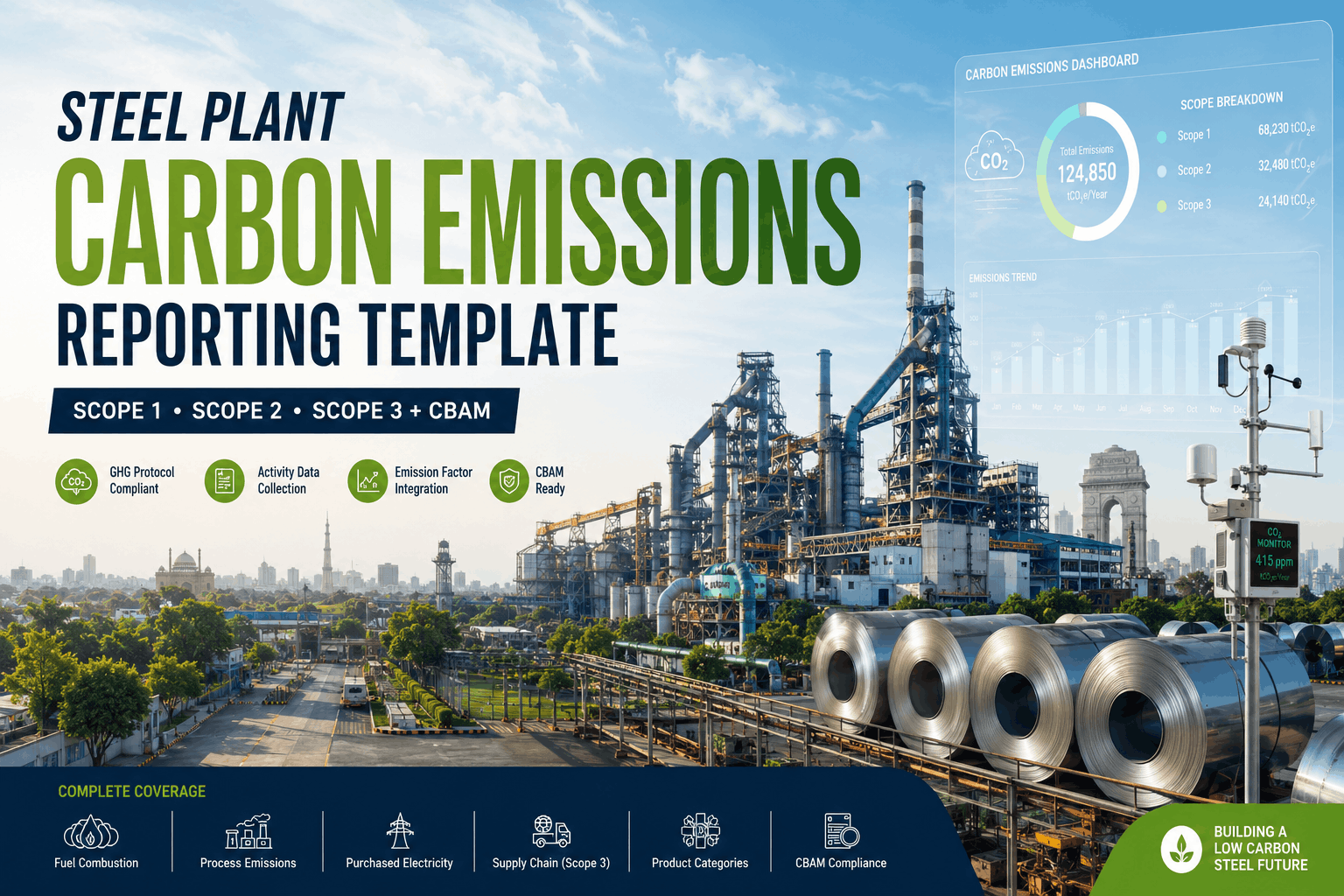
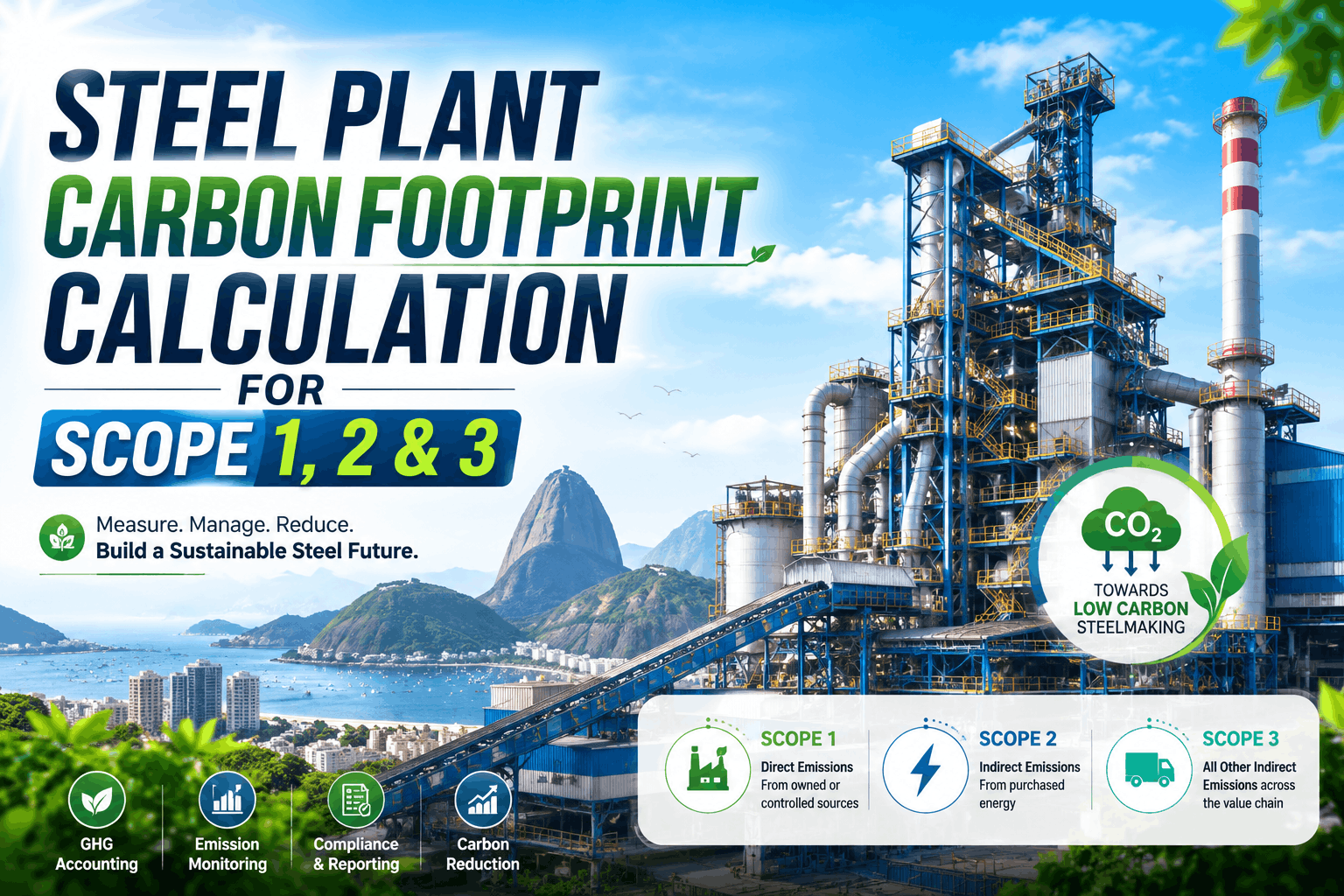
Steel production accounts for approximately 8% of global CO₂ emissions — more than the entire aviation sector, more than all heavy trucks combined, and more per unit of economic output than almost any other manufactured material. Every tonne of steel produced via the dominant blast furnace and basic oxygen furnace route emits an average of 1.85 tonnes of CO₂. Reducing that figure is not only an environmental imperative — it is becoming a commercial and regulatory requirement as carbon border adjustment mechanisms, customer ESG procurement criteria, and investor decarbonisation mandates converge on the steel industry simultaneously. Start tracking your steel plant's Scope 1, 2, and 3 carbon emissions with Oxmaint — free trial, ESG reporting active from day one.
Steel Plant Carbon Footprint Reduction: Scope 1, 2 & 3 Emissions Tracking, ESG Reporting & Net Zero Pathway Management
From blast furnace Scope 1 CO₂ to purchased electricity Scope 2 emissions and value chain Scope 3 — Oxmaint's ESG Reporting and Carbon Tracking module gives steel plant sustainability teams the real-time carbon intensity dashboard, automated CDP and GRI reporting, and net zero pathway tracking that investors, customers, and regulators now require as standard disclosure.
Scope 1, 2 & 3 Emissions in a Steel Plant — What You Must Track and Report
The GHG Protocol's three-scope framework divides a steel plant's carbon footprint into direct emissions, indirect energy emissions, and value chain emissions. Each scope has different measurement methods, data sources, and reporting obligations — and each requires a different management approach. Oxmaint tracks all three simultaneously from a single platform.
Scope 1 emissions are the largest share of a steel plant's carbon footprint — direct CO₂ from coke combustion in the blast furnace, the BOF steelmaking process (where carbon dissolved in hot metal is oxidised to CO₂ and CO), sintering and pelletising operations, coke oven combustion stacks, and fossil fuel combustion in reheating furnaces. BEE PAT scheme compliance, CPCB CEMS-based CO₂ monitoring, and Scope 1 reporting under CDP, GRI 305, and BRSR all require a structured, auditable Scope 1 inventory. Oxmaint calculates Scope 1 CO₂ from process fuel consumption data and CEMS CO₂ measurements per emission source. Sign in to activate Scope 1 carbon inventory for your plant.
Scope 2 emissions arise from electricity and heat purchased from external sources — grid electricity for electric arc furnaces, rolling mill drives, compressed air systems, and auxiliaries; and steam or heat from external cogeneration where applicable. In Indian steel plants, the Scope 2 footprint is heavily influenced by the grid emission factor (currently ~0.82 kg CO₂/kWh for the Indian national grid) and by the proportion of captive renewable generation. Oxmaint tracks monthly purchased electricity volumes by supply point, applies current grid emission factors, and calculates location-based and market-based Scope 2 figures per GHG Protocol methodology. Book a demo to see Scope 2 calculation and renewable energy tracking.
Scope 3 emissions — the full upstream and downstream value chain carbon footprint — are increasingly demanded by customers, investors, and regulators as part of comprehensive ESG disclosure. For a steel plant, the dominant Scope 3 categories are: Category 1 (purchased goods — iron ore, coal, scrap, alloys), Category 4 (upstream transportation and distribution), Category 11 (use of sold products — particularly for long products used in construction), and Category 12 (end-of-life treatment of sold products). Oxmaint builds the Scope 3 inventory from supplier emission factor data, procurement records, and industry-standard category emission factors. Sign in to configure Scope 3 value chain emission tracking.
Six Carbon Management Failures That Undermine Steel Plant ESG Credibility
Steel plant sustainability teams face a compound challenge — they are expected to deliver investor-grade ESG reporting, customer-specific carbon disclosure, and regulatory compliance simultaneously, often with data that is fragmented, delayed, and unverifiable. These are the six failure modes that generate audit findings, investor challenges, and customer ESG qualification rejections.
From Process Data to Board-Ready ESG Disclosure — Four Steps
Steel Production Carbon Intensity Benchmarks by Process Route — 2024 Reference
| Production Route | Scope 1 Intensity | Scope 1+2 Intensity | Key Reduction Lever | 2030 Target Pathway | Oxmaint Tracking |
|---|---|---|---|---|---|
| BF-BOF (coal-based) | 1.75–1.95 T CO₂/t steel | 1.85–2.10 T CO₂/t steel | BF energy efficiency, top gas recycling, scrap charge increase | 1.40–1.55 T CO₂/t by 2030 (SBTi-aligned) | Real-time intensity per heat |
| DRI-EAF (natural gas) | 0.95–1.15 T CO₂/t steel | 1.05–1.30 T CO₂/t steel | Renewable electricity for EAF, green H₂ DRI transition | 0.60–0.75 T CO₂/t by 2030 | DRI/EAF intensity dashboard |
| DRI-EAF (coal-based) | 2.10–2.50 T CO₂/t steel | 2.20–2.65 T CO₂/t steel | Coal-to-gas switch, renewable electricity, increased scrap | 1.50–1.80 T CO₂/t by 2030 | Route-specific intensity KPI |
| Scrap EAF (grid electricity) | 0.05–0.10 T CO₂/t steel | 0.45–0.65 T CO₂/t steel | Renewable electricity procurement, power purchase agreements | 0.15–0.25 T CO₂/t by 2030 (RE-powered) | Grid factor + RE certificate tracking |
| Scrap EAF (100% renewable) | 0.05–0.10 T CO₂/t steel | 0.05–0.15 T CO₂/t steel | Electrode efficiency, yield optimisation, logistics | Near-zero by 2030 — benchmark pathway | Green steel certificate generation |
| H₂-DRI EAF (green hydrogen) | ~0.05 T CO₂/t steel | 0.05–0.10 T CO₂/t steel | Green hydrogen cost reduction, scaling electrolyser capacity | Commercial scale demonstration by 2027–2030 | Transition pathway milestone tracking |
Reference: worldsteel Association CO₂ Emissions Data, IEA Iron and Steel Technology Roadmap 2023, SBTi Steel Sector Guidance. Intensity figures include process CO₂ and direct energy combustion. Scope 2 intensity assumes Indian national grid emission factor of 0.82 kg CO₂/kWh. Book a demo to benchmark your plant's current intensity against these reference points in Oxmaint.
What Oxmaint Delivers for Steel Plant Sustainability and ESG Teams
Manual Carbon Management vs Oxmaint — The ESG Reporting Gap
| ESG Activity | Without Structured Platform | With Oxmaint |
|---|---|---|
| Scope 1 carbon inventory | Compiled annually from fuel consumption spreadsheets — no continuous tracking | Calculated continuously from process and CEMS data — always current |
| Carbon intensity per tonne of steel | Available only in annual sustainability report — no operational visibility | Live KPI per production route — operations and sustainability teams share the same number |
| Scope 3 value chain emissions | Omitted or estimated from generic industry factors — fails third-party verification | Structured by GHG Protocol category from procurement and logistics data |
| CDP / GRI / BRSR report preparation | 2–4 weeks of data reconciliation across multiple teams and systems | Generated in under 1 day from the live Oxmaint carbon inventory |
| Net zero pathway tracking | Annual check against committed target — deviations discovered 12 months late | Continuous actual vs pathway comparison — deviations visible in real time |
| Carbon credit management | Spreadsheet registry — vintage and retirement records vulnerable to audit challenge | Structured registry aligned to VERRA/Gold Standard — third-party verification ready |
| Customer product carbon footprint | Not available — ESG qualification requests declined or delayed | Product-level carbon footprint certificate generated per grade and delivery period |