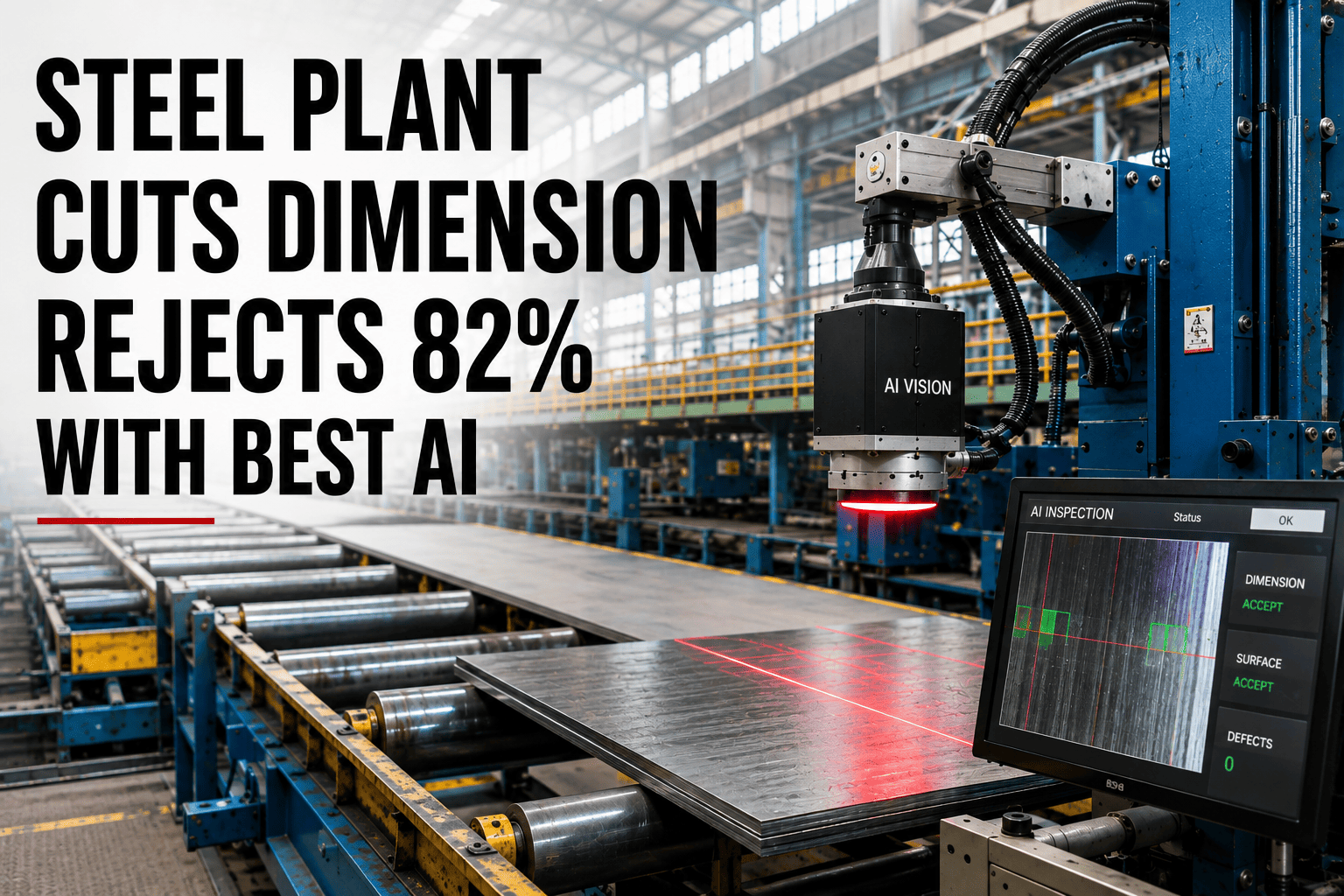
Dimension rejects were quietly eating into margins at a mid-sized flat-rolled steel producer running two cold rolling stands and one finishing line — coils that missed gauge, camber, or crown tolerance were either scrapped outright or downgraded to a lower-value coil class, and nobody on the floor could say for certain whether the drift started at the mill stand, the tension reel, or the leveler. Over eighteen months the plant had absorbed enough scrap and downgrade cost that engineering leadership approved a full AI-driven measurement and CMMS rollout across both cold rolling stands and the finishing line. Twelve months after go-live, dimension-related rejects were down 82%, first-pass yield climbed from the high 80s into the mid-90s, and the plant documented $3.9 million in annual savings across scrap, rework, and downtime avoidance. This case study walks through what changed, how the platform was evaluated and rolled out, and where the savings actually came from — start a free trial if you want to see the same measurement-to-work-order workflow run against your own line data.
How a Flat-Rolled Steel Plant Cut Dimension Rejects 82% With AI Measurement
A full breakdown of the rollout across cold rolling and finishing lines — the evaluation process, the twelve-month timeline, and exactly where the $3.9M in annual savings came from.
Where the Rejects Were Actually Coming From
Before the rollout, dimension quality was checked the way most plants check it: spot gauging with handheld micrometers every few coils, camber checked visually against a straightedge, and crown measured only when a customer complaint forced a teardown. The gaps between checks were where the losses lived. A gauge drift that started three coils into a run could go undetected until the end of the shift, by which point the entire run was flagged for downgrade.
Root cause tracing was slow and mostly guesswork. Was the variation coming from roll wear on stand two, tension fluctuation at the reel, thermal crown drift on the finishing line, or an upstream slab thickness variance carried all the way through? Without continuous measurement tied to a timestamped asset history, engineers were reconstructing shift logs after the fact instead of catching drift as it happened.
The plant's quality team estimated that roughly a third of downgraded coils were traced, after the fact, to issues that a continuous sensor feed would have caught within minutes rather than hours. Operators were also reluctant to stop a run on a hunch, since a false alarm meant lost throughput on a line running near capacity — so marginal drift often ran to completion rather than triggering an early check.
Customer-facing cost was a second layer on top of the internal scrap number. Coils that shipped within tolerance but close to the edge of the band generated a disproportionate share of downstream complaints at the customer's own stamping or forming operations, which meant claims processing, expedited replacement shipments, and strained account relationships that never showed up cleanly in the plant's own scrap ledger.
Three Hidden Issues the Continuous Data Surfaced
Once continuous measurement was running, drift-to-asset correlation surfaced three recurring causes that manual checks had never isolated cleanly, because each one only produced a measurable deviation intermittently and in combination with normal process variation.
The first was uneven roll wear on cold rolling stand two, which produced a slow gauge taper across a run that spot checks every few coils simply averaged out. The second was tension reel drift correlated with ambient temperature swings between day and night shifts, invisible without a timestamped historian tie-in. The third was a thermal crown effect on the finishing line that only appeared after roughly ninety minutes of continuous operation, well past the interval of a typical manual spot check schedule.
What the Plant Compared Before Choosing a Platform
The evaluation team scored three approaches against the same five criteria: measurement continuity, integration with existing PLCs and historians, root-cause traceability, work order automation, and total cost of ownership over three years. A continuous, sensor-fed system that closed the loop into maintenance work orders scored highest on every axis that mattered for reject reduction.
The evaluation team itself spanned quality engineering, maintenance leadership, and plant finance, since the decision touched capital spend, floor workflow, and the scrap ledger all at once. Weighting matters here: quality engineering prioritized measurement continuity and traceability, maintenance prioritized how cleanly alerts turned into assignable work orders rather than another dashboard to babysit, and finance modeled all three options against a three-year total cost of ownership rather than sticker price alone. Manual spot checks looked cheapest on paper and were the most expensive option once scrap and downgrade cost were factored in over a full year.
| Evaluation Criteria | Manual Spot Checks | Vision-Only System | AI Measurement + CMMS |
|---|---|---|---|
| Measurement frequency | Every 4-6 coils | Continuous, no context | Continuous with asset context |
| Root cause traceability | Manual log review | Limited | Automatic drift-to-asset mapping |
| Work order trigger | None | Alert only | Automatic, threshold-based |
| Historian integration | None | Partial | Full PLC and historian tie-in |
| 3-year TCO | Lowest upfront, highest scrap cost | Moderate | Lowest total cost |
Twelve Months From Pilot to Full Fleet Coverage
The single-line pilot mattered more than the schedule alone suggests. Running the model against a narrower, well-understood data set on stand one let engineers validate threshold settings against real defect history before the same thresholds were pushed to the two lines with less historical documentation. That sequencing avoided a common failure mode in measurement rollouts, where aggressive thresholds set from day one on every line at once generate enough false alarms that operators start ignoring the alerts entirely.
See the Same Drift-to-Work-Order Workflow on Your Own Lines
Every measurement, threshold alert, and resulting work order in this case study ran through one connected platform. Book a walkthrough to see how it maps to your cold rolling or finishing line setup.
Reject Handling, Before and After the Rollout
Where the $3.9M in Annual Savings Came From
Finance broke the savings into three buckets, verified against a full prior-year baseline. Scrap and downgrade reduction on the two cold rolling stands accounted for the largest share, with the finishing line and avoided unplanned downtime making up the rest.
The downtime figure is worth a closer look, since it is the bucket most often underestimated in a measurement rollout's business case. Two of the roll-wear issues identified through continuous tracking on stand two were caught and scheduled into a planned changeover window rather than discovered mid-run, which avoided what would previously have been an unplanned stoppage during a production shift. Avoided downtime of that kind rarely shows up as a single dramatic incident — it shows up as the absence of stoppages that would otherwise have appeared in the maintenance log, which is part of why the finance team required a full twelve-month baseline comparison before signing off on the number.
The Measurement-to-Work-Order Loop Behind the Results
None of the individual pieces here are exotic on their own — in-line sensors, threshold alerting, and work order routing all exist as separate tools in most plants already. What changed the outcome was connecting them into one loop instead of leaving them as three disconnected systems that a person had to manually bridge under time pressure during a shift.
Gauge, camber, and crown sensors feed every coil's data into the platform in real time, replacing the old every-few-coils spot check.
When a measurement drifts outside tolerance, the platform correlates the timing against stand, reel, and leveler asset history to isolate the likely source.
Drift events that cross a configured threshold generate a work order automatically, routed to the technician responsible for that asset zone.
Existing mill PLCs and process historians feed directly into the platform, so no separate manual data entry step sits between measurement and action.
Statistical process control charts track gauge, camber, and crown per stand over time, so a slow taper is visible well before it crosses a hard tolerance line.
Every coil carries its own measurement record tied to the work orders active on the line at the time it was produced, useful for both root-cause review and customer quality documentation.
Getting Operators to Trust the Alerts
A measurement system only pays off if operators act on what it tells them, and the plant's biggest early friction point was not the sensors or the software — it was alert volume. Thresholds set conservatively during the first weeks of the stand-one pilot generated more alerts than the crew could reasonably act on, and a few early false positives were enough to make operators start treating alerts as noise.
The fix was a deliberate threshold tuning pass built directly into the pilot timeline: engineers reviewed every alert generated in the first month against whether it corresponded to an actual out-of-tolerance coil, then tightened the model until the false-positive rate dropped to a level operators trusted. By the time the system rolled out to the finishing line, alerts were treated as a normal part of the shift workflow rather than an interruption, which is a large part of why the detection-to-repair window held under 40 minutes once full fleet coverage was reached.
What Made the Difference Here
Two things separated this rollout from a typical sensor deployment. The first was sequencing: piloting on one stand, tuning thresholds against real defect history, and only then expanding to the rest of the fleet, rather than pushing an untuned model across every line on day one. The second was closing the loop all the way to a work order instead of stopping at a dashboard alert, which is what actually shortened the detection-to-repair window from a full shift down to under 40 minutes.
Neither change required replacing existing mill equipment. The gains came from connecting measurement, asset history, and maintenance workflow into a single system that could act on drift the moment it appeared, rather than waiting for a person to notice it during a routine walkaround.
Frequently Asked Questions
How long did the pilot phase run before fleet-wide rollout?
The pilot ran for roughly three months on a single cold rolling stand, covering sensor installation and model calibration, before threshold alerts and automatic work orders went live. Book a demo to walk through a pilot scope for your own line.
Did the plant need to replace existing PLCs or historians?
No. The measurement sensors and platform integrated with the mill's existing PLCs and process historian rather than requiring a separate control system replacement.
How is a dimension drift traced back to a specific asset?
The platform correlates the timestamp of the out-of-tolerance reading against stand, reel, and leveler operating history to narrow down the likely source before a work order is issued.
Where did most of the $3.9M in savings come from?
Just over half came from scrap and downgrade reduction on the two cold rolling stands, with the remainder split between finishing line downgrade avoidance and unplanned downtime prevented by earlier detection.
Can this same approach apply to other coil dimensions or grades?
Yes. The measurement and work order loop is configured per tolerance band and applies to different gauges, coatings, and steel grades running through the same lines. Start a free trial to configure it against your own tolerance specs.
Turn Continuous Measurement Into Fewer Rejects on Your Lines
This plant went from every-few-coils spot checks to continuous, automatically routed work orders in under a year. See what the same rollout could look like on your cold rolling or finishing line — free trial, no credit card required.
.png)