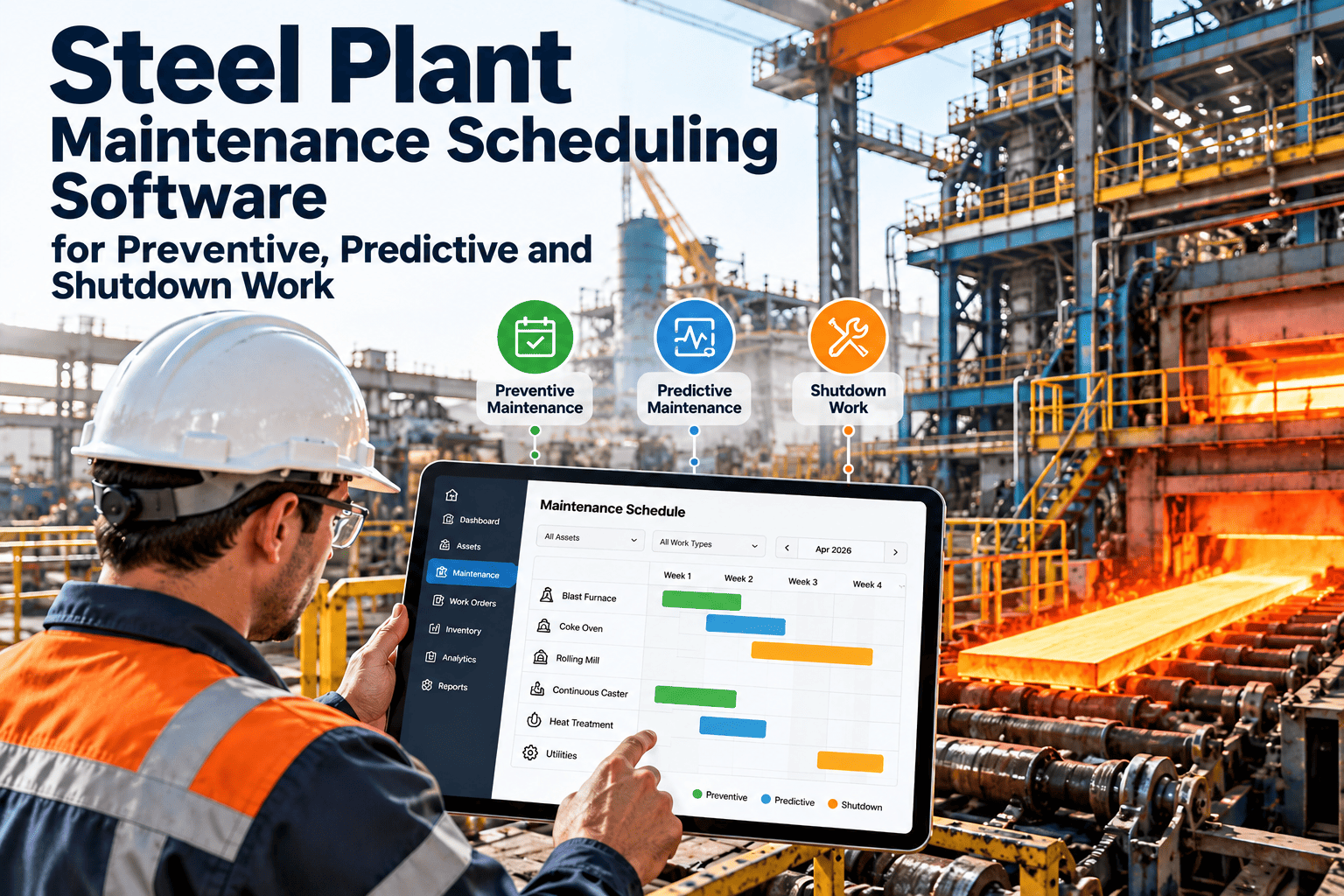
Your CMMS already contains the data that reveals your preventive maintenance scheduling mistakes — the problem is that 81% of steel plant maintenance managers never analyze it. Every PM work order your team has scheduled, every missed inspection they have logged, every emergency repair they have performed over the past 24 months contains scheduling pattern errors that repeat with statistical regularity across asset types, maintenance zones, and failure modes. A 2025 steel industry analysis found that 68% of steel plants are either over-maintaining (wasting resources) or under-maintaining (causing failures) because their PM schedules are not optimized. The bearing that is replaced every 6 months but shows no wear at 8 months is not a success — it is a scheduling waste pattern sitting in your CMMS right now, invisible because nobody has built the optimization analysis that surfaces it. Oxmaint's maintenance scheduling module turns your PM history into an optimization engine — automatically identifying frequency errors, flagging missed PM patterns, and generating optimized schedules that reduce waste and prevent failures. The data is already yours, and the analysis that fixes your PM scheduling mistakes takes minutes to configure, not months. If your steel plant is still managing PM schedules based on OEM recommendations instead of actual failure data, start a free trial or book a demo to see how Oxmaint surfaces scheduling optimization opportunities from your existing data.
6 Common Mistakes in Steel Plant Preventive Maintenance Scheduling
Identify and fix common PM scheduling errors that waste resources and increase downtime — from frequency errors and OEM dependence to PM compliance gaps and backlog issues.
The PM Scheduling Problem in Steel Plants
Steel plants face uniquely challenging maintenance scheduling conditions: continuous 24/7 operation leaves limited windows for planned maintenance, extreme conditions accelerate wear unpredictably, complex equipment hierarchies make PM scoping difficult, and production pressures constantly defer scheduled work. These conditions create a high risk of scheduling errors that waste resources or cause failures. Start a free trial or book a demo to see how Oxmaint optimizes PM scheduling for steel plant conditions.
Mistake 1 — Using OEM Intervals Without Adjustment
OEM maintenance intervals are designed for average operating conditions — not the specific conditions of your steel plant. Operating conditions — duty cycle, temperature, contamination, load — can shorten or extend component life by 20-40% compared to OEM recommendations. The result: over-maintenance wastes resources on components that last longer than OEM intervals, and under-maintenance causes premature failures on components that wear faster. A case study from a steel mill found that following OEM intervals without adjustment caused 40% of PM work to be performed unnecessarily early, while 25% of critical PMs were scheduled too late. The solution: use actual failure data to adjust PM intervals to match your specific operating conditions.
Mistake 2 — Poor Task Scope Definition
PM work orders with vague or incomplete task descriptions lead to inconsistent execution. A PM that simply says "inspect gearbox" is interpreted differently by each technician. Some will perform a thorough inspection, others will simply check the oil level. The result: the PM does not achieve its reliability objective, and maintenance quality is inconsistent across shifts and technicians. In steel plant applications, this mistake is especially costly — a poorly defined PM on a critical piece of equipment can lead to failures that cause 12-48 hours of production downtime. The solution: define PM tasks with specific, measurable, and actionable steps — what to inspect, how to measure, what to document, and what actions to take when issues are found.
Mistake 3 — Not Adjusting for Seasonal Factors
Steel plant equipment performance varies significantly with seasonal changes. Cooling towers and chillers need pre-summer maintenance, heating systems need pre-winter inspection, and equipment in outdoor areas needs protection from weather. Fixed PM schedules that don't account for seasonal factors either perform work too early or too late. A blast furnace boiler that fails in the first freeze of winter because the seasonal readiness inspection was scheduled for December 15 (after the freeze) is a predictable failure that a properly seasonalized PM schedule would prevent. The solution: schedule seasonal readiness work 4-6 weeks before the season change — pre-summer HVAC, pre-winter heating and freeze protection, and pre-rainy season drainage and waterproofing.
Mistake 4 — Ignoring Condition Monitoring Data
PM schedules that do not incorporate condition monitoring data are flying blind. Vibration analysis, oil analysis, thermography, and ultrasound can detect developing faults before they cause failure. But many steel plants continue to schedule PMs on fixed intervals even when condition data shows that equipment is healthy or deteriorating faster than expected. The result: resources wasted on unnecessary PMs for healthy equipment and failures on equipment that showed warning signs in condition data. A case study from a steel mill found that 45% of PM work could be extended beyond the fixed interval based on condition monitoring data, while 15% of PMs needed to be performed earlier due to accelerated degradation. The solution: use condition monitoring data to adjust PM intervals — extend intervals when equipment is healthy, shorten intervals when degradation accelerates.
We were replacing bearings every 6 months regardless of actual condition. When we started analyzing our vibration data, we discovered that 60% of our bearing replacements were unnecessary — the bearings had another 2-3 months of life. The remaining 40% were being replaced too late — we should have been replacing them at 4 months instead of 6. By using condition data to adjust our PM intervals, we reduced bearing costs by 35% and eliminated bearing-related unplanned downtime entirely. The data was always there — we just weren't using it to schedule.
Mistake 5 — Poor PM Compliance Tracking
PM compliance is the measure of whether scheduled PMs are actually being performed on time. Without accurate PM compliance tracking, maintenance managers cannot identify scheduling problems, resource gaps, or reliability risks. Common compliance mistakes include: not defining what "on time" means (within 10% of scheduled interval? within 30 days?), not tracking compliance by asset type, not investigating the root causes of low compliance, and not using compliance data to improve scheduling. The result: low PM compliance drives emergency failures, yet the root causes remain unidentified and unaddressed. The solution: define PM compliance clearly, track it systematically, analyze the root causes of non-compliance, and use the data to improve the PM program.
Mistake 6 — Not Resolving PM Backlogs
PM backlogs form when scheduled PMs are continuously deferred due to production pressure, resource constraints, or poor planning. A growing PM backlog is a leading indicator of future emergency failures. Yet many steel plant managers accept backlogs as normal. The result: equipment that should be receiving PMs is running without maintenance, driving emergency failures that cost 3-5x more than planned work. The solution: track PM backlog size and aging, establish a backlog clearance plan with defined targets, and create a system that prevents new backlogs from forming.
Frequently Asked Questions — PM Scheduling in Steel Plants
Fix Your PM Scheduling Mistakes — Start Optimizing Your Steel Plant Schedule Today.
Oxmaint's maintenance scheduling module identifies PM frequency errors, tracks compliance, and generates optimized schedules that reduce waste and prevent failures. Free to start.