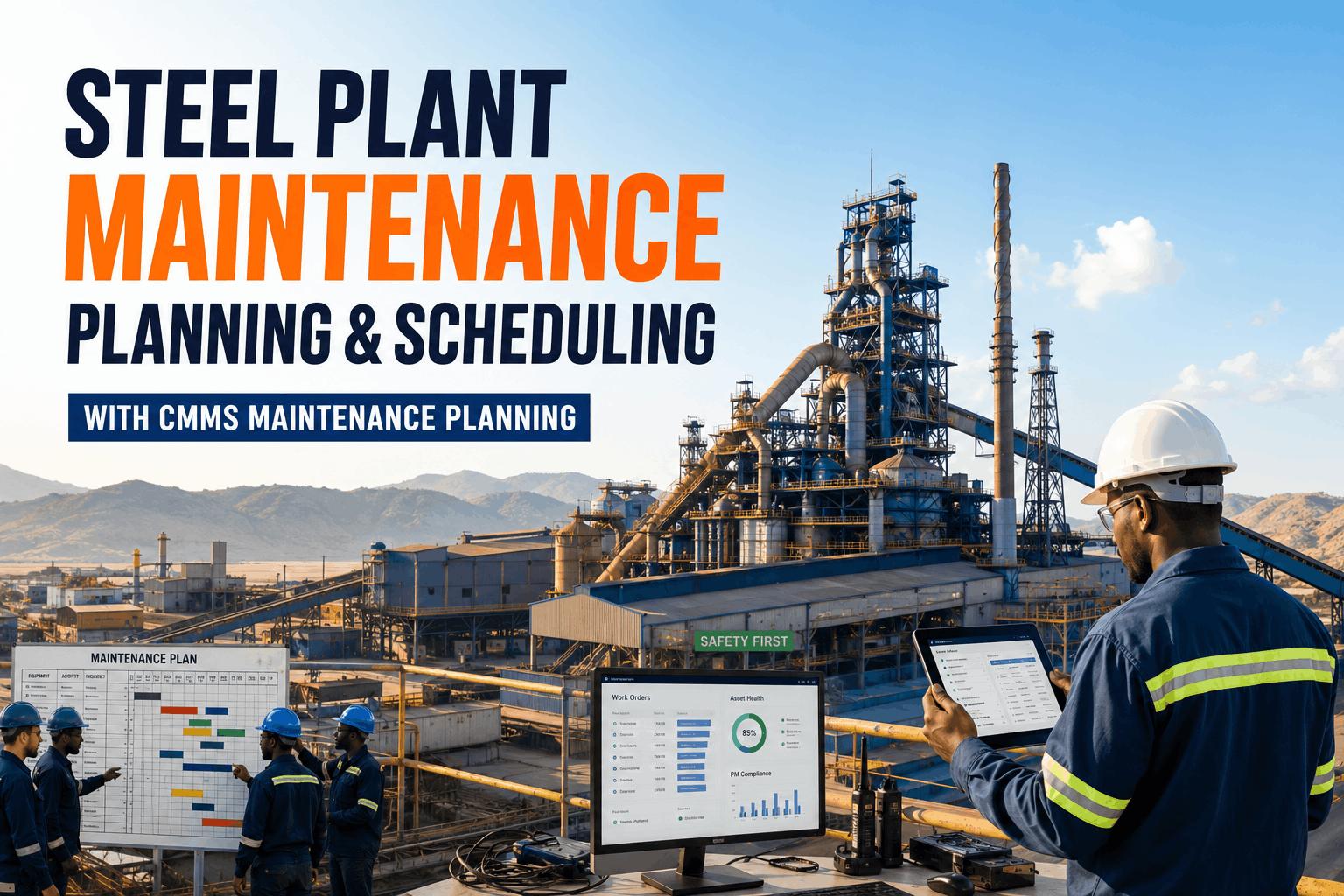
Steel plant maintenance planning is fundamentally different from discrete manufacturing scheduling. In automotive, a line stoppage for maintenance is a planned downtime event with clear start and end. In steel, an unplanned blast furnace stoppage has cascading consequences across every zone downstream for hours — steelmaking metal sitting in the kettle, caster output backed up, rolling mill unable to process new charge. Maintenance scheduling in steel must account for production zone interdependencies: a planned outage on the continuous caster blocks work on the blast furnace; a rolling mill maintenance window compresses the steelmaking schedule. The only way to plan maintenance at steel plant scale is to integrate the maintenance schedule with the production schedule — understanding which maintenance windows permit which production activities. Sign Up Free to implement OxMaint's production-aware scheduling, which surfaces maintenance-production conflicts at planning time, not at 3 AM when a furnace fails during a supposed maintenance window.
The Maintenance Planning Challenge in Integrated Steel Plants
Blast furnace campaign planning starts 12–18 months before end-of-life, coordinating refractory procurement (12-week lead time), engineering (4–6 weeks for design and safety review), production scheduling (blocking output slots 4–6 months ahead), and contractor logistics (reline requires 150–200 specialized workers over 6–8 weeks). A rolling mill maintenance outage must coordinate with blast furnace availability (metal supply), steelmaking vessel status (heat supply), and caster operating window (product strand in flight). Single-asset maintenance scheduling — managing blast furnace PM independent of caster PM independent of rolling mill PM — creates impossible conflicts and forces reactive rescheduling. Book a Demo to see how OxMaint visualizes these dependencies and helps your planners avoid the scheduling conflicts that force emergency extensions or emergency repairs.
Five Maintenance Planning Dimensions in Steel
The most mature steel plants structure maintenance planning across five integrated dimensions: long-horizon campaign planning (12–18 months out for blast furnace and major equipment overhauls), production schedule integration (6–12 months for seasonal pattern recognition), labor capacity forecasting (3–6 months to arrange specialized skills and contractor coordination), spare parts and materials procurement (lead times vary from 4 weeks to 12+ weeks for refractory), and short-horizon detail scheduling (4–6 weeks for specific work coordination). Miss one dimension and the others collapse. Sign Up Free to implement these five planning dimensions in a single CMMS that connects strategy to execution.
Long-Horizon Campaign Prediction and Planning
Blast furnace refractory campaign life is predicted 12–18 months ahead using shell temperature trends, stave wear data, and thermal cycling history. These predictions trigger procurement packages (refractory specifications, engineering design reviews, regulatory approvals) that must be completed 12+ weeks before the furnace shuts. OxMaint surfaces campaign-end predictions so your planners trigger procurement and engineering without guesswork, replacing the estimate-based timing that leads to surprise relines or unnecessary emergency extensions.
Production Schedule Integration and Zone Dependency Mapping
A planned blast furnace reline blocks steelmaking input. Steelmaking downtime blocks caster input. Caster shutdown blocks rolling mill output. OxMaint maps these cascade dependencies — when you propose a maintenance window for the caster, the system surfaces "this will block blast furnace in 6 hours and rolling mill in 12 hours" warnings so you understand the full production impact. This visibility prevents the majority of maintenance reschedules that occur because the original plan didn't account for production constraints.
Labor Capacity Forecasting and Contractor Coordination
Blast furnace reline requires 150–200 specialized contractors over 6–8 weeks. Rolling mill drive train overhaul requires hydraulics specialists and alignment technicians. Caster refractory campaigns require casting operations crew. OxMaint forecasts labor requirements 3–6 months ahead, surfacing gaps between planned work volume and available crew capacity (internal + contractor), enabling proactive recruitment or reschedule decisions. Without this visibility, you discover labor shortages two weeks before an outage starts.
Spare Parts and Procurement Lead Time Management
Blast furnace refractory lead time: 12 weeks minimum from order to delivery. Rolling mill bearing sets: 6–8 weeks. Hydraulic pack rebuild: 4–6 weeks if parts are available, 8+ weeks if custom. OxMaint links maintenance schedules to parts procurement schedules, flagging when a maintenance task is scheduled before parts can possibly arrive. Automatic escalation alerts shift work orders earlier to maintain lead time buffer, or trigger emergency procurement decisions with known cost premiums.
Short-Horizon Detail Scheduling and Work Sequencing
4–6 weeks ahead, detailed work schedules translate campaign and outage plans into specific work order sequences. Blast furnace reline: stave removal sequence, cooler inspection, new stave fabrication coordination, heat-up procedures. Rolling mill stand replacement: removal, hydraulic disconnect, bearing replacement, alignment, testing sequence. OxMaint's Gantt view supports work sequencing with dependency chains (task B cannot start until task A completes) and resource leveling (ensuring crew availability across sequential tasks).
Maintenance Planning Roadmap for Steel Operations
Implementing production-aware maintenance scheduling is a 4–5 phase program. Phase 1 establishes maintenance schedules in isolation and captures baseline MTBF/MTTR. Phase 2 integrates production calendar data, creating visibility into production-maintenance conflicts. Phase 3 builds dependency maps (caster outage blocks furnace input) so planners understand cascade effects. Phase 4 adds labor capacity forecasting and parts lead time integration. Phase 5 enables predictive reline and campaign planning using historical data, enabling 12-month planning horizon visibility. Book a Demo to map your facility's starting point and planning roadmap using OxMaint's pre-built frameworks.
Establish Maintenance Baselines and PM Schedule Discipline
Register all assets, define criticality classifications, build PM templates, and establish PM frequencies based on manufacturer recommendations and operational history. Run maintenance scheduling independent of production, capturing baseline PM compliance (current state: 40–50% of scheduled PM actually completes on schedule). This baseline identifies scheduling pressure points and where production conflicts are forcing maintenance displacement.
Integrate Production Schedule Data and Zone Mapping
Connect OxMaint to your MES or production scheduling system. Map production zone dependencies: identify which zones feed which downstream zones, what downtime in Zone A means for Zone B availability. Surface these dependencies when scheduling maintenance, so planners see the full impact. This phase typically reveals 30–50% of planned maintenance windows have production constraints that weren't visible before.
Build Campaign Prediction Models and Long-Horizon Planning
Use historical shell temperature, stave wear, and tuyere replacement data to build blast furnace campaign life prediction models. Set 12–18 month planning horizons for end-of-life prediction. Trigger procurement and engineering packages automatically when campaign-end predictions cross thresholds. This phase moves planning from reactive (surprise reline at 48 hours notice) to strategic (reline logistics coordinated 18 months ahead).
Add Labor and Parts Procurement Forecasting
Link labor rosters and contractor availability to maintenance schedules. Forecast labor requirements 3–6 months ahead (current: identify when planned work exceeds available crews). Link parts procurement lead times to maintenance tasks, triggering early order placement when lead time buffers are exceeded. This phase prevents the "we scheduled the work, but contractors aren't available" or "parts didn't arrive on time" disruptions that force last-minute rescheduling.
Enable Predictive Planning and Continuous Optimization
With 12+ months of integrated scheduling history, use AI pattern detection to optimize maintenance window selection. The system learns which time periods accommodate the highest-value work, which seasons generate the most unplanned downtime, and which maintenance windows are most disruptive. Shift from fixed-calendar planning (furnace reline always happens Q3) to data-driven planning (furnace reline happens when campaign-life prediction and production schedule optimization align).
Frequently Asked Questions: Steel Plant Maintenance Planning
How far ahead should blast furnace reline campaigns be planned?
Ideally 12–18 months — refractory procurement requires 12 weeks minimum, engineering 4–6 weeks, contractor coordination 6+ months, and production schedule blocking 4+ months. Planning less than 12 months ahead increases risk of procurement delays, contractor unavailability, or surprise cost escalation.
Can continuous caster maintenance be coordinated with blast furnace PM without stopping furnace metal supply?
Yes, by timing caster maintenance to periods when blast furnace can run at reduced burden (through built-in iron ore changes) or when steelmaking vessel is under maintenance. OxMaint's dependency mapping surfaces these optimization opportunities that manual planning cannot identify without extensive analysis.
What percentage of maintenance plans typically require rescheduling due to production conflicts?
Industry average is 40–70% of maintenance windows initially scheduled get rescheduled due to production constraints. Plants using production-aware scheduling reduce this to 10–20%, eliminating the reactive disruptions and emergency labor costs that accompany last-minute rescheduling.
How does OxMaint handle seasonal maintenance patterns in steel plants?
OxMaint learns from historical scheduling data which periods are high-disruption (seasonal shutdowns, equipment changeovers) vs. stable production windows. It recommends maintenance windows based on these patterns, helping planners avoid scheduling critical work during historically disruptive periods.
What is the typical ROI of implementing production-aware maintenance scheduling?
Most steel plants document 5–10% improvement in PM compliance (work scheduled actually gets completed), 10–15% reduction in unplanned downtime (fewer emergency reschedules and disruptions), and measurable labor efficiency gains from smoother work sequencing. Over a multi-MTPA facility, this compounds to millions annually.