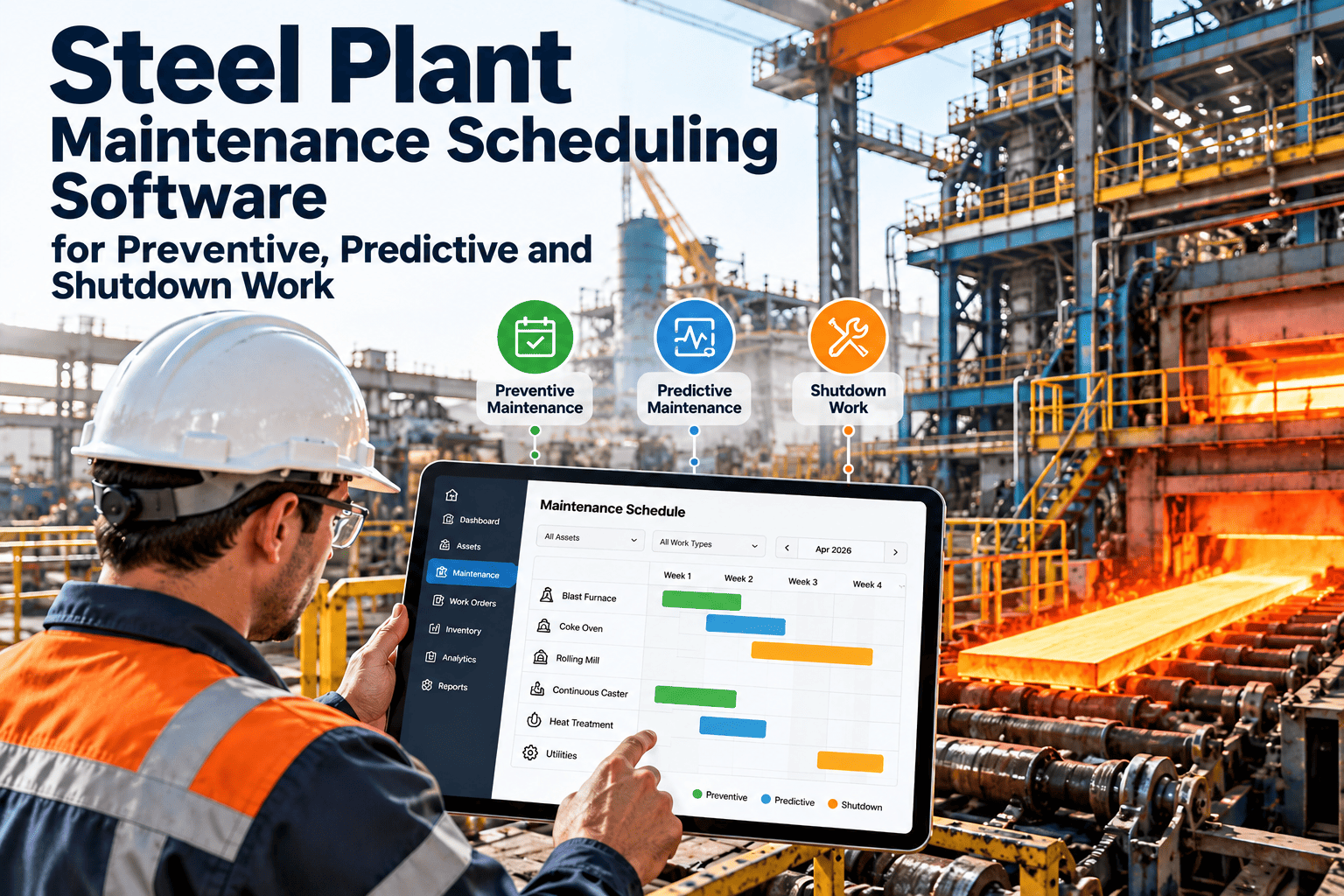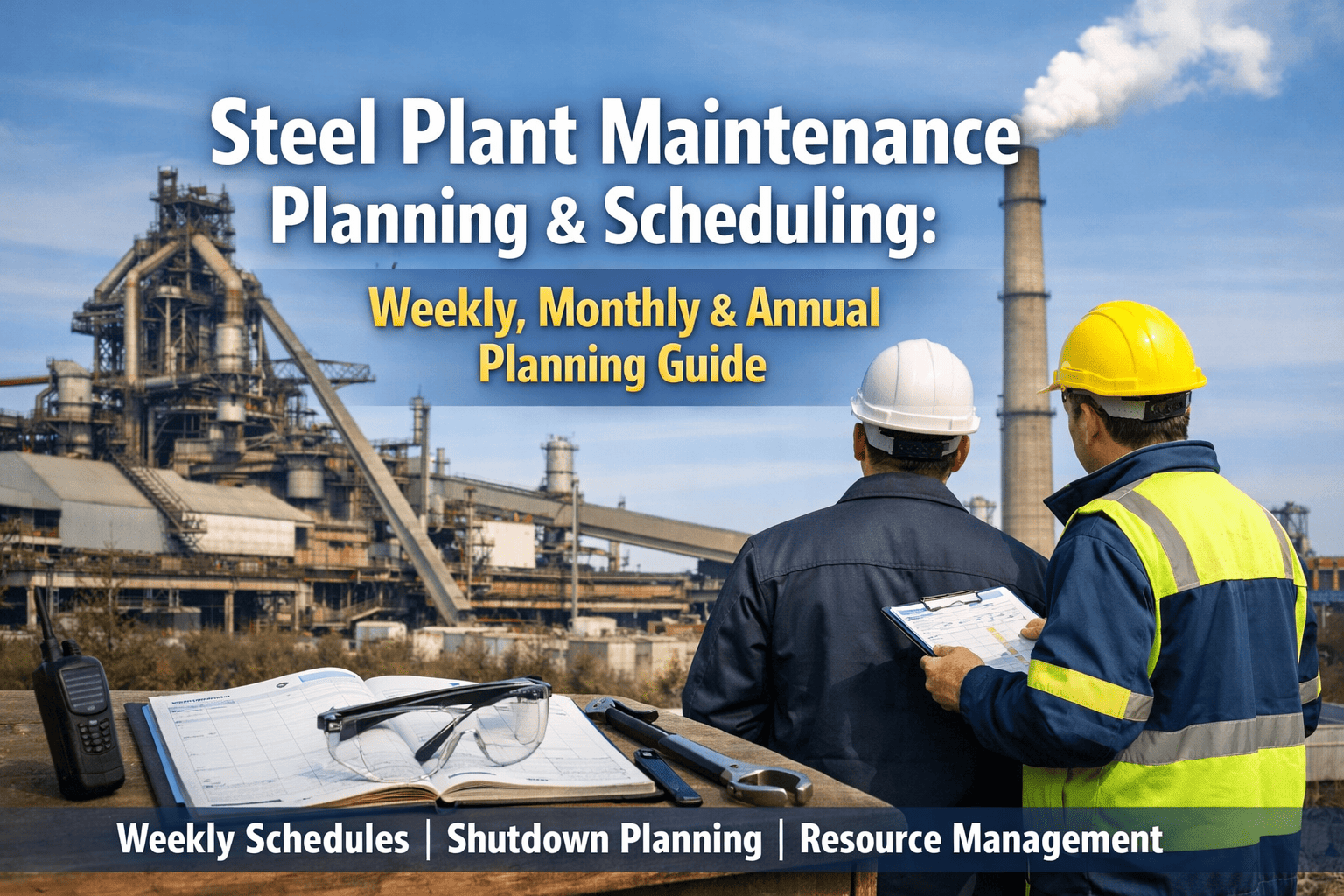
Most steel plants maintain separate planning cycles for weekly emergency repairs, monthly maintenance windows, and annual planned shutdowns — losing 30-40% of maintenance productivity to coordination overhead and duplicative planning. Weekly maintenance work is scheduled without visibility into monthly demands; monthly windows are planned without understanding annual shutdown constraints; annual campaigns start with incomplete inventory of equipment modifications needed. The result: maintenance teams scramble to fit priorities into available windows, predictable failures catch everyone off-guard because they weren't anticipated in any planning cycle, and capital projects scheduled months in advance are delayed because supporting maintenance work wasn't planned alongside them. Integrated maintenance planning systems that align weekly, monthly, and annual scheduling cycles create coherent maintenance strategy: weekly emergency capacity is predicted and reserved based on equipment condition, monthly maintenance windows are scheduled to distribute work evenly rather than bunching, and annual campaigns are sequenced to maximize equipment availability. Sign Up Free to plan weekly, monthly, and annual maintenance schedules that optimize resource allocation and maximize equipment availability across all planning horizons.
Integrated Maintenance Planning: Weekly, Monthly, Annual Coordination
Steel plants that coordinate maintenance planning across all time horizons — weekly emergency capacity, monthly predictable maintenance, annual campaign sequencing — achieve 25-35% improvement in maintenance schedule reliability and 18-22% reduction in maintenance backlog while improving equipment availability by 6-12 percentage points.
The Maintenance Planning Paradox: Why Separate Weekly, Monthly, and Annual Schedules Create Chronic Delays
Steel mill maintenance teams typically operate three independent planning systems: the weekly reactive cycle (emergency repairs, urgent failures, last-minute adds), the monthly preventive cycle (scheduled PM activities, equipment inspections, routine maintenance), and the annual campaign cycle (major overhauls, equipment replacements, facility improvements). Each cycle is planned in isolation — weekly maintenance is scheduled based on incoming failure reports and immediate equipment condition, with no visibility into what's already planned for the following month. Monthly maintenance is planned during the prior month based on historical patterns and calendar-based intervals, without knowing which weekly emergency repairs will still be active. Annual campaigns are planned 6-12 months in advance based on long-term equipment strategy, but supporting equipment work and interim maintenance are not sequenced with the campaign. The result is a three-headed coordination problem: weekly emergency repairs exceed their planned allocation because major maintenance was scheduled during periods when equipment failures also occur; monthly maintenance gets deferred because emergency work consumed the allocated hours; annual campaigns slip because prerequisite maintenance wasn't completed during the planning window. A steel plant that implements integrated maintenance planning — coordinating all three cycles and aligning planned maintenance with equipment failure probability — can predict weekly emergency demand 4-6 weeks in advance based on equipment condition, schedule monthly maintenance in slots that don't conflict with predicted failures, and sequence annual campaigns to minimize total downtime impact. Steel mills that Book a Demo see how integrated planning improves schedule reliability and reduces planning delays by 25-35%.
Six Planning Blocks That Define Your Maintenance Calendar: Weekly, Monthly, Quarterly, Semi-Annual, and Annual Cycles
Unplanned maintenance triggered by equipment failures, production stops, or discovered defects — typically 15-25 hours per week on a 24/7 production floor. Planning strategy: reserve 20-30% of available maintenance labor specifically for weekly emergencies, prevent this capacity from being consumed by deferrable planned work, track which equipment classes generate most emergency work.
Planned preventive maintenance activities — bearing replacement on rotating equipment, seal inspections on process systems, sensor calibration, routine lubrication of mill drive systems — typically 40-80 hours per month. Planning strategy: schedule monthly PM on equipment classes without predicted high failure probability that month, sequence PM activities to minimize downtime impact, use condition data to defer low-priority PM from crowded months.
Deeper inspections and minor overhauls performed 4 times annually — refractory inspection on blast furnace, comprehensive vibration analysis and bearing assessment on rolling mill drives, seal and packing evaluation on pump systems. Planning strategy: coordinate quarterly inspections with planned production slowdowns or seasonal demand variations, batch related overhauls into single maintenance windows.
Medium-duration maintenance activities requiring 200-500 hours per campaign — equipment modifications, process upgrades, replacement of major components (coolers, drives, instrumentation). Planning strategy: schedule semi-annual campaigns during lowest production demand, coordinate all supporting maintenance and material procurement 8-12 weeks in advance, align budget allocation with campaign scope.
Large-scale maintenance events requiring 1,000+ hours — blast furnace campaign-end major overhaul, rolling mill rebuild after extended operating period, caster refractory replacement, complete mill drive system overhaul. Planning strategy: schedule annual events 6-12 months in advance, sequence all prerequisite maintenance and capital work into integrated timeline, synchronize with production planning to maximize uptime between campaigns.
Capital planning horizon — phased replacement of aging equipment, major facility upgrades, process modernization spanning 2-5 years. Planning strategy: align annual campaigns with multi-year capital plan, ensure interim maintenance sustains equipment through pre-replacement years, coordinate equipment delivery with facility preparation and installation readiness.
Maintenance Planning Performance Metrics: How to Measure Schedule Reliability and Backlog Effectiveness
| Planning Metric | Definition | Baseline (Uncoordinated Scheduling) | Target (Integrated Planning) | Improvement |
|---|---|---|---|---|
| Schedule Compliance Rate | % of planned maintenance completed on scheduled date | 58-68% | 82-90% | +18-28 percentage points |
| Maintenance Backlog | Hours of planned maintenance waiting for execution slot | 600-1,200 hours | 300-450 hours | -50-65% backlog reduction |
| Weekly Emergency Capacity Utilization | % of reserved emergency hours actually consumed | 85-105% (overflow) | 65-75% (controlled) | -15-20 points prevention |
| Monthly PM Deferral Rate | % of scheduled PM activities deferred to next month | 22-35% | 5-8% | -75-85% deferral reduction |
| Annual Campaign Schedule Adherence | % of major campaigns completed within planned timeline and budget | 45-60% | 85-95% | +30-45 percentage points |
| Maintenance Labor Utilization | % of planned maintenance labor hours consumed (vs emergency firefighting) | 65-75% | 82-92% | +10-20 points planned vs reactive |
Five Critical Benefits of Integrated Maintenance Planning and Scheduling
Integrated planning reduces schedule disruptions by predicting equipment failure probability and reserving appropriate emergency capacity. When weekly emergency capacity is calculated based on equipment condition (not assumed to be constant week-to-week), monthly maintenance is scheduled away from predicted high-failure periods, and major campaigns have confirmed supporting-work completion, schedule compliance improves from 58-68% to 82-90%. This improvement means that a maintenance team's promise to complete bearing replacement on a rolling mill drive on a specific Tuesday is now achievable 82%+ of the time (vs 60% likelihood when plans frequently get disrupted). For production planning and equipment availability, this schedule reliability is transformative: production managers can commit to customer orders knowing maintenance windows are predictable, not subject to surprise emergency disruptions. Sign Up Free to track maintenance schedule reliability and improve execution consistency.
Uncoordinated scheduling accumulates maintenance backlog: low-priority PM is deferred because emergency repairs consumed planned slots, creating a 600-1,200 hour waiting list of maintenance work. Integrated planning eliminates deferred-maintenance accumulation by executing planned maintenance within the original window rather than deferring to an overloaded future month. A typical mill accumulating 200+ hours of monthly backlog growth can stabilize at 300-450 total hours (30-60 days of backlog) through proper schedule coordination. More importantly, the composition of backlog changes: uncoordinated systems accumulate low-priority PM that never gets executed; integrated systems have backlog of genuinely competing high-priority work that requires trade-off decisions. This clarity enables better decision-making and prevents chronic deferred-maintenance patterns from creating hidden risk.
Uncoordinated maintenance scheduling creates availability loss from three sources: emergency failures that could have been prevented, planned maintenance occurring during high-reliability periods when the equipment wasn't at risk, and emergency disruptions that stop planned maintenance execution mid-way. Integrated planning eliminates these losses: predictive failure identification prevents the emergency failures, planned maintenance is scheduled during periods of naturally lower reliability (reducing the availability impact), and reserved emergency capacity prevents planned work interruptions. The combined effect is 6-12 point equipment availability improvement: a mill at 82% availability can reach 88-94% availability while performing more total maintenance hours (because emergency work decreases faster than planned work increases). Book a Demo to see how integrated planning optimizes equipment availability while executing more maintenance.
Major maintenance campaigns (blast furnace overhaul, mill rebuild, facility upgrades) consume 1,000-5,000 labor hours and consume 2-6 weeks of continuous work. Without integrated planning, campaigns frequently expand beyond scheduled timeline because prerequisite work wasn't completed on schedule, material delivery arrives late and cascades subsequent work, and contractor labor schedules conflict with plant priorities. Integrated planning prevents these cascading delays by confirming that all prerequisite equipment work is completed 4-6 weeks before campaign start, material procurement is triggered based on validated campaign scope, and contractor scheduling is confirmed and locked 8-12 weeks in advance. The result: campaigns complete within planned timeline 85-95% of the time (vs 45-60% under uncoordinated planning), labor hours stay within budget because rework and schedule delays are prevented, and total campaign cost improvement averages 20-30%. For a plant executing 2-3 major campaigns annually, this efficiency gain totals $500K-1.2M in prevented cost overruns.
Integrated maintenance planning shifts labor allocation from firefighting (reactive response to failures) toward planned work where technicians can perform skilled maintenance and prevention. Under uncoordinated scheduling, maintenance teams spend 65-75% of their time on emergency repairs and only 25-35% on planned preventive work — the inverse of the time-efficiency ratio (emergency work typically takes 40-50% longer per task than planned work because of improvisation and rework). Integrated planning enables 82-92% execution of planned work because schedule reliability improves and emergency frequency decreases. This labor shift improves technician productivity (fewer context switches, better tool/parts preparation, reduced rework), reduces technician fatigue (fewer high-stress emergency situations), and enables better skill development (planned work allows training and knowledge transfer that emergency repairs preclude). The net effect is equivalent to adding 10-20% productive capacity to the maintenance team without hiring additional staff.
Maintenance Planning Implementation Roadmap: From Chaos to Coordinated Scheduling
Maintenance Planning and Scheduling: Frequently Asked Questions
What percentage of maintenance capacity should be reserved for weekly emergency work?
Baseline emergency capacity should be 20-30% of available labor, adjusted upward or downward based on your specific equipment age and failure pattern data — predictive maintenance can reduce this to 12-18% within 6-12 months as failure prevention improves.
How far in advance should annual maintenance campaigns be planned?
Major campaigns should be planned 6-12 months in advance with scope finalized by month 4, allowing 8-12 weeks for supporting work completion, material procurement confirmation, and contractor labor scheduling.
What is a reasonable maintenance backlog level?
Healthy backlog is 30-60 days of planned maintenance work — sufficient to absorb schedule disruptions but not so large that priorities become unclear. Backlog exceeding 90 days indicates that planned maintenance is systematically deprioritized by emergency work.
How can maintenance planners balance monthly maintenance against production scheduling?
Coordinate monthly maintenance planning with production demand forecasts — schedule maintenance during lower-demand months when equipment downtime has less production impact, and defer non-critical maintenance from high-demand periods to protect revenue.
What role does equipment condition monitoring play in maintenance scheduling?
Condition data allows maintenance planners to predict which equipment will require intervention 4-6 weeks in advance, enabling proactive maintenance scheduling rather than reactive response to failures — improving schedule reliability by 25-35%.
How should maintenance teams handle schedule deviations and urgent work additions?
Reserve dedicated emergency capacity (20-30% of labor) specifically for urgent additions — never pull labor from planned maintenance to handle new urgent work, which breaks the planned schedule and perpetuates backlog accumulation.
Should maintenance scheduling prioritize equipment uptime or deferred-work reduction?
The correct priority sequence is: (1) prevent unplanned failures that destroy uptime, (2) execute planned preventive maintenance as scheduled, (3) reduce deferred-work backlog — not all three simultaneously, because unrealistic targets create schedule chaos.
How can smaller mills implement integrated maintenance planning with limited planning resources?
Start with simple weekly/monthly coordination and build toward annual campaign planning — using OxMaint's scheduling tools to automate routine planning tasks and focus your planning team on high-impact decisions rather than data compilation.
Coordinate Your Maintenance Planning Today
OxMaint integrates weekly, monthly, and annual maintenance planning to eliminate schedule chaos — predicting emergency demand, scheduling planned work away from failure periods, and coordinating major campaigns with supporting work and material delivery.