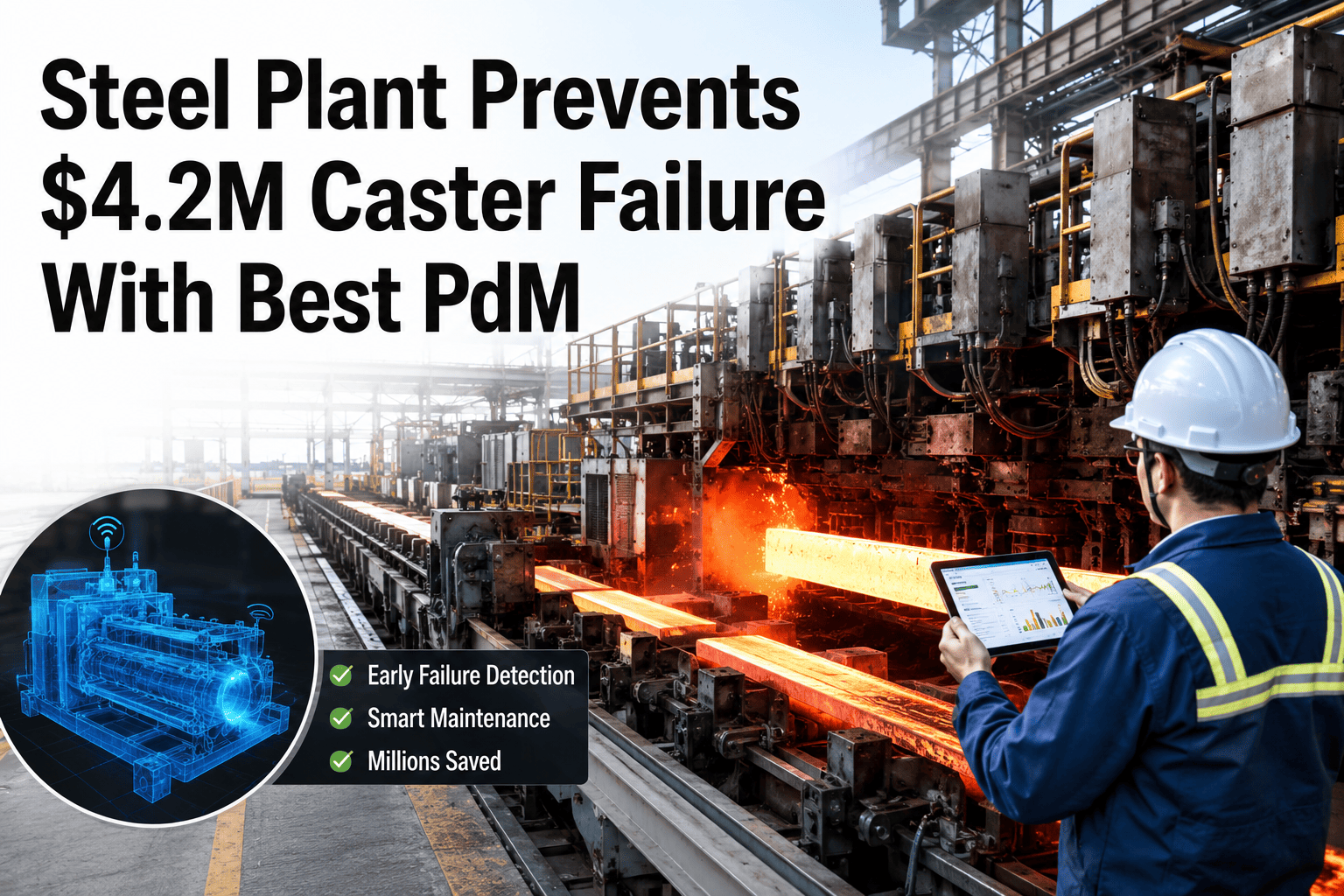
When a segment roll bearing on a continuous caster starts to fail, plant teams usually get almost no warning — the roll runs normal on one shift and seizes mid-cast on the next, triggering a steel breakout that can destroy the strand and the machine around it. At a 3.6 MTPA integrated steel facility, that exact failure mode had been building quietly for three weeks before a single person on the floor noticed anything unusual, buried inside vibration and thermal signals nobody was watching in real time. This case study walks through what the maintenance team actually saw, when they saw it, and how a failure carrying an estimated $4.2 million in equipment damage, lost casts, and downstream rolling mill starvation was caught and resolved during a planned changeover instead of a 3 AM emergency call. The full diagnostic timeline and cost breakdown below come from a caster reliability program built on OxMaint's predictive maintenance CMMS.
How a $4.2M Caster Failure Was Caught Three Weeks Before It Happened
A segment roll bearing on Strand 3 of a four-strand slab caster was degrading for 21 days with zero visible signs on the shop floor. Here is the sensor trail, the response window, and the full avoided-cost math behind it.
The Setup: A Caster Running On Borrowed Time
The plant's four-strand slab caster runs continuously across three shifts, feeding a hot strip mill that cannot absorb an unplanned strand stoppage without idling downstream. Segment roll bearings on the secondary cooling zone were maintained on a fixed calendar — pulled and inspected every three years regardless of actual running condition, because that was the schedule the OEM manual specified two decades ago. There was no continuous monitoring on these specific rolls. The plant had already logged two near-miss breakouts in the previous 18 months, both caught by an operator noticing an off smell or a visual strand deviation seconds before a full breakout — not exactly a repeatable safety strategy.
Twelve weeks before this event, the plant had installed vibration and thermal sensors across all 34 segment roll bearing housings on Strand 3 as part of a phased predictive maintenance rollout, with alert thresholds trained on 60 days of baseline running data. The bearing that ultimately failed — Roll 14, lower segment, secondary cooling zone — was one of the newly instrumented assets.
The rollout itself had been a hard sell only a year earlier. Capital committees at integrated mills tend to favor projects with an obvious, immediate output — a new furnace lining, a mill stand upgrade — over sensor hardware and software subscriptions whose payoff is a failure that never happens. The business case that finally got funded leaned on a simple framing: the plant's own maintenance and production-loss history showed unplanned failures on critical rotating equipment averaging $2–3 million a year in emergency repairs and lost output, and even a conservative estimate of catching two or three of those failures early would cover the sensor and software investment several times over. Roll 14 turned out to be the first real test of that argument.
Why Calendar-Based Maintenance Missed This For Years
The three-year bearing replacement interval on Strand 3 was not a bad decision when it was written — it was the only option available before continuous condition monitoring became affordable for individual roll assemblies. The problem is that a fixed calendar interval treats every bearing as if it degrades at the same rate, regardless of actual load history, lubrication quality, contamination exposure, or the number of grade changes the strand has run through. Roll 14 had seen an unusually high number of high-carbon grade casts in the preceding quarter, each one placing more thermal and mechanical stress on the bearing than a standard low-carbon run. None of that showed up on a maintenance calendar built around a fixed number of months.
Industry data on steel plant reliability programs backs up what this plant experienced directly: time-based preventive maintenance typically replaces components with 30–60% of useful life still remaining, wastes labor hours servicing healthy equipment, and still fails to catch a significant share of unplanned breakdowns because it cannot see condition-specific degradation between scheduled inspections. A caster segment roll bearing failing in week three of a thirty-six-month interval carries the same "not due yet" status as one that is perfectly healthy — right up until it isn't.
The Detection Timeline
Nothing about this failure was dramatic in its early stages — that is precisely why it had always gone undetected before. The signal built gradually across three weeks, each stage small enough on its own to dismiss, until the pattern across vibration, temperature, and current draw became unmistakable to the monitoring model.
What The Sensors Were Actually Telling Us
None of these four readings alone would have justified pulling a healthy-looking roll out of production. A vibration reading 8% above baseline is well within normal shift-to-shift noise on most rotating equipment, and a few degrees of temperature drift can just as easily come from an ambient change near a ladle transfer as from a failing bearing. What made the case unambiguous was the correlation across all four signals moving in the same direction over the same three-week window — a pattern the model had specifically been trained to distinguish from ordinary operating variance.
Your Caster Is Already Sending These Signals
The question is whether anything on your shop floor is trending vibration, temperature, and motor current on your segment rolls today — or whether the next bearing failure will announce itself as a breakout instead of a work order.
From Alert To Resolution: The 96-Hour Window
The gap between "we have a predictive alert" and "the bearing is replaced" is where most predictive maintenance programs actually fail — the sensor did its job, but the work order sat in a queue no one checked. Here is how the response actually unfolded.
The Cost Of A Breakout That Didn't Happen
The plant's reliability team modeled what this event would have cost had Roll 14 seized mid-cast instead of being caught on Day 21 — using historical data from the facility's own prior breakout incidents as the basis for each line item below. A seized segment roll under a strand carrying molten steel does not fail quietly. The strand shell can tear, spilling liquid steel into the machine housing and destroying the roll, the bearing assembly, and often several adjacent rolls in the same segment cluster — which is why the equipment replacement line alone typically runs into the hundreds of thousands of dollars before a single hour of downtime is even counted.
The downtime figure is the largest single line because a caster stoppage does not just idle the caster — it starves the hot strip mill downstream, which has no slab buffer large enough to run through an 18–22 hour outage without idling its own crews and burning through scheduled delivery windows. Every category below was cross-checked against the plant's two prior near-miss incidents and adjusted for the specific damage pattern a Strand 3 secondary-zone breakout would produce.
| Avoided Cost Category | Estimated Value |
|---|---|
| Segment roll and bearing housing replacement | $340,000 |
| Unplanned caster downtime (18–22 hrs) | $1,650,000 |
| Rolling mill starvation and idle labor | $780,000 |
| Refractory and mold damage risk | $410,000 |
| Expedited parts freight and premium labor | $220,000 |
| Quality rejections from a disrupted cast | $360,000 |
| Insurance deductible and incident investigation | $440,000 |
Results After 12 Months
Roll 14 was the first confirmed catch, but the value of the program compounded across the full caster monitoring rollout over the following year.
Beyond Roll 14: Scaling The Program Plant-Wide
Roll 14 was the proof point, not the finish line. Once the reliability team had a documented $4.2 million save with a clean diagnostic trail, extending sensor coverage to the remaining segment rolls on Strands 1, 2, and 4 was an easy budget conversation instead of a hard one. Within the following two quarters, the plant expanded monitoring to 148 additional bearing points across all four strands, plus the drive-side gearboxes feeding each strand's withdrawal unit.
The expansion also changed how the maintenance team prioritized its day. Instead of a fixed PM calendar dictating which of the hundreds of caster components got inspected each week, technicians now start each shift with a ranked list of assets showing the earliest signs of deviation — regardless of when they were last serviced. Work orders that used to originate from a spreadsheet reminder now originate from an actual condition signal, and every one of them carries the sensor trend that justified it, so a technician arriving on site already knows what they are looking for before they open the housing.
We had two near-miss breakouts in the eighteen months before this program went in, and both times we got lucky — an operator noticed something seconds before it turned into a real incident. Day 21 was the first time the equipment told us before a person had to. That is the entire difference between a planned bearing swap and a strand we would still be repairing.
Lessons For Other Steel Plants Running Calendar-Based PM
Most integrated steel plants are not short on maintenance discipline — they are short on visibility between scheduled inspections. The gap between a three-year bearing replacement calendar and a bearing that starts failing in month four is exactly where catastrophic caster events come from, and it is a gap that condition monitoring closes without requiring a plant to abandon its existing PM structure altogether.
Three takeaways from this event apply well beyond one caster or one plant. First, instrument the highest-consequence assets before the highest-failure-rate ones — a segment roll bearing that fails once a decade but destroys a strand when it does is a better first sensor investment than a pump that fails often but cheaply. Second, an alert is only as good as the workflow behind it; a predictive model that emails a report nobody reads produces the same outcome as no model at all, which is why the auto-generated, mobile-dispatched work order mattered as much as the sensor data itself. Third, budget for the 96-hour response window, not just the sensor hardware — the value of early detection depends entirely on having a spare bearing in stock and a changeover slot available to act on the warning before it expires.
What Changed In How The Plant Operates
The most durable outcome of this event was not the avoided cost — it was the shift in how the maintenance organization thinks about the caster. Three changes stuck:
None of these changes required replacing the caster itself, hiring additional headcount, or a plant shutdown to implement. The sensor hardware, the CMMS integration, and the alert workflow were layered onto the existing maintenance organization over a period of about twelve weeks from first sensor install to the Roll 14 catch.
Frequently Asked Questions
Catch Your Next Caster Failure Before It Happens
This is what predictive maintenance looks like when the alert reaches the right person in time to act on it. See what OxMaint would catch on your own caster, rolling mill, or blast furnace assets.

.png)