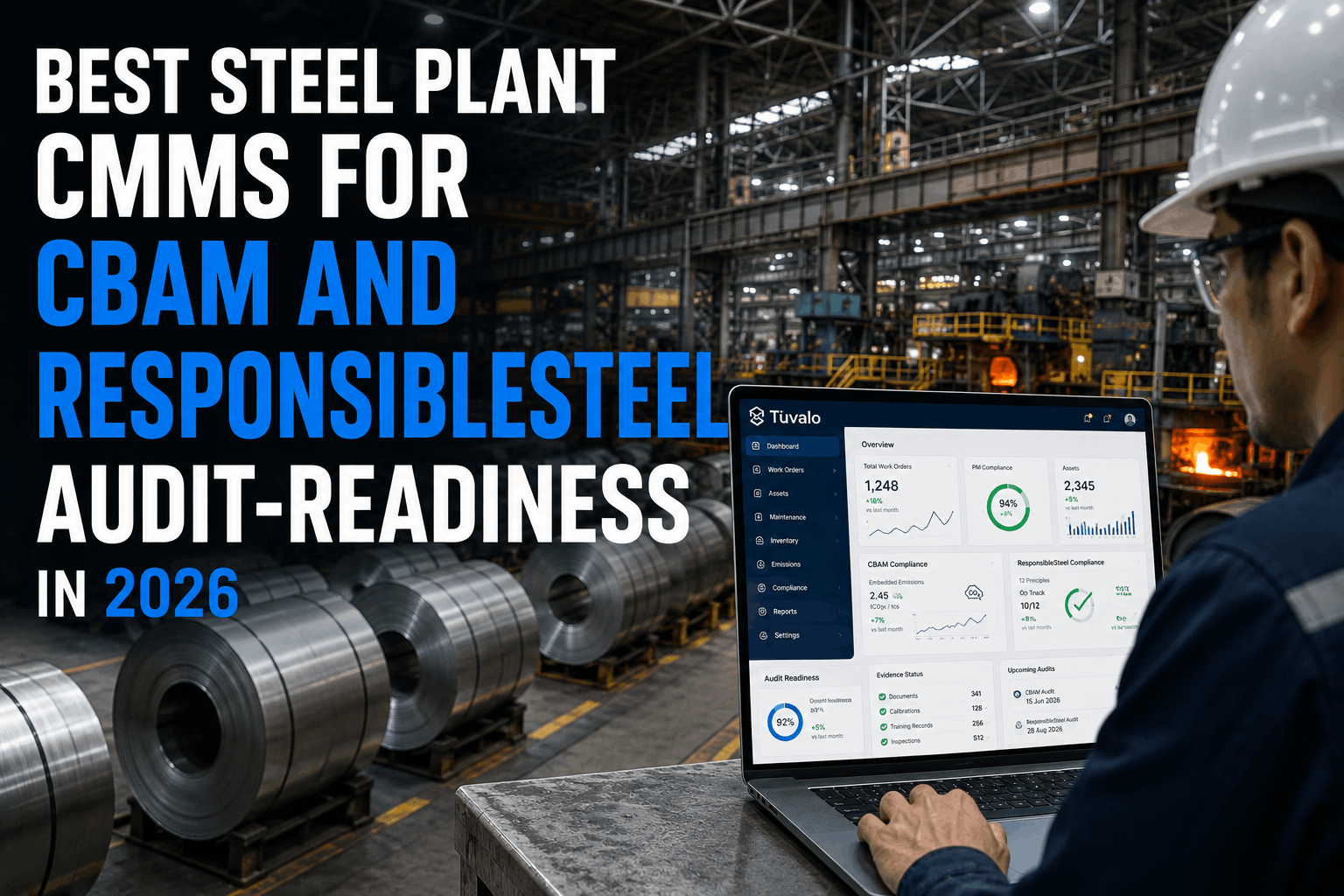
ResponsibleSteel certification stands as the steel industry's most rigorous sustainability standard, combining environmental performance, labor rights, occupational health, water stewardship, human rights, community engagement, and climate change commitments into one auditable framework. For steel mills operating in North America, Europe, and Asia, ResponsibleSteel certification has evolved from an industry preference into a market requirement — customers, investors, and supply chain partners increasingly ask which responsible steel standards you meet. The challenge is that ResponsibleSteel audits assess over 300 core requirements across 13 principles, demanding documented evidence from blast furnace maintenance records to community engagement logs. A CMMS-enabled evidence system transforms ResponsibleSteel preparation from a documentation scramble into a structured compliance workflow, where every maintenance action, inspection record, incident report, and environmental reading feeds directly into audit-ready evidence packages.
Why ResponsibleSteel Certification Matters for North American Steel Mills
Over 40% of global steel trade is now evaluated against sustainability criteria by downstream customers — a trend that accelerated sharply after 2023. ResponsibleSteel certification provides independent, third-party verification that your mill operates to the highest standards in environmental stewardship, labor rights, occupational health, and community responsibility. For mills exporting to Europe, serving automotive and construction OEMs, or competing for premium pricing, ResponsibleSteel certification is no longer optional — it is the credential that unlocks market access, justifies premium pricing, and de-risks ESG scrutiny from investors and supply chain partners.
The certification process involves two formal audit stages conducted by approved certification bodies (DNV, AFNOR, GUTcert, TÜV, and others). Stage 1 consists of remote stakeholder analysis and documentation review against the ResponsibleSteel International Production Standard. Stage 2 is an on-site audit where auditors conduct facility inspections, review physical records, interview workers and local stakeholders, and assess conformity with all 13 principles. Certificates valid for three years require a surveillance audit at the 18-month mark to demonstrate progress on any non-conformities. The entire certification journey — from self-assessment to audit completion — typically spans 12-18 months, requiring consistent evidence collection across all operational zones from ironmaking to finishing.
Many mills fail the first certification attempt not because they lack operational capability to meet standards, but because they cannot produce structured, time-stamped, digitally accessible evidence across all audit domains. When documentation lives in paper logs, spread-sheets across multiple departments, and tribal knowledge in individual technicians' memory, auditors flag gaps in evidence completeness — turning operational success into audit failure. A CMMS deployed specifically for ResponsibleSteel evidence collection closes this gap, creating a single repository where every maintenance action, environmental reading, safety incident, and labor activity is automatically recorded, date-stamped, and filterable by audit principle.
The 13 Principles of ResponsibleSteel and CMMS Evidence Requirements
ResponsibleSteel's International Production Standard organizes sustainability requirements into 13 principles, each generating specific evidence demands that must be documented continuously, not assembled at audit time. Here's how a CMMS-backed evidence system supports each principle:
ResponsibleSteel Audit Evidence Data Mapping in OxMaint
ResponsibleSteel audits require evidence across eight distinct audit workstreams — governance, environment, labor, health & safety, community, supply chain, decarbonization, and responsible sourcing. The challenge for most mills is that this evidence lives scattered across disparate systems: maintenance logs in CMMS, environmental monitoring in DCS/SCADA, labor records in HR systems, safety incidents in compliance databases, and community engagement in spreadsheets. OxMaint consolidates all audit evidence into principle-indexed, time-stamped documentation that auditors expect to see. Here's how the mapping works:
Safety & Occupational Health Records
Near-miss reports, safety incidents (with severity classification S1-S4), corrective actions, LOTO compliance checklists, safety training completions, job safety analysis documents, confined space entry permits, hot work authorizations, and contractor safety verification. All records must be time-stamped and linked to the specific asset, location, and responsible crew member.
Environmental Compliance & Monitoring
CEMS emissions data, water discharge test results, wastewater treatment plant efficiency reports, cooling system maintenance logs showing leak detection and repair, dust collection system performance records, air quality monitoring adjacent to site boundary, waste characterization and disposal documentation, and spill response records. OxMaint integrates real-time sensor data from DCS systems and stores it alongside maintenance work orders, so every equipment intervention is linked to environmental performance.
Energy & Carbon Emissions Tracking
Energy consumption per production route (BF-BOF baseline vs. DRI-EAF pathway), scope 1 and 2 GHG inventory with calculation methodology, supplier scope 3 emissions data, equipment efficiency improvements documentation (blast furnace air temperature optimization, caster cooling water reduction, rolling mill stand energy profiles), and carbon intensity trending per tonne of steel. OxMaint auto-calculates carbon impact per work order — showing how a blast furnace maintenance intervention affects energy consumption and carbon intensity.
Labor & Community Engagement Documentation
Maintenance crew hours and wage records, safety training completion with competency verification, worker grievance registers with resolution timelines, community meeting attendance logs, skills training delivered to external participants, apprenticeship participation records, and supplier/contractor compliance verification. While CMMS doesn't own HR or community systems, it can store linked references to these records and generate audit packages that pull in the required documentation.
Supply Chain & Material Sourcing Compliance
Scrap supplier conflict minerals certifications, iron ore source verification, supplier audit and compliance records, procurement documentation showing material traceability, and responsible sourcing third-party certifications. OxMaint can store scrap analysis certificates and supplier ESG compliance documents, making supply chain evidence instantly retrievable during audit.
Management System & Governance Documentation
Policy documents linked to asset management, management review minutes, risk assessment and mitigation records, system audit findings with corrective action closure, ISO 14001/45001 alignment records, and executive accountability sign-offs on continuous improvement. OxMaint's audit trail functionality ensures that every document upload, approval, and modification is time-stamped and traceable back to the responsible person.
Stage 1 vs. Stage 2 Audit Evidence: What Auditors Expect
ResponsibleSteel audits proceed in two distinct phases, each with specific evidence requirements. Understanding the difference ensures you're collecting the right evidence at the right time. Stage 1 is a remote, desktop audit conducted 6-8 weeks before your on-site audit. Auditors review your self-assessment, documentation packages, and stakeholder feedback to frame the Stage 2 audit plan. Stage 2 is the on-site verification audit, typically lasting 3-5 days, where auditors conduct facility tours, interview workers at all levels, review original records, and assess conformity. The evidence you prepare now determines whether Stage 2 auditors find conformity, minor non-conformities (which you have time to fix before certification), or major non-conformities (which delay certification). OxMaint enables you to prepare both stage evidence packages in a single system — Stage 1 documentation is auto-compiled from asset records, incident logs, and environmental data; Stage 2 on-site evidence packages are printed/available to auditors as they tour facilities, with hot-linked maintenance records, training certificates, and incident investigation reports immediately accessible.
ResponsibleSteel Certification FAQs: Evidence, Cost & Timeline
What is the cost of ResponsibleSteel certification for a North American steel mill?
Certification costs vary by certification body and mill size, but typical costs range from $40,000–$85,000 for the combined audit fee, with additional ResponsibleSteel administrative fees. Larger mills (5+ MTPA) typically pay 15–20% premium. Plan 12–18 months from self-assessment start to certification award; re-auditing after documentation gaps adds 6–12 months and $25,000–$40,000 to total cost.
Can our mill certify against both ResponsibleSteel and ISO 14001/45001 in one audit?
Yes. ResponsibleSteel allows certified auditors to integrate existing ISO 14001 (environmental) and ISO 45001 (safety) audit reports into the ResponsibleSteel audit process, reducing total audit duration and cost. Overlapping requirements are evaluated once, streamlining evidence collection. OxMaint supports integrated audit compliance by linking asset records to ISO and ResponsibleSteel principle evidence simultaneously.
Does ResponsibleSteel certification guarantee premium steel pricing or market access?
ResponsibleSteel certification is increasingly a requirement, not a differentiator. Automotive OEMs, construction distributors, and wind turbine manufacturers now mandate ResponsibleSteel (or equivalent standard) compliance as a supplier qualification criterion. Markets refusing certification are shrinking; certification provides market access, not premium pricing — though some segments (green steel, automotive) command 5–10% price premiums for certified material.
What happens if our mill is audited and found to have minor or major non-conformities?
Minor non-conformities must be addressed within 6–9 months of certification award. Major non-conformities prevent certification until corrected and re-audited. A single major non-conformity on occupational health or emissions can delay certification 12+ months. Structured evidence systems like OxMaint reduce non-conformity risk by ensuring completeness of documentation from the start.
Are there ResponsibleSteel certification bodies operating in North America, or must audits be conducted by European firms?
Approved ResponsibleSteel certification bodies include DNV, AFNOR, GUTcert, TÜV, and others with North American offices. DNV operates extensive certification programs for North American steel mills; AFNOR and TÜV also conduct audits in USA and Canada. Certification body selection may influence audit cost, timeline, and auditor familiarity with your specific mill design.
After certification, how often must our mill undergo re-audits or surveillance audits?
Certificates are valid for 3 years and require a surveillance audit at the 18-month mark to verify ongoing compliance. The surveillance audit is less rigorous than full recertification but still requires evidence of progress on non-conformities and maintenance of compliance systems. Continuous evidence collection ensures surveillance audits are low-friction events, not re-certification crises.
Can we use our existing CMMS data for ResponsibleSteel evidence, or do we need a dedicated system?
Generic CMMS platforms capture maintenance work orders but rarely support principle-indexed evidence compilation, safety criticality scoring, environmental data integration, or audit-ready reporting. OxMaint is configured specifically for ResponsibleSteel evidence mapping, auto-generating audit packages organized by principle with full traceability and time-stamping. Migration from legacy CMMS takes 2–4 weeks; parallel operation ensures zero data loss.
Which ResponsibleSteel principle generates the most non-conformities in North American steel mills during initial audits?
Principle 8 (Climate Change & GHG Emissions) and Principle 9 (Emissions, Effluents & Waste) generate the most audit findings because mills often lack integrated carbon accounting, CEMS data management, and documented decarbonization roadmaps. Principles 3 (Occupational Health) and 4 (Labor Rights) also generate findings when training records or grievance documentation is incomplete.