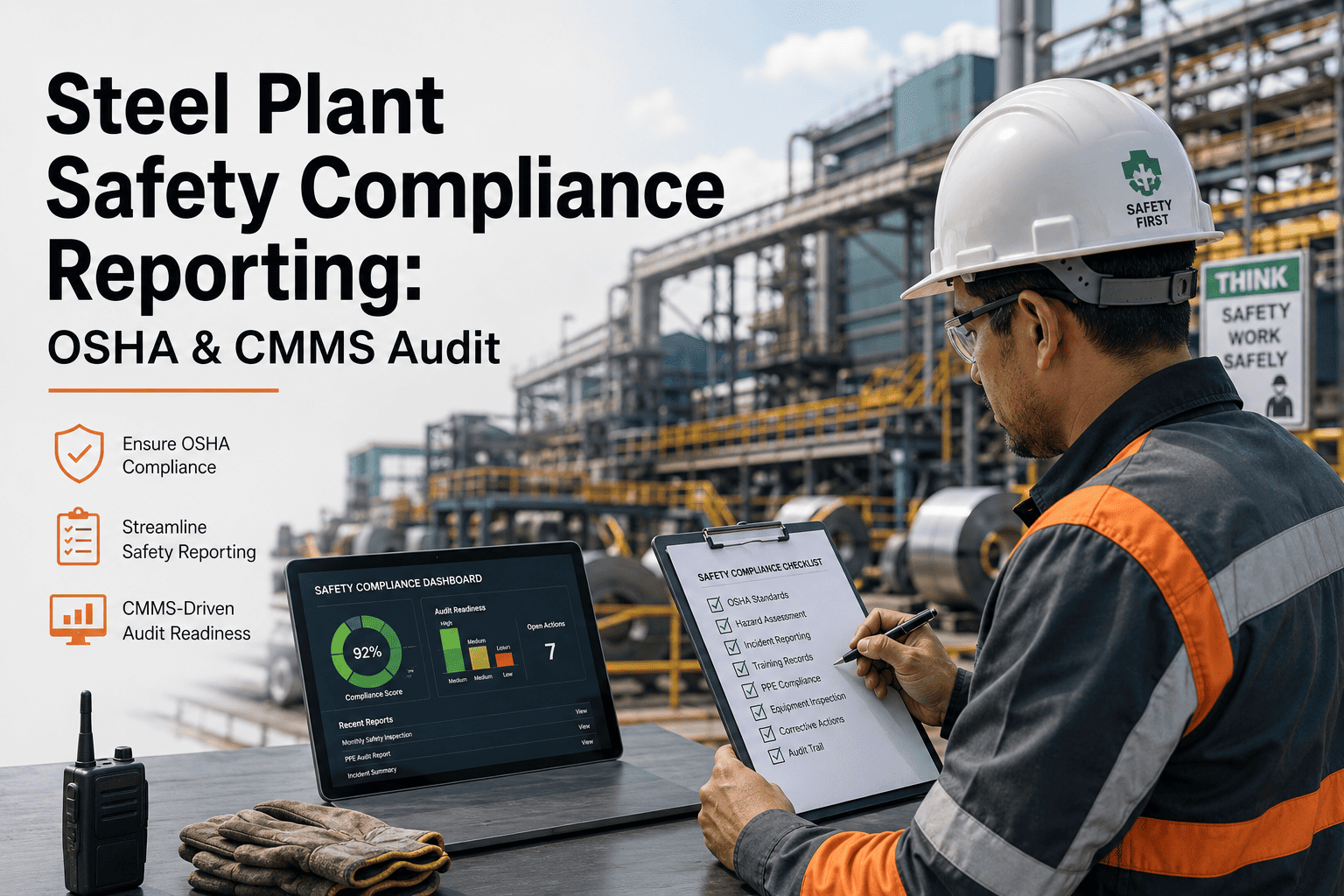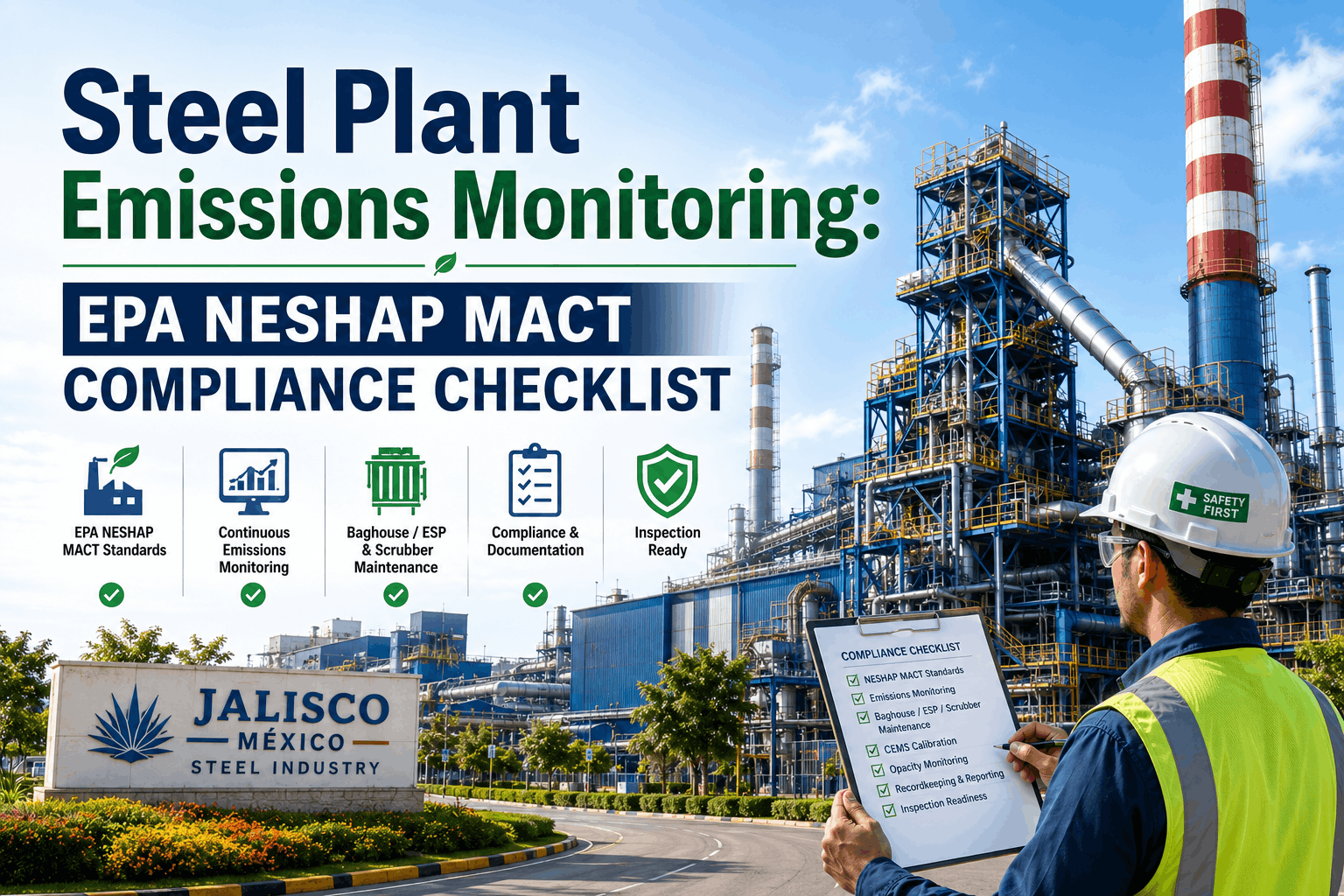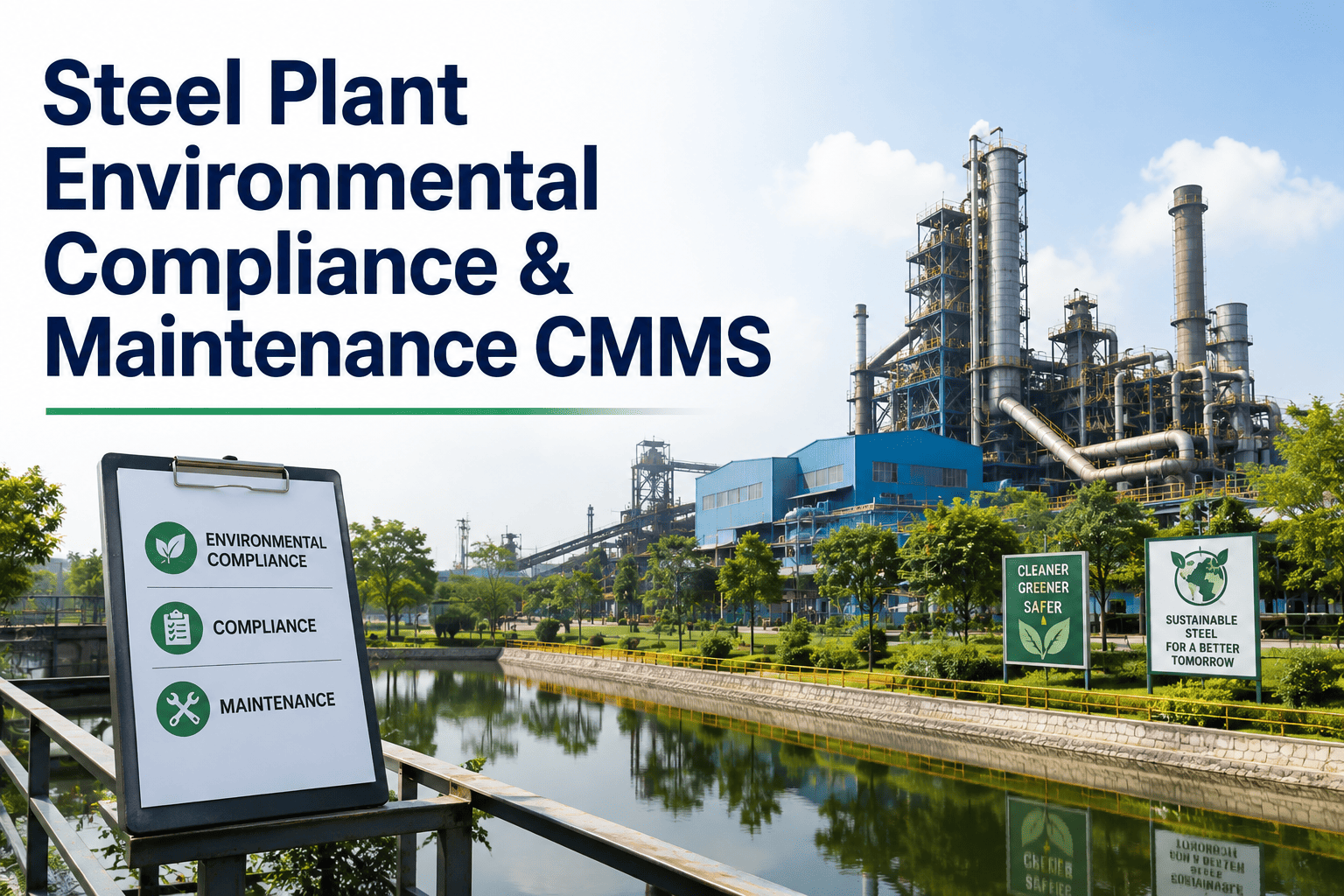
Steel plant environmental compliance hinges on disciplined maintenance execution across dust suppression, gas cleaning, effluent treatment, and emissions monitoring systems — a single failed baghouse or offline scrubber can trigger regulatory violations, six-figure fines, and forced production curtailments. Modern steel environmental maintenance programs use a CMMS to automate PM scheduling, capture audit-ready records, and predict equipment failures before they cause exceedances. This guide breaks down how integrated maintenance software transforms compliance from a reactive scramble into a controlled, documented process. Ready to replace spreadsheets and clipboards with a system built for reliability? Start Free Trial and see the difference on your assets.
Environmental Compliance & Maintenance
Can your steel plant survive an unannounced environmental compliance audit today?
Regulators don't schedule warnings. A single overdue baghouse inspection, an unlogged refrigerant top-up, or an undocumented effluent discharge can trigger consent-decree penalties exceeding $250,000 per violation. OxMaint turns environmental maintenance into a system of record that is audit-ready 365 days a year — not just the week before an inspection.
Where Compliance Meets Maintenance
Steel plant environmental compliance: five regulated systems maintenance owns
Environmental compliance in a steel plant is not an environmental-department problem — it is a maintenance execution problem. Five systems sit directly on the regulatory firing line, and every one of them depends on PM compliance, work-order documentation, and real-time condition data to stay within permit limits.
Baghouses & Dust Suppression
Particulate matter (PM10 / PM2.5) exceedances are the #1 Notice of Violation trigger. Baghouse PM — pulse-jet cleaning cycles, filter-bag replacement, hopper discharge — must be logged with date, technician, and reading.
Gas Cleaning & ESP Systems
Blast-furnace and BOF gas cleaning plants — venturi scrubbers, electrostatic precipitators (ESPs), mist eliminators — control CO, SO₂, and particulate. Plate alignment, water-flow rates, and rapping-cycle PM directly determine emissions compliance.
Effluent & Wastewater Treatment
Coke-oven and pickling wastewater contains ammonia, cyanide, phenol, and heavy metals. Pump redundancy, chemical-dosing calibration, and sludge-press maintenance are regulated under effluent discharge permits with daily reporting limits.
Refrigerant & Cooling Systems
Coke-oven gas cooling and by-product condensers use refrigerants regulated under EPA Section 608. Leak-detection inspections, repair logs, and refrigerant inventory tracking must be maintained for 3 years minimum — auditable on demand.
GHG & CEMS Infrastructure
Continuous Emissions Monitoring Systems (CEMS) feed EPA Part 75 greenhouse-gas reporting. Analyzer calibration, sample-line heat tracing, and data-acquisition system uptime are all maintenance-owned compliance assets.
Manage all five in one system
OxMaint centralizes PM schedules, work-order history, and compliance documentation for every regulated asset — so nothing falls through the cracks during shift changes or contractor handoffs.
Book a 30-min demo →12-Month Compliance Calendar
Annual steel environmental maintenance timeline for audit-ready plants
A defensible compliance program runs on a rolling 12-month schedule, not quarterly scrambles. Below is the cadence high-performing mills follow to keep dust suppression, gas cleaning, and effluent systems within permit limits year-round — automatically scheduled and tracked in a CMMS.
Annual Relative Accuracy Test Audits (RATAs) for CEMS analyzers on blast furnaces and BOFs. Schedule calibration-gas cylinder replacement, sample-probe cleaning, and data-acquisition system backups. OxMaint auto-generates work orders 30 days before the audit window opens.
Spring turnaround season: visual bag inspections, filter-bag life-cycle replacement, hopper-level-sensor calibration, and pulse-valve solenoid testing. CMMS captures bag count, row location, and differential-pressure readings per work order for opacity-verification records.
Peak cooling load stresses refrigerant systems — schedule quarterly Section 608 leak inspections on coke-oven gas coolers. Calibrate effluent pH and flow meters, inspect chemical-dosing pumps, and verify sludge-press hydraulic pressure logs.
ESP internal inspections during winter outage: plate alignment, rapping-bar clearance, insulator cleaning. Compile 11 months of CMMS work-order history, PM completion rates, and corrective-action logs into a single audit-ready package for regulator review.
From Spreadsheet to System
How OxMaint CMMS drives steel plant emission maintenance and audit readiness
Most mills still run environmental PM on spreadsheets and whiteboards — meaning a missed inspection has no alarm, no escalation, and no audit trail. OxMaint replaces that fragility with an AI-powered CMMS that schedules, tracks, documents, and predicts compliance-critical maintenance automatically.
Automated PM Scheduling
Trigger baghouse inspections, ESP rapping checks, and refrigerant leak surveys on calendar- or meter-based cycles. OxMaint auto-escalates overdue PMs to supervisors — cutting missed-inspection rates by up to 85% and eliminating "we forgot" violations.
Audit-Ready Work Orders
Every work order captures technician ID, timestamp, readings, photos, and e-signature. Generate a regulator-ready PDF for any asset, date range, or compliance standard in under 60 seconds — no more binder-hunting during inspections.
AI Predictive Failure Alerts
OxMaint's predictive analytics engine detects differential-pressure drift, vibration anomalies, and temperature excursions on scrubbers, ESPs, and baghouses — flagging failures 2–4 weeks before they cause opacity breaches or unplanned shutdowns.
Spare-Parts & Inventory Control
Track filter bags, refractory bricks, gasket kits, and calibration gases with min/max auto-reorder. Plants using OxMaint cut emergency-parts spend by an average of 22% and eliminate the "part not in stock" delay that turns a 4-hour fix into a 3-day outage.
Worked Example
A Midwest mini-mill operating 2 electric arc furnaces and 320 environmental assets was spending $48,000/year on reactive baghouse repairs and had received 3 opacity NOVs in 18 months. After implementing OxMaint, PM compliance hit 96% within 90 days, predictive alerts caught a failing pulse-valve manifold before it caused a breach, and the plant passed its next Title V audit with zero findings — while cutting environmental maintenance labor by 15 hours/week.
See OxMaint on your environmental assets — book a 30-minute demo
We'll map your baghouses, ESPs, effluent systems, and CEMS infrastructure into a live compliance dashboard and show you exactly how OxMaint prevents your next Notice of Violation.
Prevent, Don't React
Dust suppression and gas cleaning PM checklist for steel plants
Use this checklist as the backbone of your CMMS PM library. Each item maps to a regulated system and a documentation requirement that inspectors will ask to see — OxMaint pre-loads these as repeatable, auto-scheduled work-order templates.
Baghouse & Dust Suppression
- Record differential pressure across each compartment — log baseline & trend weekly
- Inspect pulse-jet solenoid valves — verify audible cycling, replace stuck valves
- Check hopper discharge gates & level sensors — clear material buildup
- Visually inspect bag condition during outage — photo-document failed bags by row
- Verify clean-air-plenum seal integrity — smoke-test gaskets & access doors
Gas Cleaning & ESP
- Calibrate venturi scrubber water-flow & pressure-drop instruments — monthly
- Inspect ESP plate alignment & rapping-bar clearance during outage
- Clean high-voltage insulators — check for tracking marks & oil contamination
- Verify T-R set secondary voltage & current readings — log against baseline
- Test mist-eliminator wash-down spray nozzles — clear blockages, check spray pattern
Effluent & Refrigerant
- Calibrate effluent pH, ORP & flow meters — verify against lab grab samples
- Inspect chemical-dosing pumps — check stroke rate, check-valve function & tank levels
- Conduct EPA Section 608 refrigerant leak inspection — log refrigerant type & charge added
- Verify standby/backup effluent pump auto-switchover — test alarm signal to control room
- Inspect sludge-press hydraulic system — check ram seals, filter press cloth condition
Reactive vs. CMMS-Driven
The cost of spreadsheet-based environmental maintenance vs. a CMMS
The gap between a spreadsheet-driven compliance program and a CMMS-driven one is measured in fines, downtime, and sleepless nights before audits. Here's what changes when steel plants move to OxMaint.
| Compliance Metric | Spreadsheet / Reactive | OxMaint CMMS |
|---|---|---|
| PM Completion Rate | 60–70% — missed PMs go unnoticed | 95%+ — auto-escalation on overdue tasks |
| Audit Prep Time | 2–3 weeks of binder compilation | Under 1 hour — filtered PDF export |
| Notice of Violation Risk | High — no predictive failure detection | Low — AI alerts 2–4 weeks before breach |
| Work-Order Documentation | Paper forms, lost in shift handoffs | Digital, timestamped, photo-attached |
| Spare-Parts Availability | Emergency purchases, 2–3 day delays | Min/max auto-reorder, 22% spend cut |
| Regulator Confidence | Adversarial — "find the record" | Collaborative — "here's the dashboard" |
Real Plant, Real Numbers
What a 180-asset steel mill saves with OxMaint environmental CMMS
"We went from 3 opacity NOVs in a year to zero. OxMaint's PM scheduler made sure every baghouse compartment got inspected on time, every time — and the audit trail was just a button click. The ROI paid for itself in avoided fines within the first quarter."
People Also Ask
Steel plant environmental compliance & CMMS — frequently asked questions
What environmental compliance regulations apply to steel plant maintenance?
Steel plants in the U.S. must comply with EPA NESHAP 40 CFR Part 63 Subpart FFFFF (integrated iron & steel), Part 75 (CEMS/acid rain), Section 608 (refrigerants), Clean Water Act NPDES effluent limits, and state-level Title V operating permits. Each regulation mandates specific maintenance, inspection, and recordkeeping cadences — a CMMS like OxMaint encodes these directly into automated PM schedules so nothing is missed.
How does a CMMS improve dust suppression system maintenance in steel plants?
A CMMS automates baghouse PM scheduling — pulse-valve checks, differential-pressure logging, bag-replacement tracking, and hopper inspections — and captures every work order with technician, timestamp, and readings. This eliminates the "we forgot" failure mode that causes opacity exceedances, while producing the audit trail inspectors require. Start Free Trial to see how OxMaint templates pre-load baghouse PM cycles out of the box.
How often should gas cleaning plant equipment be inspected in a steel mill?
Venturi scrubber water-flow and pressure-drop instruments require monthly calibration. ESP internal inspections — plate alignment, rapping-bar clearance, insulator cleaning — are typically done during semi-annual or annual outages. CEMS analyzers tied to gas cleaning require quarterly Cylinder Gas Audits (CGAs) and annual RATAs. OxMaint auto-schedules each cadence and escalates overdue tasks to supervisors.
What records does an environmental compliance audit require from a steel plant maintenance team?
Auditors expect PM completion logs, corrective-action work orders, inspection checklists with technician signatures, equipment calibration records, refrigerant service logs, and parts-replacement history — typically for the past 3–5 years. OxMaint stores all of this digitally with photos and e-signatures, and can export a filtered compliance report for any asset or date range in under a minute. Book a Demo to see a live audit-export walkthrough.
How long does it take to implement a CMMS for environmental compliance in a steel plant?
A focused implementation for environmental assets — baghouses, ESPs, scrubbers, effluent systems, CEMS infrastructure, refrigerant systems — typically takes 4–6 weeks. OxMaint provides pre-built PM templates for steel environmental equipment, so the team starts with a working library rather than a blank system. Most plants see PM compliance rates above 90% within the first 90 days of go-live.
Stop worrying about your next environmental audit
OxMaint makes your steel plant's environmental maintenance audit-ready 365 days a year — with automated PM scheduling, AI failure prediction, and one-click compliance reports that inspectors trust.
Free 14-day trial · No credit card