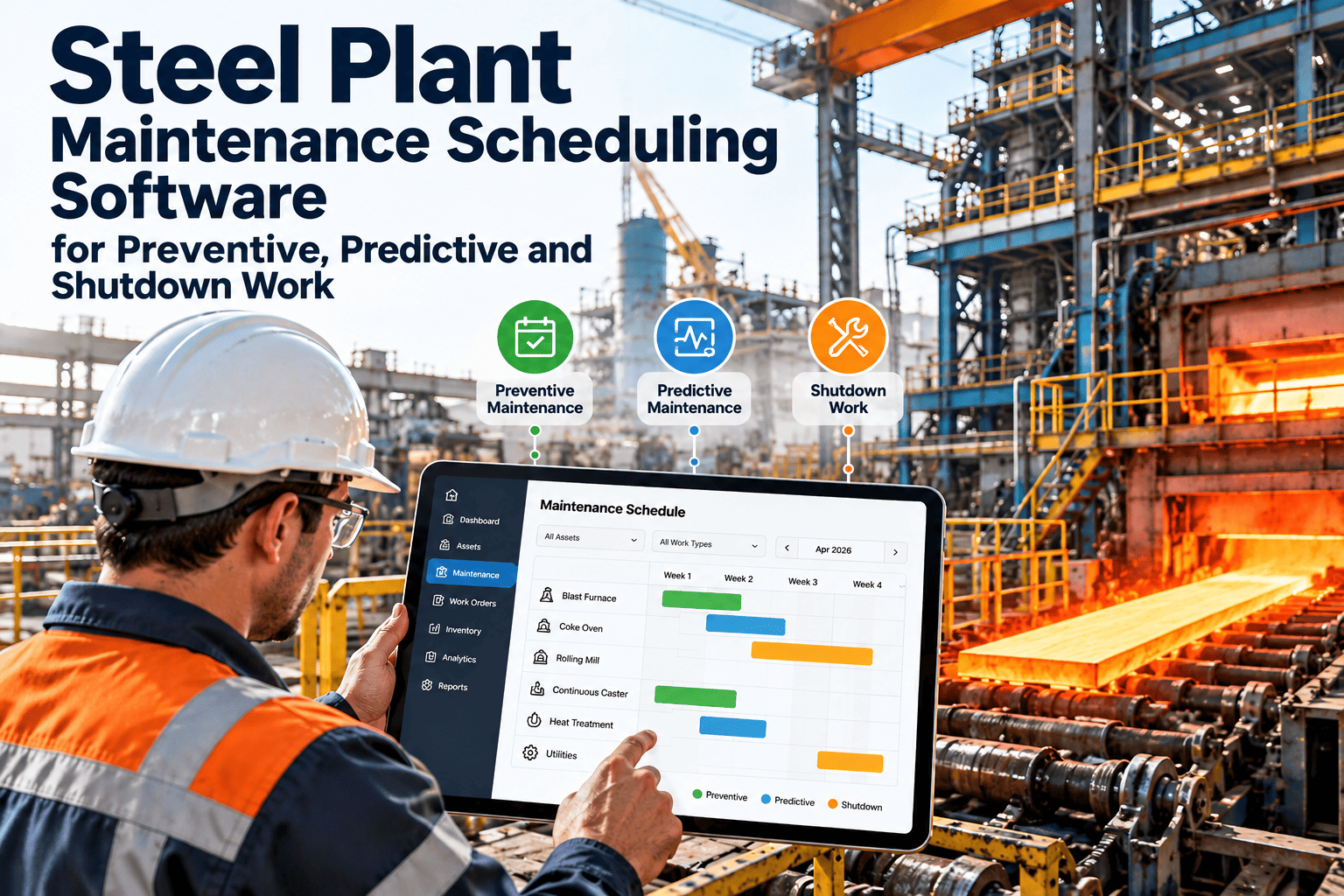
A steel plant shutdown is one of the largest single maintenance spends of the year, and one of the easiest to lose control of. Scope grows after the budget is approved, contractors arrive before parts do, and findings during opening up add work nobody priced. Every lost hour also delays restart and the production that pays for the outage. This article explains how to control scope, schedule, contractors, parts and cost across a turnaround, with practical gates and measures you can apply to a furnace, caster or rolling mill outage. If you want to plan and track that work in one system, you can look at Oxmaint.
Steel Plant Shutdown Cost Control and Turnaround Budget Management
Planned outages, relines, mill stops and annual turnarounds
Hold the budget by freezing scope early, staging parts and contractors, and tracking cost against the plan every day of the outage.
Where turnaround budgets actually leak
A
Late scope additions
Work requests keep arriving after the list is meant to be closed, each one small and each one unpriced.
B
Opening-up surprises
Refractory, bearings or structural wear found once equipment is opened can add work that was never estimated.
C
Contractor standby
Crews wait for permits, isolation, cranes or parts, and the clock runs whether the work is moving or not.
D
Expedited parts
Items ordered late carry premium freight and supplier charges that planned purchasing would avoid.
E
Rework and restart delays
Poor quality checks mean the same job is done twice or the restart slips while defects are corrected.
F
Weak cost visibility
When actuals arrive weeks later, managers decide without knowing how much of the budget is already spent.
Before and after: how control changes the outage
Without a controlled process
- The work list lives in several spreadsheets and keeps changing.
- Estimates are based on the last shutdown, not on recorded condition.
- Parts are chased during the outage and arrive in the wrong order.
- Cost reports are compiled after the restart.
With a controlled process
- One work list with owners, estimates and approval status.
- Scope built from inspection findings, backlog and failure history.
- Parts and permits staged against each task before the stop.
- Cost against budget visible every day of the outage.
Stage gates from first idea to restart
- Gate 1
Define objectives
Agree why the outage is needed, the target duration and the production plan around it. - Gate 2
Build the scope
Collect inspection findings, deferred work, statutory checks and capital items into one candidate list. - Gate 3
Freeze and estimate
Close the list, price labor, parts and services, and set the budget and contingency. - Gate 4
Readiness review
Confirm parts, permits, crews, access equipment and isolation plans are ready for each task. - Gate 5
Execute and track
Run the outage with daily progress and cost reviews and a controlled change process. - Gate 6
Restart and review
Verify quality, restart safely and record lessons for the next outage.
Controlling scope: the largest cost lever
Build scope from evidence
- Use condition inspections, vibration and thermography findings and failure history rather than habit.
- Bring in deferred corrective work orders from the backlog, tagged by asset and priority.
- Separate must-do items such as safety and statutory work from improvement items.
- Give every item an owner, an estimate and a reason for needing the outage.
Protect the freeze date
- After the freeze, new requests go through a change form that shows cost and schedule effect.
- Late additions need approval from a named decision maker, not a verbal agreement on the floor.
- Keep a short list of work for the next outage so good ideas are not lost.
A simple scope test
If a task can be done safely while the plant runs, ask why it is in the outage. Work that needs only isolation, not a full stop, often costs less outside the critical path.
Where the money goes: a budget breakdown view
| Cost block | What it includes | Control method |
|---|---|---|
| Internal labor | Maintenance crews, overtime and supervision | Task-level hours planned against actual |
| Contractors | Specialist crews, scaffolding, cranes and cleaning | Defined scope, rates and daily progress sign-off |
| Parts and materials | Spares, refractory, bearings, rolls and consumables | Kitting by task and receipt checks before the stop |
| Equipment hire | Cranes, lifts and temporary services | Hire periods matched to the schedule |
| Contingency | Allowance for emergent work | Released by approval, tracked separately |
| Lost production | Output delayed by overrun | Critical path monitored daily |
Estimating with evidence instead of last year's total
| Estimate input | Where it comes from | Common weakness |
|---|---|---|
| Task hours | Closed work orders and job plans from previous outages | Hours recorded in bulk, not by task |
| Parts and materials | Bills of materials linked to assets and past usage | Parts used but never booked to the job |
| Contractor effort | Quotes against a written scope and unit rates | Quotes based on a vague description |
| Condition findings | Inspections, vibration, thermography and thickness checks | Findings kept in reports nobody links to the plan |
| Duration | Sequenced tasks with dependencies and access limits | Tasks planned as if all crews could work at once |
Scheduling around the critical path
Plan the sequence, not only the list
- Identify tasks that sit on the critical path, such as refractory work, roll changes or heavy lifts, and protect their start dates.
- Check shared constraints like crane time, confined space entry, scaffolding and isolation points, because these block parallel work.
- Place inspection and testing hold points in the schedule so quality checks do not become late surprises.
- Plan restart tasks such as cold checks, interlock tests and commissioning as part of the outage, not as an afterthought.
Use float deliberately
- Tasks with spare time can absorb crew shortages or late parts without moving the end date.
- Where float is thin, add a named backup crew or approved alternative part before the stop.
Why schedule and cost move together
Each extra day brings standby charges, equipment hire and delayed production. A schedule slip is therefore a cost event, and daily reviews should show both numbers side by side.
Managing contractors without losing control of cost
- Scope
Write it down
Each contractor receives a task-level scope with drawings, access limits and acceptance tests. - Rates
Agree the basis
Fix lump sums or unit rates for known work and set a clear method for pricing variations. - Safety
Verify before work
Confirm induction, permits and lockout arrangements are complete before crews start. - Progress
Sign off daily
Review completed work each day so payments follow measured progress, not estimates. - Variation
Approve in writing
Extra work needs a signed variation showing cost and schedule effect before it starts. - Close-out
Collect records
Obtain test results, certificates and as-found notes before final payment.
Parts, kitting and receiving
Common parts failures
- Long-lead items ordered too late to arrive before the stop.
- Wrong revision or size delivered and found only at installation.
- Parts stored in several locations with no link to the task.
- Premium freight paid to recover a missed date.
Better practice
- Link each part to the task and the asset, with a required-by date.
- Check delivered items against the job requirement on receipt.
- Stage kits by area so crews collect everything in one trip.
- Return unused parts to stock and book them correctly after the outage.
Contingency and change control in practice
| Situation | Who decides | What must be recorded |
|---|---|---|
| Finding inside the frozen scope | Task owner with the outage manager | Cause, added hours and parts, and effect on the critical path |
| New request after the freeze | Named approver, usually operations and maintenance leads together | Reason it cannot wait, cost estimate and schedule effect |
| Safety or statutory finding | Outage manager with safety lead | Hazard, required action and approval to release contingency |
| Work that can wait | Planner | Corrective work order with priority for the next window |
Keep contingency visible
Track contingency as its own line so every release has a reason and an owner. When the reserve is spent without a record, the next estimate cannot learn from it, and the same surprises return at the next turnaround.
Plan the outage in the same system that runs maintenance
Oxmaint helps teams manage work orders, assets, preventive maintenance, inventory and reports, so shutdown scope can draw on real condition and backlog data.
Risk matrix for emergent work
Low schedule effect
High schedule effect
Likely to occur
Plan the work. Allow time and parts in the baseline.
Prepare early. Stage parts and a standby crew.
Unlikely to occur
Accept. Cover from contingency if it appears.
Hold a plan B. Know the fallback before the stop.
Contractor and parts readiness checklist
- Scope of work, rates and acceptance criteria are agreed for each contractor.
- Permits, isolation and lockout plans are prepared for every task.
- Contractor crews hold the needed training and site induction.
- Long-lead items are ordered with dates tracked against the outage start.
- Parts are checked on receipt against the task, not only the purchase order.
- Kits are staged by task and area, with a named location.
- Cranes, scaffolding and access are booked in the order the schedule needs.
- Quality hold points and test records are listed for each critical task.
Tracking cost and schedule during the outage
Morning
Review the critical path, safety status, crew allocation and permits for the day.
Midday
Check progress on key tasks and log new findings with an estimated cost and time effect.
Afternoon
Approve or reject change requests and release contingency only where needed.
End of day
Update percent complete, hours and parts used, and compare spend with plan.
Restart readiness
- Confirm that every isolation is removed and recorded before energizing equipment.
- Complete functional tests on safety interlocks, cooling systems and drives before material is introduced.
- Hold a handover meeting where maintenance, operations and automation agree the equipment is ready.
Plan the restart as carefully as the stop
Many overruns appear at the end of an outage, when cold checks, interlock tests and commissioning are squeezed. List restart tasks in the baseline schedule, assign owners, and keep a small crew available for punch-list items so production is not held up by minor defects.
Measures that show whether control is working
Scope stability
Share of the final work list that was in the frozen scope.
Emergent work share
Hours spent on work not in the baseline.
Schedule adherence
Planned against actual completion of critical path tasks.
Cost variance
Actual spend against budget by cost block.
Parts readiness
Tasks with all parts on site at the planned start.
Restart quality
Defects or rework found after restart.
What a closing review should capture
Records to keep
- Actual hours, parts and contractor cost by asset and task.
- Findings during opening up, with photos and condition notes.
- Variances against the estimate and the reason for each.
- Open items carried into normal work orders.
Questions to answer
- Which findings could inspections have shown before the stop?
- Which estimates were wrong and why?
- Which contractors delivered to the agreed scope?
- What belongs in the next outage list or in routine PM?
Close the loop
The most valuable output of a turnaround is better data for the next one. Record findings against assets and update preventive maintenance tasks and spare part levels while the details are fresh.
Safety, permits and quality: costs that do not show up on the budget line
Permit delays
Late isolation or permit approval leaves crews idle and pushes tasks onto the critical path. Prepare permits ahead and track them as a task dependency.
Congested work areas
Too many crews in one place slow each other down and raise risk. Sequence work by zone and limit headcount where access is tight.
Skipped quality checks
Missed hold points lead to rework after restart. Record tests and sign-offs on the work order so they can be found later.
How Oxmaint supports turnaround cost control
- Asset records and work order history that inform scope and estimates.
- Work orders with tasks, labor, parts and cost captured against each asset.
- Inventory tracking so parts needs can be checked before the stop.
- Inspections that record condition findings and raise corrective work.
- Mobile updates from crews so progress is visible without waiting for reports.
- Dashboards and reports for backlog, cost and completion status.
Frequently asked questions
What is the biggest driver of turnaround overruns?
Scope growth after the freeze is usually the largest driver, followed by late parts and contractor waiting. A formal change process limits the first two.
How much contingency should a steel shutdown carry?
It depends on how well equipment condition is known. Plants with strong inspection data can set a tighter reserve than those working from assumptions.
When should scope be frozen?
Early enough to order long-lead parts and book contractors. Late changes then need a recorded approval.
Can a CMMS help plan a shutdown?
Yes, by holding asset history, backlog, inventory and cost in one place. You can book a demo to see this applied to outage work.
How do we track cost daily?
Capture hours, parts and contractor progress against each task as work is done, rather than after restart. You can sign up for Oxmaint to try this.
Bring the next shutdown in on budget
Plan from real condition data, stage parts and crews, and see cost against plan while there is still time to act.