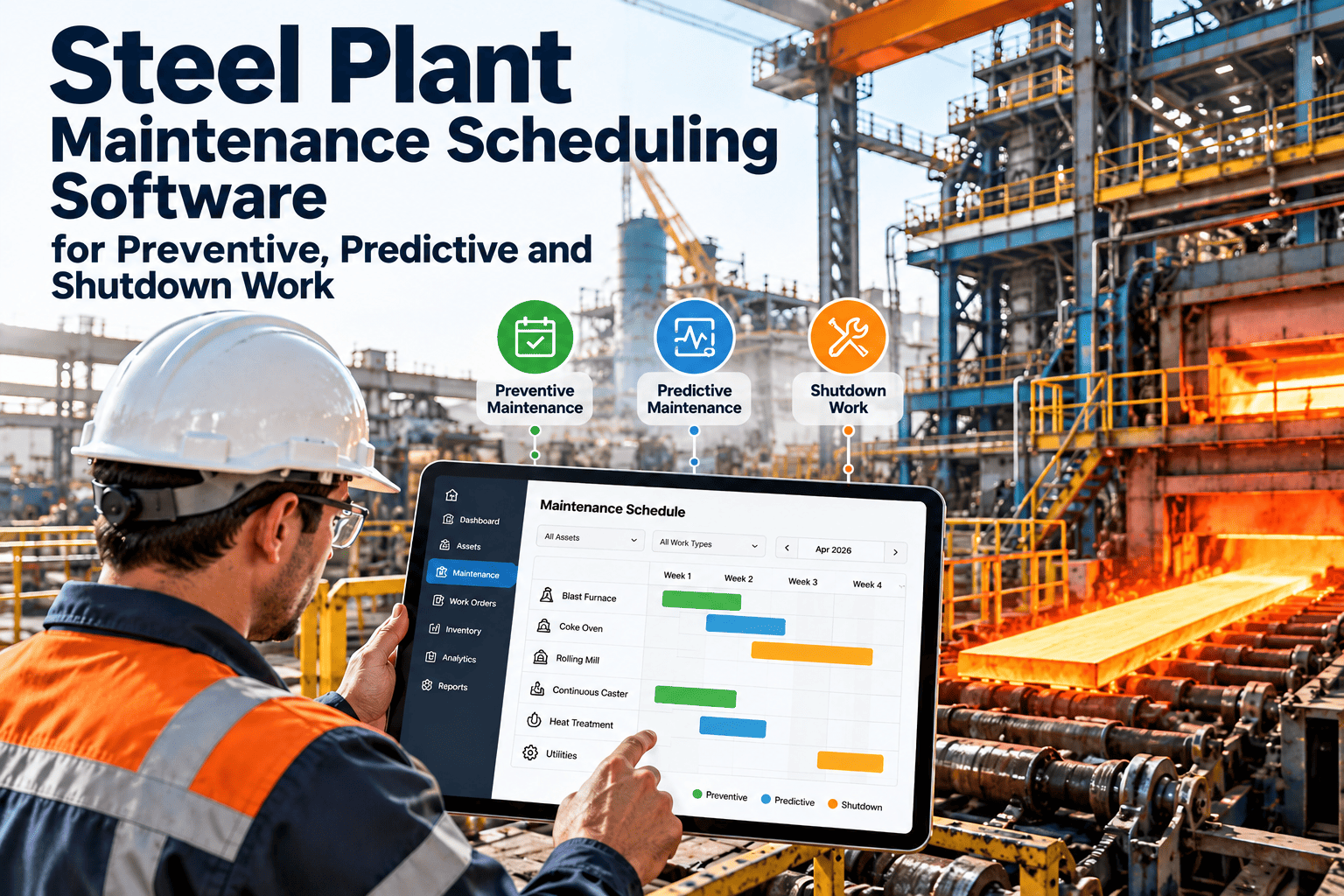
A steel plant shutdown is a short window in which a year of deferred work, regulatory inspections and capital upgrades must be completed safely and on time. Hundreds of tasks, several contractors and a long list of parts compete for the same crane, the same access and the same few days. What decides whether the restart happens on schedule is usually not the largest job but the chain of dependent jobs that cannot slip. This article explains critical path management for turnaround planning in steel, and you can open an Oxmaint account to organise scope, work orders and parts for your next stop.
Steel Plant Shutdown Critical Path Management for Turnaround Planning
Find the chain of tasks that sets the restart date, protect it with early planning and live tracking, and keep scope, contractors and parts under control.
Isolation and permits
Strip and inspect
Instrument and electrical
Main component change
Utilities and cooling
Alignment and testing
Safe restart
Critical pathTasks with float
Why steel shutdowns overrun
Scope grows late
Requests keep arriving after the plan is built, each one small, and together they consume the float.
Emergent work appears on opening
Refractory, wear and corrosion found only after strip-out change the duration of key tasks.
Dependencies are guessed
Planners know the main sequence but not which crane, scaffold or permit links two jobs.
Parts arrive late
A long-lead item, a missing gasket or an unready spare holds the whole path.
Contractor interfaces break
Mechanical, electrical, refractory and scaffolding crews wait on each other without a shared view.
Progress is reported by feel
Percent complete is estimated optimistically, and delay is seen only at the end of the shift.
What the critical path actually is
The critical path is the longest chain of dependent tasks from start to restart. Any delay on it delays the whole shutdown.
IsolateStripReplace main unitAlignTest and restart
IsolateReplace sensorsLoop checksWait for test
Terms planners should use consistently
- Float is the time a task can slip without moving the restart date.
- Near-critical paths have little float and can become critical after one delay.
- Resource constraints, such as one heavy crane, can create a path that no logic diagram shows.
- Duration estimates should come from past records, not memory.
Scope control with time-based gates
12 to 9 months
Define
Collect candidate work from inspections, failure history and capital plans. Rank by risk.
9 to 6 months
Approve
Management approves scope and budget, and long-lead items are identified and ordered.
6 to 3 months
Plan
Work packages, logic networks and resource plans are built and reviewed with contractors.
3 to 1 months
Freeze
Scope is frozen. New requests follow a change process with a stated impact on path and cost.
Final weeks
Prepare
Kits are staged, permits are drafted, crews are briefed and critical tasks are rehearsed.
Gate timings vary by plant size and the lead time of key components. Use them as a pattern, not a rule.
See your whole shutdown on one page
Bring scope, work orders, parts and contractors together so the critical path is visible every shift.
Work package readiness checklist
- Scope item is approved and linked to an asset and a reason, such as a failed inspection or a failure mode.
- Task steps, estimated hours and crew skills are written and reviewed by the executing team.
- Parts, tools, lifting equipment and scaffolding are identified and reserved.
- Isolation plan, permits and safety requirements are prepared in advance.
- Predecessors and successors are confirmed with the neighbouring crews.
- Acceptance criteria, test steps and sign-off roles are stated before work begins.
- Contingency is defined for known risks, such as damaged parts found on strip-out.
Contractor interfaces: where time is lost quietly
| Interface | Typical conflict | Control |
|---|---|---|
| Scaffolding and mechanical | Scaffold removed before inspection or erected late | Scaffold requests tied to work packages with dates |
| Refractory and mechanical | Both crews need the same access and the same crane time | Shared lift plan and access sequence |
| Electrical and instrumentation | Loop checks wait for mechanical completion | Early checks on items that do not need the main work |
| Operations and maintenance | Isolation and handover timing is unclear | Agreed handover times and a single permit owner |
| Contractor and stores | Parts supplied by the contractor do not match records | Material lists reviewed before mobilisation |
Protect the path with parts and logistics
Before the shutdown
- List long-lead components first and order them as soon as scope is approved.
- Inspect repaired or refurbished units on receipt, not on the day of fitting.
- Check that lifting plans match the weight and size of the real component.
- Reserve parts against each work package and stage kits by area.
During the shutdown
- Keep a staffed issue point with clear opening hours and a runner for urgent items.
- Record every issue and return so shortages appear immediately.
- Hold a small buffer of common consumables for emergent work.
- Track returned and damaged parts for later review.
Daily execution rhythm
Start of shift
Review the critical path tasks, assign crews, confirm permits and parts.
Mid shift
Check progress against plan and raise blockers before they cost a whole shift.
End of shift
Record completed work, findings and new tasks, then hand over by area.
Daily meeting
Update the schedule, decide on changes and communicate the forecast restart time.
Measure progress by completed steps and verified milestones, not by a manager's estimate of percent complete.
Emergent work needs a fast triage method
| Finding | Question | Typical decision |
|---|---|---|
| Wear beyond limit on a critical part | Is a spare available, and does it sit on the critical path? | Replace now and re-plan successors |
| Minor defect with float available | Can it be done without moving the path? | Add to the plan with a named owner |
| Defect that can wait safely | Is there an inspection date and a monitoring method? | Defer with a documented risk assessment |
| Unsafe condition | Does it threaten people or the environment? | Fix before restart, no exceptions |
Match the planning depth to the type of stop
| Stop type | Typical purpose | Planning emphasis |
|---|---|---|
| Major turnaround | Large overhauls, relines, statutory inspections and capital work | Full critical path model, long-lead procurement, contractor mobilisation plan |
| Annual or planned shutdown | Combined preventive work and inspections across a line | Work packages, shared access and crane plan, kit staging |
| Short opportunity stop | Quick jobs inside a production gap | Pre-built task lists, parts ready, crews on standby |
| Rolling or sequence stop | Roll changes and planned changeovers | Standard jobs with strict time limits and repeated improvement |
Standard jobs repeated at short stops are the best source of reliable duration data for the larger turnaround.
Risk register for the critical path
Risk
Level
Response
Long-lead component delivered late
High
Track the order weekly, confirm shipping dates and prepare a fallback unit if one exists.
Heavy lift cannot proceed in weather or wind limits
Medium
Plan alternate sequences and keep lifting windows flexible.
Key specialist unavailable
High
Confirm names early and arrange cover for scarce skills.
Strip-out reveals damage beyond scope
Medium
Pre-inspect where possible and keep contingency parts and hours.
Permit delays at shift change
Low
Prepare permits ahead and stagger handover times.
Use past data to build realistic estimates
Data worth pulling from work orders
- Actual hours and crew size for similar jobs
- Parts used, including items nobody planned for
- Findings recorded on opening or inspection
- Delays and their reasons
How planners use it
- Replace guesses with ranges based on history
- Add contingency to tasks with a record of surprises
- Challenge unusually short or long estimates
- Improve each year with newly recorded durations
Without recorded history, every turnaround starts from the opinion of the most senior person in the room.
Shortening the path without adding risk
- Move work off the path by doing it before the shutdown, such as pre-fabrication or pre-assembly of components.
- Run tasks in parallel where access and safety allow it.
- Add crews only to tasks where extra people actually reduce duration.
- Swap complete assemblies and repair the removed unit afterwards.
- Rehearse repeated or complex lifts, so the real operation has no surprises.
Compressing time raises cost and risk. Review each option with safety and operations before it enters the plan.
Communication that keeps the shutdown aligned
Before
Kick-off meetings with contractors, operations and stores, using the same schedule and scope document.
During
Visible boards or dashboards showing the critical path, blockers and forecast restart.
After
A review that records what worked, what failed and what changes before the next stop.
Safety and compliance stay on the critical path
- Isolation and lockout procedures, aligned with OSHA 1910.147 in the United States or the local equivalent, must be completed before any work begins.
- Confined space entry, aligned with OSHA 1910.146, adds permits and rescue planning to vessel and duct work.
- Hot work, lifting and work at height each need permits, trained people and clear supervision.
- Statutory inspections of cranes, pressure systems and electrical equipment are often planned for the shutdown, and their records should be attached to the same work orders.
A rushed permit is a safety risk and a schedule risk. Prepare permits in advance and keep their status visible.
Which tool fits which stage
| Capability | Spreadsheets | Standalone scheduling tool | CMMS with shutdown workflow |
|---|---|---|---|
| Task list and owners | Possible but manual | Strong | Strong, tied to assets |
| Dependencies and critical path | Weak | Strong | Depends on the setup, often paired with a scheduling tool |
| Asset history and failure reasons | None | None | Strong |
| Parts and reservations | Manual | Limited | Strong |
| Field updates from technicians | Slow | Limited | Strong on mobile |
| Post-shutdown learning | Scattered files | Schedule data only | Work, cost and findings in one place |
KPIs for turnaround performance
Schedule adherence
Planned against actual finish for critical path tasks.
Scope growth
Work added after freeze, as a share of the approved scope.
Emergent work
Tasks found during the shutdown and their effect on the path.
Package readiness
Share of work packages complete with parts and permits before the start.
Restart quality
Failures or rework in the weeks after startup caused by shutdown work.
Cost variance
Budget against actual, split by labour, parts and contractors.
Restart and commissioning readiness
Gate 1
Mechanical complete
All work packages closed, tools and temporary items removed, guards refitted.
Gate 2
Inspection sign-off
Statutory and quality inspections signed, records attached to the work orders.
Gate 3
Functional tests
Interlocks, protections and utilities tested with documented results.
Gate 4
Handover to operations
Locks removed under control, permits closed and a start-up plan agreed.
Skipping a gate to save an hour is how a shutdown turns into a second, unplanned shutdown.
Planning mistakes worth avoiding
- Building the schedule around the work the plant wants to do, instead of the work that the risk assessment demands.
- Treating every task as equally urgent, which hides the real critical path.
- Letting contractors build separate schedules that nobody has merged.
- Ordering parts after scope approval is complete, when the lead time has already passed.
- Updating the plan weekly in the weeks before the stop, when daily review is needed.
- Recording findings on paper and losing them before the next turnaround.
Roles that keep a turnaround on track
Shutdown manager
Owns the overall plan, the budget and decisions on scope changes during the stop.
Planner and scheduler
Builds work packages and the logic network, then updates the forecast every shift.
Area coordinators
Manage crews, access and permits in each area and report blockers quickly.
Stores and logistics lead
Controls parts staging, deliveries, returns and shortage escalation.
Safety lead
Reviews permits, isolation plans and simultaneous operations across the site.
Operations representative
Confirms isolation, handover and restart conditions with the maintenance team.
After the restart: close the loop
- Compare planned and actual durations for every critical task, and update the estimate library.
- Review each emergent finding and decide whether inspection or strategy should change.
- Record lessons from contractors, stores and operations in one review.
- Monitor restarted equipment closely for the first weeks and compare readings with the pre-shutdown baseline.
How Oxmaint supports the turnaround workflow
- Work orders hold scope items with tasks, crews, parts and sign-off.
- Asset management links every job to equipment history and earlier findings.
- Inventory supports reservations, kits and issue tracking for shutdown parts.
- Mobile workflows capture progress, photos and new findings during the work.
- Reports compare planned and actual hours, cost and completion, and preserve the history for the next turnaround.
Frequently asked questions
How early should shutdown planning start?
Long-lead items drive the timing, so start as soon as scope can be drafted. Many plants begin a year ahead.
Can a CMMS replace scheduling software?
It depends on logic complexity. Many teams pair the two. Book a demo to see how work orders feed a schedule.
What is the best way to stop scope creep?
Use a scope freeze and a change request that states impact on cost, parts and the critical path.
How do we handle emergent work?
Triage by safety, path impact and float, and record every finding. Capture findings on the work order itself.
What should be measured after the shutdown?
Compare planned and actual durations, scope growth, emergent work and early failures after restart.
Plan the next turnaround around the path that matters
Organise scope, contractors, parts and findings in one workflow and give every shift a clear view of the restart date.