Steel service centers live and die by throughput precision. A slitting line producing strips 2mm wider than specification scraps the entire coil. A cut-to-length machine with blade wear beyond tolerance ships short cuts that fail downstream stamping operations. A crane mishandling a 25-tonne coil damages product worth thousands in seconds. Unlike integrated steel mills where failure costs are measured in furnace refractory and rolling campaign disruption, steel service center failures are measured in product quality, customer returns, and order cancellations — losses that are quiet, recurring, and cumulative. Book a demo to see how OxMaint's asset lifecycle management module tracks slitting line blade life, cut-to-length calibration records, and crane inspection cycles in one structured maintenance system.
Blog · Steel Processing · Service Center Maintenance · Asset Lifecycle
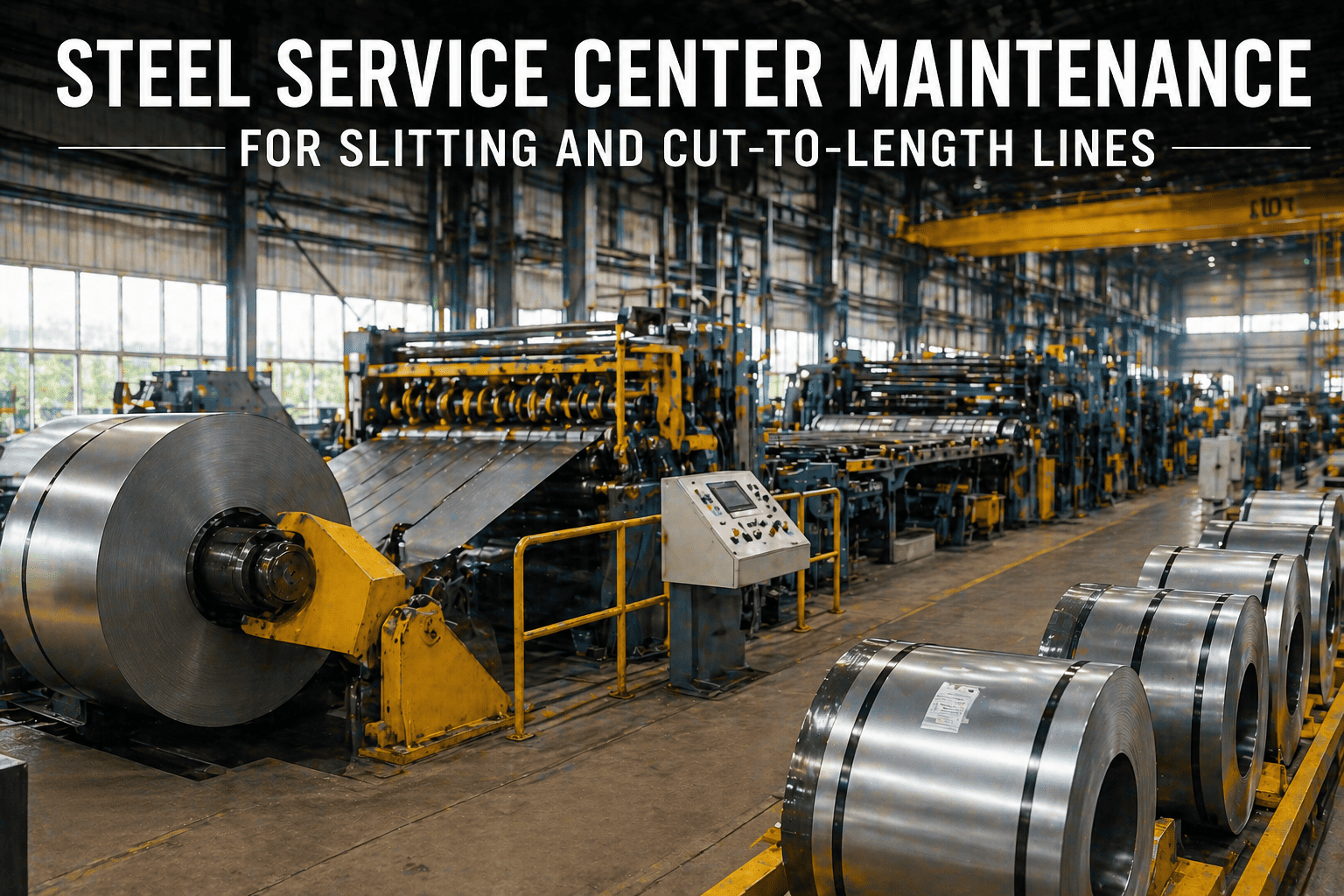
Steel Service Center Maintenance for Slitting and Cut-to-Length Lines
Blade wear, tension drift, crane inspection gaps, and coil handling failures — the maintenance discipline that separates high-OEE service centers from those losing margin on every rejected coil. Here is the full asset lifecycle framework.
50%
Unplanned downtime reduction with AI predictive maintenance on slitting lines
20%
Blade life extension from proper lubrication and scheduled sharpening cycles
$260K
Average cost per hour of unplanned downtime in steel processing operations
30%
Repair cost reduction from predictive vs reactive maintenance programs
Equipment Architecture
4 Asset Categories That Define Service Center Reliability
Steel service center operations run on four interdependent asset categories. A failure in any one stops the entire production flow — and the maintenance requirements for each are fundamentally different in frequency, tooling, and failure mode signature.
01
Slitting Lines
Arbors, spacers, knives, tension reels, and pit accumulators. Dominant failure modes: blade wear causing burr formation, knife clearance drift, arbor bearing wear, and tension system inconsistency. Knife clearance must be calibrated to 1–3% of material thickness — tolerances that deteriorate silently with use.
Critical failure: Blade wearMonitor: Knife clearance
02
Cut-to-Length Lines
Straightening rolls, shear blades, levelers, and stacking systems. Blade wear creates burring and dimensional inaccuracy — cutting length deviation beyond tolerance causes downstream stamping failures. Straightening roll alignment drift causes camber in the cut sheet that fails flatness specifications.
Critical failure: Shear blade wearMonitor: Cut length accuracy
03
Coil Storage Systems
Coil saddles, coil cars, transfer cars, and storage racks. Weight distribution, structural integrity, and floor loading compliance are the primary concerns. Coil damage from inadequate saddle maintenance — bent or corroded saddle surfaces — creates edge damage and surface marking that makes premium coil into secondary material without any process failure.
Risk: Coil edge damageInspect: Saddle surfaces monthly
04
Crane and Coil Handling
Overhead bridge cranes, C-hooks, and coil lifting beams carry 15–30 tonne loads at height. Statutory inspection requirements under ASME B30.2 and OSHA 1910.179 are non-negotiable — but compliance alone does not prevent damage. Hook deflection beyond tolerance, worn sheaves, and brake deterioration are all detectable between statutory inspections if condition monitoring is applied.
Statutory: Annual certCondition: Brake and hook monthly
Slitting Line — Detailed PM Tasks
Blade and Tooling Maintenance: The Margin-Critical Tasks
Slitting line blade maintenance is the highest-frequency, highest-consequence maintenance task in a steel service center. Dull blades and incorrect clearance are responsible for the majority of edge quality rejections and strip width non-conformances. The decisions made here — blade rotation interval, clearance setting per grade and thickness, and sharpening cycle — directly determine product yield.
| Task | Specification | Interval | Quality Impact if Missed |
| Knife clearance setting |
1–3% of material thickness (varies by grade) |
Every tooling change; verify every 8 hours on AHSS |
Burr height exceeds tolerance; edge cracking on AHSS grades |
| Blade sharpness inspection |
Visual + surface roughness check; replace at first burr sign |
Every coil change on thin gauge; shift end on standard gauge |
Strip width deviation; burr contamination in downstream forming |
| Arbor bearing lubrication |
Per OEM specification — NLGI 2 EP grease; do not overpack |
Per runtime hours — not calendar |
Arbor run-out; variable knife gap across strip width |
| Tension reel inspection |
Surface condition, mandrel expansion system, drive coupling check |
Monthly full inspection; daily visual |
Coil telescoping; recoiled strip lap marks; customer claim |
| Spacer and separator condition |
Measure flatness — distorted separators cause width variation |
Quarterly dimensional check; replace on distortion detection |
Strip width non-uniformity across the slit coil set |
| Hydraulic system inspection |
Fluid condition, hose integrity, pressure regulator calibration |
Monthly fluid check; annual full service |
Knife gap drift under pressure variation; positioning inaccuracy |
Cut-to-Length — PM Framework
Shear, Leveler, and Straightener Maintenance by Interval
Daily
Pre-shift Checks
Verify cut length on first piece — measure and record against specification
Check shear blade clearance indicator — reset if drift detected
Inspect straightener roll surfaces for burrs or contamination
Confirm hydraulic pressure readings are within operating range
Weekly
Alignment and Wear Check
Measure flatness of cut sheets — camber beyond 2mm/2000mm indicates roll misalignment
Inspect shear blade edge condition with magnification — record wear index
Check feeder roll nip pressure — excessive nip marks indicate over-pressure
Lubricate all designated points per route card — record completion
Monthly
Full Mechanical Inspection
Straightener roll alignment check — laser alignment tool or dial gauge
Shear blade gap measurement across full width — identifies uneven wear
Drive chain tension and sprocket wear inspection
Control system calibration verification — encoder accuracy for cut length
Annual
Overhaul and Life Assessment
Full straightener roll replacement evaluation — surface hardness and roundness check
Shear blade replacement decision — cumulative cut count vs tolerance drift
Control system software update and calibration documentation
Hydraulic cylinder seal replacement — preventive based on cycle count
Turn Every Blade Rotation, Crane Inspection, and Calibration Record into a Tracked Asset History
OxMaint's asset lifecycle management structures PM routes, tracks blade life by cut count, logs crane inspection certifications, and triggers condition-based work orders when equipment data crosses defined thresholds. Book a demo to see how service centers use OxMaint to protect product quality at every process step.
Expert Perspective
What Service Center Maintenance Engineers Say
★★★★★
We had a blade wear problem that we could not track because nobody was logging cut counts against blade condition. We were replacing blades on a 3-week calendar cycle — sometimes too early, sometimes too late. OxMaint gave us a cut-count-triggered PM on each knife set, and we immediately found that some grade combinations wore blades 40% faster than others. We reduced blade cost 28% in 6 months and eliminated our edge quality rejections on automotive grades entirely.
RK
Rahul K.
Maintenance Manager, Steel Service Center, India
★★★★★
The crane inspection tracking alone justified OxMaint for us. We were managing 14 cranes across 3 bays with paper certification records and a shared spreadsheet. We failed a customer audit because the inspector could not confirm the last brake check date on Bay 2. Now every crane has a complete digital record — inspection dates, certifications, and condition notes — exportable in minutes. We have not had an audit finding since deployment.
MP
Martin P.
Engineering Director, Multi-Bay Steel Processing Facility, Germany
★★★★☆
Cut-to-length flatness is where we were losing the most customer claims. We kept getting camber complaints and could not trace the cause because our straightener maintenance was calendar-based without alignment trend tracking. Once we started logging alignment measurements per shift against cut quality outcomes in OxMaint, we found the correlation — alignment drifted progressively after every tooling change. We now check alignment after every setup and the camber claims have stopped.
SA
Sona A.
Quality & Reliability Lead, Cut-to-Length Processing Center, South Korea
Frequently Asked Questions
Steel Service Center Maintenance — Common Questions
How should slitting line blade life be tracked in a CMMS?
Slitting line blade life should be tracked by cumulative cut count and material grade rather than calendar time, because the wear rate varies significantly between standard carbon steel, high-strength grades, and coated materials. OxMaint tracks blade sets by asset ID and logs each production run against the specific knife configuration — building a cut-count history that reveals grade-specific wear curves. When a blade set approaches its wear threshold for the specific grade being processed, the CMMS triggers a PM work order before dimensional drift causes product rejection. This approach typically reduces both blade cost and edge quality claims simultaneously.
Book a demo to see how OxMaint structures blade life tracking per knife set and material grade.
What is the correct knife clearance setting for slitting operations?
Knife clearance — the gap between upper and lower blades — should be set to 1 to 3% of the material thickness, with the exact value depending on material grade and tensile strength. Higher-strength grades require tighter clearances than mild steel; coated materials require clearance settings that account for coating thickness without scoring the protective layer. These settings must be documented per material specification and re-verified after every tooling change. Clearance drift between setups is the most common cause of burr formation and edge quality complaints. Recording clearance settings and actual burr measurements per coil in OxMaint creates the traceability needed to diagnose edge quality issues and defend against customer claims.
Start a free trial to create knife clearance records per material specification in OxMaint.
What crane inspection requirements apply to steel service center overhead cranes?
Overhead cranes in steel service centers are subject to ASME B30.2 and OSHA 29 CFR 1910.179 in the US, with equivalent national standards applying in other jurisdictions. These require frequent inspection (pre-shift visual inspection before each use), periodic inspection (monthly to quarterly depending on service class), and annual thorough inspection by a qualified person with a documented record. Statutory compliance covers the baseline — but service centers handling coated, high-value, or precision-slit steel should also conduct monthly condition checks of brake performance, hook deflection measurement, and wire rope condition independently of the statutory schedule. All records must be retained and retrievable for customer and regulatory audit.
Book a demo to see how OxMaint manages crane inspection records and certification expiry tracking.
How does CMMS help reduce product quality claims from slitting and CTL operations?
Quality claims in steel service centers almost always trace to maintenance gaps — blade wear beyond tolerance, clearance drift, straightener misalignment, or tension inconsistency. CMMS creates the traceability chain needed to diagnose claims: which knife set was running, what the clearance setting was, when the last alignment check was completed, and what the production parameters were on the specific coil. Without this record, root cause analysis relies on memory and assumption. With OxMaint maintaining a complete production-linked maintenance history per asset, claim investigations move from guesswork to documented evidence — and pattern analysis reveals which maintenance gaps generate the most claims before they recur.
Book a demo to see how OxMaint links maintenance records to production quality outcomes.